Using nice pocket knives as cuttlery in a pinch. Edge damage?

Maybe I am under thinking it (I’m trying not to say your over thinking it). A knife is a sharpen piece of steel. Key word is steel, (not aluminum or cardboard), it’s built and designed to live life cutting things. You talk about cutting food. Not to cut things like wood, pvc, rubber, or tile, just food that your teeth is capable of mashing up and then you swallow it. So it can’t be that tough that you have to exert maximum force while cutting the food. I don’t care if the plate is ceramic, concrete, stone, or adamantium, I doubt you are putting that much force down cutting food to damage a nice and robust steel like S90V.

I use my Elmax, 3V, S30V, cru-ware, VG-10 and even 440C knives to cut food all the time. I have never finished eating food and found that I buggered up any knife edge. Don’t over think it.
 
Bamboo has silica in it bad for blades very bad . Don't know about you but can't remember going to restaurant with marble table's .
Yeah, just take the steak off the plate and baton it up on the table. If the joint ain't classy enough to provide a baton use one of those big pepper mills they got.

If you're an artist you can carve your initials into the table as you cut up your meal.
 
Little off topic maybe.

I remember a table knife created by a Japanese knife maker for chefs competing in a french cooking competition (used when they served dishes to referees).
It was designed to be sharp enough to cut meat easily on a ceramic plate and to stay that way, but not sharp enough to cut fingers.
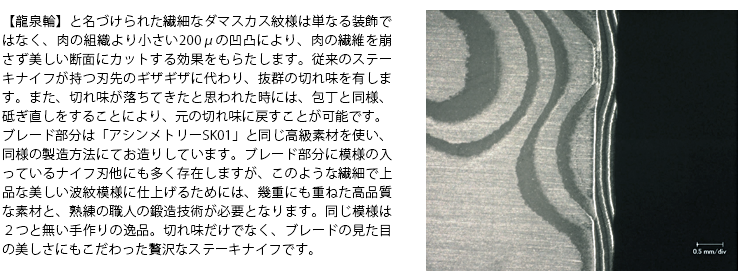
The solution was to use a kind of damascus steel, in which the pattern makes small (200 micron) serration like structures at the edge.
The structure is fine enough to cut into meat but not human skin.

sk_c_p_06_2.png


So I am wondering if a knife with Damasteel or likes works better on a ceramic plate.
 
Very interesting. Although if it cuts meat, surely skin would quality too? I am unsure but that is a very interesting idea, especially given the previously stated serration principle of the serrations not being dulled by ceramic plate contact.

As for the force thing someone mentioned and not worrying about it. The only thing is some people here are saying any amount of force, if you touch it, it is pretty much dull, very dull and almost immediately so :S So if I were to use my nice shiny S90V blade in a pinch as a cuttlery knife, I would feel like I should be as careful as an EOD technician haha. Man I would hate to dull my knife that badly requiring me to take off more metal than a normal sharpening from average use would take. My Spyderco Dragonfly looks like a horizontal V and is shortened enough from years of sharpening that the blade edge is almost visible when closed and the point can actually scratch you if you close the knife and run your finger across the top edge of the knife. I want to preserve the longevity of my knife while actually using it and not treating it like a precious artefact :P
 
Whenever I use my carry knives for dinner cutlery, I pretend like what I’m doing is in no way effecting my edge, then I can be surprised later at how dull my blade is after “just sharpening it that long ago”. It’s most likely a heat treat issue anyway
 
Most knives for food are super thin, usually more thin than any pocket knife. Even if they are dull they can likely still cut. I've cut with a dull opinel without much struggle. Though it's not fun the more dull it gets. Serrations are much better for some food types though.
 
Most knives for food are super thin, usually more thin than any pocket knife. Even if they are dull they can likely still cut. I've cut with a dull opinel without much struggle. Though it's not fun the more dull it gets. Serrations are much better for some food types though.
The reason most dinner cutlery is serrated is not because it's better for food. It's because only the tips of the serrations hit the ceramic plate, leaving the scallops sharp. It will still cut, but my plain edge knives cut at least as well as any of my serrated steak knives, which I keep screaming sharp. They also cut cleaner than any serrated knife. It's my preference. I hear claims that serrated knives are better for this or that all the time. I go out and compare, and always prefer plain. The problem with using plain on a plate is that as soon as a spot of the very thin edge touches a ceramic plate, that spot is dull. Try it. Cut a piece of steak or chicken, etc., on a plate, and let the plain edge blade touch the plate. Use light pressure, but let the edge touch the plate during the cut. Then examine the spot that touched under bright light. You will see light reflected from the flattened area that touched the plate, and is now dull. Cut only once. Doesn't take more than that.
That's why, if I use my pocket knife to cut meat on a plate, I turn the edge up, and cut from under the meat, or put the meat on a piece of bread, and don't cut through the bread.
 
Little off topic maybe.

I remember a table knife created by a Japanese knife maker for chefs competing in a french cooking competition (used when they served dishes to referees).
It was designed to be sharp enough to cut meat easily on a ceramic plate and to stay that way, but not sharp enough to cut fingers.
The solution was to use a kind of damascus steel, in which the pattern makes small (200 micron) serration like structures at the edge.
The structure is fine enough to cut into meat but not human skin.

sk_c_p_06_2.png


So I am wondering if a knife with Damasteel or likes works better on a ceramic plate.
They now have a sharpener that can make micro serrations. Was discussed on this forum last year. Interesting idea. It's not the same as your solution but they found the edge lasted longer for obvious reasons.
I can't remember what it was called for the life of me
 
This is why cutting boards are a thing...
Very true. However in this context I am talking about actually sitting at a table eating a meal that is already prepared. I think I would be a bit apprehensive, enough that I might likely not use my pocket knife. I have no issue freehand sharpening but I would hate to ding up the blade moreso than would happen through regular usage, requiring me to do emergency / major maintenance on it.

Although, assuming my 1000 grit-sharpened S90V Manly Wasp was effective enough at effortlessly cutting through the toughest of meat relatively easily, it would be a bit less scary of a proposition, since turning the knife upside down and making a quick slice, might be enough. But knowing me, I'd instinctively take a big fat chip, stab it with the fork and use the knife to slice and laterally scrape it apart thus really scuffing up the edge into a massive (maybe) burr of epic proportions compared to a clean slice into the plate.
 
Little off topic maybe.

I remember a table knife created by a Japanese knife maker for chefs competing in a french cooking competition (used when they served dishes to referees).
It was designed to be sharp enough to cut meat easily on a ceramic plate and to stay that way, but not sharp enough to cut fingers.
The solution was to use a kind of damascus steel, in which the pattern makes small (200 micron) serration like structures at the edge.
The structure is fine enough to cut into meat but not human skin.

sk_c_p_06_2.png


So I am wondering if a knife with Damasteel or likes works better on a ceramic plate.

wait were they serving the dish on a person?
 
Cut through your food about 90% then using your fork lift one side up and cut through the last 10% in the air, the weight of the drooping side will be enough to hold the food taut to finish the slice with only air underneath.

At least that's how I do it when required. It is a real joy to slice a steak with a razor sharp smooth edge compared to using a serrated blade.
 
The reason most dinner cutlery is serrated is not because it's better for food. It's because only the tips of the serrations hit the ceramic plate, leaving the scallops sharp. It will still cut, but my plain edge knives cut at least as well as any of my serrated steak knives, which I keep screaming sharp. They also cut cleaner than any serrated knife. It's my preference. I hear claims that serrated knives are better for this or that all the time. I go out and compare, and always prefer plain. The problem with using plain on a plate is that as soon as a spot of the very thin edge touches a ceramic plate, that spot is dull. Try it. Cut a piece of steak or chicken, etc., on a plate, and let the plain edge blade touch the plate. Use light pressure, but let the edge touch the plate during the cut. Then examine the spot that touched under bright light. You will see light reflected from the flattened area that touched the plate, and is now dull. Cut only once. Doesn't take more than that.
That's why, if I use my pocket knife to cut meat on a plate, I turn the edge up, and cut from under the meat, or put the meat on a piece of bread, and don't cut through the bread.
I don't have any serrations on any of my knives but apparently they are pretty good
 
Yes, when my knife is not as sharp as I want, I sharpen it. That doesn't mean I want to purposefully put it in situations where it will get so ridiculously dull (from super easy accidents like hitting the plate) that I need to do a major sharpen on it. As you well know, knives are a consumable. They do not last forever if you use and sharpen them. I have an old AUS-8 Spyderco Dragonfly which is no longer safe to carry in a pocket because of how much metal is missing from doing tests and general use and needing to sharpen. I am hoping the harder S90V steel will be easier to maintain and require less metal to be removed. But I suppose that will be a factor of how dinged it gets through use.
 
This is very true and being British, I scrape food with the knife, which if I fall into that habit when using a fancy steel pocket knife, I'll be in for some unwanted sharpening I guess. I'll have to play it by ear if the event happens. At least it should be far sharper than regular cutlery so it should be easier to get carefully positioned cuts done quickly rather than scrubbing back and forth with garbage table cutlery knives.
 
Yes, when my knife is not as sharp as I want, I sharpen it. That doesn't mean I want to purposefully put it in situations where it will get so ridiculously dull (from super easy accidents like hitting the plate) that I need to do a major sharpen on it. As you well know, knives are a consumable. They do not last forever if you use and sharpen them. I have an old AUS-8 Spyderco Dragonfly which is no longer safe to carry in a pocket because of how much metal is missing from doing tests and general use and needing to sharpen. I am hoping the harder S90V steel will be easier to maintain and require less metal to be removed. But I suppose that will be a factor of how dinged it gets through use.
The enjoyment of a fine knife comes from using it. Sure, pride of ownership is also a factor and for some of us, sharpening a knife is also a great source of enjoyment. If you are "in a pinch" I don't see why you would be concerned about it. It's very enjoyable to use a favourite knife to eat a delicious meal! :thumbsup:
If you find yourself in a pinch on a regular basis,o_O maybe consider carrying a plastic disposable knife? *shrug*
 
Back
Top