What can you fairly expect a knife to do?

How to accept knife damage is your fault

Alot of times it is.
Not always, and as I was not the person using it I cannot say in the case in question.
But alot of times it is.

 
Wrong. :thumbdn: :( :thumbdn:


Study the history to discover the Bravo-1 is a hunting knife modified to meet the needs of a small group of Force Recon Marines.

They required a GP/Utility knife to handle cutting chores, not a "survival" knife.

Then BKRT are experts at deceptive advertising. From their own site:


The Bravo-1 was specifically designed with the folks at the Southern Training Center of the Force Recon Units of the U.S. Marine Corps. That initial contact was back in 2006 and we began delivery in 2007 of the Bravo-1 and they are is still in heavy demand from professionals, both Military and Private Contractors, and is in use by a lot of private citizens as their "Go To" knife for Heavy Outdoor Use. Since that time we have delivered over 12,000 Bravo-1s.

This All started back in 2006 when the instructors from Force Recon took $5,000.00 of their funds and bought a bunch of knives to test. They never told any of the Manufacturers and bought them online, like any other customer. When all the testing was done there were only two knives left not broken or damaged beyond use. The Bark River Gameskeeper was one of the two. It was totally undamaged in everything these folks did to it.


Not only that but BKRT advertise the knife as one of their "Search And Rescue" series. How can chopping twigs and slicing chopsticks be out of the fair range of use for a "search and rescue" knife designed for "heavy outdoor use"? And what were those other knives the Marines tried that broke even more easily?


The knife has become Bark River's biggest seller because America's knife user's like a knife that cuts; sharpened pry-bars are all to common in the knife world, when in reality other tools are better suited for such tasks.

Somehow some fools think the Bravo-1 is designed to cut concrete blocks and car hoods; get a clue, it's meant to slice the things that need a sharp edge for cutting.

Ok: apparently you think twigs and chopsticks are made of concrete....

Once again, no one would have a problem if these knives had chipped cutting concrete. What bothers us is that they chipped cutting teensy pieces of wood.
 
One thing I see here is that BRKT is missing a huge opportunity. They should offer classes on proper knife use to prevent this type of thing. Topics could include how not to whittle a chopstick with a blade >= 3/16" thick, and how to chop branches 3/4" diameter or less. How to accept knife damage is your fault and how to be content when we grind out damage instead of replacing a faulty knife are acceptable alternative topics.

A huge opportunity for Big Mike!
 
A huge opportunity for Big Mike!

It seems that this thread has an unfortunate amount of talking about each other rather than the knives...

As for the knife, I don't have that particular model.
What I do know though is that in the 4 inch range of blade, I never chop.
4 inch bladed knives are great for cutting...although I prefer folders in that blade length.
Bigger knives, like in the 8 inch and up range are great for chopping. I'd be pissed off if my knife in the chopping type of design chipped.
 
What I do know though is that in the 4 inch range of blade, I never chop.
4 inch bladed knives are great for cutting...although I prefer folders in that blade length.
Bigger knives, like in the 8 inch and up range are great for chopping. I'd be pissed off if my knife in the chopping type of design chipped.

You're confusing efficiency - a knife being too small to be an effective chopper - with the issue of whether a knife should be damaged chopping a twig.

Also - have you seen the video linked in this thread where a chunk falls out of the edge of a Bark River because the owner tries to use it to SLICE a chopstick?
 
Also - have you seen the video linked in this thread where a chunk falls out of the edge of a Bark River because the owner tries to use it to SLICE a chopstick?

No, I have not seen that video, but at times I wonder what use the knife had that we're NOT being told of beforehand.
Is it the first use of the knife? Or was it used to wail on seasoned oak for 18 hours beforehand?

I tend to put more stock in the experiences of people I know the habits of.
 
I tend to put more stock in the experiences of people I know the habits of.

I think "familiarity with people's habits" is why many many are having a hard time buying the "user error/inexperienced user/improper technique" excuse.
 
I'll say my piece and be done with it.

I have always said, here and elsewhere, that Mike Stewart is more than capable of producing a well-made knife, and is very capable of designing a very well thought out knife.

But this circle the wagons, blame the user, make sure this is never spoken of again, loose the hounds nonsense whenever anything goes wrong with BRK knives and their sheaths (and things do go wrong) does BRK so much more worse than good.

Its a damn shame. Silly.
 
No, I have not seen that video, but at times I wonder what use the knife had that we're NOT being told of beforehand.
Is it the first use of the knife? Or was it used to wail on seasoned oak for 18 hours beforehand?

I tend to put more stock in the experiences of people I know the habits of.

I'm sorry, but this makes no sense to me. First of all, the idea that misusing a knife can delayed damage in cutting is one there is no evidence for. De-tempering doesn't happen this way. Secondly, it would take an amazing conincidence for the knife to be at exactly the right point so that the blade would fail the very next time it was used to cut at the spot tested. It would just be impossible for all practical purposes. If 18 hours of oak bashing was required to weaken the knife, then you'd have to not only give those 18 hours BUT NOT ONE SECOND LONGER. The odds against this are millions to one.
 
I'm sorry, but this makes no sense to me. First of all, the idea that misusing a knife can delayed damage in cutting is one there is no evidence for. De-tempering doesn't happen this way. Secondly, it would take an amazing conincidence for the knife to be at exactly the right point so that the blade would fail the very next time it was used to cut at the spot tested. It would just be impossible for all practical purposes. If 18 hours of oak bashing was required to weaken the knife, then you'd have to not only give those 18 hours BUT NOT ONE SECOND LONGER. The odds against this are millions to one.

No one mentioned detempering...don't know where you got that from.:confused:

As for use causing breakage later on, here's one for you...
I had (well, still have) a paring knife. It is a decently made, name brand knife. It was never used to smash logs, pry anything, or anything abusive. It was used to cut vegetables and meat, and always with a proper cutting board.
One day, I went to cut (not chop) a carrot...and the blade did not chip; it split in half.
That's right, I now held in my hand a knife with a blade half as long.
I reground it into a far shorter sheepsfoot paring knife.:)

So don't tell me that a knife cannot be pre-fatigued by use, or that failures are a "millions to one" occurrence, because I have experienced it.

The same thing has happened with tips and other parts of knives over the years.
When you use a tool, you use up some of it's lifespan, every single time, whether you know it or not.

Some knives hold up to more use than others. Some are so overbuilt so that you never end up noticing.
But you do not make the steel stronger by using it, whether it is light, medium, or heavy use.

I've also had screwdrivers that failed from turning screws (after years of use).
I've seen a pry bar break at an annoying time.

If all these were "millions to one" occurrences, I'd be far older than 35.;)
 
OK, here we go...I really want to know why the hell you guys think you need to chop and baton wood all the time, I make knives, and they will stand up to this, but why? I have spent as much time outdoors as anyone, I have had years where I spent 200+ days living in a tent in the woods. I have lived in a tepee that I made myself in Alaska. All this said, I have never "needed" to baton or chop wood with a 4" knife, NEVER. I have always either cut with a machete, or hatchet. If I dont have either of those, I simply build a fire/shelter with sticks/branches that I can break by hand, or with leverage. Now, I know this is off topic, and that knife should not have failed like that, none I make would have, if so it would have been money back, or full replacement. Really though, whats up with this type of mindset that you feel like you need to do this? Is it to test the knife? is it because you saw it on some web site, or some fake reality series? Im not trying to troll here, I just want to know.....

You bring up a good point - an extremely good point. I agree with you 100% about batoning - I've never needed to baton anything, ever, and I can't think of a single situation where someone would absolutely have to baton with their knives. I honestly can't - any situation that I can think of where an individual might want to baton with their knives can be accomplished more safely and/or more efficiently with other methods, even if some of them do require a little imagination. Additionally, if I arrived for every camping trip or work day or whatever completely, 100% prepared for the chores ahead of me, I would never have needed to chop anything with my knives, either.

Speaking for myself, I've only needed to do any kind of chopping with my knives when something unforeseen comes up - for example, if I wasn't expecting to need a hatchet / chopping tool for whatever reason, or if a buddy borrowed my hatchet/axe for another task during the trip, or I dropped the hatchet in the drink / broke it / misplaced it / whatever. It's in cases like those when I end up using my knives for light chopping tasks - usually knocking small evergreen boughs off of branches / saplings, or similar tasks.

In a lot of those cases where I do use my knives for chopping, I guess I could just macguyver a way to do it where I wouldn't strictly speaking have to chop with my knife at all, or use some other slower method - assuming I'm not on some kind of time restriction - but generally speaking, I do expect even my most fragile knives to be able to shrug off that sort of use in the short term.
 
No, I have not seen that video, but at times I wonder what use the knife had that we're NOT being told of beforehand.
Is it the first use of the knife? Or was it used to wail on seasoned oak for 18 hours beforehand?

I tend to put more stock in the experiences of people I know the habits of.

The guy in that video shows the edge and says he hasn't tried cutting with that part yet. Then he tries to slice into a chopstick and afterwards shows the edge all deformed. If slicing a chopstick causes that much damage there's no way he was doing anything worse to it beforehand because the edge would already have been mangled.

http://www.youtube.com/watch?v=p4ss8NtqEkw

Skip to 10:30 if you want to watch him do it.
 
No one mentioned detempering...don't know where you got that from.:confused:

It was an attempt to create a halfway rational version of what you said.

As for use causing breakage later on, here's one for you...
I had (well, still have) a paring knife. It is a decently made, name brand knife. It was never used to smash logs, pry anything, or anything abusive. It was used to cut vegetables and meat, and always with a proper cutting board.
One day, I went to cut (not chop) a carrot...and the blade did not chip; it split in half.
That's right, I now held in my hand a knife with a blade half as long.
I reground it into a far shorter sheepsfoot paring knife.:)

So don't tell me that a knife cannot be pre-fatigued by use, or that failures are a "millions to one" occurrence, because I have experienced it.

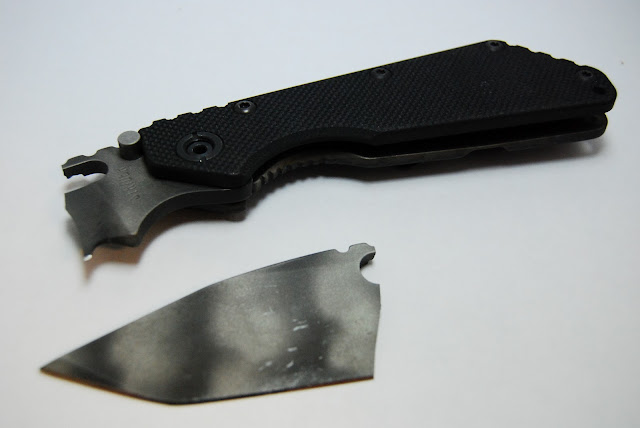
Is there a smiley for face palming? A stress failure from fatigue is completely unlike what that video showed. Stress peaks at a point and you get a snap that leads from that point - you don't get an entire edge turned brittle; it's not one of the possible results, because stress will vary across the blade and by the time the tip is ready to fatigue then the choil will have gone. A stress failure looks like this:

DSC_0043.JPG


I've also had screwdrivers that failed from turning screws (after years of use).
I've seen a pry bar break at an annoying time.

If all these were "millions to one" occurrences, I'd be far older than 35.;)

Hint: any time you are tempted to end what you think is a smart argument with a smiley, it's not....

Those weren't "coincidences" because they didn't conincide with anything. Which is what a conincidence is, hmm? Instead they were just plan simple failures. So you're missing the point. Once again:

it would take an amazing conincidence for the knife to be at exactly the right point so that the blade would fail the very next time it was used to cut at the spot tested in front of the camera. It would just be impossible for all practical purposes. If 18 hours of oak bashing was required to weaken the knife, then you'd have to not only give those 18 hours BUT NOT ONE SECOND LONGER. The odds against this are millions to one.


For a knife to fail the way you say is sort of believeable - if the failure is a stress fracture, which this wasn't. But for the failure to be createable on demand, at a given point - no. That would take stressing the knife to a precise degree that is impossible. You couldn't do that even in a metallurgy lab using an x-ray machine and with previous specimens to go off.
 
I think maybe this thread has run its course...

8947332.jpg


Things we learned from this thread:
- It's probably wise to avoid chopping or batoning with your knives if they aren't designed for it.
- Bark River knives, like other manufacturers, produces lemons. Unlike other manufacturers, they refuse to admit that they produce lemons.
- Any time a Bark River knife breaks, it was the customer's fault.
- Big Mike receives payment / free knives / sexual favours from Mike Stewart in exchange for defending Bark River knives on internet forums.
- For any normal knife, cutting twigs is a light camp chore. For Bark River knives, cutting twigs is abusive.
- Insinuated connections to branches of the armed forces make excellent marketing tools.

GOODNIGHT EVERYBODY! :D
 
Yeah I think ultimately the point is that regardless of whether or not the user was using the knife 'properly', the knife would not have failed like that unless it was faulty to begin with. If Bark River are really trying to deny that and insist that it must have been purely the fault of the user this is very disappointing.
 
No, I have not seen that video, but at times I wonder what use the knife had that we're NOT being told of beforehand.
Is it the first use of the knife? Or was it used to wail on seasoned oak for 18 hours beforehand?

I tend to put more stock in the experiences of people I know the habits of.

Nope, it is a reviewer that has done reviews on a bunch of knives.

He takes the undamaged portion of the edge, and attempts a slice on a disposable chop stick right on camera, and the edge waves and chips out right in front of the camera.

http://www.youtube.com/watch?v=p4ss8NtqEkw&feature=player_embedded

Go to about 9:33 if you don't have patience. He sounds a lot like virtuovoice, but has a different screen name. He appears to have about 101 video reviews.


Another member told me that this is Virtuovoice (SP?), just a different screen name. I have watched quite a few of his video's in the past. He seems to be a pretty solid reviewer. Taking knives out and actually using them to skin and process before making an assessment (from the video's I watch, he normally just cuts the back straps out. I believe the deer he is shooting are for population control, as they are a non native invasive species). Which offends many people. I don't always agree with his opinion, but he has seemed pretty solid, and, if I remember correctly has reviewed lots of Bark River, and usually has good reviews of them.

I don't think I can remember any of his video's where I thought he was doing anything non knife appropriate. (but I have not watched near all of them, just a few on the models I was interested in).

My thoughts probably don't add too much to the conversation, but I have seen a few threads where knives that appear to have failed very easily are dismissed as user error.

Any company that tells me a fixed blade marketed as a survival/outdoors/hunting/woods knife is not capable of lopping off a few twigs and branches won't get my money. It won't bother them, I am sure.

I have seen some companies step up and honor warranties, and kept the mood jovial and supportive of the user.

Others, not so much.


I have made the mistake of taking an edge too thin on more than one knife. Usually to see how it performs. If the steel wont' support the angle, I back off a bit, and change the angle to be a bit stronger.

I, very rarely, leave an edge stock angle, as most of my knives come with edges that are, in my opinion not my ideal angle (I usually thin them a bit, and convex the edge).

To have knives ground so thin they won't cut without rolling and blowing out (whether from angle of grind, or from poor heat treat, or more likely a combo of too thin, and overheating during finishing the convex grind), is not something I would be happy about. Then to have a pile on of people telling me it was operator error, and have some one from the company tell me that they will grind it down to a sliver for me to "fix it" would really steam me. (from any company).

An appropriate response would be "send it in, and we will make it right. We will send you a new knife and look at the old one to see what went wrong."


I am not a chain chopper, or concrete stabber. Nor do I cut up cars with my knives.

I do tend to use some knives harder than others (ones with great warranties).

I will use a $1000 knife or a $50 knife to chop, and pry apart logs and stumps to get at fat wood, if they are built to take it (am thinking Busse and Condor as my two examples here). Both have excellent warranties, and represent opposites from a cost standpoint. Condor has a limited life time warranty for defects in materials and manufacturing, and a satisfaction guarantee. I have witnesses them replace blades through this forum, no questions asked. Normally through the dealer. (they use 1075, and 420 series steels in a lot of models, nothing high tec).

I have seen Busse (and kin) replace broken blades cheerfully, and without ire. (though some times the knife owners can be unruly, and have to be reigned in by the Boss).


I have seen ESSE cheerfully replace broken or damaged blades with the same cheer, and support of their customer base. 1095 is nothing magic. It just represents a solid user's steel, with a good heat treat and reliable performance.


If I see a company crap on a user and use intimidation and owner/fan pile on to disreguard an unsatisfied user's concerns, I simply won't give them my money. Nor, I might add, will I direct others toward their products when tender new guys and gals ask where they should spend their money.

I am funny like that. Also, if I find a companies ethics lacking (whether from a marketing, or dealings standpoint), I will, like wise refrain from supporting them. Nor will I encourage others to do so either.

Like I stated, I am not adding anything new, or valuable here. Just giving my opinion, which may or may not be worth anything.

Thanks.

I have also seen
 
Last edited:
So if knives aren't meant to process wood... What the hell is the point of knives longer than 4 inches?
 
No, I have not seen that video, but at times I wonder what use the knife had that we're NOT being told of beforehand.
Is it the first use of the knife? Or was it used to wail on seasoned oak for 18 hours beforehand?

I tend to put more stock in the experiences of people I know the habits of.


It was literally brand new, and he showed the knife taking the damage on film. It's irrefutable. He takes a clean, new portion of the edge and push cuts one of those super soft disposable chop stocks, and it completely warps the edge. Pitiful.

You can clearly see in the video that the knife is ground wafer thin. Like literally wafer thin at the edge. Is it really hard to believe that an edge will fail under normal cutting when it is ground that thin?

ETA: Oops, didn't see the post above me.
 
Last edited:
It was literally brand new, and he showed the knife taking the damage on film. It's irrefutable. He takes a clean, new portion of the edge and push cuts one of those super soft disposable chop stocks, and it completely warps the edge. Pitiful.

You can clearly see in the video that the knife is ground wafer thin. Like literally wafer thin at the edge. Is it really hard to believe that an edge will fail under normal cutting when it is ground that thin?

ETA: Oops, didn't see the post above me.

The problem wasn't the thin edge. Lots of knives with very thin edges with cut much tougher stuff than this. Also a correctly ht-ed thin edge of 12c27 - which I think was the steel - is usually going to roll instead of chip - it's one of the nice things about the steel. The only way for it to chip like this is for BKRT to have totally blown the heat treat and made it brittle.
 
Back
Top