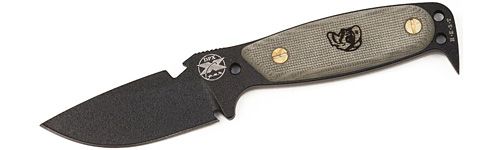
What is a "survival" knife?

I hear that buzzword often and I don't know what "survival" means in the context of knife use. I have heard it used to describe the opposite of a bushcraft knife which is supposedly thin as it is optimized for fine work.

yeah its become a joke for sure, a 'survival' knife could be a flint found in the bush or something you grab from your kitchen drawer... its as simple as that really... !!!
 
Last edited:
For me, my edc is my survival knife because I find that I am lost without it. I tried an experiment recently to see if I even need to carry a knife constantly. I merely left my small folder at home for a week. The results were amazing to me. My workday lost so much productivity that it was like being lost in the woods. I made do by resourcefully finding other tools to use when I needed to, but that took many minutes of precious time and energy. The bottom line is, if I don't have a knife with me I will immediately find or make one.
 
The definition differs from person to person, most of the well made modern knives can helpy ou survive, ancient people survive with animal bones and stones, hell you can even survive without a knife.

Survival, tactical, combat, utility...most of these terms are just additives to make buyers feel like they're buying something more than a knife eventhough that's all they're buying, a knife...
 
The way I see it, a survival knife is a knife that you can depend on for a wide variety of tasks, because its the knife you have on you. A good survival knife should be TOUGH, and capable of performing reasonably well at a wide variety of tasks that you might encounter in a survival situation. But, because you never know when you're going to be IN a survival situation, it should be one that you can use all the time also. Just seems more practical that way.
 
A survival knife to me is one that I would purposefully choose to take with me as I walk away from my home and other worldly belongings. Whether I am walking away for a few days into the woods, or walking away as looters and zombies drive me out, the point is that I will rely on this ONE knife to do all I could ask for a knife to do. It also pre-supposes no re-supply. In normal circumstances, if my worldly possessions were lost to a natural disaster, I would make a claim on my insurance company and replace my belongings. In a "survival" situation, this is not possible (either because you are cut off from the civilized world, or because the civilized world is gone!)

This is the knife you would grab as you ran out the door, not necessarily the knife you already have with you as you ran out the door. If you had time to grab one, and could only take one, which one would it be?

This knife would be used to perform minor surgery, dental work, cuttings limbs to build a shelter, bushwhacking, fire-starting, hunting, spear-fishing, crop cultivation, skinning/field-dressing, chopping, and self-defense.

If the knife could easily be lashed onto a stick to be used as a spear, that would be a good thing.

If the knife had a saw-tooth back to cut limbs, etc.., that could be a good thing.

If the knife was sharp, and came with a sharpening stone in the sheath (so they were always together), that would be a good thing.

If the knife was large/heavy enough to chop, that would be a good thing.

If the knife was long enough to fight with, that would be a good thing.

If the knife was small enough to easily carry with you, that would be a good thing.

The survival knife is a jack-of-all-trades blade.

Frankly, I don't believe in ONE knife being the end-all/be-all blade. I prefer to have a few that are mission-purposed. Its hard to beat a SAK, locking folder and fixed blade trio.
 
The military survival knives and machetes were/are issued to aircrews to help them to survive in the event of a crash or shoot down. In this particular context, survive mean to stay alive long enough to evade enemy forces and return to friendly lines or be rescued.

The problem with the typical usage of "survive" is that when most people use it, it's without a specified context, so it can mean anything and everything.
:thumbup: +1
I do not remember hearing the term "survival knife" outside of military contexts when I was younger. The tool was intended to function in leiu of those more appropriate to the task: axe, saw, hammer, shovel, pick, spear-head, and indeed even as a knife, all in a compact "indestructible" package for use by soldiers in theater. Pocket knives and SAKs were in a different category, as were woodcraft blades like the nessmuck and puukko designs, traditional bowie knives, and machetes.
 
The tool was intended to function in leiu of those more appropriate to the task: axe, saw, hammer, shovel, pick, spear-head, and indeed even as a knife, all in a compact "indestructible" package for use by soldiers in theater.

Exactly.
 
When I think of a survival knife, I think of a Randall #18. Not sure, but Randall might have been the first knifemaker to offer a knife designed specifically for "survival". Even though Case and Kabar had already offered hollow handle knives years before, those knives were designed for hunting.

$(KGrHqR,!hwE1KvKOl+EBNc-spQO7Q~~_3.JPG


Obviously, the Randall is not the only survival knife out there, but it sure had something to do with starting the trend.

Randall Model 18 "Attack-Survival"
34367-ran18-7a9.jpg


From Randall Made Knives: The History of the Man and the Blades, by Robert L. Gaddis, pp. 198-203


Quote:
--------------------------------------------------------------------------------

On 8 January 1963, Bo received a nicely typed letter from Capt. George W. Ingraham, Medical Corps, United States Army. He was then with the 94th Medical Detachment and flew about Vietnam in old CH-21C helicopters. We'll let him tell his story by quoting from the letter than Bo received and kept filed away.

Quote:
--------------------------------------------------------------------------------

I recently found a copy of your catalog here and began to cogitate on a knife especially designed for helicopter pilots and crew members here in Vietnam. Our problem is, in case of going down in the jungle, quite a large one as far as survival is concerned.

An airman going down in the jungle here has the problem first of getting out of the aircraft, then of constructing shelter and finding water, possibly hand-to-hand combat..., and finally of signaling rescue aircraft which come to search for him.

I believe that the knife best suited to this task would be a somewhat radical modification of you Model 14 "Attack" Knife as follows:

1. Into the top of the blade, saw teeth should be cut or filed, to cut aluminum, Plexiglass, etc., in freeing personnel from aircraft wreckage. I have seen one knife with this feature in the possession of an air force pilot here.
2. The 1/4" brass guard could be extended to form a full half-circle to serve as a "knuckle duster" for close combat.
3. The trickiest part of the modification would be the handle. I have illustrated the handle in the enclosure, and you will note that it features a screw-on butt plate, hollow handle of brass or copper pipe, silver-soldered or brazed to the tang of the knife blade. The compartments in the handle would be used for matches, water purification tablets, Dexedrine pills..., and possibly Demerol tablets for severe burns, etc. Leather rings could be sandwiched in the usual manner for the grip.
4. A sheath similar to the model C -- or the model C as illustrated -- should be used.


--------------------------------------------------------------------------------


...After thinking about Ingraham's ideas for a week, Bo wasn't happy with what he had to tell the serviceman. His 15 January letter opened with: "Your idea for the Survival knife looks good. It almost makes me cry to have to answer and tell you I (we) can't make even one for you." Bo went on to explain, "We've not been able to learn a way to put those sawteeth in, but I do agree that they should be there. I shall hope that sometime we can figure out how this is done."

...But the negative answer just wasn't god enough for Bo, and he couldn't get Captain Ingraham's ideas out of his mind. On Friday afternoon, he and Gary left for the Randall ranch, near the northern end of Lake Okeechobee. While driving south, they began to discuss this survival knife concept, and by the time they returned to Orlando the following night, they had formulated a design and fabrication plan....

Bo and Gary arrived home on Saturday night, and the next day, Gary went to the empty shop and began working on the prototype blade, starting with a Solingen Model 14 blank. He was successful, and the first thing Monday morning Gary put the finished blade on his father's desk. The new Survival Knife was off to a flying start!

...The next morning Bo wrote a new letter to Captain Ingraham and included it in the box with the two knives being sent to Vietnam. This time he was able to to begin on a positive note.


Quote:
--------------------------------------------------------------------------------

"Well! I just couldn't resist the challenge you threw at me--especially since it got to keeping me awake nights. So!! I got my son on it too--and we worked Sunday bringing the #1 prototype of the "Ingraham-Randall Attack-Survival" knife into being--and here's yours, at no charge, the 1st of what may be quite a number of these knives--for I am now kind of enthusiastic over it and like the way it came out. Hope you do too.

I was particularly glad to discover we could cut the sawteeth in once we set our minds to it. These aren't bad either--we took a garbage can lid and cut it out of it without phasing the teeth at all.

...Brass pipe, of course, too heavy for the "compartment handle" -- So we finally dreamed up the stainless tubing. Then the problem of capping the end cropped up--since we were unable to thread said tubing and besides threading and making special threaded (watertight) cap too expensive....So! the crutch tip had to do it.

It is now our idea that the user will wrap whatever material he desires around the metal part of the handle, to attain a desired slip-proof grip; I'd think it could be either cotton or nylon cord glued into place; leather strips; or easiest of all--just adhesive tape of one kind or another.

...Anyway! here's hoping you like the way "she" came out. I am sending you a 2nd one also--for you to see how they will sell at $28.50, which is what we'll have to get for them."


--------------------------------------------------------------------------------


..."There is a lot of interest here for the knife,' Ingraham noted, "but most of the pilots are 'getting short' on their tours and don't want to spend the money this late in the game. I would certainly think that the knife would sell as a catalogue item, if the enthusiasm of the small detachment here is any indication." Within a couple of years, these words proved to be prophetic.

 
Friend of mine was retriving an elk, flipped his ATV and was severely injured. Now by himself on foot and with a collasped lung from a broken rib. HIS survival knife, an issued Ontario Ka-Bar was used to chop a branch to use as a crutch then walked 6 miles for assistance. While most people do not need a survival knife, the hunters who walk the mountains of Colorado might. Maybe someone from NY city might use a swiss army knife to cut an apple as a survival knife (unless the city police arrest him for concealing an "auto-blade"). Would depend on the user and what the user does for fun.
 
A survival knife to me is one that I would purposefully choose to take with me as I walk away from my home and other worldly belongings. Whether I am walking away for a few days into the woods, or walking away as looters and zombies drive me out, the point is that I will rely on this ONE knife to do all I could ask for a knife to do. It also pre-supposes no re-supply. In normal circumstances, if my worldly possessions were lost to a natural disaster, I would make a claim on my insurance company and replace my belongings. In a "survival" situation, this is not possible (either because you are cut off from the civilized world, or because the civilized world is gone!)

This indicates a specific definition of survival, which is far different from some others. Not bad, just different. The origin of tyhe Survival Knife concept in recent history comes from the aircrew experiences, and jumpers. Randall wasn't the only one, of course, but his was to become one of the signature models, as iconic as the Air Force and chute knives.

This is the knife you would grab as you ran out the door, not necessarily the knife you already have with you as you ran out the door. If you had time to grab one, and could only take one, which one would it be?

It wouldn't be one as I have a piggyback setup. For a few reasons.

This knife would be used to perform minor surgery, dental work, cuttings limbs to build a shelter, bushwhacking, fire-starting, hunting, spear-fishing, crop cultivation, skinning/field-dressing, chopping, and self-defense.

Okay, without intending any offense, I'm going to get a bit harsh in dissecting some of this.

Surgery, self defense, fishing, and chopping do NOT go together in one knife. Just don't. Really don't. There's a whole slew of edge geometry and hardness reasons. What you use for flensing, surgery, or similar fine work on soft materials is WAY different than what you use to chop into ribs or logs. Just... way different. That's one reason we don't use 1/32 inch thick scandi ground, rc 65, 16 inch razor blades for machetes.

And I have NO idea, aside from mandibular amputation, how in Hades you get from dental work to chopping in one knife!

If the knife could easily be lashed onto a stick to be used as a spear, that would be a good thing.

My personal preference for that is a separate, lightweight, blade for the purpose, but it's really mostly irrelevant. While I make knives to be used for javelin tips, if you want a full size spear, you are better off either purpose carrying a CS knife designed for it, a lightweight spearhead, or just using hardwood and tempering in the fire. It will work.

If the knife had a saw-tooth back to cut limbs, etc.., that could be a good thing.

This is one of those things I occasionally have to explain to a person. The sawteeth on a military survival knives such as the randall 18 or the USAF blade - they are designed to TEAR through aluminum and plexiglass, not to saw wood. This is a massively different set of purposes, geometry, and requirements.

At the most basic, the simple fact that you don't get offset teeth on a knife (so the kerf is wider than the blade, preventing binding) is a killer. In fact, with a VERY few exceptions, most sawbacked knives I have seen are THINNER at the cut than the blade.

Sawteeth for vehicular demolition, cool. Sawteeth for sawing wood.... get a saw. Really. it don't work (and don't even TRY to combine this with a fine work skinning knife. yuck)


If the knife was sharp, and came with a sharpening stone in the sheath (so they were always together), that would be a good thing.

Sharp is Good. The stone is mostly not needed. It's great to have, in case you are in a mudflat with not abrasives around. But what you ge in your stone pouch is minimal and less useful than any decently size flat rock, and that's not that hard to come by- except, again, in a rapid movement military SERE scenario.

If the knife was large/heavy enough to chop, that would be a good thing.

I make heavy choppers, ligh choppers, heavy batoners and light batoners. I'll put my nose out for someone to swing at and state that for most wood processing, a light, 1/8 or even 3/32 blade of proper temper and edge geometry, with a baton, will handle everything you need to do - with time- except chop down trees over the sapling stage.

A decent heavy chopper will make work of a tree, for sure, in time. It's still not an axe.

If the knife was long enough to fight with, that would be a good thing.

If self defense is part of the task list for your survival knife, then it's good to have a blade that will do it. Without wanting any debate in here. (I'll participate in a prac tac thread on the subject if you want, but will NOT respond in this thread)----

Length is not the only, and for many persons not even a primary, consideration in a self defense blade. There are persons who are quite adequately deadly with a 2 or 3 inch blade, and persons who are highly trained with 20-40 inch blades.


If the knife was small enough to easily carry with you, that would be a good thing.

That's REALLY dependent on the person. Where I live, carrying a full sized Alaskan doesn't raise eyebrows. Where I used to live, I got stares with a 3 inch stead knife. I'm also *used* to carrying a fixed blade at all times- that's crucial.

The survival knife is a jack-of-all-trades blade.

The survival knife isn't a jack of all trades, it's a knife to do one of two things-

get you out of a survival siutuation alive

or

Assist you in making other tools to make survival happen in an extended scenario.

Frankly, I don't believe in ONE knife being the end-all/be-all blade. I prefer to have a few that are mission-purposed. Its hard to beat a SAK, locking folder and fixed blade trio.

I agree almost 100%

It's hard to beat an SAK, a small fixed blade, and a large fixed blade.
 
Definition of survival knife: a cutting tool used in a survival situation.

It's not a bad idea to learn how to knap your own.
 
The sawteeth on a military survival knives such as the randall 18 or the USAF blade - they are designed to TEAR through aluminum and plexiglass, not to saw wood. This is a massively different set of purposes, geometry, and requirements.

At the most basic, the simple fact that you don't get offset teeth on a knife (so the kerf is wider than the blade, preventing binding) is a killer. In fact, with a VERY few exceptions, most sawbacked knives I have seen are THINNER at the cut than the blade.

Sawteeth for vehicular demolition, cool. Sawteeth for sawing wood.... get a saw. Really. it don't work...

I agree. Here is one of the "VERY few exceptions" with full width teeth designed to cut wood...

sanders1.JPG
 
This indicates a specific definition of survival, which is far different from some others. Not bad, just different. The origin of the Survival Knife concept in recent history comes from the aircrew experiences, and jumpers.

I think my definition fits your downed aircrew example. They are cut-off from civilization with no re-supply. The ONE knife will have to do it all. Perhaps the difference would be that a downed aircrew would be more interested in getting rescued, than just surviving. I suppose an Aircrew Survival Knife should have a mirror polish on one side of the blade for signaling rescue planes? ;)

It wouldn't be one as I have a piggyback setup. For a few reasons.

I don't have a survival knife. I have many tools that are specifically designed to do various tasks. I believe a survival knife is one that tries to do all things, but none of them very well.

Surgery, self defense, fishing, and chopping do NOT go together in one knife. Just don't. Really don't. ... And I have NO idea, aside from mandibular amputation, how in Hades you get from dental work to chopping in one knife!

I realize this. But if you are stuck on an island with an infected tooth that needs to get removed, you are going to use whatever you have to get that tooth out, edge geometry aside. (See Castaway) ;)

While I make knives to be used for javelin tips, if you want a full size spear, you are better off either purpose carrying a CS knife designed for it, a lightweight spearhead, or just using hardwood and tempering in the fire. It will work.

Fair enough, I was just saying that it might be nice to be able to lash the knife to a stick if the need ever arose.

The sawteeth on a military survival knives such as the randall 18 or the USAF blade - they are designed to TEAR through aluminum and plexiglass, not to saw wood.

Fair enough. I think if it will tear through aluminum and plexiglass, it will tear through wood, too, in a pinch. And that's what I am talking about -- a tool to use 'in a pinch.'

The stone is mostly not needed. It's great to have, in case you are in a mudflat with not abrasives around.

Exactly.

Length is not the only, and for many persons not even a primary, consideration in a self defense blade.

Eh... My training and experience seems to favor 5-6" blades for immediate incapacitation. Shorter blades are deadly, but slower to achieve the desired effect.

The survival knife isn't a jack of all trades, it's a knife to do one of two things-

get you out of a survival siutuation alive

or

Assist you in making other tools to make survival happen in an extended scenario.

Ummmm.... I think we agree in spirit, but disagree in semantics. Getting oneself out of a survival situation can call upon the knife to do a number of things.

Let's say you are hungry, and that you find a can of soup. Open the can without losing the contents. A swiss army knife with a can opener is best, but a large fixed blade can still do it -- but not too well. This would be an example of the ONE survival knife being a "jack of all trades."

It's hard to beat an SAK, a small fixed blade, and a large fixed blade.

Fair enough. The above comments are almost entirely academic to me, as what I practice is a multi-layered approach.
 
The military survival knives and machetes were/are issued to aircrews to help them to survive in the event of a crash or shoot down. In this particular context, survive mean to stay alive long enough to evade enemy forces and return to friendly lines or be rescued.

The problem with the typical usage of "survive" is that when most people use it, it's without a specified context, so it can mean anything and everything.
BINGO! You hit the nail on the head. The way "survival" is tossed around has reduced it to an abstraction with emotional overtones.
 
"A survival knife is the knife you have when you encounter a survival situation"
Harry Archer

I think this is about as succinctly, and truthfully, as this question (as it was worded) can be answered. For in order to be able to use it to survive with you have to be able to carry it on you, or acquire it within the environment in which you are surviving. A "survival knife" can range from any possible knife you may carry to a sharp stone, piece of broken glass, or a sharpened piece of scrap metal. It's always relative to the location, environment, and situation at hand at the time. I'd bet small folders and kitchen cutlery have served as "survival knives" as often as any other on a global scale.

As for "purpose-built survival knives", which is what I am thinking you may be asking about, they all seem to have certain aspects in common. All decent made ones I have used were designed to be durable, have a bit more lateral strength than sporting knives, and designed to multi-task... this is to say they are usually designed for prying, hammering, and digging with as much as for cutting.

In the end it likely won't be the design of the knife that decides one's fate in a survival situation. It is more likely that it will be the amount of knowledge within the persons head, the ability to improvise and think outside the "box", the will to live, and luck.
 
this is the ultimate survival knife

RamboSurvivalKnife.jpg


Hollow handled knives are a joke to me. I like great quality, full tang, perfect fit and finish, 1095 and good heat treat. any knife can be used as a survival knife, but how long will it last? Maybe the "best" survival knife imo would be the tom brown tracker (j/k....j/k). My preferred knife if i could choose one in a survival situation would be rather my esee 6 or my junglas. either is great for chopping and batoning if it had to be done and the heat treat is great.i have never had any problems with any of my esee knives and my 6 is pretty well used imo.
 
What are you surviving from? I spend a 100 days a year in the woods for almost 20 years and I havent needed to baton anything yet.

So, you have survived 20 years of being in the woods. Whatever knife you have used is a 'survival' knife. No? :)
 
Back
Top