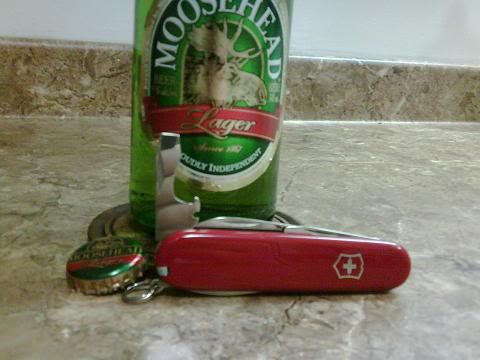
What is a "survival" knife?

Hi guys...

Imo it´s important for a knife for such functions that it has full-tang. After my experience that´s one of the most important because of stability.

My thoughts...

Kind regards

My peanut doesn't have ANY tang! And I am still alive! :)
 
Thanks. I know I'm being jaded about it and ruining the fun...but "survival" is pure marketing. You got a dozen "survival" shows on (whatever that means) and manufacturers are riding the wave. And they should. They'd be idiots if they didn't!

But look at all these "I want a survival knife" threads....The vast majority of people asking haven't even thought about what they are even asking. And it's not their fault....they aren't stupid or anything. They probably just watched one of the "survival" guru shows and now want a "survival" knife so they can go out and do "survival."

When what they are really wanting to do is go camping or hiking in the woods or desert or swamp or where ever.

But there's nothing sexy about a "camping knife" anymore....is there? Now it's "survival."

Nonsense.

Sorry....rant over. I'm gonna take my survival peanut over to the break room and get a cup of extreme minimalist survival coffee. Hydration is key to survival!

Yah, I do understand. My original purpose when I posted the thread was to show a local(to me) guy the responses to this thread because he really wanted "a survival knife" that could stab through a coin and I was not eloquent enough to explain what you guys have so nicely written. I told him that "a survival knife" didn't need to stab through coins unless stabbing coins is what he needed to do to survive.
 
I have over 30 yrs of wilderness experience in the Catskills and Adirondack areas in the North Eastern part of the USA. I started out with Bucks and KA-Bars which have served me well over the years, but I feel dollar for dollar the Bussekins (especially Scrap Yard Knives) are extremely hard to beat in comfort, quality, and price. Those resiprene c handles feel really good in my arthritic hands. Getting old is a female dog.
If I had to pack light and expect to do the necessary tasks like making a fire, signal for help, make a shelter, make a weapon, make traps for food, fishing pole or spear, make splints, etc. any quality 6 inch knife will do. I just recomend the ones I have become used to over the years because I am a cheap skate and want excellent quality for the lowest possible price. Just being honest.
 
I think the best thing anyone has said on this particular subject is, "You didn't buy a knife, you bought a good luck charm." That's what I think sometimes when I see people bring up survival knives because the it always seems like there's some kind of expectation that it's going to save their butts in a real pinch just by its merits of being a really strong knife.

On the other hand I think there are some other more practical and sensible characteristics of a "survival knife", but I think the big two things is that it will be expected to serve several roles, and it will be expected not to break or fall apart while doing that. I think there are differing definitions of what a survival knife is given what the circumstance is. If you're a diver for example, then your survival knife would probably have to be something you can use to free yourself from tangle or something with very easy, maybe something heavily serrated, highly visible for low light situation, etc. On the other hands a lot of survival ideology is wrapped up in the wilderness so you see some aspects of a survival knife also being good aspects for a camp/bushcraft/hunting knife.

What about things like the swiss army knife or various multi-tools though? A lot of people don't really lend a lot of credence to these as "survival" knives because they claim there's too much screwdrivers and things that would only be useful in an urban environment, but what if you had to survive and urban disaster? I think I'd take a multi-tool over a really stout bowie if we're talking about that kind of scenario.

So I think the real definition of a survival knife isn't really so much in its function but what its intended or desired use would be.
 
jwise is wise and gave the perfect answer... from dental work (ouch) to ditch digging.
A survival knife to me is one that I would purposefully choose to take with me as I walk away from my home and other worldly belongings. Whether I am walking away for a few days into the woods, or walking away as looters and zombies drive me out, the point is that I will rely on this ONE knife to do all I could ask for a knife to do. It also pre-supposes no re-supply. In normal circumstances, if my worldly possessions were lost to a natural disaster, I would make a claim on my insurance company and replace my belongings. In a "survival" situation, this is not possible (either because you are cut off from the civilized world, or because the civilized world is gone!)

This is the knife you would grab as you ran out the door, not necessarily the knife you already have with you as you ran out the door. If you had time to grab one, and could only take one, which one would it be?

This knife would be used to perform minor surgery, dental work, cuttings limbs to build a shelter, bushwhacking, fire-starting, hunting, spear-fishing, crop cultivation, skinning/field-dressing, chopping, and self-defense.

If the knife could easily be lashed onto a stick to be used as a spear, that would be a good thing.

If the knife had a saw-tooth back to cut limbs, etc.., that could be a good thing.

If the knife was sharp, and came with a sharpening stone in the sheath (so they were always together), that would be a good thing.

If the knife was large/heavy enough to chop, that would be a good thing.

If the knife was long enough to fight with, that would be a good thing.

If the knife was small enough to easily carry with you, that would be a good thing.

The survival knife is a jack-of-all-trades blade.

Frankly, I don't believe in ONE knife being the end-all/be-all blade. I prefer to have a few that are mission-purposed. Its hard to beat a SAK, locking folder and fixed blade trio.
 
...the point is that I will rely on this ONE knife to do all I could ask for a knife to do...The survival knife is a jack-of-all-trades blade.

I agree somewhat, but I think a survival knife should meet certain tactical considerations. First of all, the six things you need for survival are 1) air, 2) blood circulation, 3) water, 4) shelter to conserve energy (includes protection from elements/radiation and fire to keep warm), and 5) food.

1 and 2 are often ignored because they are assumed, but without them, we would die in minutes. That means that a survival knife must be sharp enough and thin enough to be able to perform a tracheotomy, and heavy duty enough to cut through rope or other materials that might be holding us under water, or constricting blood vessels in your neck.

The knife must be able to help us prepare a solar still or cut through roots while digging a hole to find water.

It also needs to be sturdy enough to help prepare an emergency shelter (cutting rope and branches) or perhaps even small saplings.

Lastly, for food purposes, it needs to be able to be converted into a hunting / offensive distance weapon (such as a spear / Atlatl) to hunt larger game or fish, yet dainty enough to perform harvesting tasks.

Fact of the matter is that almost any modern knife could perform these tasks, even a small SAK or your EDC.

As far as "long term survival / apocalypse" scenarios are concerned, where you need to reconstruct civilization while cooperating with a few other people, it wouldn't take long to nap out a few stone knives and tools and get started making an oven hot enough to smelt iron / steel into a variety of knives and other tools.
 
Marketing gimmick, plain and simple. Mr. Russell had it correct in his post; the knife you have with you is your "survival knife". I have travelled around the world, both in uniform and out, and have found that just having a tool to help you create other things puts you way ahead of the curve. Add a way to make fire and you win. The huge choppers, the hollow handles, the sawbacks are all gimmicks to sell knives. While all of these things may have their uses, but narrow the scope of a tools actual usefulness.

My choice? A Victorinox Fieldmaster. All the tools one needs and able to be carried in the pocket, where it will be when one needs it. Isn't that the mission of a "survival knife"?
 
The knife that you have with you when the trouble hits. I try to tell others the mantra that 2 is 1 and 1 is none. In simple terms, carry at least 2, whether it be knives, flashlights, etc.

As any knife you have only one of is "none," you won't miss them if you send them to me.
 
I think this is about as succinctly, and truthfully, as this question (as it was worded) can be answered. For in order to be able to use it to survive with you have to be able to carry it on you, or acquire it within the environment in which you are surviving. A "survival knife" can range from any possible knife you may carry to a sharp stone, piece of broken glass, or a sharpened piece of scrap metal. It's always relative to the location, environment, and situation at hand at the time. I'd bet small folders and kitchen cutlery have served as "survival knives" as often as any other on a global scale.

As for "purpose-built survival knives", which is what I am thinking you may be asking about, they all seem to have certain aspects in common. All decent made ones I have used were designed to be durable, have a bit more lateral strength than sporting knives, and designed to multi-task... this is to say they are usually designed for prying, hammering, and digging with as much as for cutting.

In the end it likely won't be the design of the knife that decides one's fate in a survival situation. It is more likely that it will be the amount of knowledge within the persons head, the ability to improvise and think outside the "box", the will to live, and luck.

+10

**********************
 
Originally a "survival" knife is a purpose and not a reference to any specific style of knife. It was any knife that would have been included in a survival kit; especially military kits for aircraft, life boats, life rafts, etc. A wide variety of knives were used by the US military depending on the specific survival scenario and the availability during time of war. This would include bowie-style knives, like the Collins model 18, various folding machetes made by Camillus and Imperial, various non-folding machetes, large folders like the massive lifeboat knives made during WWII by companies like Imperial. We should remember that the military traditionally hates knives and would rather spend its budget on actual weapons systems, it seldom has provided soldiers with a knife as basic equipment, and when it does supply knives they are intended for a specific purpose; whether that purpose be for KP use, the trades, survival or as decorative uniform items.

Prior to the 1970s, and certainly before the Randall Model 18, hollow handled knives were just matchsafe knives. Then along comes First Blood and opens a great marketing opportunity to sell expensive, massive and ackward gadget laden knives that would not have been otherwise marketable to hunters, campers, or anyone else interested purely in woodlore. As users gained experience with these knives the tubular hollow handle became mostly a negative. It was a weak point on many cheaper imports, they were cold during the winter, the round shape didn't fit the hand well, and the usefulness of all of the tiny gagets cramed into the handle came into question. So away went the hollow handle and instead we saw more and more full tang "tactical knives". Survival had been redefined from evading and providing minimum needs for a couple of days until rescued, to a new reality which seemed to promise the ability to whittle an entire forest into a township without even having to resharpen; and, to their maker's credit many of these knives really deliver.

So now we are hauling very bulky and heavy knives which can be pressed into chopping wood, while at the same time we have mostly retreated from carrying the axe and from actually chopping wood (fire hazzards, low impact camping, hug a tree, etc). Which is fine for anyone with an active imagination, who can concern themselves with carrying a tool to fend off tigers, lions, bears and the occassional flying monkey or zombie appocalipse.

n2s
 
Last edited:
"First Blood," 1982

Ken Warner, 1976:
There is survival and survival. Everyone is surviving these days, it seems, and inevitably, there are survival knives. . . . If a stout knife fits your plan, it ought to have these characteristics: 1. Five inches or more of blade, with no fragile aspects, made of 3/16-inch or thicker stock. 2. A reasonably sturdy guard on at least the cutting edge side of the handle. 3. A generous-sized handle (for maximum leverage) made of any durable material. 4. Provision for a thong or lanyard, which should be installed and left there. 5. An extra-heavy sheath, or a regular sheath reinforced. It should not be possible to fold the sheath over on itself.
 
This is my 'survival' knife...

sak01.jpg
 
What are you surviving from? I spend a 100 days a year in the woods for almost 20 years and I havent needed to baton anything yet.

That was not the question, but when all you have is a hammer, everything looks like a nail - or chance to denounce the contact method of wood cutting.
 
The knife that you have with you when the trouble hits. I try to tell others the mantra that 2 is 1 and 1 is none. In simple terms, carry at least 2, whether it be knives, flashlights, etc.

Two rifles? Two backpacks? Two stoves? Two pairs of boots? Two tents? Just asking. ^___^
 
Quote Originally Posted by jwise View Post
If the knife had a saw-tooth back to cut limbs, etc.., that could be a good thing.
This is one of those things I occasionally have to explain to a person. The sawteeth on a military survival knives such as the randall 18 or the USAF blade - they are designed to TEAR through aluminum and plexiglass, not to saw wood. This is a massively different set of purposes, geometry, and requirements.

At the most basic, the simple fact that you don't get offset teeth on a knife (so the kerf is wider than the blade, preventing binding) is a killer. In fact, with a VERY few exceptions, most sawbacked knives I have seen are THINNER at the cut than the blade.
The saw teeth on the original Garcia (Hackmann) Survival knife had kerf. They made a pretty poor saw compared to a folding prunning saw, but it did allow cutting angles for traps or cutting down a pole quietly. Pretty rare thing. Also rough on any wooden baton you might use were you so inclined.
 
Back
Top