savagesicslayer
Gold Member
- Joined
- May 24, 2005
- Messages
- 3,363
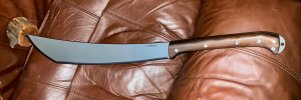
My current machete crush...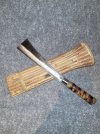

The BladeForums.com 2024 Traditional Knife is available! Price is $250 ea (shipped within CONUS).
Order here: https://www.bladeforums.com/help/2024-traditional/


Who makes this one

Appears to be a modified Martindale/Chillington Crocodile.Who makes this one

Yes.Appears to be a modified Martindale/Chillington Crocodile.

Yes.
I believe I've seen these before, maybe there was a company rehandling them or something?

yep that's it, I recognized the handle from the Essee machete.It’s a one of a kind. I had Ray Ennis of Entrek Knives modify it to fit the handles off of an Esee Lite Machete
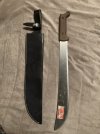
The OKC-made U.S. army machetes are well made but I find them too thick for blackberries. They’re about 1/8” thick. For blackberries I want speed not mass. I find a 22” or longer South/Central American machete to be more effective. The OKCs were made for the heavier work of the South Pacific jungles. Shrubs and small branches need the heavier blades.I've tried a few, mostly on the blackberries that keep spreading back into my yard and I keep going back to the cheap military issued one I somehow acquired when I was active duty years ago. Like i really don't remember how I got it. Might have picked up from some extras in supply, stuck it in my ruck, and forgot about it. I think it's made by Ontario. It's worked well for me for a few decades.
Shrubs and small branches tend to be fairly lithe and springy and still need fairly high tip velocity, though they need more forward concentrated mass to go with it to carry through the cut after initial contact, and the Ontarios are too thick and poorly distributed with their mass to do well on those. I find they deal better with thick branches and wrist-thick saplings, but I would rather something like an Imacasa No.32 20" panga in that weight class, as it's only a fraction of an ounce heavier while having more favorable mass distribution and increased length for higher tip velocity.The OKC-made U.S. army machetes are well made but I find them too thick for blackberries. They’re about 1/8” thick. For blackberries I want speed not mass. I find a 22” or longer South/Central American machete to be more effective. The OKCs were made for the heavier work of the South Pacific jungles. Shrubs and small branches need the heavier blades.
In the spring and fall here (the temperate rain forest of Western Washington state) we can go from almost nothing to having standing vines an inch thick in a week to week and a half. Especially when they are coming over from the neighbors, and there have been some as thick as small saplings that have made it over, or through the fence.The OKC-made U.S. army machetes are well made but I find them too thick for blackberries. They’re about 1/8” thick. For blackberries I want speed not mass. I find a 22” or longer South/Central American machete to be more effective. The OKCs were made for the heavier work of the South Pacific jungles. Shrubs and small branches need the heavier blades.

That top one is a Panga, the Panga is an amazing heavier pattern.
The big bolo on top can really chop some serious brush and branches. I chopped a few small-to-medium sized palm trees down with it. I am getting too old to swing it to max effectiveness any more though. The small amount of added weight at the end of a long lever takes some energy to get going.
Yeah the rozador is a great pattern. In pangas I generally prefer the more flared types that are narrow down by the ricasso. I'm also a big fan of colima machetes. Not only are they good at back-and-forth cutting through lush vegetation, but the bulge of the back edge is good for a few things; most notably as a sacrificial edge when chopping in dirt or among rocks.That top one is a Panga, the Panga is an amazing heavier pattern.
My favorite pattern is the rozador, but pangas and Bolos are great.
Those blackberries do grow fast. I’m also in Western Washington.In the spring and fall here (the temperate rain forest of Western Washington state) we can go from almost nothing to having standing vines an inch thick in a week to week and a half. Especially when they are coming over from the neighbors, and there have been some as thick as small saplings that have made it over, or through the fence.
I haven't had issues with it not easily zipping through the smaller vines, but I'll give a thinner slightly longer one a try.
Of those I’d take the one in the middle.
The big bolo on top can really chop some serious brush and branches. I chopped a few small-to-medium sized palm trees down with it. I am getting too old to swing it to max effectiveness any more though. The small amount of added weight at the end of a long lever takes some energy to get going.