What specific knife features do you require on a Bush Craft Knife?

Looks like I forgot one from my list:

8) The point needs to be sharp. No spear points and for heaven's sake no tanto points.


Or that's what I think, anyway. You have to admit, though - folding knives are a compromise on many levels, and only on two levels can they ever even hope to compete with a fixed blade of equal quality: size and weight. And where size and weight - and even in these the differences aren't always that large - isn't critically important, there's no reason to carry a folder over a fixed blade. Of course, some people just like folders. Nothing wrong with that, as long as one knows the limitations of said tools.

I'm amused by a lot of the replies, if a smaller knife didn't have a choil, I wouldn't even consider it. To me, they're extremely handy when I'm choking up on it, and I do that a lot. Interesting how so many people can have very different opinions about a simple thing!

Yes, I think it's interesting, too. And I think it's mostly because in certain parts of the world, people are used to knives more derived from swords than work knives, and for this reason are so used to guards and choils and large ricassos that they actually don't know how to use a knife that doesn't have these things. If the knife had been properly designed to be used in work that requires any kind of precision, you wouldn't need a choil on it to choke up on, you could just hold the blade by the handle, as a knife is supposed to be held. Choils are one of my pet peeves, actually. On large knives that are heavy and awkward, sure, put choils on them, it may actually help a bit, but they're very detrimental to performance on small knives. It's really extremely simple. :)
 
Yes, I think it's interesting, too. And I think it's mostly because in certain parts of the world, people are used to knives more derived from swords than work knives, and for this reason are so used to guards and choils and large ricassos that they actually don't know how to use a knife that doesn't have these things. If the knife had been properly designed to be used in work that requires any kind of precision, you wouldn't need a choil on it to choke up on, you could just hold the blade by the handle, as a knife is supposed to be held. Choils are one of my pet peeves, actually. On large knives that are heavy and awkward, sure, put choils on them, it may actually help a bit, but they're very detrimental to performance on small knives. It's really extremely simple. :)

Choils help a great deal when using a "pinch grip" for many tasks. They can get hung up on things, but with experience, it's not a problem. I like them on smaller knives as they allow for more precision. On larger knives, I don't like them, a pinch grip is uncomfortable for me when the blade is so wide.
 
When I am doing woodcraft work like, traps, fire making, carving stuff, and making a bow and drill, I prefer a knife with:

1. A deep finger grove and little bit of a guard.
2. Drop point
3. Convex or flat ground
4. Jimping on the thumb ramp
5. Comfortably grippy handle
6. Parrot beak handle
7. 3/16ths thick blade stock


What are some of yours?

:D Sounds kinda like Rat Cutlery ? I love my RC3 for wood crafts:thumbup:
 
..., but with experience, it's not a problem.
The funny thing is that the same can be said about knives without choils or extended ricassos :D

I started out with a knife based on Ed Fowler's designs, big guard, big ricasso. It worked very well for chopping with its balance falling right at the guard, it also worked well for cleaning game. I took it on a wilderness skills course for a week and while it did everything needed it did have some disadvantages that experience did not entirely overcome. Since then I have concluded that when the majority of work is going to involve wood carving (actually, anything but game prep) guards, finger choils and extended ricassos are a disadvantage.

What you gain in some ways with a guard and ricasso, you lose in others. Being able to cut right in front of the handle lends a lot of mechanical advantage. A short blade can be handy, but a short blade with a long ricasso becomes just the opposite. I have found that on blades 5inches and less that a ricasso hinders more than it helps.

Guess it just depends on what you do and where you are doing it.

The knife I like best for camp and fire making is 5 inches (it is a little cumbersome for cleaning game), flat ground with long convex secondary bevel, the edge runs almost to the start of the handle, spear/drop point, handle width is very important, 19mm wide at the front, 24-25 in the middle, back to 19-20 and a flare at the butt.
 
Choils help a great deal when using a "pinch grip" for many tasks. They can get hung up on things, but with experience, it's not a problem. I like them on smaller knives as they allow for more precision. On larger knives, I don't like them, a pinch grip is uncomfortable for me when the blade is so wide.

Choils only allow for more precision if the design of the knife is already flawed with regard to precision work. If there is no ricasso, and no finger guard, and if the blade starts right from the handle as it starts in wood carving puukkos, then there's absolutely nothing that a choil would do to allow for more precision. Instead, on such a knife, a choil would either 1) decrease precision by taking the cutting edge farther away from the hand or 2) decrease ergonomics by taking the hand partly away from the handle and to the very uncomfortable metallic choil part of the blade. This is all blatantly obvious, but it may be hard to believe if one is used to always using knives that weren't really designed with precise work in mind.

Like C_Claycomb said in his post, "being able to cut right in front of the handle lends a lot of mechanical advantage." If you want the highest possible control, accuracy and precision on your knife work, then you will have to grip the knife so that your hand is gripping right next to the cutting edge. The less distance between the cutting edge and your hand, the higher your control on the knife is in precision work. Think about it for a second. Why do you think a choil allows for more precision on a knife? Because, choking up on the choil moves your hand closer to the cutting edge. The reason you need a choil to get your hand close to the cutting edge is that there are pointless ricassos and finger guards in the way of your hand. If you remove these obstructions to performance, taking away the ricasso, finger guards and choil, then you will end up with a natural grip right next to the cutting edge, and you will have the best of both worlds and something you can never achieve with a blade that has a choil on it: you will have an ergonomical grip on a properly designed handle without having to hold onto the metal of the blade, and you will have the highest possible control of the blade because your grip is right next to the cutting edge. As a plus, whatever you're cutting certainly won't ever snag in the choil, because there is no choil. It's really that simple.

The downside is, of course, that you don't have a finger guard, and you may be afraid of your hand slipping on the blade. But with skill and common sense, that is not a problem. :) I suggest everyone who ever does any precision work with their knives to at least give a try to a completely choilless, guardless design. I've used a lot of knives that had choils and guards on them, and I've used a lot of knives without either, and there really is no comparison in precision work: the knives without choils and guards win, every single time.
 
Honestly I love mora ergonomics, and anything added or substracted generally make it less convenient. The only complain (apart from small possible improvements like steel grade, finish) is that it isn't meant for batonning pommel.

I like flat grinds for both ease of sharpening, sharpness and because large bevels allow you to know what you're going.

The "barrel" handle is comfortable and neutral enough to fit most grips (arguably symetric handle may cause confusion about where the edge is pointing when the knife is handled in the dark etc... but it is only a minor problem compared to benefits)

As for the no guard, it is generally better for whittling and small work. My only complain is when batonning pommel, I'm always worried about missing pommel and having fingers slide on blade. Maybe a small guard like the one clipper or F1 would be an improvement without standing too much in the way.
 
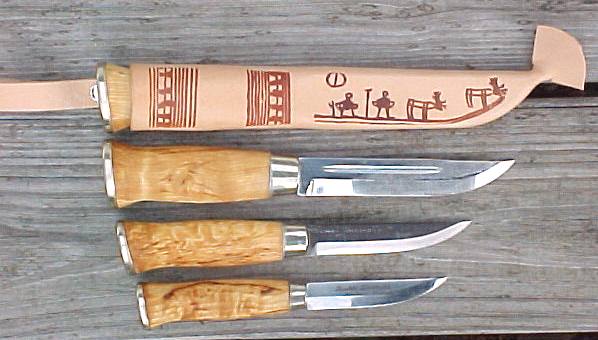
My perfect woodscrafter would be like the middle one of these Jarvenpaa Puukkos, with a full (preferrably exposed) tang.
They are the same basic design, but IMO "mo' better" than Moras (also "mo' 'spensive"):
puukko.jpg
 
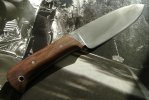
I have been carrying this one lately, it was originally made for Mtnfolk Mike but he wanted a slightly different shape.
 

Attachments

  • BushCraft.jpg
    BushCraft.jpg
    83.7 KB · Views: 45
I have been carrying this one lately, it was originally made for Mtnfolk Mike but he wanted a slightly different shape.

That one is sweet. The tip looks nice and stout :thumbup:

psy-ops pretty much nailed down my preferences as well.
 
- Carbon steel
- 1/8" thick blade
- 3.5" to 4" long blade
- Scandi grind
- Drop point w/ pointy point
- Squared spine without thumb grooves
- No choils
- No guards (finger groove is acceptable but not prefered)
- 3/4 to full hidden tang
- Nice oval or egg cross section to the handle
- Natural material for handle (wood, antler, or combination)
- 4.5" long handle
- Sturdy leather sheath with firesteel loop.

Now I just got to make it... :D
 
That one is sweet. The tip looks nice and stout :thumbup:

psy-ops pretty much nailed down my preferences as well.


Yeah! it looks like you have the knife of my preference.

Stephanfowler, did you make that for MM?
 
Looks like I forgot one from my list:

8) The point needs to be sharp. No spear points and for heaven's sake no tanto points.


Funny...spear points, in my experience, are some of the best points for woodworking and general bush work, unless, of course, you mean that it must be sharpened on both sides.

And, interestingly, ever since a professional woodworker I know gave me the idea, I have been taking tanto points more seriously...you essentially have a chisel of one type or another, and can shape wood with a high degree of precision.
 
Hmmm.....as for the choil "sticking" haven't you gusy ever seen a rounded choil? If not, check out my website. I happen to make knives with choils and hidden tangs. One distinct advantage is that I can have a wider blade without either having a handle that looks like a 2 x 4 or one where the width of the ricasso does not match the width of the handle.......stylistic faux pax IMHO. A number of the choiless knives that I see still have a "choil of sorts because the sharpened dege does not go all the way to the start of the handle materiel. So whats the dif? As fr the guard issue, see if you can find the picture that convinced Ed Fowler that all knives should have guards. By the way, I do have two of my hunters being used to carve cute little wooden spoons in the UK.....because that is about the only thing that they can do with them over there.....lol
 
Funny...spear points, in my experience, are some of the best points for woodworking and general bush work, unless, of course, you mean that it must be sharpened on both sides.

And, interestingly, ever since a professional woodworker I know gave me the idea, I have been taking tanto points more seriously...you essentially have a chisel of one type or another, and can shape wood with a high degree of precision.

My experiences with (single-edged, as double-edged are right out) spear points aren't very good. They seem to make tip work harder than it needs to be, but perhaps that is because I'm much more used to a normal point from a flat spine.

As for americanized tanto tips as chisels, not really my cup of tea. If I wanted a chisel I'd carry one, but I need the knife to have a usable tip with a proper curve, which is something the americanized tanto certainly does not have.

Hmmm.....as for the choil "sticking" haven't you gusy ever seen a rounded choil? If not, check out my website. I happen to make knives with choils and hidden tangs. One distinct advantage is that I can have a wider blade without either having a handle that looks like a 2 x 4 or one where the width of the ricasso does not match the width of the handle.......stylistic faux pax IMHO. A number of the choiless knives that I see still have a "choil of sorts because the sharpened dege does not go all the way to the start of the handle materiel. So whats the dif? As fr the guard issue, see if you can find the picture that convinced Ed Fowler that all knives should have guards. By the way, I do have two of my hunters being used to carve cute little wooden spoons in the UK.....because that is about the only thing that they can do with them over there.....lol

Yeah, have seen a lot of them, but rounded or not, they still cause sticking - which is really no wonder, seeing how they're essentially an enormous dent in the cutting edge. The sticking isn't really the main problem that choils cause, though. As for the small sharpening choils, they shouldn't be there either, in my opinion, but I can't really make them disappear from knife design, now can I. Fortunately, there are many knives that have neither the larger finger choils nor the smaller sharpening choils. As far as guards are concerned, there's no such image that could convince me that guards are needed on all knives. Sure, if you're going to be stabbing people with that knife, then it should have a guard or two. If you're just going to use it in general utility, a guard does hinder performance, but if it makes you feel safe... I've used guardless knives all my life, like my forefathers before me, and I've never managed to cut myself in any way that a guard would have prevented. But then, different strokes for different folks.
 
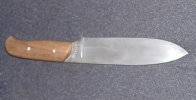
How about this type of "guard" sharpened clear back to the nub

(this was the final version of MM's knife)
 

Attachments

  • bushcraft1.jpg
    bushcraft1.jpg
    24.2 KB · Views: 51
The downside is, of course, that you don't have a finger guard, and you may be afraid of your hand slipping on the blade. But with skill and common sense, that is not a problem.

Until, of course, you are hypothermic and rapidly losing fine motor skills. Been there, done that.

I suggest everyone who ever does any precision work with their knives to at least give a try to a completely choilless, guardless design. I've used a lot of knives that had choils and guards on them, and I've used a lot of knives without either, and there really is no comparison in precision work: the knives without choils and guards win, every single time.


Many of us, myself included, have used both designs. If choil - less works for you, great. The choil allows me to get much closer to my work (notice how I haven't said anything about guards). I can use a much narrower pinch grip than if I am gripping the handle, whether the blade goes all the way to the guard or not.

I've got no problem with you having a different conclusion - but don't present it as fact. It's opinion, just like mine.
 
The funny thing is that the same can be said about knives without choils or extended ricassos :D

Very true!

Guess it just depends on what you do and where you are doing it.

Agreed, but I would also add "and how". I think when people are talking like this, it would be interesting to see how people grip and use their knives.

The knife I like best for camp and fire making is 5 inches (it is a little cumbersome for cleaning game), flat ground with long convex secondary bevel, the edge runs almost to the start of the handle, spear/drop point, handle width is very important, 19mm wide at the front, 24-25 in the middle, back to 19-20 and a flare at the butt.

That sounds nice, what steel is it made out of?
 
Elen--

I agree with you to the point that choils on short blades aren't necessary and can interfere with precision and utility, such as when carving wood.

But I've used well-designed and functional choils for years on blades in the 4" to 10" range and think they're great. I don't think I've ever needed every last inch of blade to cut anything. The closer the blade gets to the handle the more leverage and mechanical advantage is lost, and the more difficult and awkward cutting becomes. If I really need that extra inch or so of blade directly in front of the handle then I'm using a knife that is too short.

The edge immediately in front of the handle is just wasted space without a choil, in my experience, and the choil adds immensely to a knife's utility and versatility. In some ways it's like getting 2 knives for the price of 1, a tremendous advantage with no drawbacks or compromises.

Personally, I don't own, and would not use, a sharp fixed-blade knife without a guard.
 
Back
Top