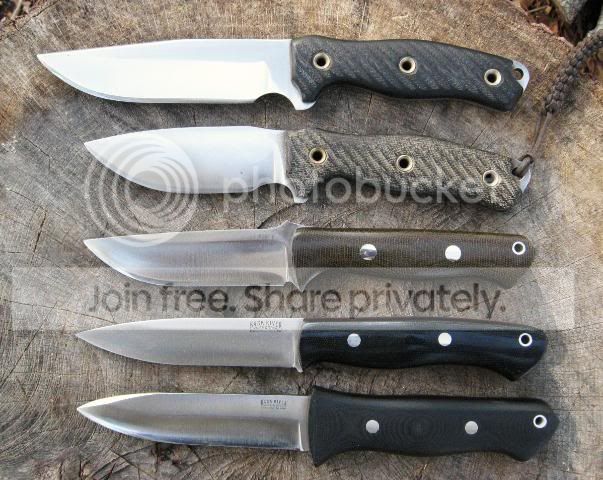
And I'm awake again!

Well, now, like I said, it's only a fact given certain parameters.
You mention the Fehrman Peacemaker, a knife that has a guard on it. If your knife has a guard that effectively prevents your hand from getting close to the cutting edge as is required for a precision grip, then adding a choil will naturally bring your grip closer to the cutting edge and in so doing increase precision. That in itself is good, but there's a downside: when you choke up on the choil, you have to partly grip the metal of the blade, hardly shaped up to be comfortable in hand for prolonged periods of time, so you lose ergonomics.
So the point to my no choil, no guard, no ricasso ranting is exactly that: with a knife that has none of those, you will be able to both 1) get your hand right next to the cutting edge for precision and 2) still have your grip on the handle instead of the blade for superior ergonomics. That is the issue, and it's a measurable fact: it wouldn't be difficult to measure, in millimeters, the distance of the hand from the cutting edge and the power exerted while cutting, nor would it be hard to measure, roughly, the ergonomic comfort of the grip in prolonged work.
As I say, the choil is a relic feature more derived from swords than work knives. A choil does in fact increase precision with huge chopping knives, and on those it's all good. A choil also increases precision on smaller knives that have guards or extensive ricassos on them, but in these cases, the increase in precision comes packed with a decrease in ergonomics. That's the problem with choils. They will always decrease ergonomics, and won't allow for a grip any more precise than the knife would have if it was relieved of excessive guards and ricassos. The only exception to this I can see are knives with blades much wider than the handles, in which case a choil will allow you to take your grip much closer to the cutting edge for precision, but again, for the price of losing ergonomic comfort.
Some people over here in Finland prefer to have guarded knives for hunting purposes, but a lot use guardless, including myself. The following is one of my favourite user knives, a Tommipuukko made for all kinds of general work from wood working to skinning. I've used it on all manner of things, with bloody hands, cold hands, wet hands, you name it, it's done the job so far. And the precision allowed with this kind of handle and blade configuration is really rather unmatched. If you want to see a seamless transition from the blade to handle, take a look at this. I don't see the handle bumping out wider near the edge...

It's true, of course, that one can easily avoid getting things stuck in the choil - just limit the length of your cuts. But if there is no choil for things to get stuck in, then you don't have to limit your cuts, which I consider a pretty good thing.
The main reason, I believe, with the way Scandinavians generally favour guardless, choilless designs and Americans prefer the exact opposite, with large ricassos, enormous choils and sometimes even double guards, is mainly cultural. Scandinavia has some tens of thousands of years of knife culture (although we didn't exactly have supersteels those thousands of years back, not that we have them today, either
) while the majority of the American population today is descended from people that only came to the continent a couple of hundred years ago, already in the age of firearms. That, I believe, has made Americans in general less passionate about knives than Scandinavians, and less likely to spend a lot of time on learning proper knife use. That, in turn, directly translates into a desire for safety features like guards, ricassos, and even choils as a counterbalance to the hindrances caused by the previously mentioned safety features. Another thing that seems to have affected this is seeing knives as much as weapons as tools, which has caused the addition of swordlike features into knives. Over here, knives have always been tools first, weapons a distant second, and for that reason, even "knife fighters" have avoided adding too many swordlike features to the knives, because that would ruin their performance in the much more common general, non-combat usage. Oh well - the most important thing, as I see it, is to use what feels right for you, while remembering to occasionally experiment in order to, perhaps, find something that works for you even better still. :thumbup:


 You can't, that's how, and this is why what I've repeatedly stated about choils is in fact, uh, a fact. It's not an opinion, my friend.

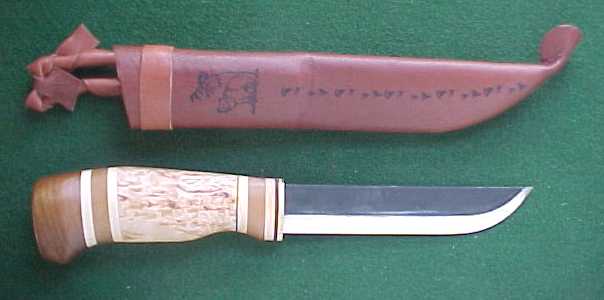
 for very fine carving work. Rather them than me, but it seems to work for them. I ain't brave enough to try to emulate them despite them offering explanations for why it isn't as dangerous as it looks.