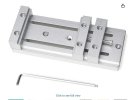
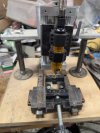
Mine is a 710W generic Foredom from Amazon; there are more powerful ones out there. I use various burrs and stuff to link up holes in the tang, cut sharpening notches/choils, jimping, etc. I got tired of holding the Dremel body all of the time. They are usually under 100 bucks. I also picked up a desktop CNC with a 800W spindle and 3 axis full linear rails recently, too. I need to try that on some annealed steel and brass, copper, aluminum, etc for guards and stuff. Works great on Micarta and G10! I had to learn some cad/cam type stuff, but I use Easel online to design and I can import those files into LightBurn for the laser, too.
For a Dewar, go to local colleges/universities and see if they have one they aren't using. I pulled a Taylor Wharton 18XT and a MVE 30L dewar out of the dumpsters at work (with permission!) and just had to buy the foam core plugs for them on ebay. They are often used in the Health Center and Science (Bio) departments. Many times, they will get them if they need to hold specimens in cryo for a longer time period, but most use the Larger 250L tanks on wheels and dispense from those into their smaller container to freeze samples instead of using the big dewars to hold, so they end up getting rid of them if no one is doing experiments where they need to hold for a long time. Freezing skin tags and warts are what the Health Centers use them for.
Being in Alabama, look at farms/agriculture places; they sometimes use them to store semen to inseminate their animals and may get rid of some that are older? They may also know places to get the LN2 for cheap. In CT, it's like $13/L, which is stupid high!
For a laser, first determine if you want a Galvo or Gantry setup. Galvo uses lenses to move the laser around, usually in a 100-150mm square area and is fast with a smaller footprint. xTool F1, or F2, Scuplfun G9 and WeCreate Lumos are 4 I have been looking at; they are 10-15W diode and 2-5W IR Laser setups in a Galvo with cameras to position where the laser goes and around 1000-1500 roughly. You can get conveyor belts to do multiple items and rotaries to do tumblers in these as well.
A Gantry is more open and the actual laser moves back and forth on x and y axis (sometimes Z), but is much slower and larger footprint. My gantry has nearly a 24"x24" work area; most are 15"x15" or so. I have 3 different heads I use on my gantry, 11W and 20W blue Diodes and the 2W Infrared. A 2W IR laser will laser etch logos and stuff really nicely, but no color control really. 10-20W diode will cut 1/8" plywood and hardwoods to make templates and stuff, engrave tumblers, bottle openers, key chain tabs, and stuff like that. I've also cut out leather sheath patterns with the diodes, made little knife stands for shows, laser out templates to trace, etc. I think I have around 1000 into my laser stuff (I got the Sculpfun IR head on sale, the 20W diode on sale on Amazon and my Sculpfun S33 11W Ultra as a refurb, as well as my roller setup as a refurb unit, and then won a 200 gift card I put towards the new rotary chuck tool from Sculpfun, which cost me $9 after the gift card). My wife loves my cricut and doing stuff for work on it and she may start doing wood decorations on the laser, which is why I went with a larger gantry style to be more versatile. If I was just doing blade etching, I would have gone Galvo.
There are more powerful diodes out there now over 40W, UV lasers hitting the market, etc. If you want to mark blades and do smaller projects, the Galvo is great, especially for saving space. They make mini gantry's now or cubes that are gantry setups, but self contained. Sculpfun has their iCube Ultra (12w diode and 1.2w IR) for under 600, but it's a gantry setup, but with built in exhaust system and you can add in a camera.


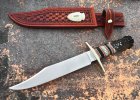


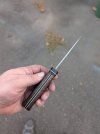
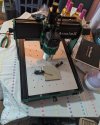




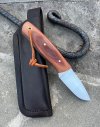
 .....Looks great