What's going on in your shop? Show us whats going on, and talk a bit about your work!

Got started on a couple of kitchen blades for the wife and I. A more classic styled "chefs knife" for her. Mine will be the Santoku'ish one. Both are 3/32" Magnacut. Hers is leftover CPM from a previous project, and mine is recently purchased, and is the Erasteel version. It will be interesting to see how they react to the same heat treatment. Planned heat treat will be 2050F plate quench/dry ice slurry and 350F temper. That is, if I don't screw up grinding them, and get to that stage!

 
a little this and that today
8qbcNOb.jpg
 
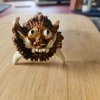
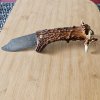
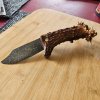
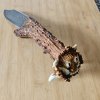
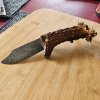
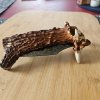
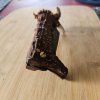
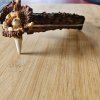
Back up and running! First time working with stag/antler. The peened pin is actually a small copper corby bolt, hammered to make it look like it belongs.

6vK6xQ4.jpeg

0Kopfjs.jpeg

2mRahtM.jpeg
There's just.something about copper.....👍👍👍

Great job..... Now.it needs nice leather pants.......👌
 
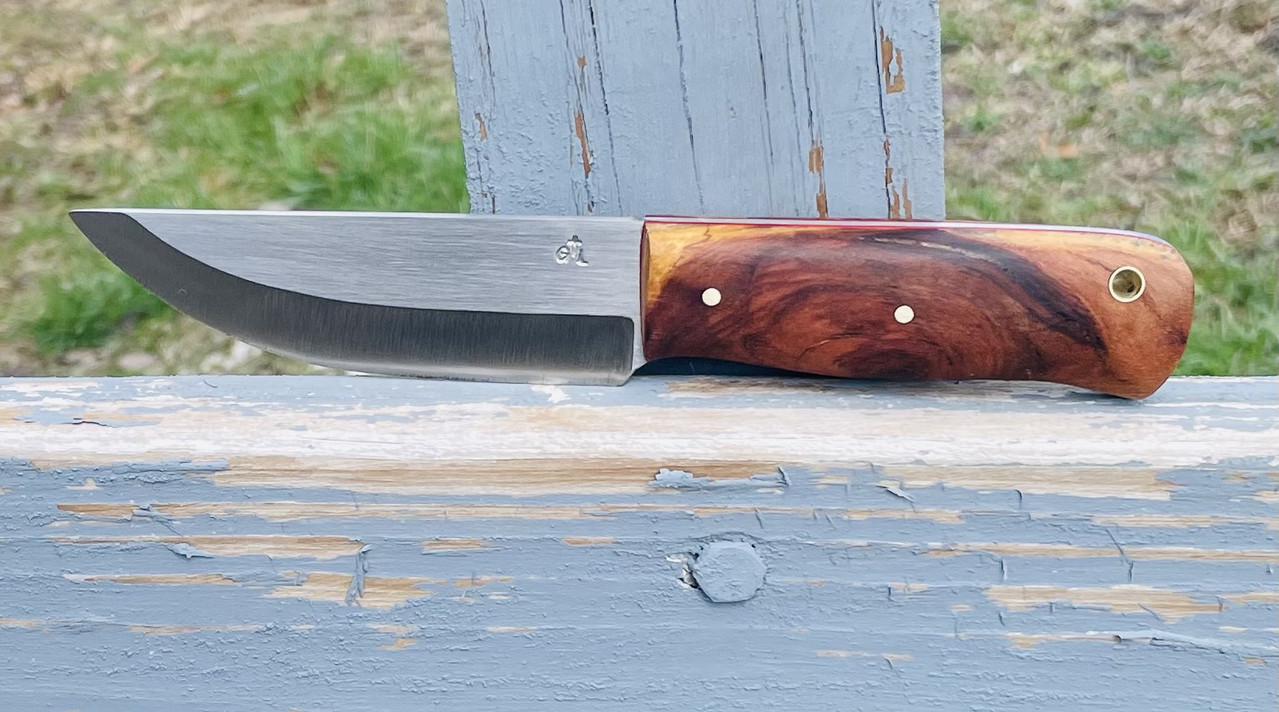
Here’s a drop point hunter I’m finishing up. The blade is SF100 stainless steel with burl wood scales. So far I’ve sanded the scales up to 500 grit. I’m not sure what species of wood the scales are, any help would be greatly appreciated.
IMG-9238.jpg
Beautiful wood.
Try lining out the pins from the top of the handle. That way you get a flowing line
 
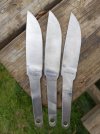
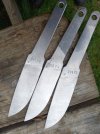
Some prototype/test blades I made out of 52100! I sent these off to a friend of mine for heat treat since there's only three.

The blade profile itself is a slightly shortened tracing from a photo of an Ed Fowler Pronghorn, the spine and ricasso are crowned, the plunge lines are round and very gradual, based on my study of old Marbles Woodcraft knives, and the grind itself is a full flat grind with a twist--literally! After establishing the grind itself, I 'twisted' the blade from the original angle to a more acute one, in a similar manner to a vari-grind, in order to grind past the spine and create a distal taper effect, then blended everything together! After heat treat the edge itself, which I ground to around .02" will be thinned and cleaned up and the edge will be ground convex in a similar manner to an old Woodcraft or a Fallkniven. And, of course, they'll end up mirror polished. ;)

In terms of the handles, I plan on sort of a blend of Ed Fowler and Bob Loveless, with 1/2" thick brass for the guards and likely vintage paper micarta for the handles, with a brass pin and a lanyard tube. :)


20260315_161129.jpg
20260315_161143.jpg
20260315_161155.jpg
 
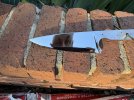
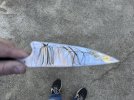
I’ve been going down the polishing rabbit hole again… I think I’ve about got a new system worked out that goes against conventional knife polishing wisdom. I stopped hand sanding this one at 600 grit and it never touched the buffing wheel. I’m working on some different tooling that I think will make it better but for a first try it’s already probably the best mirror finish I’ve ever achieved. This knife is “S” ground and other than looking at the plunges you can barely tell it. It does freak out the focus on my camera though.
IMG_1381.jpeg
IMG_1386.jpeg

Edited to talk through my method:

Well, the short answer is, I used power tools. There was a discussion about mirror polishing on here a few months ago and it got me thinking. I had some exposure to polished injection molds in my younger days because a lot of my friends were machinists. After polishing, the mold finishes were essentially flawless mirrors. Often on odd shapes which is even more impressive. With that in mind I started looking into how professional polishers do it. They pretty much use oscillating and rotary tools exclusively. What I’m starting to see is that’s not just about speed/efficiency. There is belief that the scratch patterns need to be erratic because it prevents the surface metal from “smearing” and developing ripples. Essentially it’s better to sand in every direction at the same time.

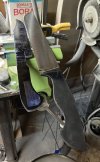
So, I made some leather and rubber backed sanding pads for my oscillating tool and sanded to 1500 grit with it. That took about 10 minutes. I also made some felt buffing pads for the oscillating tool and started using powdered abrasive slurries. The weird thing that happened at about 3000 grit was all of a sudden old belt and hand sanding marks started to show up. I was shocked by that. As far as I could tell under multiple light sources and magnification the 600 grit surface I started with was perfect. Anyway it only took a few minutes to touch those areas up. After that I went to diamond paste on small felt buffers on my Dremel tool (yes I know) just to see what happened. It worked fine but I want to work out something to cover more area. I’m looking at a mini die grinder that I found on a mold polishing website but it’s a bit pricey just to experiment with. I’m also looking at a vibrating edm stone holder.

When it was all said and done I ended up with a 100,000 grit finish that takes micro scratches if you touch it with your finger. I don’t personally have much use for mirror finishes but one afternoon of experimenting with this method all but retired my buffer. I guess I’ll still use it for handles.

IMG_1388.jpeg
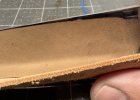
The picture above is a reflection of the smooth side of a piece of leather. The fine detail isn’t blurry at all. It is very slightly distorted because of the concave grind in the center of the blade. If you zoom in at the very top of the blade near the spine you can see where I’ve been rubbing it with my fingers and various cloths to see how badly they affect the surface. This blade has a differential heat treatment so the top of the blade is much softer than the rest which obviously makes it more susceptible to scratches. I haven’t finished the ricasso area near the plunge line at all.
 
Last edited:
I’ve been going down the polishing rabbit hole again… I think I’ve about got a new system worked out that goes against conventional knife polishing wisdom. I stopped hand sanding this one at 600 grit and it never touched the buffing wheel. I’m working on some different tooling that I think will make it better but for a first try it’s already probably the best mirror finish I’ve ever achieved. This knife is “S” ground and other than looking at the plunges you can barely tell it. It does freak out the focus on my camera though.
View attachment 3139414
View attachment 3139415
Wicked cool.....👌. Nice work
 
I’ve been going down the polishing rabbit hole again… I think I’ve about got a new system worked out that goes against conventional knife polishing wisdom. I stopped hand sanding this one at 600 grit and it never touched the buffing wheel. I’m working on some different tooling that I think will make it better but for a first try it’s already probably the best mirror finish I’ve ever achieved. This knife is “S” ground and other than looking at the plunges you can barely tell it. It does freak out the focus on my camera though.
View attachment 3139414
View attachment 3139415
So how did you do it?
 
Back
Top