What's going on in your shop? Show us whats going on, and talk a bit about your work!

Well, we all do it sooner or later!!!

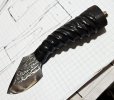
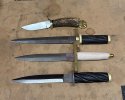
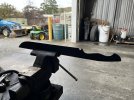
I had a nice skinner blade of layered tamahagane and 1080. I hung it in the FC tank to check the pattern before the last sanding grit. Then went to do another task, and then fix dinner, and then do some hand sanding .... and found it the next morning. I was eaten severely. I reground it as a thinner and smaller blade. I had to redo the handle a bit because the tang was now thinner than when I cut the slot in the ebony. I'll post a photo of it after the final assembly today or tomorrow, but here is what it looked like when I found it.

View attachment 3122325View attachment 3122326View attachment 3122327
Did you ever post a pic of it reground?
 
Haven't done the final buff and re-etch yet. I'll get a shot tomorrow when finishing a batch of blades.
 
This is the first knife I ever made where I ground the blade from raw bar stock, properly heat treated the steel myself, and ground the bevels free hand. Pretty proud of it despite being about as simple as a knife can be.
image.jpg
 
This is the first knife I ever made where I ground the blade from raw bar stock, properly heat treated the steel myself, and ground the bevels free hand. Pretty proud of it despite being about as simple as a knife can be.
image.jpg
Looks damn good. From here.....👌

I certainly couldn't do that.....😉
 
Made a quick little storage rack for my steel tubing (and whatever else, if it has space left at the end) once I got bored of knocking the pile over, and picking them up one too many times.
Nothing fancy, but what I found quite satisfying is how well one of my clamps fit as a stop, completely by chance :D
ALKfZLb.png

There is still plenty to go in there, but they have most likely been stored somewhere for ages before getting to me, so I still have to clean them, before final storage.
They are covered in so much crap that my first pair of gloves became unusable once I finished bringing them inside, because everything I touched afterwards got black and brown smears everywhere.
 
Just had a set 9f GripX scales Crack in half wile drilling. Stuff reminds me if kirinite.. which I despise. I do not trust this material.
Thats weird. All the stuff I've worked with has been great. I have had problems with kirinite but lots of successes to... Reach out to Matt, he's great to work with!
 
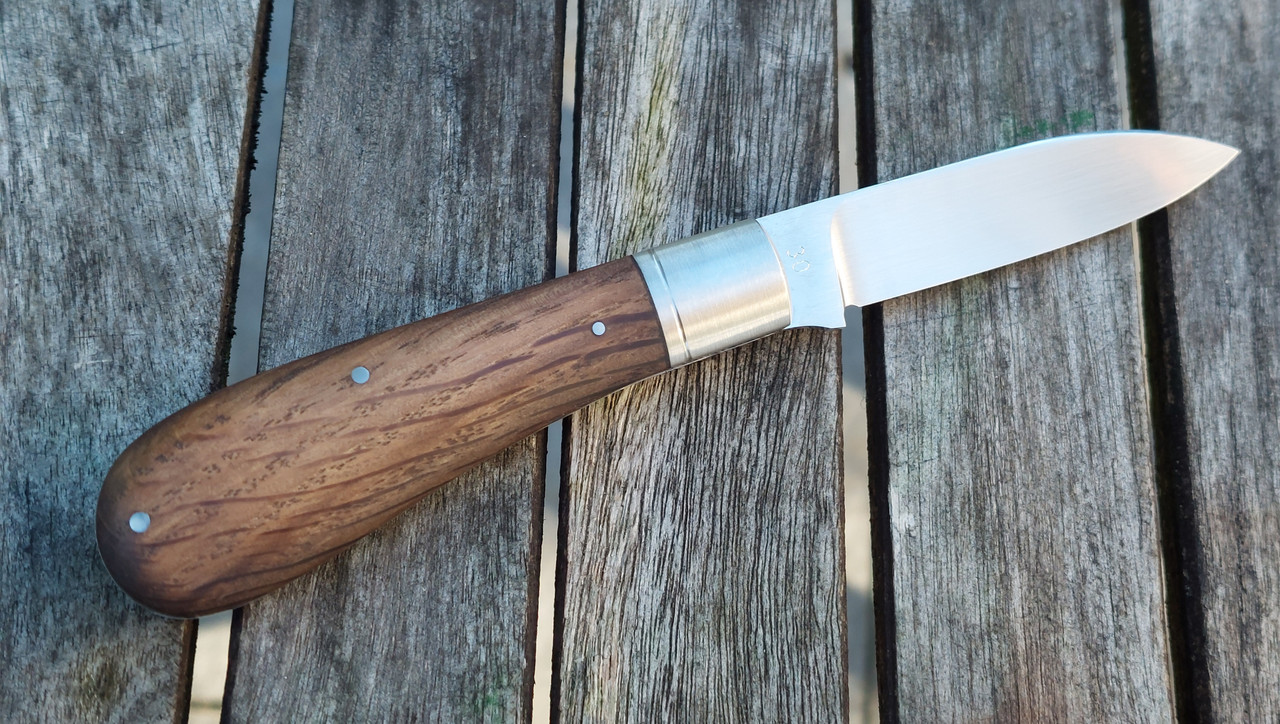
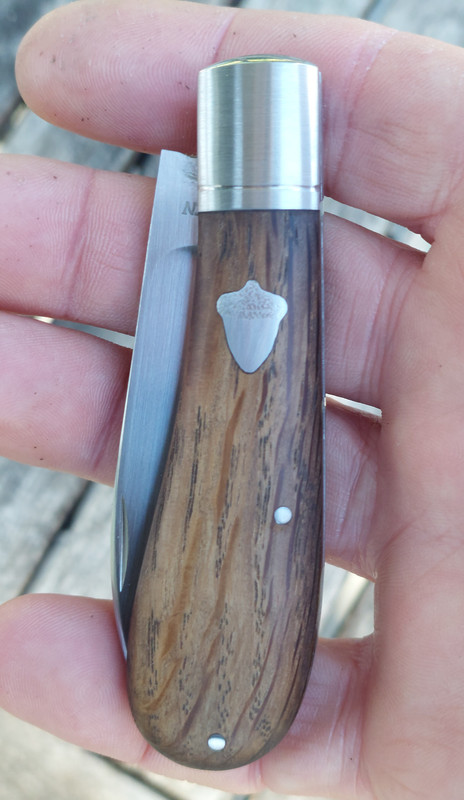
I finished this oak zulu, but I'll make it again, starting all over. There's a defect in the material so I'll start again with new materials
It does look good imho. Live and learn.
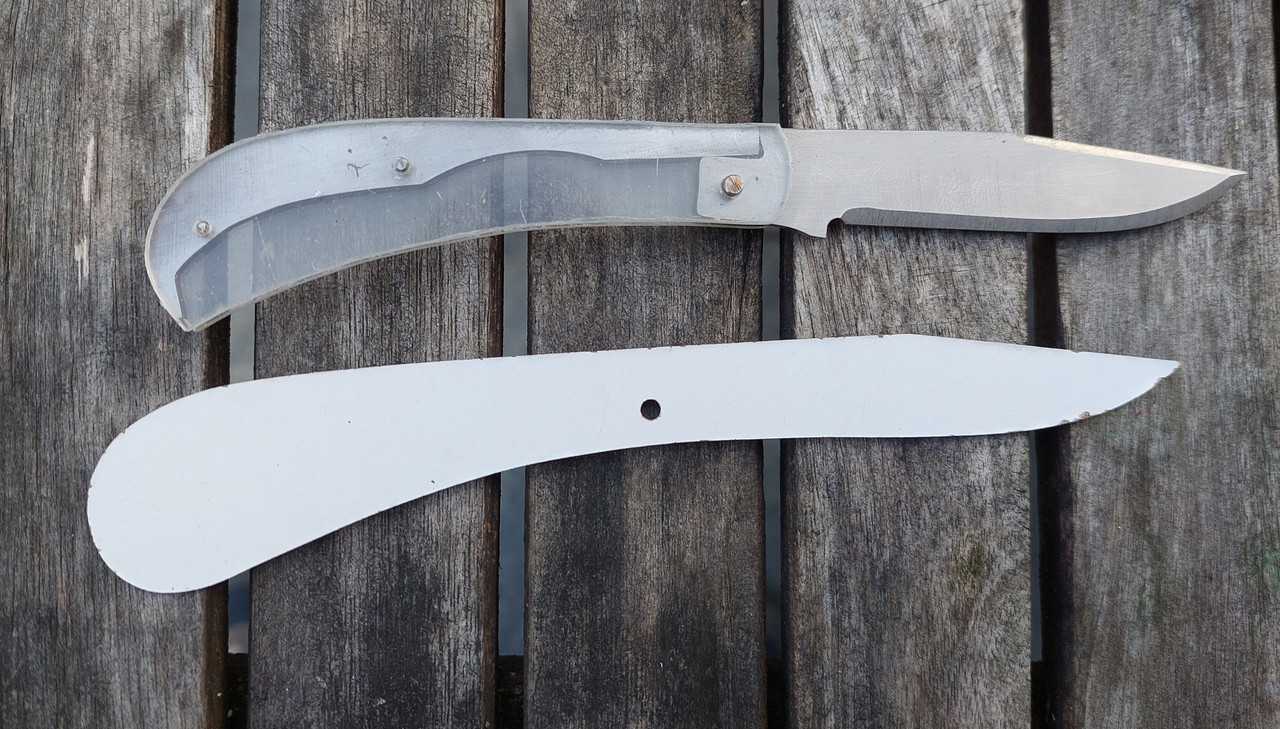
And I saved this clippoint to work on while other knives are off for HT. I first designed it like the white shape but the handle is a bit to big for the blade I think.
I'm glad that I left some extra steel on the spring. I redesigned it more like a fat penny and I think that that's the way I'll go.

20260305-090657.jpg


20260305-091003.jpg


20260306-155208.jpg
 
Finally got this ridiculously heavy beast assembled this morning and made a few test cuts. Now I can focus on making room for it. I found a very good use for the LED magnetic flashlight as it puts much needed light in the right spot. The rolling dolly base is worth every penny; I can't imagine moving this thing around without it. I cleaned all of the cosmoline type protectant from the work surface with acetone and treated it with Wicked Wax. What are you guys using to protect your cast iron work surfaces from corrosion?

IMG_8970.jpg
IMG_8971.jpg
 
What are you guys using to protect your cast iron work surfaces from corrosion?
Depending on the machine, way oil, or cutting oil, by nature of using it. Also started using silicone oils as of recently, as I got told that it was much harder to remove, compared to oils made from hydrocarbons, and whets out on blank metals by itself, or "going into nooks and crannies on its own". I can't tell from this angle (the blade I mean) if you use the saw for wood or metal, if you can't use oil (if you're cutting wood for expample), you can use anything that prevents oxygen and moisture to get to the surface, but recently I learned that anything that makes the surface alkaline prevents rusting. You can get NaOH (or sodium hydroxide) as a white powder, if you wipe a surface with it, and any moisture gets on it, it creates a highly alkaline solution through an exothermic reaction. Periodically it will have to be reapplied, as with most protective coatings.
 
Here is the fun project - a kiritsuki gyuto from a massive billet of 420/1070 san-mai. It is heavily forged to give the edge a flame pattern.
The Kiritsuki-gyuto was a project I have set aside for a while. I had a dozen of the big billets made in Brazil a while back, and have only made two blades from them so far. I put a shot of the roughed out blank from the billet. Grinding a 1/4" thick billet of 420 and 1070 core down to a thin kitchen knife takes time and careful attention to the core position to make both sides even. Think I nailed this one. This one is now ready for HT and final grinding.View attachment 3095890View attachment 3095891View attachment 3095892View attachment 3095893View attachment 3095894View attachment 3095895View attachment 3095896View attachment 3095897View attachment 3095898View attachment 3095899
Stacy- I really like the pattern on this one. The only problem is I don’t speak Japanese very well.🤣
 
Kiritsuki is a large kitchen knife with a back-angled tip. Gyuto means it has a western double bevel. San-mai means the blade is made from three layers of steel.
The pattern is caused by the way the billet is forged. I just finished the blade and wil mount the handle today or tomorrow. I'll post photos of several more knives then.
 
Last edited:
Depending on the machine, way oil, or cutting oil, by nature of using it. Also started using silicone oils as of recently, as I got told that it was much harder to remove, compared to oils made from hydrocarbons, and whets out on blank metals by itself, or "going into nooks and crannies on its own". I can't tell from this angle (the blade I mean) if you use the saw for wood or metal, if you can't use oil (if you're cutting wood for expample), you can use anything that prevents oxygen and moisture to get to the surface, but recently I learned that anything that makes the surface alkaline prevents rusting. You can get NaOH (or sodium hydroxide) as a white powder, if you wipe a surface with it, and any moisture gets on it, it creates a highly alkaline solution through an exothermic reaction. Periodically it will have to be reapplied, as with most protective coatings.
Don’t use silicone oils on any equipment that will be used to process wood. It contaminates the wood and makes it difficult or impossible to get a good stain.
 
Don’t use silicone oils on any equipment that will be used to process wood. It contaminates the wood and makes it difficult or impossible to get a good stain.
Yes, just as SharpBits said, though, I'd usually go a little further and don't use any kind of oil with abrasive- or cutting machinery while working with wood. As he said, not only will it make finishing harder, up to impossible, depending how much more wood gets removed after the fact, it will also clog up the works really quickly.
 
Kiritsuki is a large kitchen knife with a back-angled tip. Gyuto means it has a western double bevel. San-mai means the blade is made from three layers of steel.
The pattern is caused by the way the billet is forged. I just finished the blade and wil mount the handle today or tomorrow. I'll post photos of several more knives then.
So what will that beefy looking blade be used for in the kitchen? Slicing hams? Etc
 
Last edited by a moderator:
Your question made me realize I used the wrong name for the knife.

Kiritsuki refers to the K-tip. The word translates as "To Slit/Cut Open". K-tip is also called reverse-tanto. The knife is pronounced Key-Ree Sue-Key.
It is a large multi-task blade. They are used to chop vegetables as well as slice meats and fish. Size and blade geometry vary. That is the same function as my knife, so I called it kiritsuki without thinking.
I started out to make it with a standard K-tip, but decided that it would work better and safer as a chopper with more forward grip area for using two hands. I will also break down and chop BBQ with it. The edge is very thin, but the spine is thick.

Mine has a tanto style or "reverse K-tip", so it is not a kiritsuki. I will called it a Gyuto-Honekiri. The honekiri knife is used for slicing pike fish, but I wanted an all-around large double-bevel chopper-slicer.
There is a name for the tip shape, but I forget what it is called. Hopefully, one of the Japanese knife guys will have a better name for this knife.
 
Working on these four during my spare time away from my regular knives so I can keep up with what I need to have ready by April when I start running my route.
I really want to get these done as soon as I can, but my regular knife production would suffer if I put more than an hour into these every day. Trying to practice patience here!
IMG_8839.jpeg
That reminds me of a sticker I saw years ago of two buzzards sitting on a limb, one buzzard was telling the other “patience brother, patience!”
The other buzzard replied, “patience hell I’m gonna kill something”.
 
Back
Top