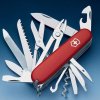
Why carry a multi-bladed knife

Here is an interesting thought:

If a knife company was challenged to create a modern knife with multiple blades, what would it look like in the end and how would it function compared to a traditional slipjoint style knife?

It definitely would be a challenge that no company (to my knowledge) has met.
 
Here is an interesting thought:

If a knife company was challenged to create a modern knife with multiple blades, what would it look like in the end and how would it function compared to a traditional slipjoint style knife?

It definitely would be a challenge that no company (to my knowledge) has met.

A Leatherman Wave without the pliers comes to mind.
 
Here is an interesting thought:

If a knife company was challenged to create a modern knife with multiple blades, what would it look like in the end and how would it function compared to a traditional slipjoint style knife?

It definitely would be a challenge that no company (to my knowledge) has met.

swissarmy.jpg ;)
 
Many would consider that a traditional slip joint, no?

Not this one:

victorinox-soldier-knife.jpg
 
Here is an interesting thought:

If a knife company was challenged to create a modern knife with multiple blades, what would it look like in the end and how would it function compared to a traditional slipjoint style knife?

It definitely would be a challenge that no company (to my knowledge) has met.

Spyderco Dyad, Byrd Wings, Buck Crosslock, Buck X-tract, Leatherman Crater, Toologic series, CRKT Zilla, CRKT Guppy, CRKT Cicada, Kershaw Twocan, and I don't know how many more
 
Luckily, we don't need to choose between traditional slipjoints and modern locking knives. I find a use for both types and enjoy them a lot. Like Hardheart has already pointed out, blanket statements about either kind of knife are bound to be quite inaccurate.

There are just too many "traditional" and "tactical" knife variants to consider. Some are awesome, some are awful.
 
I use and carry both, usually some sort of Spyderco - Caly 3, Calypso Jr., etc., and a SAK Climber. I really don't consider those particular Spydercos "tactical", but if others do, that's fine.

I use the Caly much more often, usually because it's much easier to get to (especially when sitting in my office), and it's quite thin as well, so it cuts well. The SAK is truly indispensable for me, I find it is a necessary carry. Stockmans are my favorite patterns, but whenever I carry one, I end up needing a SAK, so they generally don't get much pocket time, which is a pity.

Carry whatever you like, simply because you like it. You don't need anyone's permission, and you don't have to "switch groups". Contrary to many claims of superiority, it's quite acceptable to like BOTH. I refuse to choose.
 
From someone who carries and uses both. There is a lot of misinformation in this thread if not outright mistakes.

I am glad we have the choices we have for the applications we encounter and those differ from person to person.

I had no idea that that all my slipjoints in 52100, BG 42, ATS-34, CPM 154, 154CM, D2, 3v were made from inferior steels. :)

After 50 year I had no idea that the thinner edges I put on my slip joints as opposed to my tacticals are an illusion at 15 to 20 degrees per side. :)

No did I know that owning locking tactical folders made me a mall ninja. I have never heard of a custom worth their salt maker alluding to great stiff back springs. The vast majority go for stiffness in the mid range of a scale of 1-10 say 5 to 7. When I encounter an overly stiff backspring for the pattern the first thought is that the maker needs more experience in making the knife.

Like I was saying a lot of confusion and misinformation in this thread.
 
Last edited:
...
I had no idea that that all my slipjoints in 52100, BG 42, ATS-34, CPM 154, 154CM, D2, 3v were made from inferior steels. :) ...
The OP was specific about Case knives, which use 420, 1095 and ATS-34. So, nobody included alloys in your list as "inferior", simply because Case knives don't use them, please don't add to misinformation in the thread... And as I stand corrected, there are no inferior alloys out there, thee are only superior and better than 420/1095 etc...

I have never heard of a custom worth their salt maker alluding to great stiff back springs. The vast majority go for stiffness in the mid range of a scale of 1-10 say 5 to 7. When I encounter an overly stiff backspring for the pattern the first thought is that the maker needs more experience in making the knife.
I see there are a lot of posts in this thread form which knife makers can learn how to make better knives... Ditch locks, loosen up springs, and so on.

Like I was saying a lot of confusion and misinformation in this thread.
Indeed.
 
I am sorry, I have Case slipjoint knives in ATS-34 and 154-cm.
(Like I was saying there is a lot in misinformation in this thread indeed.) :)

The OP was specific about Case knives,

No.

"Like a case stockman" is what the OP posted. There are a lot of people who make stockmans. "Like a Case stockman" is not specific to case it is a reference to a pattern that mentions Case.
Like I was saying there is a lot in misinformation in this thread indeed. As well as twisting of facts. :).

I will deal in facts based on knowledge that is accurate rather than draw facts from opinions that are not accurate.
 
Last edited:
My apologies for restating the obvious that a thin blade outcuts a thick blade.


To you. Not to me.


If people use seatbelts as an excuse to drive unsafely.

The most effective car safety device ever invented was a sharp steel spike set into the windshield 3" directly in front of the forehead.
It was rejected for "other reasons".
 
I am sorry, I have Case slipjoint knives in ATS-34 and 154-cm.
(Like I was saying there is a lot in misinformation in this thread indeed.) :)
I am not sure where you are going with this, you make it sound as if someone denied or tried to hide the fact that Case used ATS-34, when in fact I said if multiple times, including the post to which you are replying.

...as per Case website, they use 420 stainless, 1095CV and ATS-34...

...Case knives, which use 420, 1095 and ATS-34.
 
I carry both and can honestly say whichever peanut, toothpick, or pen knife I'm carrying is the workhorse. I find a few uses for a tactical or fixed.
 
My first folder was a two bladed penknife. My second was a Victorinox Spartan and I never looked back. To me the Swiss Army Knife was the modern slip joint because it had two huge advancements. One was stainless steel blades. The other was the "other tools." I could never give up having screwdriver, awl, and bottle/can openers always ready to hand. Much later I discovered one handed locking folders and now I don't want to give those up, either.

I never used the stockman pattern but see the benefit of multiple sizes/styles of blade in one compact tool.
 
Not going anywhere with it just correcting some misinformation such as
From what I know, as usual it's plain carbon steel, 10xx series, and pretty soft at that, 54-55HRC... Compared to modern alloys used in modern folders that IS inferior.

As well as other mis-informed information regarding spring strength that is incorrect indeed such as "one of the highlights form makers was the strength of the spring.".

Also Case uses 154CM at times.

So all I am doing is adding facts rather than guessing or making sweeping statements and having to correct them.

I also have a tough time understanding how carbon steels can be so inferior as knife blades when in the vast majority of cases it is a carbon blade that wins cutting competitions?

Just dealing in facts rather than supposition.
 
Last edited:
There shouldn't be a steel discussion anyway, as both slipjoints and locking folders use all options. But the OP was under the impression that slippies often have 'inferior' steel, and it was followed by specific suggestions for Case CV, GECs and Schrades, which came in 1095. Also, being easy to sharpen was mentioned several times as a benefit, which very few are going to associate with something like the S60V in a Bose or BG-42 in a Britton. But if anyone has to have a patina and pegs touching up an edge on the bottom of a coffee mug as a critical requirement, then they can tell makers like Tomes, Alsdorf, Easler, or dozens of others that they're doing it wrong.

There are slipjoints in super steels with carbon fiber, titanium, and more. There are locking folders with low alloy steels that will rust, including 1095. There are slipjoints with pocket clips and one hand opening. There are locking blades with a nail nick and a sheath. This polarization of us vs them by some posts is empty and baseless.

I have a Ray Kirk folder, hand forged 52100 blade, slipjoint, wood scales. The liners are titanium, the scales attached by torx screws and stabilized, so has a lot of 'plastic' in the mix. I have an Enzo folder, natural birch scales, no lock, nail nick to open. Blade is S30V and I removed the shiny deep carry pocket clip. Al Mar SERE 3003A. Nail nick, stainless bolsters, brass liners, sheath carry. Locks, blade is a Japanese stainless, it's pretty damn large and 'tactical'.

I think M4 wins most of the cutting competitions, unless things have changed the last couple years. That's a very alloyed steel with a 12% carbide volume. Not really closer to carbon steel than S30V.

 
Last edited:
Thank you HH. You more than clarified the whole story with that post. A well made knife is a well made knife no matter the style or configuration. A well made knife with a properly ground and heat-treated blade is a good thing no matter what the materials are.
 
Back
Top