
-
The BladeForums.com 2024 Traditional Knife is available! Price is $250 ea (shipped within CONUS).
Order here: https://www.bladeforums.com/help/2024-traditional/
You are using an out of date browser. It may not display this or other websites correctly.
You should upgrade or use an alternative browser.
You should upgrade or use an alternative browser.
Why carry a multi-bladed knife
- Thread starter rocker786
- Start date


- Joined
- Sep 30, 2007
- Messages
- 20,235
Come on....obviously, the more blades you have in your knife, the more opportunities there are to cut yourself. Everybody knows that.
Fixed that for you.


- Joined
- Apr 10, 2000
- Messages
- 3,794
That's pretty hard actually. I've been researching for a while before ordering my first custom slipjoint. Even for expensive knives choice is pretty limited, ATS-34/154Cm, 1095, etc. I managed to get W2 at 64HRC from Chuck Gedratis and so far I am quite happy with it. Easy to sharpen, even with ~10 deg. per side edge I don't have problems with chipping for small edc cutting. W2 is not much of a "super steel", but for a small knife, at high hardness it works very well....I'd personally love to see a slip joint made from today's "super steels."

- Joined
- Jan 27, 2007
- Messages
- 6,518
I've kind of stayed away from all this, mainly because I settled this issue for myself years ago, and this thread seems to have degenerated into yet another debate on steels, when the OP was wondering why he should get a Stockman.
To answer the OP's question: well, every man needs a traditional pocket knife. Get a nice one, carry it for a week or two, and you'll know why they're so useful & alluring. One reason: you can't peel an apple very well with a * (enter any large tactical model here) *. I know this because I've tried. You can with most traditional knives though. Sitting on a porch, peeling & sharing an apple with a child, is one of the simple pleasures in life.
As far as, "why get a Stockman pattern?" Here's my reasons. I have specific uses for each type of blade on a Stockman pattern; that makes it easy to justify having the extra blades. I personally like the feel of the serpentine handle shape. (But there are an infinite number of handle shapes out there. You should get a couple of different patterns and check it out for yourself.) The Stockman has an interesting history tied to it, a history that is rooted in the American West. I have a bit of a family history with the pattern - my grandfather worked for the North Carolina Dept. of Agriculture, and he carried a Stockman at times. (And trained folks to use the spay blade for what it...uh...was designed for.) The Stockman is a common enough pattern that every manufacturer of traditional knives makes them, with some variations. There are threads by custom makers in the Traditional sub-forum that show work-in-progress on how multi-bladed knives go together - it takes a lot of talent and patience to get it right. Lastly, in PC situations, non-knife folk won't usually get upset when they see a traditional-looking knife.
And as for some of the other issues:
I don't need a lock. My hardest working knife is a Case #6265SAB two-blade Hunter. Not once in 27 years have I put it down and grabbed another knife because I wasn't sure it was safe for the job at hand without a lock. (My other hard users are U.S. Schrade lockbacks, but that's because they're my sentimental favorites too, not just for the locks.) I own and use a lot of other more modern locking knives, but the old Traditionals still get the job done just as well.
It seems to me that every American manufacturer did a pretty good job of heat-treating their carbon steels for blade use. I haven't had an American-made traditional pattern yet that couldn't take a good edge - a few people here may have different experiences - but I've had many other more modern knives that were terrible in sharpening & edge endurance. I free-hand sharpen my slipjoints, and I can get a better edge, faster, on carbon steel than I can on stainless, but that's just me. In my honest opinion, the very best steel I've seen that consistently takes and holds an edge is the steel in three of my old Imperial shell-handled knives - some of the best steel, in some of the least expensive knives produced in this country. Go figure.
Every time I go to a thrift store here, or a flea market or a garage sale, I find old traditionals that have seen better days. No matter how far down the blades are worn, they all still cut, whether stainless or carbon steel.
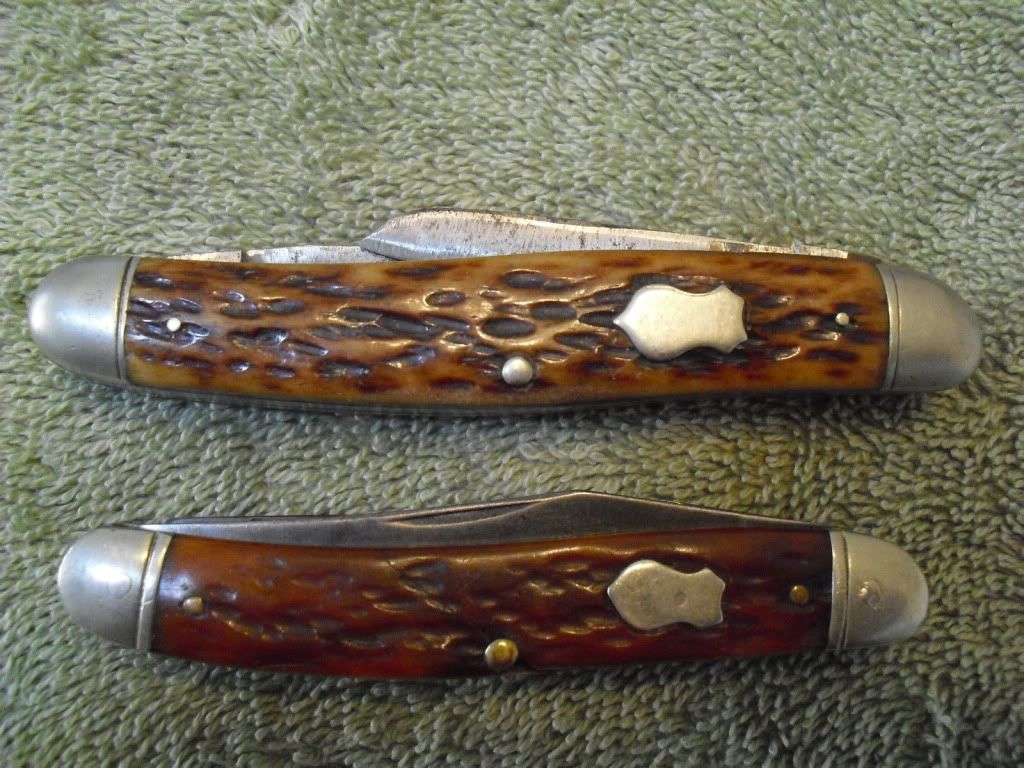
Obviously, the previous owners of these old Stockmans didn't have any qualms about the steel in them. The one good blade (spay) on the Remington [top] will still shave hair off my arm and slice paper with no resistance, and it was that way when I bought it. The main blade on the Primble [bottom] is almost as sharp, and it'll peel an apple like a razor. I haven't put either of them to a stone.
So, that's my long-winded, put-you-to-sleep opinion. I'll get off my soap box now.
Yup. A.G. Russell has a few nice ones that utilize different steels for the blades; I occasionally see other manufacturers' models as well with newer steels. And of course, there's always customs. I drool over the photos in some of the threads in the Traditional forum here.
Anyway, to each his own. That's the nice thing about knives: get it, try it, and trade/sell it if it isn't working for you.
~Chris
To answer the OP's question: well, every man needs a traditional pocket knife. Get a nice one, carry it for a week or two, and you'll know why they're so useful & alluring. One reason: you can't peel an apple very well with a * (enter any large tactical model here) *. I know this because I've tried. You can with most traditional knives though. Sitting on a porch, peeling & sharing an apple with a child, is one of the simple pleasures in life.
As far as, "why get a Stockman pattern?" Here's my reasons. I have specific uses for each type of blade on a Stockman pattern; that makes it easy to justify having the extra blades. I personally like the feel of the serpentine handle shape. (But there are an infinite number of handle shapes out there. You should get a couple of different patterns and check it out for yourself.) The Stockman has an interesting history tied to it, a history that is rooted in the American West. I have a bit of a family history with the pattern - my grandfather worked for the North Carolina Dept. of Agriculture, and he carried a Stockman at times. (And trained folks to use the spay blade for what it...uh...was designed for.) The Stockman is a common enough pattern that every manufacturer of traditional knives makes them, with some variations. There are threads by custom makers in the Traditional sub-forum that show work-in-progress on how multi-bladed knives go together - it takes a lot of talent and patience to get it right. Lastly, in PC situations, non-knife folk won't usually get upset when they see a traditional-looking knife.
And as for some of the other issues:
I don't need a lock. My hardest working knife is a Case #6265SAB two-blade Hunter. Not once in 27 years have I put it down and grabbed another knife because I wasn't sure it was safe for the job at hand without a lock. (My other hard users are U.S. Schrade lockbacks, but that's because they're my sentimental favorites too, not just for the locks.) I own and use a lot of other more modern locking knives, but the old Traditionals still get the job done just as well.
It seems to me that every American manufacturer did a pretty good job of heat-treating their carbon steels for blade use. I haven't had an American-made traditional pattern yet that couldn't take a good edge - a few people here may have different experiences - but I've had many other more modern knives that were terrible in sharpening & edge endurance. I free-hand sharpen my slipjoints, and I can get a better edge, faster, on carbon steel than I can on stainless, but that's just me. In my honest opinion, the very best steel I've seen that consistently takes and holds an edge is the steel in three of my old Imperial shell-handled knives - some of the best steel, in some of the least expensive knives produced in this country. Go figure.
Every time I go to a thrift store here, or a flea market or a garage sale, I find old traditionals that have seen better days. No matter how far down the blades are worn, they all still cut, whether stainless or carbon steel.
Obviously, the previous owners of these old Stockmans didn't have any qualms about the steel in them. The one good blade (spay) on the Remington [top] will still shave hair off my arm and slice paper with no resistance, and it was that way when I bought it. The main blade on the Primble [bottom] is almost as sharp, and it'll peel an apple like a razor. I haven't put either of them to a stone.
So, that's my long-winded, put-you-to-sleep opinion. I'll get off my soap box now.
You know, if we dialed down the testosterone level a few notches here, this could be an interesting thread. I'd personally love to see a slip joint made from today's "super steels." How 'bout we discuss that for a while instead of each other?
Yup. A.G. Russell has a few nice ones that utilize different steels for the blades; I occasionally see other manufacturers' models as well with newer steels. And of course, there's always customs. I drool over the photos in some of the threads in the Traditional forum here.
Anyway, to each his own. That's the nice thing about knives: get it, try it, and trade/sell it if it isn't working for you.
~Chris


- Joined
- Feb 27, 2001
- Messages
- 26,713
Well stated Chris.
I have not been addressing an individual here. Just a few inaccuracies that have been posted.
There are plenty of slip joints available with steels other than 1095. As far as ats-34 being exactly the same as CM154. My experience is different that is just my experience not necessarily a fact.
That is based on hundreds of knives that I own and use. Some from the same makers who treat CM154 differently than ATS34. Fact is the two steels come about by a different process.
Fact is the vast majority of cutting competitions have been won with carbon steel blades. (Forged without a doubt some damascus).
I do not know the the type of steel that was forged. It does not change the above fact. Just because I do not know the steel that was forged to win the competitions does not change the fact that carbon steels have vastly won first place in most cutting competitions. Just a fact that has been glossed over.
The statement is accurate. The term Carbon steel is sweeping yes. But the statement is 100% true. Other sweeping statements have been made by others which are not true at all. There is a difference there that is not very subtle.
So tell me where have I been inaccurate.
I am not talking about slipjoints made 100+ years ago. (Although I do use can carry one that is 100 years old and it still preforms quite well, not as well as a modern knife, but well. It sharpens easily to an edge I have not been able to obtain with thicker bladed knives although the edge does not last as long. It was made by Electric which went out of business in 1913. The steel 1095 on it does not hold an edge as long as the CV or stainless that case uses today and I think the comparison equating the current stainless and CV steel that Case uses today to 1095 used and treated 100 years ago is apples and oranges. The 1095 from 100 years ago is softer than what I encounter on modern 1095 slipjoints.)
I am talking about modern ones. They work and work well and offer much more versatility as well as more cutting edge than a single bladed knife of any type of the same closed length. Like I said before I own and enjoy both. They both have their place. It seems to be someone else's idea that they are outdated and inferior and that stance has been backed up with inaccuracies and mis-information. I disagree with that stance. I own more than a lot of modern and much older 1095 slipjoints and the comparison that has been made in this thread is not accurate and can not be based on real experience.
I am heading out with a Carson in my pocket along with a Rogers peanut. The peanut cuts quite well, better than the thick bladed tacts that I own. The peanut is hafted in Carbon Fiber with an ATS-34 blade. Tomorrow I might be carrying a Cook folder in S35V and a swayback jack in cases CV. The Cook is awesome holds an edge longer that the swayback locks up like a vault. The swayback cuts better and has an excellent action as well as fit and finish. I am in equally no danger from either of those knives folding up on my fingers. It is just not going to happen.
Take a pen blade from a decent slipjoint. Sharpen it. Do the same with a tact. Open a thick plastic blister pack with both knives. Make up your own mind. In my experience that pen blade makes a much easier job of it with less of a chance of making a mistake with better control with less of a chance of cutting something that you do not want to cut even if it is made from "lowly 1095".. Try the experiment and let us know how things worked out for you.
As far a toughness. Stick a modern stainless steel knife in a vise and bend it 90 degrees. It is going to break or at least crack in the majority of cases. Try it with a blade in 1095 that has a differential HT. If done correctly it will bend without cracking or breaking. Which is tougher; which will take more abuse? Depends upon what you consider tough and abusive.
I have not been addressing an individual here. Just a few inaccuracies that have been posted.
There are plenty of slip joints available with steels other than 1095. As far as ats-34 being exactly the same as CM154. My experience is different that is just my experience not necessarily a fact.
That is based on hundreds of knives that I own and use. Some from the same makers who treat CM154 differently than ATS34. Fact is the two steels come about by a different process.
Fact is the vast majority of cutting competitions have been won with carbon steel blades. (Forged without a doubt some damascus).
I do not know the the type of steel that was forged. It does not change the above fact. Just because I do not know the steel that was forged to win the competitions does not change the fact that carbon steels have vastly won first place in most cutting competitions. Just a fact that has been glossed over.
The statement is accurate. The term Carbon steel is sweeping yes. But the statement is 100% true. Other sweeping statements have been made by others which are not true at all. There is a difference there that is not very subtle.
So tell me where have I been inaccurate.
I am not talking about slipjoints made 100+ years ago. (Although I do use can carry one that is 100 years old and it still preforms quite well, not as well as a modern knife, but well. It sharpens easily to an edge I have not been able to obtain with thicker bladed knives although the edge does not last as long. It was made by Electric which went out of business in 1913. The steel 1095 on it does not hold an edge as long as the CV or stainless that case uses today and I think the comparison equating the current stainless and CV steel that Case uses today to 1095 used and treated 100 years ago is apples and oranges. The 1095 from 100 years ago is softer than what I encounter on modern 1095 slipjoints.)
I am talking about modern ones. They work and work well and offer much more versatility as well as more cutting edge than a single bladed knife of any type of the same closed length. Like I said before I own and enjoy both. They both have their place. It seems to be someone else's idea that they are outdated and inferior and that stance has been backed up with inaccuracies and mis-information. I disagree with that stance. I own more than a lot of modern and much older 1095 slipjoints and the comparison that has been made in this thread is not accurate and can not be based on real experience.
I am heading out with a Carson in my pocket along with a Rogers peanut. The peanut cuts quite well, better than the thick bladed tacts that I own. The peanut is hafted in Carbon Fiber with an ATS-34 blade. Tomorrow I might be carrying a Cook folder in S35V and a swayback jack in cases CV. The Cook is awesome holds an edge longer that the swayback locks up like a vault. The swayback cuts better and has an excellent action as well as fit and finish. I am in equally no danger from either of those knives folding up on my fingers. It is just not going to happen.
Take a pen blade from a decent slipjoint. Sharpen it. Do the same with a tact. Open a thick plastic blister pack with both knives. Make up your own mind. In my experience that pen blade makes a much easier job of it with less of a chance of making a mistake with better control with less of a chance of cutting something that you do not want to cut even if it is made from "lowly 1095".
. Try the experiment and let us know how things worked out for you.As far a toughness. Stick a modern stainless steel knife in a vise and bend it 90 degrees. It is going to break or at least crack in the majority of cases. Try it with a blade in 1095 that has a differential HT. If done correctly it will bend without cracking or breaking. Which is tougher; which will take more abuse? Depends upon what you consider tough and abusive.
Last edited:

- Joined
- Sep 19, 2001
- Messages
- 8,968
They're out there, just not as common as some of us would like. Same for 'premium' steel SAKs. Every steel has its place, every knife has its role, and every user has his needs, so what is necessary or superior is going to vary in opinion, but more options is rarely a bad thing. If you want more modern alloy developments in traditional patterns, there are some sources. I mentioned some earlier, with the Boses likely the top of the heap. Mike Alsdorf made some fabulous slippies for me in damascus, but also CPM154. AG Russell had a couple patterns in BG-42. I couldn't hope to mention all the makers working with highly alloyed steels in classic patterns, but I know there are more.I'd personally love to see a slip joint made from today's "super steels." How 'bout we discuss that for a while — instead of each other?
Take the performance of thin blade stock and thin grinds, make it from steel that won't corrode on you, has much more wear resistance to keep the edge from blunting longer, add several points of hardness to keep the edge from bending, and you get more work done between sharpenings while still having that familiar and comfortable pattern in hand.

- Joined
- Jun 6, 2008
- Messages
- 1,574
I'd personally love to see a slip joint made from today's "super steels." How 'bout we discuss that for a while — instead of each other?
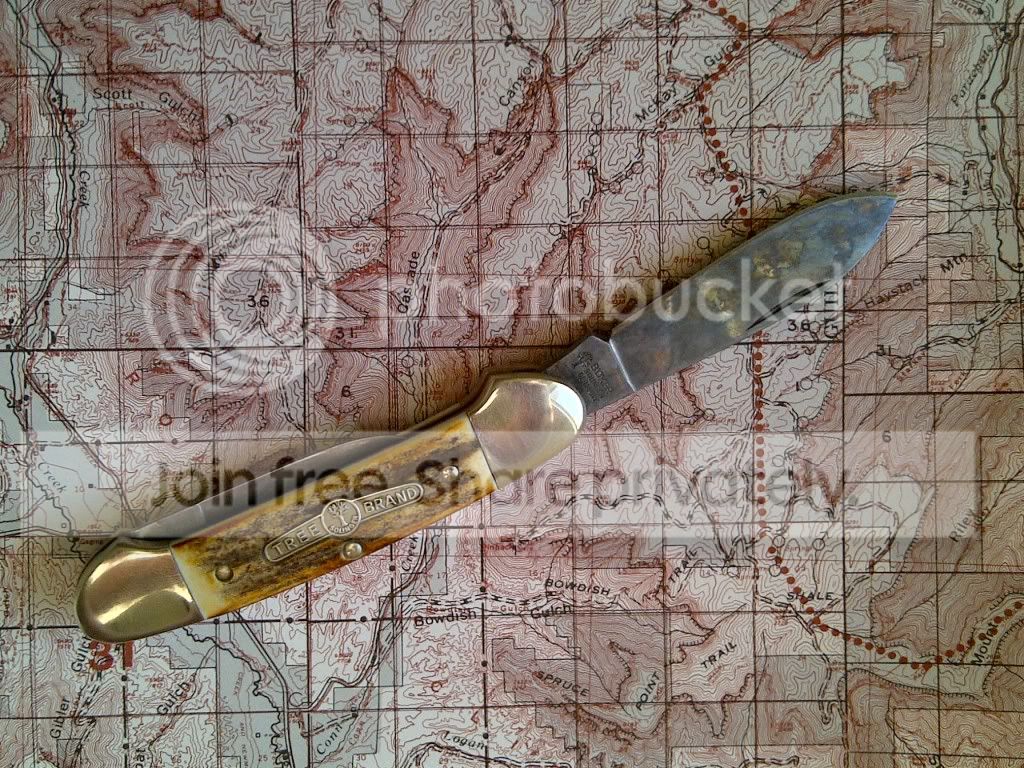
That Boker Canoe is sweet!
Here's one that I posted earlier in the thread.
I think it's a beautiful mix of modern and traditional materials.
Northwoods Knives: Gladiator Double End Jack - CPM s60v - Sambar Stag

- Joined
- Feb 27, 2001
- Messages
- 26,713
Very nice knife Brian. Looks like some premium steel with edges longer than the handle to me hafted beautifully in a premium natural material that gives a solid grip and will last for generations. What's not to like?
I carry a leather man that has lasted me years and counting. the reason I carry it and not just a knife it because the plires are the most used tool on it. It seems like I need a second because half the time I don't have one on me because it's being used!
- Joined
- Apr 10, 2000
- Messages
- 3,794
I asked you 10 times whow do you define carbon steel, but you refuse to answer, so I'll try for you. If you define carbon steel as any non stainless steel, then the statement is true, however, in that case, your definition includes many modern superalloys, which traditionalists refuse to acknowledge as worthy of any attention. Well, that's a matter of taste...Fact is the vast majority of cutting competitions have been won with carbon steel blades. (Forged without a doubt some damascus).
However, if you go by AISI definition ( Steel is considered to be carbon steel when no minimum content is specified or required for chromium, cobalt, molybdenum, nickel, niobium, titanium, tungsten, vanadium or zirconium...) then in that case 10xx is the only carbon steel that fits the criteria. M4, M2 and other alloys used in knives are out.
Sigh, it's hard to argue when your'e debating something that I have never said and then bring arguments in support of that. From this paragraph you clearly define carbon steel as any non stainless.It does not change the above fact. Just because I do not know the steel that was forged to win the competitions does not change the fact that carbon steels have vastly won first place in most cutting competitions. Just a fact that has been glossed over.
The statement is accurate. The term Carbon steel is sweeping yes. But the statement is 100% true. Other sweeping statements have been made by others which are not true at all. There is a difference there that is not very subtle.
However, when you started:
(post 78):
It is pretty clear what were you referring to in this context when speaking of "carbon steels" - 10xx which I said were inadequate compared to modern.Not going anywhere with it just correcting some misinformation such as
...GATOR97 said:From what I know, as usual it's plain carbon steel, 10xx series, and pretty soft at that, 54-55HRC... Compared to modern alloys used in modern folders that IS inferior.
I also have a tough time understanding how carbon steels can be so inferior as knife blades when in the vast majority of cases it is a carbon blade that wins cutting competitions?
Either you were referring to 10xx and then competition winning statement is inaccurate, or you lumped all non stainless steels into Carbon steel group, and then it was inaccurate and irrelevant, because I never said anything about carbon steels in that sense. It is inaccurate, in that you make it look like I was putting all carbon steels as inferior...
And since we are on the subject of cutting competition, from what I see on the bladesports, those blades are 8-10" or even bigger, and competition includes a lot of chopping and other tasks which simply can not be done by small knives like slipjoints, or tactical folders for that matter.
On the other hand, slipjoint or any small knife can benefit from very hard, alloyed steels, providing very long lasting edge, but would fail miserably in the same cutting competition... E.g. ZDP-189, CPM-S110V, K390 and many others.
Compositions are nearly identical. Your experience is apparently caused by different HT of different knives, plus geometry, etc... No reason to claim steels are different and accuse me of deliberate misinformation by omitting 154CM from Case's list. In fact, it is very likely that Case lake many US manufacturers switched from ATS-34 to 154CM...As far as ats-34 being exactly the same as CM154. My experience is different that is just my experience not necessarily a fact.
Your accusation was pretty well defined - I was misleading readers by omitting 154CM. The fact that "some" makers HT them differently doesn't mean that Case HTs them differently, unless you have that information, and definitely doesn't mean the two alloys are different. They behave differently based on HT, but the same is true for ANY alloy. 2 makers can HT 154cm from the same batch differently and they will behave differently, does that mean we have 2 different steels? Of course not, but I have to argue with you all day and defend the obvious - 2 steels with identical composition are the same thing.Some from the same makers who treat CM154 differently than ATS34. Fact is the two steels come about by a different process.
It is ironicAs far a toughness. Stick a modern stainless steel knife in a vise and bend it 90 degrees. It is going to break or at least crack in the majority of cases. Try it with a blade in 1095 that has a differential HT.
 After all the lecturing and comments I got from from traditionalist slipjointer crowd about locks being necessary only for inexperienced and/or abusive people, using locks as an excuse for improper techniques, etc, we came down to bending tests?! And I presume bend tests on slipjoints Anyhow, despite my preference for locks, I definitely avoid bending my folders and I have no interest in that exercise. Cutting performance and edge holding are more important.
This is the killer test for me. Every knife I buy, no matter how inapropriate, is pitted against an apple.To answer the OP's question: well, every man needs a traditional pocket knife. Get a nice one, carry it for a week or two, and you'll know why they're so useful & alluring. One reason: you can't peel an apple very well with a * (enter any large tactical model here) *. I know this because I've tried. You can with most traditional knives though. Sitting on a porch, peeling & sharing an apple with a child, is one of the simple pleasures in life.
I pay a lot of attention to steel before buying, but this test has nothing to do with steel: it's all about design. Any kind of steel can peel an apple without dulling. The way the knife peels an apple tells me a lot about a new knife.
To give my answer to the OP, these traditional knives are often POCKET KNIVES. They sit in a pocket wonderfully, especially one with rounded bolsters. Pocket clips & rough scales won't where your pants out fast.
I won't recommend a stockman for you, because I prefer 2 blader's, like copper heads, jack knives, & trappers.
You need at least a 2.5 inch blade to do a great job on an apple.
Last edited:
- Joined
- Jan 27, 2007
- Messages
- 6,518
This is the killer test for me. Every knife I buy, no matter how inapropriate, is pitted against an apple.
I pay a lot of attention to steel before buying, but this test has nothing to do with steel: it's all about design. Any kind of steel can peel an apple without dulling. The way the knife peels an apple tells me a lot about a new knife.
To give my answer to the OP, these traditional knives are often POCKET KNIVES. They sit in a pocket wonderfully, especially one with rounded bolsters. Pocket clips & rough scales won't where your pants out fast.
I won't recommend a stockman for you, because I prefer 2 blader's, like copper heads, jack knives, & trappers.
You need at least a 2.5 inch blade to do a great job on an apple.
I can't argue with that at all. My favorite two-blade traditional would be my old Kabar #1013 Barlow, and I had a Case Mini-Trapper that pushed the Stockman out of my pocket for a short time. A VERY short time.
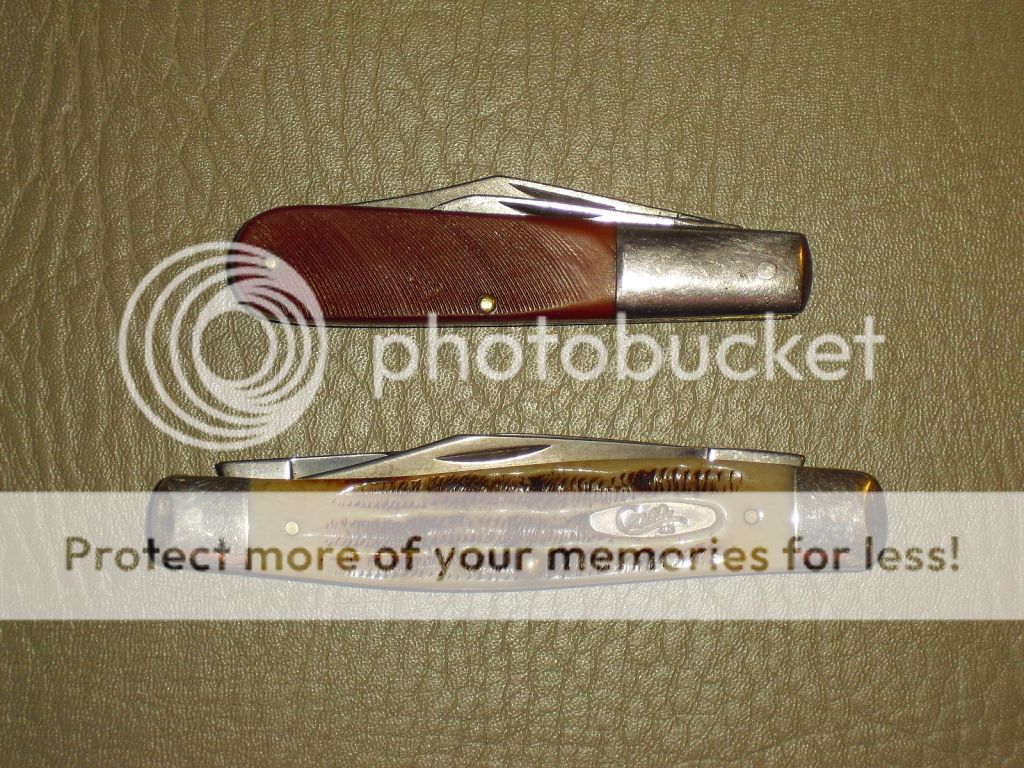
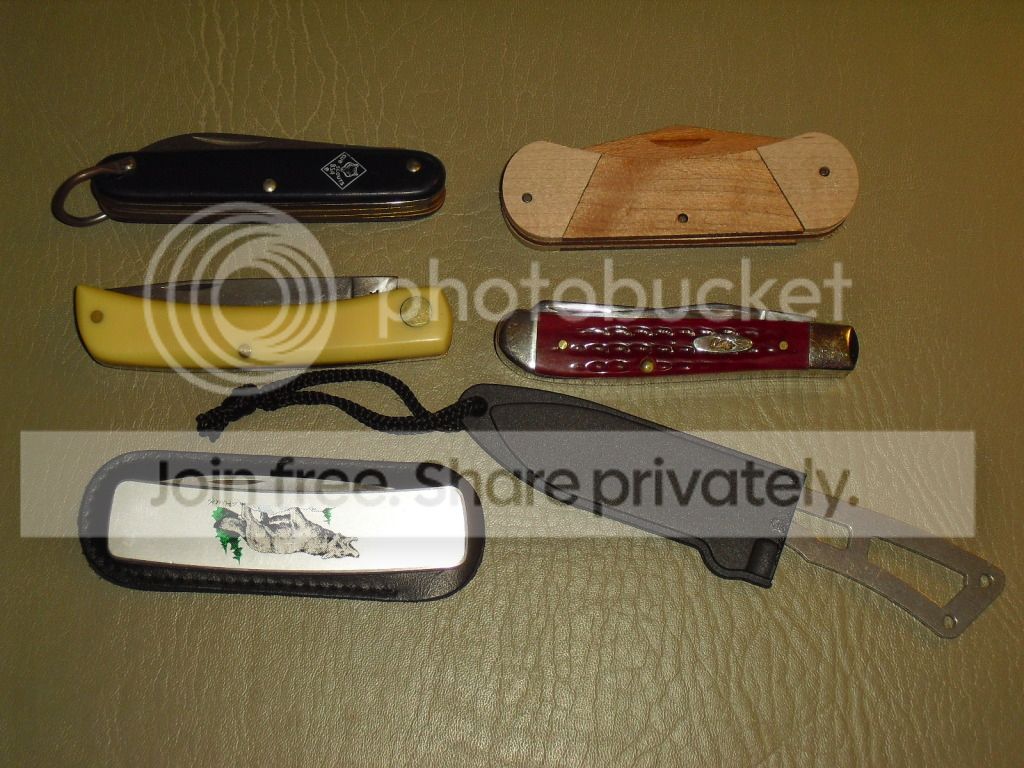
For the benefit of the OP, the pic below is my son's little knife collection; a few other patterns to maybe consider. Tempting though it may be, I won't necessarily steer him toward the Stockman pattern, or any pattern for that matter, since he is allowed to use any of my knives when needed. He prefers the small, slim, Swedish EKA slipjoint on the lower left, and uses it very effectively. I also just got a Case Mini-Trapper in pocket worn red jigged bone for him, made the year he was born (2000). In his stash drawer of his dresser, he also has a Case Sodbuster, Camillus Scout knife, a little wooden kit knife, and a Becker Remora, which almost never gets used.
He got his "Totin' Chip" in Scouts using the Camillus Scout knife on the upper left, and it doesn't lock.
~Chris
- Joined
- Feb 27, 2001
- Messages
- 26,713
Your semantics still do not affect the fact that cutting competitions are won in the vast majority of cases by forged carbon steels. If you want to know what type of carbon steel ask the winners.
Fact is there were inaccuracies posted in this thread and they were corrected. You can not change that fact.
I have not had to backtrack on anything here I posted due to inaccuracy. You have not pointed out specifically what I have posted that is inaccurate for some reason you have been dealing with semantics. Good luck with that.
It should not be hard for folks to see who has been posting inaccuracies and who has had to backtrack on some of their statements. BTW. Please do not do something as dumb as placing a folder in a vice. Use a fixed blade. (I was talking about the steel in that statement, I am very sorry you extrapolated thinking I meant to put a folder in a vice I never expected anyone to come to that silly conclusion although it seems you have. Since that would be a dumb move much like putting pressure on the spine of a slipjoint or twisting it.
Again I apologize for not being more specific on bending, I must remember that I sometimes am dealing with situations in which common sense takes a backseat to silliness and that someone would defend their stance by talking about bending a folder rather than dealing with the fact I was presenting. (Now there is real irony.)
I should have taken into account the pattern that has been taken over and over in this thread regarding ignoring the facts and going off on tangents in an attempts to dispute the facts and or cover up the inaccuracies that have been posted. In short I better repeat what I felt should have been obvious to a person of reason. Do not place a folder in a vice to bend test a steel type and it's HT. The would be unsafe and unwise and really would not be a decent test of actually bending the steel type and seeing the results.
My mistake in not pointing that out. I assumed a certain level of common sense and was obviously wrong.
Fact is there were inaccuracies posted in this thread and they were corrected. You can not change that fact.
I have not had to backtrack on anything here I posted due to inaccuracy. You have not pointed out specifically what I have posted that is inaccurate for some reason you have been dealing with semantics. Good luck with that.
It should not be hard for folks to see who has been posting inaccuracies and who has had to backtrack on some of their statements. BTW. Please do not do something as dumb as placing a folder in a vice. Use a fixed blade. (I was talking about the steel in that statement, I am very sorry you extrapolated thinking I meant to put a folder in a vice I never expected anyone to come to that silly conclusion although it seems you have. Since that would be a dumb move much like putting pressure on the spine of a slipjoint or twisting it.
It is ironic After all the lecturing and comments I got from from traditionalist slipjointer crowd about locks being necessary only for inexperienced and/or abusive people, using locks as an excuse for improper techniques, etc, we came down to bending tests?! And I presume bend tests on slipjoints Anyhow, despite my preference for locks, I definitely avoid bending my folders and I have no interest in that exercise. Cutting performance and edge holding are more important.
Again I apologize for not being more specific on bending, I must remember that I sometimes am dealing with situations in which common sense takes a backseat to silliness and that someone would defend their stance by talking about bending a folder rather than dealing with the fact I was presenting. (Now there is real irony.)
I should have taken into account the pattern that has been taken over and over in this thread regarding ignoring the facts and going off on tangents in an attempts to dispute the facts and or cover up the inaccuracies that have been posted. In short I better repeat what I felt should have been obvious to a person of reason. Do not place a folder in a vice to bend test a steel type and it's HT. The would be unsafe and unwise and really would not be a decent test of actually bending the steel type and seeing the results.
My mistake in not pointing that out. I assumed a certain level of common sense and was obviously wrong.
Last edited:

Modoc ED
Gold Member
- Joined
- Mar 28, 2010
- Messages
- 14,568
To the Op I'd say, I find a multi-blade knife to be more useful that a single blade knife. I still do a little ranch and farm work and that is why multi-blades come in handy - heavy cutting with the main blade, scraping with the Sheepsfoot blade, and fine cutting with the spey blade. You know, ear notching and that type of thing. If I worked only in an office, a single blade knife might well be called for.
As to steels, I like Case's CV, GEC's 1095, Buck's 420 HC, and Cases SS (Tru-Sharp). Why? Because all four of those steels can be easily sharpened free-hand on a hard or soft Arkansas stone - even the two stainless steels I listed. You don't need a diamond stone as you do with some steels. Heck, you can even sharpen those steels on various stones/rocks you find in the field or even on a brick or cinder block if you've got the right touch. None of those steels are super steels but they take an edge easily and hold the edge well.
It's a lousy feeling not being able to sharpen the blade/blades of a knife you've recently purchased and used. So start out with an easily sharpened steel and then progress to a super steel.
To the rest of you guys arguing/bantering back and forth about super steels, I can't add anything to what your're saying. Truthfully, I don't have extensive knowledge about steels and their make-up.
As to steels, I like Case's CV, GEC's 1095, Buck's 420 HC, and Cases SS (Tru-Sharp). Why? Because all four of those steels can be easily sharpened free-hand on a hard or soft Arkansas stone - even the two stainless steels I listed. You don't need a diamond stone as you do with some steels. Heck, you can even sharpen those steels on various stones/rocks you find in the field or even on a brick or cinder block if you've got the right touch. None of those steels are super steels but they take an edge easily and hold the edge well.
It's a lousy feeling not being able to sharpen the blade/blades of a knife you've recently purchased and used. So start out with an easily sharpened steel and then progress to a super steel.
To the rest of you guys arguing/bantering back and forth about super steels, I can't add anything to what your're saying. Truthfully, I don't have extensive knowledge about steels and their make-up.