Why does CPM-M4 dominate in national cutting competitions?

Why would it be hard to do tests, that is the whole point of the mule project, for end line users to compare and contrast steels using the same blade design.

We can do tests like wear resistance against ropes, and push-cutting edge retention, but how would we measure toughness and chip/dent resistance?

We would also need to measure the hardness of each blade because 1 point difference in hardness makes quite a big difference in performance. Spyderco also runs the 52100 at 62 which is much harder than how it is typically ran and therefore not representative of typical knives in that steel.
 
We can do tests like wear resistance against ropes, and push-cutting edge retention, but how would we measure toughness and chip/dent resistance?

We would also need to measure the hardness of each blade because 1 point difference in hardness makes quite a big difference in performance. Spyderco also runs the 52100 at 62 which is much harder than how it is typically ran and therefore not representative of typical knives in that steel.

Spyderco's purpose was to create a even testing platform. My understanding was that each steel was hardened for optimal cutting, not toughness or chip / dent resistance. I am pretty sure you can't chop with a ~3" blade.
 
fracture toughness is already measured for steels in impact testing, but we can check for chipping in chopping, slicing, and push cutting. I had knives suffer microchipping cutting cardboard.

You can chop with a 3" blade, just not very well. Still, for the lone idea of checking for how the edge reacts to impacts, something could be done. It would be easy enough to turn things around, chuck the knife in a vise edge up, and swing a board down on it, or drop a block on it with some additional weight on top to increase the impact force. Any number of guides could be used to match the distance dropped/force at impact and the angle.
 
You can chop with a 3" blade, just not very well. Still, for the lone idea of checking for how the edge reacts to impacts, something could be done. It would be easy enough to turn things around, chuck the knife in a vise edge up, and swing a board down on it, or drop a block on it with some additional weight on top to increase the impact force. Any number of guides could be used to match the distance dropped/force at impact and the angle.

Good idea. We need something more controlled than manual testing, like a guillotine:

http://www.bladeforums.com/forums/showthread.php?t=668486

I can attach the Mule onto the guillotine, and drop the blade into wood at high speed. I would use elastic propellers and weights for really high momentum, and examine the edge afterwards.

BTW, the Mule is actually a 3.5" inch blade, not 3" as Josh says.
 
Good idea. We need something more controlled than manual testing, like a guillotine:

http://www.bladeforums.com/forums/showthread.php?t=668486

I can attach the Mule onto the guillotine, and drop the blade into wood at high speed. I would use elastic propellers and weights for really high momentum, and examine the edge afterwards.

BTW, the Mule is actually a 3.5" inch blade, not 3" as Josh says.

I was guessing, I didn't look up the specs and I don't have one in front of me at the moment. Regardless, 3" vs. 3.5" you still can't really go chop some limbs. I find it hard to chop with a RC-6. It just wasn't designed for that.
 
You guys had cutting competitions in kindergarden? Wow, I wish I grew up in Russia too. In America they took all my knives away =(

Oh, I am sorry to hear this - I hope they will give you back your knives, sometime... I guess in US kindergarden are more strict, because I had always some pocket knives even early years in school back in USSR.

No we did not have cutting competition in kindergarden. What I meant is level of immaturity I feel like radiating from you. Sorry for your knives again...

Thanks, Vassili.
 
Oh, I am sorry to hear this - I hope they will give you back your knives, sometime... I guess in US kindergarden are more strict, because I had always some pocket knives even early years in school back in USSR.

Thank you for your sympathies. I grinded my first knife out of nickel when I was 6 years old and took it to school to show off to friends, but the knife was taken away from me. I no longer care about that knife.

What I meant is level of immaturity I feel like radiating from you. Sorry for your knives again...

Thanks, Vassili.

You implied that ZDP-189 would make a better competition knife than CPM-M4, and here you have a great opportunity to prove it by joining a cutting competition. Why are you trying to deflect attention toward me, so that you can back out of your statement gracefully? If I was an owner of a competition knife, I would join.

You said, "I will say it again, ZDP is the best production steel on the planet" did you not?
 
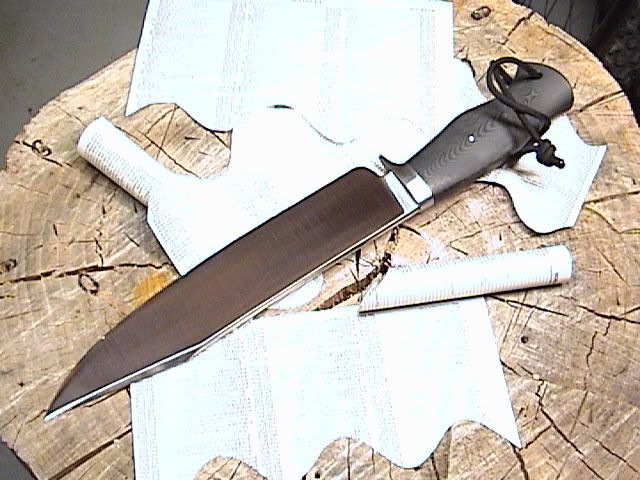
CPM-M4 has indeed been the dominate steel in cutting competitions over the last couple of years. At the 2009 World Championship at the Blade Show in Atlanta, 7 of the 9 competitors were using M4 and the winner used M4.

Veteran master knifemakers Gayle Bradley and Warren Osbourne were instrumental in developing the heat treatment to adapt M4 for blade steel. They did a LOT of testing and experimenting with many different steels. These guys have probably broken and thrown away more knives than most of us have made or owned. They do know a little about steel and making knives.

Here is a video of the cutting competition in Waxahachie Texas this month:
http://www.youtube.com/watch?v=yRNiAhrIqNo
 
CPM-M4 has indeed been the dominate steel in cutting competitions over the last couple of years. At the 2009 World Championship at the Blade Show in Atlanta, 7 of the 9 competitors were using M4 and the winner used M4.

Veteran master knifemakers Gayle Bradley and Warren Osbourne were instrumental in developing the heat treatment to adapt M4 for blade steel. They did a LOT of testing and experimenting with many different steels. These guys have probably broken and thrown away more knives than most of us have made or owned. They do know a little about steel and making knives.

Here is a video of the cutting competition in Waxahachie Texas this month:
http://www.youtube.com/watch?v=yRNiAhrIqNo

Great info! I looked up Gayle Bradley and found a picture of his competition blade:

http://www.bradleysblades.com/cutting.html
 
Why when the through hardened blade will require more force to move past the elastic range? A baseball bat made from play-doh won't shatter, but I think I would prefer one made from carbon fiber.

Have any of the competition cutters suffered any damage beyond edge chipping that leads to DQ?

Looking at the normal test of bending the blade sideways, and the blades you are comparing are otherwise identical, I agree.

The problem is that many brittle failures are caused by more than just exceeding the strength of the design/steel as a whole. They are caused by design issues (stress risers), material degradation of some sort, or material homogeneity issues. Really they are caused by the technical definition of toughness - a material's resistance to crack propogation. And while a crack in the soft spine of a differentially treated blade goes nowhere, the crack in a full hard steel full of 45 micron sized carbides goes very fast and leads to catastrophic failure.

I would suspect that a good number of competitors have been DQ'd for a rolled edge - that is an area where the harder/stronger blade would have an advantage. The stronger the steel the thinner you can make your edge. Though again, brittle catastrophic failure must be avoided at all costs.

My point is that a knifemaker needs to have complete confidence that not one of their blades ever experiences a brittle failure - I will gladly give up a little performance advantage to never experience a brittle failure.

This is a design question that many have died for throughout history - how much of your large safety factor can you give up, for increased performance, before you start experiencing catastrophic failures?

btw a carbon fiber bat would be unlikely to fail in a brittle mode - but weld an aluminum bat in half, leave the weld as-is, and you could see a brittle failure. Though if you friction stir welded it correctly, the weld would be more elastic than the rest of the bat!
 
I like mine out of forged 3V - it is one mofo chopper!

DSC05036.jpg

Broos, that's a good looking knife. Did you make that?
 
Well, did they try ZDP189?

Thanks, Vassili.

I don't know if they tried it. You would have to ask them.

Forgive me if I am a little skeptical. Every year there is a lot of hype about the latest greatest super steel, most of it usually from those who are selling it. ZDP might be the greatest thing since sliced bread. I don't know.

CPM-M4 has been around for 30 years as a tool steel but it had never been adapted for cutlery. They did a lot of experimenting and found that it was ideally suited to cutting competitions with the proper heat treatment.

Who knows, next year it might be ZDP or XYZ or whatever the flavor of the month is.

Here is champion Shawn Scott's winning knife from theis year's World Championship. It was made by Steve Singer from M4.
ScottKnife1.jpg
 
Depending on the kind of test, these steels would rank differently. Slicing would be different from push-cutting, which would be different from chopping. It would be really hard to do tests on them.


Can you explain why you think they would rank differently going from push cutting to slicing? Is there a speed of slice or degree of slice where wear resistance can trump hardness? Would wear resistance matter more when slicing than when push cutting? Why?

It would be interesting to test a CPM-440V blade versus a really hard carbon steel blade here. Unfortunately you still could not take the results of these tests and obtain any relationship between hardness versus wear resistance with slicing or push cutting, because you cannot assume that the mechanism of dulling is exactly the same for any two steels.

I have said this before, but the deeper you look at these questions, you come to the realization that the best info you will ever have for these questions will be empirical in nature, and not theoretical. As a result, you must always qualify your conclusions based on the test & the results if you want to remain in the realm of fact.

I think the issue of push cutting versus slicing was discussed briefly by the Professor's in the edge retention testing thread - I'll have to look back on that, but if I recall his opinion was the ranking would probably not change...
 
Can you explain why you think they would rank differently going from push cutting to slicing? Is there a speed of slice or degree of slice where wear resistance can trump hardness? Would wear resistance matter more when slicing than when push cutting? Why?

It would be interesting to test a CPM-440V blade versus a really hard carbon steel blade here. Unfortunately you still could not take the results of these tests and obtain any relationship between hardness versus wear resistance with slicing or push cutting, because you cannot assume that the mechanism of dulling is exactly the same for any two steels.

I have said this before, but the deeper you look at these questions, you come to the realization that the best info you will ever have for these questions will be empirical in nature, and not theoretical. As a result, you must always qualify your conclusions based on the test & the results if you want to remain in the realm of fact.

I think the issue of push cutting versus slicing was discussed briefly by the Professor's in the edge retention testing thread - I'll have to look back on that, but if I recall his opinion was the ranking would probably not change...

The rankings did indeed change based on tests published in an engineering journal. I have read the article but don't have online access to it for linking.

Basically, they gave the steels an extremely acute bevel and did push-cuts. The high carbide steel (they used 440C, I know there are much higher carbide steels available) edge didn't last, I guess the large chromium carbides just fell out because it couldn't support a thin edge. The simple carbon steels handled the push-cut tests much better.

Then they tried slicing, and here, the high-carbide steels won. Under a microscope, the hard carbides stayed in the steel matrix even as the steel matrix itself wore out. So the high-carbide edge protected the rest of the steel and continued slicing.

So my prediction, between the simple carbon steel 52100 and high carbide S90V, is that the 52100 would win the push-cut edge retention battle while the S90V wins the slicing edge-retention. The ZDP-189 is so hard that it might even be better in both types of edge retention, but if you softened it to 62 just like the 52100, my bets are on the 52100.

A parallel concept, a ceramic knife has better edge retention than ANY steel. But only for cutting soft things, once you move onto anything medium hardness, like rope, you get a lot of microchipping and pretty much any steel beats it.
 
I don't know if they tried it. You would have to ask them.

Forgive me if I am a little skeptical. Every year there is a lot of hype about the latest greatest super steel, most of it usually from those who are selling it. ZDP might be the greatest thing since sliced bread. I don't know.

CPM-M4 has been around for 30 years as a tool steel but it had never been adapted for cutlery. They did a lot of experimenting and found that it was ideally suited to cutting competitions with the proper heat treatment.

Who knows, next year it might be ZDP or XYZ or whatever the flavor of the month is.

Here is champion Shawn Scott's winning knife from theis year's World Championship. It was made by Steve Singer from M4.
ScottKnife1.jpg

I am not sure if you aware that this steel is in use from 2005 - for 4 years now. It is not really steel of the month and it show better then 52100 results on manila rope edge retention test.

This is what my point is - you work for years with some steel until realize that 30 years old CPM M4 is pretty good. I am not sure that I buy this special heat treatment story - it is all in Crucible data sheets. It may be simpe as having better furnace which can handle required temperature (Paul Bos refuse to HT CPM M4 when I asked him 2004 for this reason).

So once again if CPM M4 dominated on competition - this is good steel, but it can not mean automatically that it is better then ZDP189.

Who knows may be in 30 years it will be adopted to be dominated steel on competition?

Thanks, Vassili.
 
What was edge angle and thickness? Do you know what material was cut in each test? Wondering whether the same failure mode would occur with normal knife geometries.

I'd like to see the results. Can you expound on the your thoughts (or their conclusions) that related the results or observations of the test to the characteristics & properties of those steels (grain size, carbide size, carbide volume, HRc, compressive strength, WR)? Wondering if they blamed the failure of the high (& large?) carbide failure on a lack of toughness (how I might term the steel disintegrating/cracking/big carbides falling out), or that compressive strength of the steel simply exceeded.

The edge stability guys might suggest that the results would vary whether a machine or a human did this testing. Thin edge with or without large lateral forces encountered during the cut could be trouble for a low edge stability steel. might make a difference.

Did they develop any models in their hypothesis?

Maybe there is a scenario where the test method and baseline conditions could favor this result, particularly with the very acute edge on a steel with large carbides - ?

thanks for the good info and cool pics on m4, MC!
 
I am not sure if you aware that this steel is in use from 2005 - for 4 years now. It is not really steel of the month and it show better then 52100 results on manila rope edge retention test.

This is what my point is - you work for years with some steel until realize that 30 years old CPM M4 is pretty good. I am not sure that I buy this special heat treatment story - it is all in Crucible data sheets. It may be simpe as having better furnace which can handle required temperature (Paul Bos refuse to HT CPM M4 when I asked him 2004 for this reason).

So once again if CPM M4 dominated on competition - this is good steel, but it can not mean automatically that it is better then ZDP189.

Who knows may be in 30 years it will be adopted to be dominated steel on competition?

Thanks, Vassili.

I'm not going to get into an argument about it. I never said CPM-M4 was better than ZDP189. I honestly don't know. Based on the title of this thread and the fact that some question whether M4 did dominate the competitions I just added a little information that I know from covering some of the competitions over the last couple of years.

To be clear, there is no secret magic heat treatment with M4. It had been used for years as tool steel but the heat treatment used for that purpose was too hard and brittle for cutlery use. The people mentioned did a lot of experimentation with temperatures and techniques to find a treatment that worked well for blades. I'm sure they would tell what they learned.
 
Thin edge with or without large lateral forces encountered during the cut could be trouble for a low edge stability steel. might make a difference.

Did they develop any models in their hypothesis?
Not quite sure I get you, you don't believe lateral loads or forces will affect thin and even not so thin edges?
 
Back
Top