Why is Convex bad?

Sorry... I was trying to be polite to you by NOT posting what I found when I looked them up.

Stitchawl

Jesus — you again?! Come on man, the suspense is killing me... just show us your cards and be done with it.

STOFFI

 
Ok, I don't understand what it means when people keep saying that those who do convex just don't know how to sharpen correctly. What does this mean? I am starting to love convex, but i don't want to feel like im not doing the "real" way of sharpening. Does this mean in order to become good at sharpening, you have to do the v grinds? ive heard this more than a few times now. someone please elaborate or explain that side of it? im just trying to figure it out still. thanks
 
Often when people say that edges eventually become convex, they're referring to incorrect v-grind edge sharpening techniques. I've never heard that "those who do convex just don't know how to sharpen correctly"; but, I can understand the confusion because freehand sharpening v-grinds is often very difficult if not practiced. It is quite natural to accidentally get a bit of a convex edge in this type of freehand sharpening. A full convex grind however, is something completely different, since it involves the entire blade.
 
Someone on the 3rd page of this thread said, "Convex edges on knives have become popular because they are easy to form for people who can't seem to sharpen a "V"."
This is what i mean. Now, If the only way to really get a perfectly flat V is to use a guided system like an EP(all freehand V's are a little convex, aren't they?), then how could this be true?
 
Hey everybody, this is a bit OT (but we had the argument on grinds a bit back so...) just out of curiosity — what would you call this type of grind:

morat.jpg


It's completely flat with a 20° bevel (40° total).

stoffi - To me that would be a Scandi ground blade (though there is VERY little bevel to be seen) I just don't think any other "category" would fit. If the knife blade is thin enough and since there isn't any other bevel I would think that it would probably cut OK.

If a person couldn't grind a straight secondary bevel out of the steel (which I can't) then this might be a good way for someone to make his/her own knife out of a sturdy piece of thin steel.
 
Someone on the 3rd page of this thread said, "Convex edges on knives have become popular because they are easy to form for people who can't seem to sharpen a "V"."
This is what i mean. Now, If the only way to really get a perfectly flat V is to use a guided system like an EP(all freehand V's are a little convex, aren't they?), then how could this be true?

That was Bill DeShivs. I don't agree with that statement at all. Personally I find v-ground edges much easier to lay flat on a stone under a light than to "feel it" with a convex grind. It's all practice though, so one can't escape the necessity of übung either way.

@ Hillbillenigma: yeah, I'd say it was a scandi too. An odd scandi, but a scandi nonetheless. It was sold as a "hobby-blade" from Mora. It had a similar edge on it when I bought it new from the store, but I put a 20° bevel on it and slapped some paracord on there.
 
You will get a slightly convex edge when freehand sharpening because the bevel is too narrow to control precisely with human hands. Particularly if you reset the bevel angle, which requires significant steel removal. Still, with good control, the variance is only a couple degrees. Like what hlee was discussing, a line tangent to the curve at any point near the top of the bevel should only vary in slope from one near the cutting edge by 2 or 3 degrees.
 
At the same final edge angle, a convex edge will always have a smaller cross-sectional area. Contrary to popular belief, convex grinds are actually weaker than V-grinds in terms of resisting lateral stresses, but they are better optimized for cutting performance.
 
I said that some people can't seem to properly form a "V" edge. Many can't, so the mousepad convex is popular because it is forgiving. It offers no other benefit. The convex edge is misconstrued as state of the art. As long as your knife gets sharp, it doesn't matter. I do think that highly polished edges are popular because they look flashy on black "tactical" knives.
 
Last edited:
Convex edges are not as sharp, easy to do, for those with lesser sharpening skill, not effective..... all points of view from those that have no idea what they are talking about.

A proper convex is a complex skill don't let anyone fool you. Its taken me the past 2 years to perfect my convex skill and from comments made by many on this forum I usually just sit Back and laugh because I know with the convex edges I've sharpened or created it will shatter most of these myths.

I don't convex like you hear talked about here though, I have a method of heavy pressure that does a little something special.

No one will ever agree on the truths of convex and there will aways be someone that is a try-hard trying to disprove whatever you say about that edge type, its a never ending battle......good luck.
 
I don't convex like you hear talked about here though, I have a method of heavy pressure that does a little something special.

Please do tell! I mean, unless you feel it's your trade secret or something and don't wanna share. I'd love to be able to take my convexing skills to the next level.
 
After trying to use light pressure and not getting the performance I was looking for I messed around with many techniques and finally settled on a method I call heavy pressure convex. When you use light pressure at a low enough angle to remove the shoulder of the bevel your not leaving enough support at the edge, while the cutting performance increased the amount of deformation at the cutting edge was no different than a V edge of similar angle and often times worse. I use the same low angle of 8-12 degrees per side and use excessive pressure, this extra pressure adds a extra convex roll to the last 1mm or so of the edge and is almost like a microbevel with a final edge angle closer to 15 per side (angles will vary per knife). I do this only with the sandpapper, once I start polishing on my leather strops I go back to light pressure and slightly raise my angle so I polish just the edge. Little more to it but that's the basics behind it ;)

This method is done with a JRE EMS Sharpening block, I do not know how well it works with other backings.
 
Thanks a lot! I'll definitely screw around with this technique to try to get it to work for me. Thx!
 
Knifenut1013's "heavy pressure convex"- by his own description- effectively makes the apex angle of the convex edge much more obtuse (15 deg) than a comparable V-grind (8-12 deg). Because of this, it is no longer comparable to the 8-12 deg V-grind edge, as the apex angles are different. It is more robust, but at the cost of acuteness.
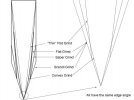
The answer to the OPs original question is that there is no "best grind" and convex grinds are not BAD- at least no more so than V-grinds or hollow grinds. Form follows function and use dictates what works well. Don't stress over it and just keep your knives sharp.
 

Attachments

  • Flat, Saber, Scandi 5.jpg
    Flat, Saber, Scandi 5.jpg
    33.2 KB · Views: 25
I don't know if there is a "best grind", but I certainly believe that certain grinds are better suited for specific tasks than others.
 
when i convex certain blades i use my contact wheel to help form the edge. this requires some pressure but it takes a certain hardness/softness backing (in combination) to get the required results. too soft and you turn the edge into a rounded cold chisel edge. i had a member bring me a game warden sharpened by someone else that was exactly that. it wouldnt cut hot butter on a 100 degree day. i had to use a lot of pressure to thin the edge down and get rid of the steep shoulder enough to give it a proper convex edge.
 
No one will ever agree on the truths of convex and there will aways be someone that is a try-hard trying to disprove whatever you say about that edge type, its a never ending battle......good luck.

Sharp enough to cut; strong enough to keep cutting - everything else is blah blah blah blah.

Bill,

Polished edges look cool on Japanese-style kitchen knives, too. Okay, very little performance is added when going finer than a 1,200 diamond and 90+% of cuisine will benefit from that minor addition of performance, but having chef knives fall through potatoes like low-budget guillotines is one of life's simple pleasures (so is watching the acids from the vegetables oxidize the formerly polished blade between uses).
 
You got me there Bill D. I just like shiny things. I can get a hair shaving edge with a file, but there is no flash to that.

Humans have 2 great obsessions: shiny things and killing things from a distance.
 
Knifenut1013's "heavy pressure convex"- by his own description- effectively makes the apex angle of the convex edge much more obtuse (15 deg) than a comparable V-grind (8-12 deg). Because of this, it is no longer comparable to the 8-12 deg V-grind edge, as the apex angles are different. It is more robust, but at the cost of acuteness.

Rather, the convex edge is much thinner behind the edge than a comparable V-grind.

It has a thinner and smoother cross-sectional geometry and thus can cut with less resistance/drag than a 15 degree V-grind, but at the cost of lateral blade strength and toughness.
 
Back
Top