Why nail breakers?

I like heavy springs. I think they help the knife in one area and that is push cuts. They give a tactile response to you and you can easily tell...oh oh this could go wonky on me. Knives with light springs you are always forced, for safety, to use a draw cutting or push cutting motion.

Also heavy springs remind me of the older Remingtons, Ulsters etc that the men in my family carried back in the day
 
I have one knife that is a nail breaker and I never ever carry it. The dang thing is too dangerous and scares me every time I handle it. Sooooo I have to agree with most of the Forumites here.
 
For me, it is the action of the half-stop snapping the blade open to the 90 degree position that causes one to lose control of the blade. Brent's example of a softer pull to half-stop would alleviate the problem, but I've never seen a factory knife with that configuration.
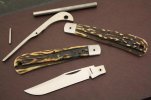
Jeff I agree totally and the geometry to alleviate that issue is not that difficult to achieve. As you can see from this picture, the spring contact point, in the Half to Open position (Arrow A) is nearly a 90 degree... SHARP corner. Compare that to the Closed to Half position (Arrow B) and you can see it's more of a radius.

This helps make the knife smooth to open to half and slows the blade to close alleviating spring wrap. Moving the contact point closer to the pivots center creates less tension in the spring.

It is a dance to find just the right combination... I've had this SaddleBack a part about 30 times as you can see from the scratches that I'll have to remove before assembly.

I hope this helps. I don't usually get into this much explanation but it's something that I've thought about a lot!

attachment.php
 

Attachments

  • Illustration.jpg
    Illustration.jpg
    70.1 KB · Views: 315
  • Web Illustration.jpg
    Web Illustration.jpg
    59.6 KB · Views: 65
Last edited:
Thanks, Brent. Maybe you should send your photos and explanation to Bill Daniels at GEC!
 
That vicious half-stop is what caused me to take a trip to Med7 to get the end of my finger glued back together. This was due to my Queen/Burke Barlow after I had just reprofiled the main blade.
 
I wish this were true. If I squeezed a tennis ball for an hour the next morning I would not be able to move my hands for a very long time. I am only 54 but it is surprising how fast arthitis limits everyday activities.

I'm only 22 and know exactly what you mean. I have hands of a 80 year old. I also have carpal tunnel so that don't help much. As for pulls I like 6. Its what I consider "perefect" :)
 
I know what you mean. My wife found a cheap Chinese sak-type knife and I could barely get any of the blades open. It promptly went in the trash.
 
Yep, I really hate knives with overly strong pull. Never mind the real nail breakers - those I consider totally unusable and not-a-knife (and curse the makers for putting out such wretched trash). Overly strong pull makes a knife simply unpleasant to use. It's something I don't want to mess with and fight to crank around every time I open and close the !@%$ thing -- it's like a door that sticks or a really stubborn lock - it's an additional annoyance in life and I want nothing to do with any more annoyances and aggravations in my life, thank you. I love the pull on the Buck 30x series and on the old 70x series (at least all I've tried) -- that's the pull I want a proper slipjoint to have. Just about all the great old Joseph Rodgers and George Wostenholm congress knives I have (most pre-1910 or so) have wonderful pull and action - a great, lighter, sweet snappy action that I pretty much never see on modern (or even vintage) knives - not even customs.
 
Squeeze a tennis ball for an hour a day and your hard to open knives will magically become easy to open.
Greg

This is akin to saying "eat a live toad every morning and nothing worse will happen to you the rest of the day". And squeezing a tennis ball does nothing to make your nails stronger -- and why the @$%@ should we try to adapt ourselves to poorly designed and built knives - they should be built properly with proper ergonomics for us to use without damaging bits of ourselves opening the things.

Yes, I know you're just taking the mickey, but still, had to be said. :rolleyes:

-- Dwight
 
I also dont like nail breakers much. I keep my nails quite short and just cant deal with nail breakers. Interestingly, I have 3 GECs and they all have great pulls. A little more tough than a SAK but still quite easy.
 
Just supposing...

Let give GEC the benefit of the doubt, and say they decided as a marketing strategy to build knives with hard springs.

As a start-up company they would look at who is the market to buy knives.
A very large market share of knife buyers are the 'modern' knives with lockbacks or linerlocks.
The folks out there are used to locking knives, with the myth that slipjoints are 'dangerous' becuase there is no lock.
So build a strong big knife that opens with very strong springs, so a guy that is used to a locker can use it with a much higher degree of confidence.
The Scout and the Pioneer are tanks, they were hard to open and hard to close and resembled in feel of a locking knife.
So they can build a knife that can make inroads in to the locking 'modern' knife market.

A few years later, GEC has taken off as a quality slipjoint maker.
They have created, quite cleverly a 'boutique' semi collectors market.
They are doing very well.
They no longer need hard springs to be in compertition with the locking knife market, and kudos to their change to the collectors market responses for softer springs.
 
I like a medium pull.
To soft pull may make the knife fold if one accidently touches something with the spine of the blade. It may be in cleaning a fish or in a butterpackage on a mountain trip. for me they just have to stay open and plus a little way from there.
To heavy pull makes them hard to open and not safe if the hands are cold or slippery wet. And if one does a misstake that makes them fold they are like trap that cuts you harder than nessisarry. No meatcutting snap for me anyway.
I consider a reed SAK to be perfect and a alox SAK to mark the line where they get unessisarry hard to open.
A slipjoint should always be used with the preasure against the edge and the spring is to hold the knife open and prevent minor usermistakes to fold the blade on your fingers.
If they are firm as in nailbreaking tuff I see them as defect. Even more so than if they are to soft.

Bosse
 
I'm in the minority, don't care:D

I like a heavy spring, although it is true that this works best with a medium to large knife. Perhaps my nails are tougher (get that vitamin B down you!) than average? That said, this year's Forum Knife's Clip blade actually TORE OFF my nail in one go in its first opening:eek: This is clearly too much and odd because Queen usually has a knife with a good smooth action. It was only the factory gunk and whatnot jamming the spring up, it's still heavy though, niiice:thumbup:

We all have different tastes and the Traditional knife really caters for these as no other. Many enthuse about Canal Street but I'm dismayed by their soft springs, don't fancy it at all and will get rid of them at a suitable time.
 
This is not a problem for my nails, but for the overall usability. I have strong nails and has never hurt them on a knife. I wouldnt pull harder eather than what feels good If I had a knife too hard, but that is not my point. I want to open my slipjoints easyly. I want it to be done 10 times of 10 even if im cold and wet or in the dark just feeling the blade. I want to be able to do it with more than my thumbnail. Its not nessisarry to be able to do it with the little finger but at least the index and long fingers should be possible to use. This could be because Im a lefty and most knifes are done for righthanded thumb opening but for me there is no distinkt finger to use, I want to be able to do different if needed. I dont need my blades to be overly stiff in folding together as that kind of misstake seldom has happened to me but if it happens I dont want a bear trap snap cutting my finger off.

Bosse
 
I was wondering about this. Reading another thread (and others before it) it seemed that there was a lot of approval for the cutting the knife owner received while trying to operate his knife. I was beginning to think I was on the outside looking in on this issue.

It's by me. I like snappy springs, but not rat traps.

I am in the camp that considers a knife that is very difficult to open an manufacturing flaw.

If I reach in my pocket to pull out a knife to cut shipping strap, open a box of nails, cut the end of a tube of caulk, trim a piece of molding, sharpen my pencil, etc., etc., I don't want it to turn into a process of using the knife. I don't want to make the simple act of cutting something a ritual required by the knife.

The knife should be on the ready, waiting to slice something. I don't want to set everything down I am working on and concentrate on the simple act of opening a knife to be able to use it, much less add the problems of possibly cutting myself if I am not totally focused on opening of folding the knife.

I couldn't use them at all in wet, really cold, or hot sweaty days. Too hard to handle.

I guess they have their appeal for collectors, though. It seems (although it's just my opinion) that many seem to think that really tough springs seem to mean they someway have a better knife. GEC may think this way... I dunno. Until them, I have never heard of any another knife company that made their own bulk blade openers!

Robert

 
I have two GEC 73's and they are bears to open. Don't know why I bought the second one. They have both cut me several times. The first one I spent a long time working it and it is getting close to useable. The other just lives in a drawer.
 
Some of my favorite looking knives, never got carried, because they were unbelievably hard to open. Its really a shame.

My new Buck 301 is very smooth, and easy to open. Almost a little to easy, but after carrying it, and using it, I really appreciate it when I go to open it, and I've never felt like it was unsafe
 
The knife should be on the ready, waiting to slice something. I don't want to set everything down I am working on and concentrate on the simple act of opening a knife to be able to use it, much less add the problems of possibly cutting myself if I am not totally focused on opening of folding the knife.

Robert

This sums up the whole issue in a nutshell for me. Well said, Robert! :thumbup:
 
Back
Top