Why would a frame lock be stronger than a liner lock??

Do you believe that what I have said there is absolutely ridiculous? Is that so obvious that linerlocks and framelocks will last much longer without any wear symptoms than any other kind of lock - than AXIS, than backlock, than button or compression locks?
Why then some premium folder manufacturers are trying to find solution for that non-existing problem of frame lock longevity - hexagonal or eccentric stop pins, special replaceable "heads" screwed on the working end of frame lock?

What is so stupid in what I have said that actually made some people to suspect that I do not really know what I am talking about? Could somebody please check/read my original post and show it to me? That is important - I do not really like to make a fool out myself... ;)

Why so many people are concerned with lock strength? I do not recall ever doing anything which required much lock strength. For all the practical purposes SAK is as good as any framelock folder for me.
I believe that lock longevity is much more important. I want lock perform consistently over as many years as possible. In this regard neither liner lock, no framelock are able to give me much confidence...

The contact area of any lock can be peened or deformed by repeated impacts (abuse). The problem with longevity for framelocks/liner locks is that although some consideration is given to allow for self adjustment (by providing an arc or line across the back of the blade tang), the material used for the lock is often softer than the blade steel against which it interfaces. Thus, one can see the deformation that occurs when non-heat treated titanium lockbar "wears" in. Take a look at the end of your BM's lockbar. I'm fairly certain you will see that the titanium has an indentation.

Higher end titanium knives often (and in my opinion should) take into consideration this type of deformation: for, when wear of this type occurs, the only solution is to replace the stop pin with another pin of a larger diameter, or to replace an entire slab of titanium. Chris Reeve, the originator of the framelock, appears to have recognized this problem and he has the Sebenza's lockbar face heat-treated, and on the Umnumzaan he put a ceramic ball which has a higher hardness than the blade. Lionsteel and Spyderco (on the latest iterations of the titanium Military) address this problem by utilizing a replaceable steel insert.

Longevity of the lock has more to do with the types of uses it is put to. In environments with sand/dirt/debris, the framelock really shines. If you take a look at some old knives that have been passed down through the generations (and which had little care given to them), you will probably see more wear around the pivot area than the lock area. I would prefer to have a knife that I can easily clean out, take apart, and replace parts as they wear or corrode--I'm less concerned about wear on the lock, than on the pivot.
 
Thanks Cinic. I have similar understanding - that there are certain issues to address and a gap between high-end more expensive knives and regular production ones (the ones I have for example). As for what is more important - that is quite individual, based on type of use and kind of knifes you have. You may have high end folders - so may not be concerned with the lock, more with pivot (which is understood considering their construction). I have simpler knives and am more concerned with the lock and less with pivot - which is understood if it is already more than half-way through... :)

P.S. And are there any existing solutions for liner locks? (Yes, I have knives with this type of lock too!) ;)
Because of the longevity concern nobody makes liners of titan (or am I wrong?). Steel-steel combination gives better lock longevity but not as strong for locking as titan-steel. Which is not my primary concern but provides some insight to the question. ;)
 
Last edited:
Liner and frame locks have a simplicity that also cause the shortcomings. Since the lockbar and spring are integral, then the wear resistance, ductility, hardness, ultimate strentgh, etc are tied between the two. Ti is light, and also not very hard/wear resistant compared to the super steel tang it is impacting every time it locks open. A spring thin enough to be comfortably manipulated by hand isn't going to handle the load of a full thickness Ti handle slab (so the handle scale dimensions are a non-factor), an axis pin, the lockbar of a Chinook, etc. Lock springs usually just hold the lock pin/bar in place, not directly receive the forces on the lock.

Hinderer stabilizer, Rotoblock, strategic placement of the pocket clip, replaceable steel inserts, heat treated or carbidized Ti lockfaces, LAWKS, they all show a identified 'need' and industry attempts to overcome perceived issues with the frame/liner lock. No one sings the virtues of being able to use the squishy flesh of their hand to support other locks, because they neither can nor need to. IMO, the lock should function on its own. If I need to grip the handle to support it, then there was no need to progress beyond the friction lock.

I have seen accelerated wear on liner and frame locks from hard openings. To me this means these knives should not be flicked. Fine, there are knives that should not be used to pry, baton, turn screws, etc either. The difference for me is that the lock has nothing to do with edge geometry or cutting performance. I want folders that I can flick because I know there are locks that can handle it without alarming wear-in rates, that don't weigh much more (if at all), handle higher static loads, open as quickly/smoothly, and don't have many more parts. The blade will cut as well as it ever could, handle ergonomics remain essentially unchanged, and the junction between the two has measurable increases in some areas with no negatives... at least to me.

Back to the OP. Frame locks do not handle higher static loads than liner locks. Frame locks also do not last a whole lot longer. The thickness is irrelevant because the lock bar stops compensating for wear when there is resistance to movement at zero thickness. When the inside corner of the lockbar contacts the opposite bar, the bar can no longer adjust, no matter how thick the bar is. Both a liner and a frame lock will maintain contact with the tang of the blade until that happens. When there is enough wear at that time to allow some vertical play, the frame lock is not going to move to take up the slack, even though there is additional material there. Where any increase in longevity may come in is if the frame lock is able to distribute wear on a greater area of the lock face, and that is going to depend on a great deal on geometry and execution.
 
y concern nobody makes liners of titan (or am I wrong?). Steel-steel combination gives better lock longevity but not as strong for locking as titan-steel. Which is not my primary concern but provides some insight to the question. ;)
Plenty of titanium liner locks. Titanium is not "stronger" than all steels, but it has a better strength to weight ratio. A steel lockbar is stronger than a titanium one if they are the same dimensions, but the steel bar will weigh more.
 
Plenty of titanium liner locks. Titanium is not "stronger" than all steels, but it has a better strength to weight ratio. A steel lockbar is stronger than a titanium one if they are the same dimensions, but the steel bar will weigh more.

Yes, you are right about titanium liners. I have been a bit off-balanced by previous exchanges - so have forgotten even those I have got myself: like Lone Wolf T2 or Emerson folders....
I think that main advantage for titan in liner/framelock is not even the weight/strength, but the coefficient of friction in titan-steel combination. Coefficient for steel-steel is lower, so this pair would not offer such a strong locking.
 
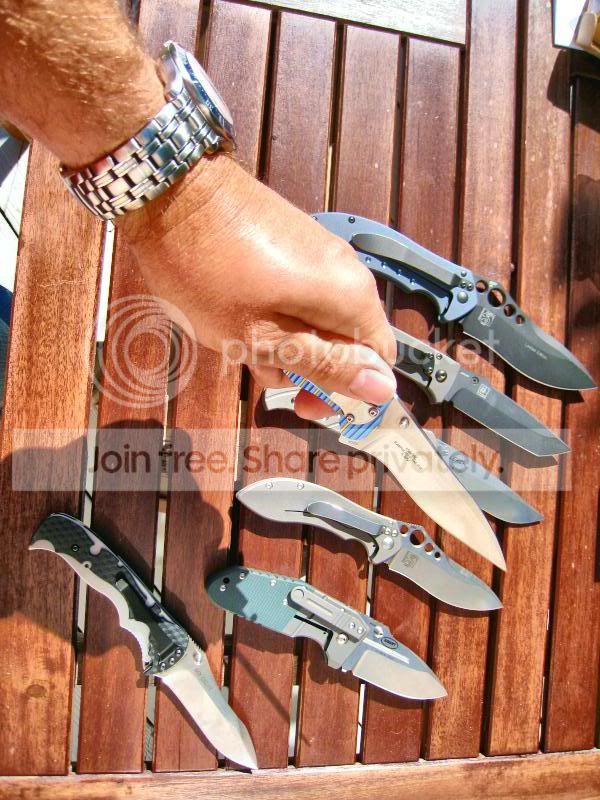
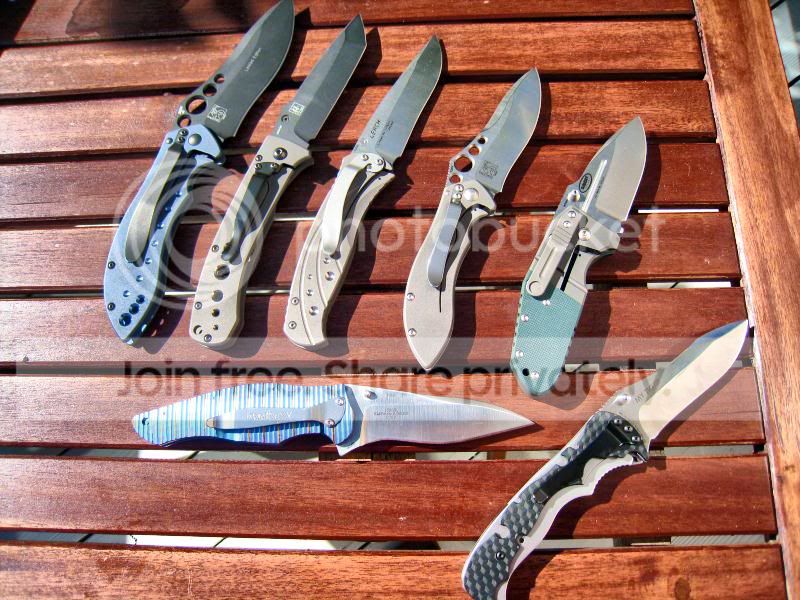
Year, there are photos anyway:
Framelocks3.jpg

Framelocks2.jpg

Framelocks1.jpg

They are crap, but well, show that I am not lying - so will do.
 
I have seen accelerated wear on liner and frame locks from hard openings. To me this means these knives should not be flicked. Fine, there are knives that should not be used to pry, baton, turn screws, etc either. The difference for me is that the lock has nothing to do with edge geometry or cutting performance. I want folders that I can flick because I know there are locks that can handle it without alarming wear-in rates, that don't weigh much more (if at all), handle higher static loads, open as quickly/smoothly, and don't have many more parts. The blade will cut as well as it ever could, handle ergonomics remain essentially unchanged, and the junction between the two has measurable increases in some areas with no negatives... at least to me.
Don't assisted opening knives slam the tang against the lockbar with about as much force as flicking? And yet, a majority of SpeedSafe knives from Kershaw/ZT seem to be either liner or framelock.
 
Year, there are photos anyway:
Framelocks3.jpg

Framelocks2.jpg

Framelocks1.jpg

They are crap, but well, show that I am not lying - so will do.

Did you swipe those knives from your neighbor so we'd THINK you owned a framelock? More pics displaying a name tag plz!! :D
 
Year, there are photos anyway:
They are crap, but well, show that I am not lying - so will do.
Yes, I don't think Benchmade framelocks are much to look at. Though my 890-111 Torrent with a titanium linerlock seems to hold up much better over time as opposed to any Emerson I've owned.

Still, aside from Emerson, none of my knives have had the lockbar wear all the way down to the opposite side as of yet. For a few, there will be a break-in period where the lockbar seems to move quite a bit, and then it more or less stops and stays that way for a while. Though I've only observed this on my ZT 0551 and my R.J. Martin Overkill.
 
Don't assisted opening knives slam the tang against the lockbar with about as much force as flicking? And yet, a majority of SpeedSafe knives from Kershaw/ZT seem to be either liner or framelock.
Nah, you can thumb flick much harder, and wrist snaps are another level. I'm not saying they're a good idea, but I've had linerless zytel lockbacks that took hundreds of them without developing play. Assess the tool and use it accordingly.
 
Did you swipe those knives from your neighbor so we'd THINK you owned a framelock? More pics displaying a name tag plz!! :D
Year, I knew that would not be enough! :D
Though isn't it sort of funny that some people would imply that owning something IS experience... ;)
 
Nah, you can thumb flick much harder, and wrist snaps are another level. I'm not saying they're a good idea, but I've had linerless zytel lockbacks that took hundreds of them without developing play. Assess the tool and use it accordingly.
Hmm, and what about manual flippers with bearing pivots? I would think my R.J. Martin Overkill pops open pretty fast given the roller thrust bearings. Also curious about the various mid-techs with IKBS flippers and titanium linerlocks.
 
Why?
O, yeah, I am a stupid poor thing....
I do not go around stabbing trees, but I thought that is OK.

Did my opinion offend you in any way?
Why to be rude?


No, I think I will not be even bothered.

Go away and stop being a dick.
 
Back
Top