WIP - Restoring a Bradley 40lb Helve Hammer

I just wanted to say thank you for rescuing that hammer.

It really kills me to see great old tools sitting and unused, rotting away. It just seems wrong somehow.

I look forward to seeing video of this up and running.
 
So after killing a couple hours letting fish no larger than the lures I was using stare blankly at me, I decided that I just wasn't going to wait any longer to either wreck this old girl, or continue forward. I can't justify getting a custom tap cut (especially if there's a chance that all that will happen is that the blunted, smeared threads that are left in the lower cushion cup are just going to fall out!). Seeing the damage on the original adjusting bolt (not sure what caused it to begin with), I filed the first two thread's worth off, and blended the existed threads smooth to use as a thread chaser.

Here's a shot of some of the 'bulge' that caused the problem... unfortunately, I had already started to file when I remembered to take pictures, so you don't get to see that the bulging occurred all the way around:

web.jpg


web.jpg


Here's what it looks like now, after removing the ruined threads:

web.jpg


web.jpg


Although there was lots of resistance, bit by bit it re-aligned the smeared threads in the lower cushion cup. A quarter turn at a time, un-thread it, clean the threads out with a toothbrush, thread the bolt back in, rinse, repeat. All that's left are the final 1/4" where the greatest amount of distortion occurred. I just didn't have enough umph! to get it done today, and I was starting to get sloppy, so I quit.

My bride caught this super action shot of me during the aforementioned task. Told ya I was skinny!

web.jpg


One more day of working at it, and this shouldn't be an issue. Then on to getting the eccentric free so the ram throw can be adjusted!

 
Last edited:
This advice may be a little late, but if that last 1/4" proves to be a problem...

If the bolt is harder than the internal threads, using the bolt as a chaser can work. If the internal threads are harder, or equally hard, using the bolt as a chaser may damage the bolt threads again. Generally speaking as an engineer, the part that's easier to replace is supposed to be a little softer. (i.e. nut softer than stud, bolt softer than engine block...) In this case I'd guess that would be the bolt...

What is the pitch? Perhaps someone has a tap they'll loan you. You can get all sizes of "special thread" taps, Travers is fairly cheap, so you may not need a custom tap.

There is also a generic single point re-threading tool available for internal threads that will work with any 60 degree thread as long as the hole is big enough to get the tool in. I've never used it but I've used the external thread version from Nes with good results. Google Nes INTERNAL THREAD RESTORERS

If none of these is an option, try forming the end of the first thread on the bolt into a full height chisel shape to push the internal threads back into shape, or cut the end of the first thread at a clean 90 degree angle to shear off the burrs in the internal threads. A Dremel tool should work to form either of these shapes
 
Thanks for the input, Mahoney. I exhausted a ton of possibilities in discussions with folks like yourself before finally just diving in the way I did. The tap required is 1-5/16"x7tpi. After searching for quite a while, the only possible source would have been to get one made. North American Tool & Die were the most reasonable (with three day turnaround - fast!), but the tap would have run me $175, with no guarantee that the cast iron of the original threads would have enough integrity to be cleaned up, or just end up stripped out. The only difference between the last 1/4" and the rest is that I ran out of steam, and just didn't feel like making a mistake and screwing something up in my fatigue. I'll finish it up tomorrow, and then see if I can capture a good shot of the internal threads so that you can see how nasty they look.
 
WOOHOO!!!!

Look what I got:

web.jpg


My friend finally got the chance to turn the cushions to the taper I needed, and here's a picture of one!

He made 5 of them for me (one spare), and now I've really got to get moving on the helve - man, I wish it wasn't so busy at work! The notches are due to the fact that they had an existing mould that they used for this project, and I can't imagine it affecting the performance of the hammer. If these work out for this project, I'll find out if they'd be willing to manufacture these for other folks.

MANY MANY thanks to Joe Divissich and the crew at Apple Rubber products - this project would likely have been permanently hung up if it wasn't for these guys!
 
Thanks for the input, Mahoney. I exhausted a ton of possibilities in discussions with folks like yourself before finally just diving in the way I did. The tap required is 1-5/16"x7tpi. After searching for quite a while, the only possible source would have been to get one made. North American Tool & Die were the most reasonable (with three day turnaround - fast!), but the tap would have run me $175, with no guarantee that the cast iron of the original threads would have enough integrity to be cleaned up, or just end up stripped out. The only difference between the last 1/4" and the rest is that I ran out of steam, and just didn't feel like making a mistake and screwing something up in my fatigue. I'll finish it up tomorrow, and then see if I can capture a good shot of the internal threads so that you can see how nasty they look.

if it did strip out you could just drill it out a decent amount more to accommodate a sleeve with a harder/more wear resistant material...I've done this on old equipment like this a few times, in one case I drilled and sleeved plus made a new bolt in a more common size. Like your issue we could not find a tap with the same pitch and size anywhere to attempt a repair and a thread file wasn't going to work.
 
Hehehehe all this work, while admirable, I could get you right now a complete working 100 pound Bradley Helve for 3000$
 
Hehehehe all this work, while admirable, I could get you right now a complete working 100 pound Bradley Helve for 3000$

...and it STILL wouldn't have the finish capability of my lil' 40 pounder. Rumor around the campfire says that this girl, when dialed in, will be capable of leaving a finish like hot rolled.

The odds of me getting this thing dialed in that well are slim to none, but just sayin'. ;)
 
Robert, your talking like a helocoil?

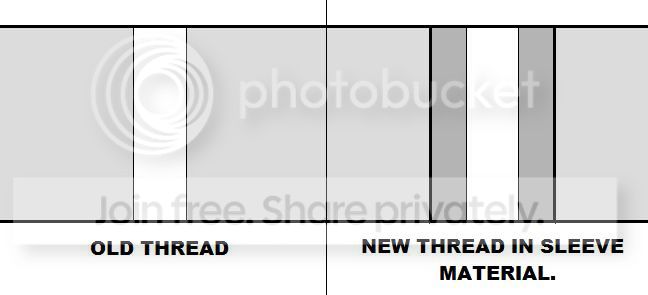
no, I'm talking a sleeve of new material...you can thread the new sleeve in for extra strength but the stuff i've done was press fit as their was no shock load or stress going on the sleeved area. Helicoils i'm not really fond of except when working with aluminum.

Untitled-5.jpg


here is a basic diagram of what I mean, if any shock is going onto that bolt I would have run a coarse thread on the sleeve and tapped out the drilled hole with that same thread and once in place put a few peens to keep it in place or silver solder into the sleeves thread.

Many ways to get the job done.
 
... at long last, I can provide an update on this!

One of the tensioning bolts of the helve husk was missing, and after resigning myself to having one made, a gentleman named Phil Cox found exactly what I needed!!! As previously mentioned here, Phil collects power hammers (Bradley's in particular), and he's been an enormous asset to me!

Here's a shot of the nuts and tensioning bolt I received from Mr. Cox - perfect!!

5574099420_e801819e1e_b.jpg


...now if it'll just warm up for a while and let me get to the darn contraption I can get fiddling with it again. It hasn't risen above the high twenties here yet in weeks - cold even for us this time of year.
 
Way cool, Matthew. This project might have driven me insane long ago... it's gonna be a rad hammer when you get done.

The weather will warm up soon, it is here.
 
Well, I got a bit of time to work on the ol' girl today. I power washed it to get the crud off, loosened the helve husk to see if I could work it free so when I have a helve I can spread it open...

5614695016_327b3b9f59_b.jpg


then had it slip off the pivot on the left side! Thought for sure the entire upper half of the hammer was coming down. I managed to jury rig a platform and got my floor jack under it, propped it back into place, and tried to tighten it in place with the fulcrum pivot screw. The bolt moved freely, but I can see the threads next to the husk, and they ain't budging. Removed the bolt to find that it's sheared, with the pivot point of it in place.

5614115423_4aef33edca_b.jpg


Now I gotta find a bolt, and find a way to get the sheared end out. I'm guessing I'll to have to build a chainfall cradle in order to keep the upper assembly from collapsing. Oh well, she's over 100 years old. I guess this stuff is bound to happen!

5614695618_cd29a0eed2_b.jpg
 
Oh man! Rough bit o luck Matt. Keep pluggin away at her...your getting close.
She looks good all washed up!
Mace
 
Touch Luck Matt! If nothing else, center punch that bolt end, and drill it out until you just have a thin shell and the threads left. Then, pick out the rest with something long and thin.

-d
 
Back
Top