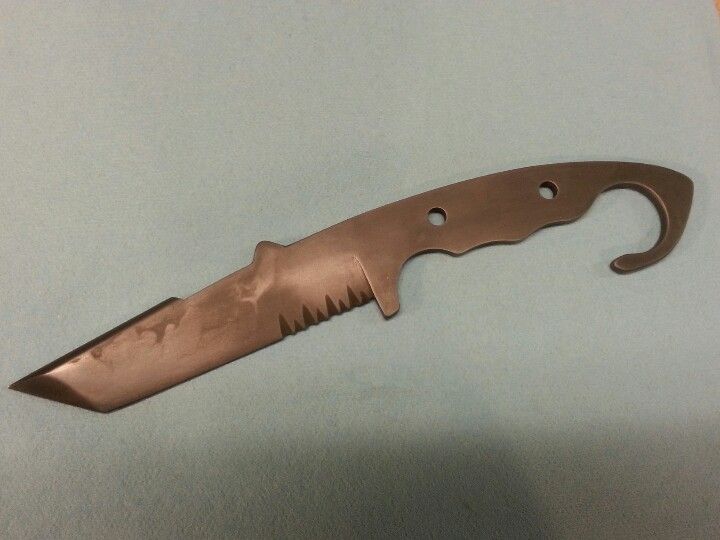
WIP tactical knife for a buddy...

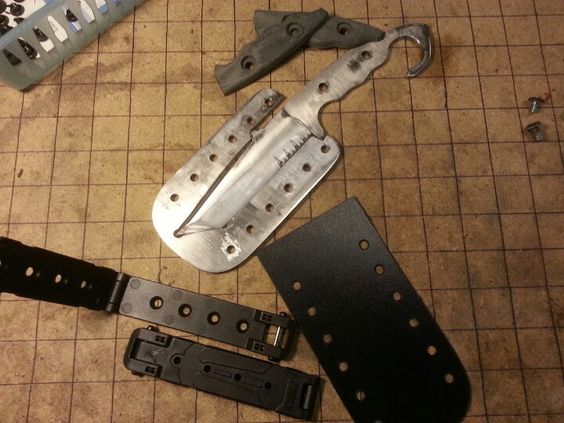
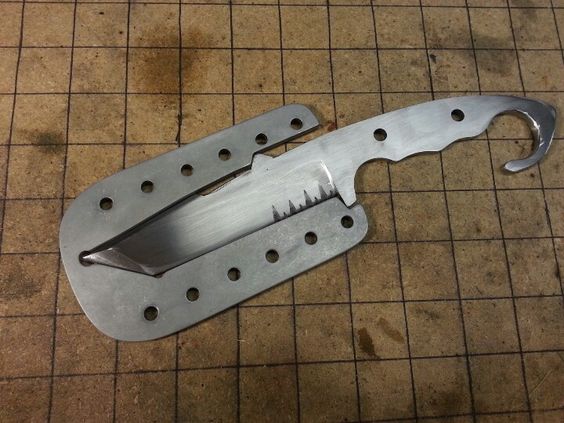
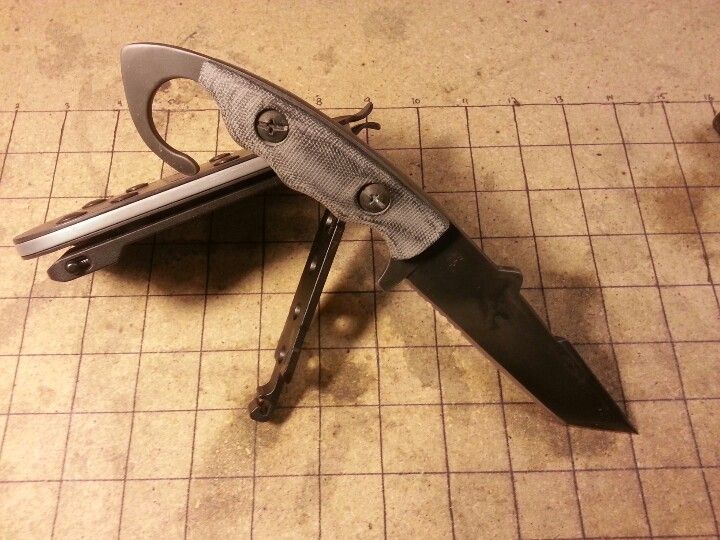
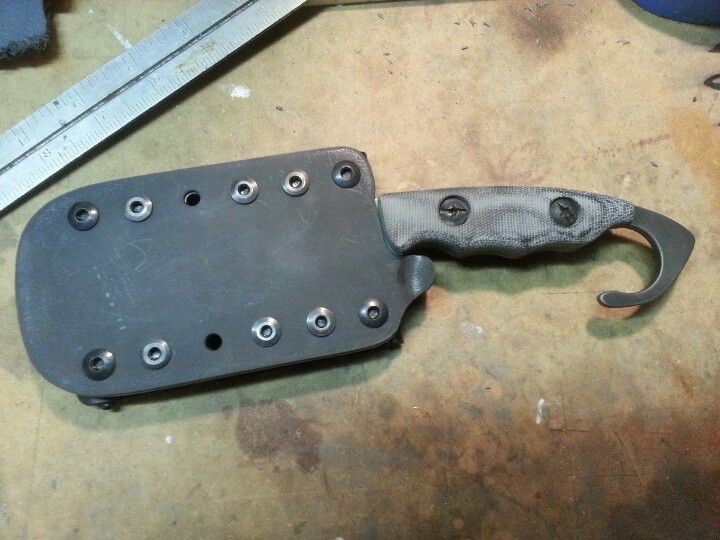
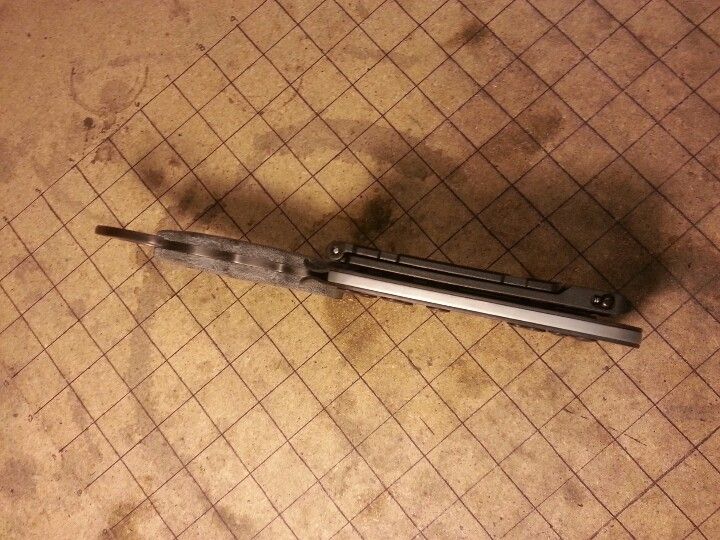
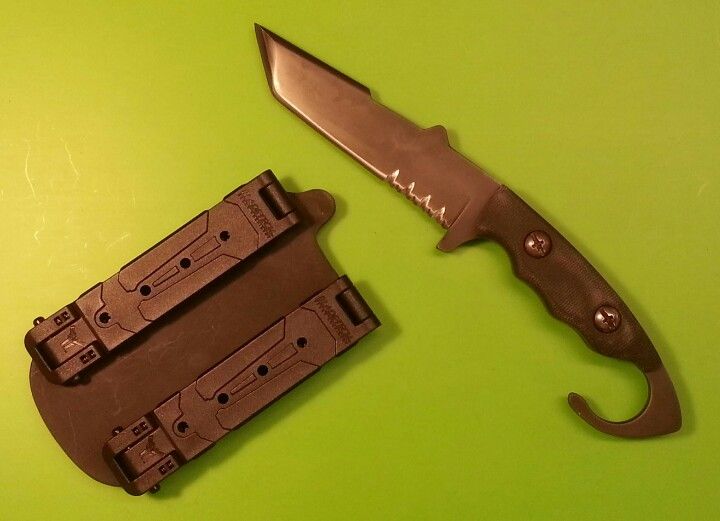
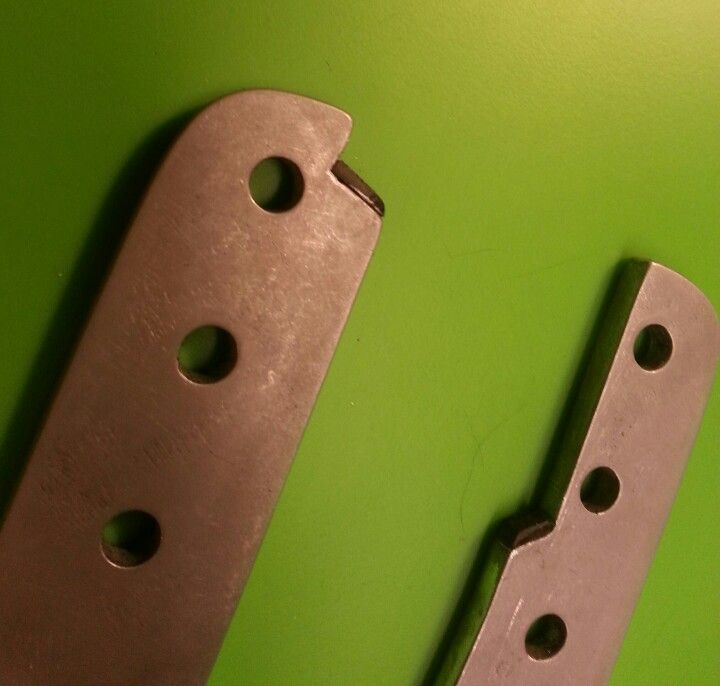
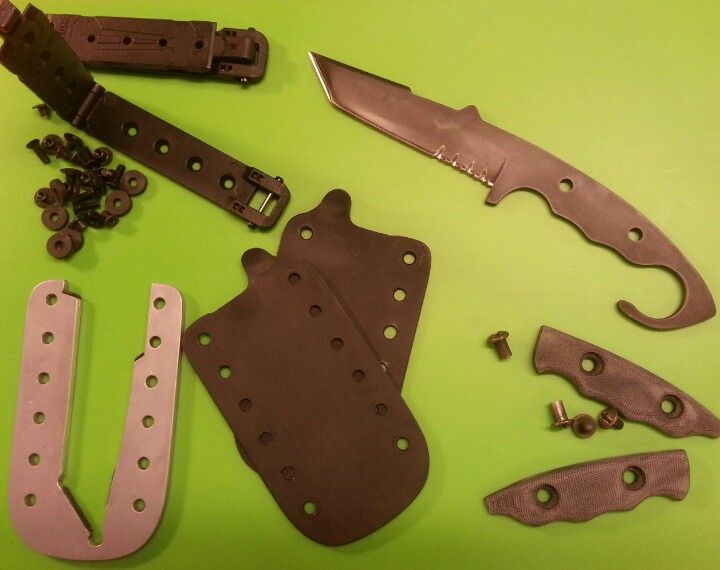
It's getting there slowly. My free time to work on it has been slim lately. Here is a picture of some of the sheath fitment work provided it attaches ok. Ignore the weird colorations and stuff, some of it is smeared sharpie, some is tumbler crud (wd-40 and metal bits...). It is probably apparent what I'm shooting for. It is basically an aluminum center section with kydex sides. It uses blade-tech MOLLE locks and the holes are spaced to allow a variety of carry options. The sheath indexes on the spine for the most part. I made sure the areas where the tip of the knife and the lower angle of the blade edge dont ride on the aluminum. That said, this is very soft aluminum by most standards but very flexible. The kydex will be fit in typical fashion to lock the knife in.
The rough scales are also in this pic. They are black/grey canvas micarta and completely removeable. I am rounding over the edges of the tang where it meets the scales in the event the scales are ever swapped with paracord.
As stated previously the focal points for the sheath were easy decon/able to fully disassemble the whole mess, and also variable mounting positions.
97dc9c7df8300eaedac4d93145b4dbce.jpg
 
Last edited:
No pictures to post right at this second...

I thought I would recount the testing process however, just to kind of document what went into destructive testing...

First up was testing of the glass breaker, just because I like to break glass (not really, it was my area of greatest concern.) I was concerned that the glass breaker and finger guard would bend and trap a finger inside the guard. Well, glass broke with a reasonable amount of force without deforming the pommel. The finger guard was then clamped in a vise across the opening and progressively tightened. The vise was not able to deform the finger guard even with a pipe placed on the torsion lever for extra clamping force. The pommel was then placed in the vice laterally with just the small section in the vise, and force was applied laterally to the knife. It took a pretty good deal of force to bend the guard, and no break occurred. I guess the shape, a circle, and the inherent strength of the steel is more than enough to end my concern of the guard bending closed on a finger.

Then the blade was tested by placing it in a set of clamps, clamping to a fixed wooden step, and then standing on the blade. With the majority of the blade in the clamps, the knife flexed a little, however did not bend permanently or break. Impact testing also withstood a great deal of force more than I honestly expected it to.

Now came the fun part... I decided to use a resource at my disposal, a -25f storage facility at a local grocery store warehouse, and see how this thing fared when really cold. Honestly, I was a bit cocky, and didn't think this was cold enough for it to make a difference. The reason for this test is the blade will spend its life in Colorado initially at least where we would frequently see -10 to -15 degree temps during the winter on routine patrol when I worked there. I did, once, see -27, so it is feasible that it can see these temps.
I left the blade in the cold for a couple of hours to make sure it was thoroughly at temperature. I then clamped the blade again and tried to stand on it. I don't know if I stood closer to the pommel or not, but the blade snapped at the rear of the grip through the rear scale hole. I suspected to some degree that I may have hardened the steel a little too far forward of the pommel in addition to the cold, and adjusted the finished blank accordingly, but the cold may have been the deciding factor. I was told, however accurately, that -25f was enough to make the steel more brittle. Expert metallurgists chime in and correct me if I am wrong...
Then I placed the blade in a vise, about half way, and struck it gingerly with a 2 pound hammer. Then another strike, and finally a pretty spirited third... The third resulted in a nice "SNAP - PING - WHOA!!!" Again, don't know if it was just the cold, and doubt it will ever see this abuse in real life, but I adjusted my temper accordingly going just a couple of points lower... Just in case.

Once completed, time allowing, I will post a completed knife, sheath, and sort of demonstration of this knife and its intended use. There are some unique features that I think will be very practical. One of which I am particularly proud, and that is the ability to regain a proper grip on one's rifle or pistol without having to resheath or drop the knife. I will have to post a few pics to show how this works, but it is kinda neat... Its the first practical way of maintaining a knife while shooting a rifle that I have seen...

Time willing I will have this puppy finished next week. Thank you all for the support thus far. Much appreciated...
Hate to be a downer on this, 1095 may not be your best choice for a knife to be used hard in cold temperatures. Google "Liberty Ships" and thermal transformation embrittlement, and thermal embrittlement + carbon steel

-Page
 
Most of what you will find under ductile-brittle transition talks about structural steels but I have seen articles about it occurring in hypereutechtoid steels as well

-Page
 
Thanks Page, hopefully any occasion the blade will see these temps will be few and far between. In this instance I used 1095 mainly because I have a huge supply of it, and knew we would go through a bit of it trying stuff out, and I'm doing it for free. I also used my own micarta to save a little moolah. I have had requests already for this knife in stainless and d-2. May go that direction eventually.

Generally speaking, this knife will live on an entry vest and the typical SOP for hitting a place is: suit up, brief, and get in van. Arrive near location, exit van, run to house and stack up then hit it. Most of the outdoors stuff is about 20 seconds.
There are times stuck outdoors on inner perimeter that can be prolonged. However, really really cold temps are fairly rare in Denver metro area. I routinely saw -10 or so during the winter on nights, but did see -25 at least once...

I have seen -30-40f temps in the mountains do weird stuff to certain materials. Nalgene bottles are like glass, some metal just seems to snap like a twig...

Thanks Page, gives me something to look into... Speaking of liberty ships and cold temps, maybe I'll make em out of pykrete... :)
 
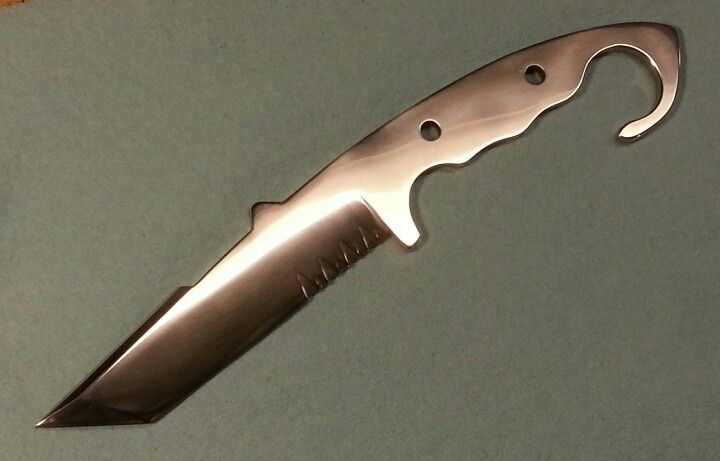
For anyone still following this at this slow pace, here is the blade finished to 320 grit all over and s couple of areas like the plunges and the rear hook finished to 600 grit and cleaned up. As you can see, the serrations up the bevel are much shorter after final grinding. They still need to be finalized but I will do so after the final edge is established.
The aluminum core of the sheath is nearly finished except for a little protective material on the blade contact surfaces to keep from smacking aluminum upon reinsertion. The finish is a media tumbled finish and may be chemically blackened prior to assembly depending on how bad the color sticks out...
Here is a pic, similar to the one above just a little more to go
af846dd115e6bdb740edd2dd74cc734a.jpg
 
Cool thread and a very unique knife! :)

I have $0.14 worth of unasked for advice ;) It might just be the lighting, but the finish on the inside of the pinky lug looks kinda' funky. Even if it's not (:foot:) I have an easy way to finish areas like that---

You can rough it in with either carbide burrs or a small drum sander and a rotary tool.

Then to smooth it out and true it up... put the blade in your vise so the hook/lug is pointed down toward you. Take shop cloth and rip it into strips that are only 1/8" wide.... then "shoe-shine" away. You can put a perfectly smooth radius inside, and easily take it up to a mirror polish if you want, using this technique.

The key is ripping the shop roll narrow. If you try to do it with the shop roll even 1/2" wide, it will just dig in on the outer edges. That will take longer and never give you as smooth of a surface.

You can also use sandpaper, but you'll have to stick Gorilla tape on the back side and then slice it into narrow strips. :)
 
Cool thread and a very unique knife! :)

I have $0.14 worth of unasked for advice ;) It might just be the lighting, but the finish on the inside of the pinky lug looks kinda' funky. Even if it's not (:foot:) I have an easy way to finish areas like that---

You can rough it in with either carbide burrs or a small drum sander and a rotary tool.

Then to smooth it out and true it up... put the blade in your vise so the hook/lug is pointed down toward you. Take shop cloth and rip it into strips that are only 1/8" wide.... then "shoe-shine" away. You can put a perfectly smooth radius inside, and easily take it up to a mirror polish if you want, using this technique.

The key is ripping the shop roll narrow. If you try to do it with the shop roll even 1/2" wide, it will just dig in on the outer edges. That will take longer and never give you as smooth of a surface.

You can also use sandpaper, but you'll have to stick Gorilla tape on the back side and then slice it into narrow strips. :)

Nice! I know this isn't my thread but thanks Nick! :)
 
Thanks Nick, it is in fact the lighting. I did exactly what you describe to true it up and round it out... :)

That area and the plunge are 600-800 finish so they are really shiny, as opposed to the rest of the blade which is at 320 in that pic. I will try to take a pic tomorrow evening as everything is at a clean unidirectional 800 grit now. My shop lighting sucks for pics, but is great for work. I have three portable lights that are on flexy stalks with CFL bulbs in them as well as GE Reveal bulbs in fixtures above the work areas. Then I have two long florescent lights above and at an angle to my work areas, I can get zero shadow with them all on. I try to use the GE Reveal bulbs for pics, but use my cell phone camera for these so it doesn't show up as the best pics ever... Haven't broken out the SLR for this knife just yet.

I will admit it took a few tries to come up with a good way to get the inside radius, the angle and radius of the glass breaker, and the rounding of the edges of the tip of the hook to all look symmetrical. Cartridge rolls in different grits roughed it in basically at little angles, then a soft arbor on the rotary helped me blend those angles. Then I broke out the shop roll and cut into strips and did exactly what you described. I too discovered that anything wider than about a 1/4 of an inch does start to eat on the edges of the abrasive as you follow the radius. I have one of those 360 vises and use it all the time for this kind of stuff, easy to get the angles I need...

I may be going too far with the finishing on it as it is getting black oxide coated anyway, and will be etched prior to that, but my plan is to go to a smooth 2000 before etching it. I want the etch deep enough to hold the oxide coating and resist scratching, as well as ensure a reflection free surface, but still smooth enough to really show the detail in the angles and everything. I am a little concerned about wear on the sides of the blade from repeated insertion and removal from the sheath, but don't really want to line the kydex with alcontara as I usually do for holsters. It seems to hold contaminants, and it is needed to do meth lab duty as well, so will have to be decon'd quite frequently. I am afraid the alcontara would make wet decon nearly impossible.

Guess that's another thing to test... Coat it and sit on the couch watching TV while inserting and removing the knife from the sheath about a thousand times? Maybe I can leave it unsharpened and get my 7 year old to take care of that for me... I swear sometimes that kid could break an anvil. Makes for a good test subject..
 
I might have missed it, but what's the purpose of the aluminum spacer in the sheath?
 
It makes it a three piece sheath. The outer layers are kydex and there are the typical tabs at the top that lock it in. Being made this way, the knife and sheath can be easily decontaminated and can also be configured to ride on MOLLE gear in a variety of angles. Meth lab service and chemical agents are used a lot by us and complete decon is sometimes difficult. I used aluminum in the same width as the blade for a nice uniform fit. And aluminum because it is stronger than the alrernative. It makes a nice solid click when its all together and inserted in the sheath, and this positive notification that it was in the sheath was a requirement. We also tend to place both guns and other weapons (sticks, knives, tasers) back in the holster/sheath with a little 'enthusiasm' at times and the aluminum should also hold up to this well.
Thanks for asking, I am really enjoying this project as it keeps pushing me outside my norm as a maker, but is right in my wheelhouse as a user... When its done I will do a series of photos explaining everything as well as a possible youtube demo with some manipulation demos.
 
What I love about this is that everything you are doing is so well-considered. I think the sheath design is a stroke of genius. Now if you could utilize the forward facing side of the sheath for something else I would be REALLY impressed.

I am very excited about what the future evolutions of this design may be.
 
So I finally had time to get some real work done on this one. It seems like lately every time I think I am going to have some free time to devote to the projects I have going in the shop something comes up. I am sure you guys with kids and/or hectic and odd work hours can relate.

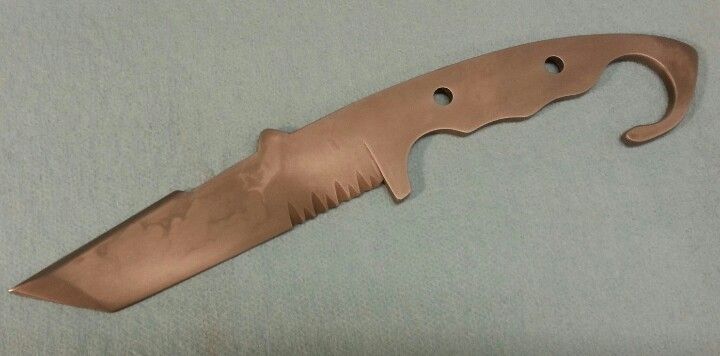
Anyway, here is the blade section prior to doing the etching on it. I took it to 2000 grit prior to the etch. Everything is in its final position at this point obviously. The rear pinky guard area looks oblong in the pic but is actually perfectly round. The area under the scale location is flat, the rear is very round, and the tip of the hook is a bit flat on the inside, thus making it look odd.

762daac08aff27771f85707358a779cc.jpg


Here is a picture after the etch. I used a combination of FeCl and vinegar. After the etch, I gave it a good rub with 0000 steel wool, thus resulting in this finish.

d7660c263a9a01153aef0f36d34ed8d8.jpg


I took it a bit further with the steel wool after that pic was taken, then used a cold blue to darken the steel. I then gave it another good rub with the 0000 wool.
fb460e99a1b0f132de0d47139c14e4de.jpg


After this, though I don't have a pic of just the blade section done that way, I did add another cold blue treatment and a little more elbow grease. I then coated the blade section with oil, and started a little final fitting of the sheath. The scales are about 90% done, and the sheath is also about 90% done. When it is completely done, I will update with more appropriate better quality pictures. The ones below here are during some of the fitment but give a pretty good idea of what the final look will be. I know it isn't a knock you over looker of a piece, but I think it turned out pretty nice in the looks department for what it is. This thing is going to be used hard, I know how my buddy is, so it won't look like new for very long anyway. And truly, I love seeing a tactical knife, big chopper, or other hard user with some scratches and dings on them...

Again, the scales are not completely done. They will be shaped a little more, rounding the edges more and such. They will then be taken to about 600 grit for a final finish. You can see the open Blade-Tech MOLLE-Lok as well as how the aluminum center plays into the sheath construction.

a9a15444bd777d4e7ff570d8022c0972.jpg


Here is a crappy picture of the knife in the sheath as it looks from the front. This was again during sheath fitment, however gives a good idea of the finished product.

696c550d6cc8b724db4557dfb100adf9.jpg


And here it is side-on. The scales will be just a smidge thinner when completely done. The taper at the rear will be more acute, and the edges a little bit more round. Again, the edges of the tang are rounded as are the edges of the scales so they will not appear completely flush. I left the edge of the tang just a tiny bit above the edge of the scales to give a nice uniform appearance. I think I mentioned it at some point, but I left the edges rounded over in case he every wants to cord wrap the handle instead of using the scales.

64a2f975ed8759b4a2c3df682ad2ed05.jpg


FWIW the Blade-Tech MOLLE attachments come with rubber spacers. They are on the sheath in these pics, and probably will be when mounted to an entry vest to keep the knife out away from the body armor, but without those being used the sheath is nice and tight up to whatever it is mounted to. I have also made a couple of belt loops that can be used with the sheath.

Once I get it all to final shape and finish, and get a good edge on it, I will dig up the SLR and take some better pics, and post a few demo type things as well. Maybe even a video or something.

Thanks to everyone that has provided the positive support during this build. I am hopeful the knife lives up to its full potential and gives my buddy many years of great service.

Cheers!!

 
That has come together beautifully. I hope your mate doesnt hold back; that knife is just screaming for hard use.
 
Well, I was going to wait until tomorrow, until after the actual photo shoot was over, to post anything. But, I couldn't wait... IT'S FINISHED!!

I would like to say a HUGE thank you to everyone who provided feedback, kind words, and suggestions along the way, it is much appreciated.

I won't be undertaking another build with this much R&D for a while. It flat sucks to cut, grind, etc etc etc blanks out for the sole purpose of destroying them. I understand why it needs to be done, especially with a knife that absolutely cannot fail, but man it sucks because you see each one as a possible finished knife... Sorta like killing 3 turkeys just to have a little taste test so you know the 4th one will be fit for Thanksgiving...

I apologize ahead of time, as always, cell phone pics again... Sorry, I am breaking out the real camera tomorrow to take some pics with the entry gear and whatnot. I am planning on making a short video too demonstrating some of the unique features as they relate to manipulation of the knife.

Anyone following this thread knows the knife specifics, so here's the payoff. I did a couple of little things, there was a little bit of refinishing that was done since the last photos. We decided the visible hamon, while cool to knife nuts, might not be understood by the rest of those I want to market this thing to. Therefore I subdued it a bit more. It is still slightly visible, just not as much as before, and appears more like a finishing technique than a hamon. I sanded away the factory texture from the kydex and smoothed it out with a little heat. I have found in the past with some holster applications that this makes for a neat looking and feeling surface on the kydex.
25a7565b7c95ad7c945860bbd940cc1a.jpg


I had been asked about the knife riding against the aluminum inside the sheath. My plan was to buffer that somehow when we started out. I ended up using kydex as a contact buffer on all the areas that contact the aluminum. This includes the 'dorsal fin' as it has been referred to :), and the heel/guard. I also included a thin bit of kydex to contact the raised false edge spine and the front edge (kissaki I reckon).
298e5d222fdbcccd0446a811775e4cf6.jpg


Below is a picture of everything completely stripped. Everything is hand made by me and bespoke to this application aside from the Gen 3 Blade-Tech MOLLE-Loks (which I would highly recommend to anyone attaching anything to MOLLE platforms.)
3aa75bb0f5249880eb79547b282bdc9d.jpg


Thanks again everyone. I will post the good photos and overall final review of the build soon.
Cheers!
 
Last edited:
wow, thats an awesome wip right there, looking forward to the real pics and movie to get a feeling of the size. Great job!
 
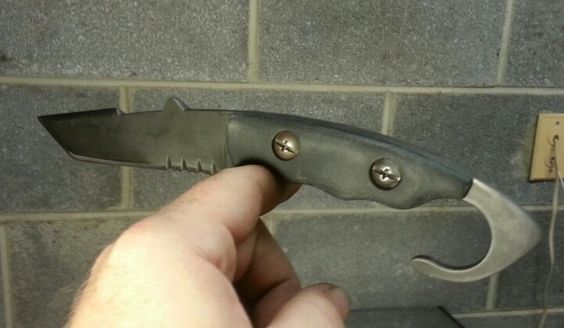
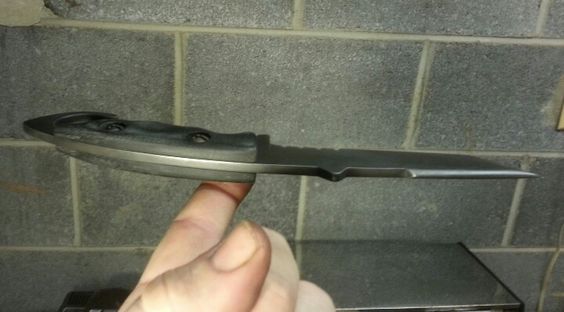
OAL is right at 9.25 inches. Grip area is sized in between bare handed and wearing a glove type sizes. It is very well balanced, winding up balancing right on the index finger. Having played with it a bit it transitions really well in the hand and feels very natural.

74d15af60beef71997a5210246d05f45.jpg


65c9a8ee457efb4214d017b1bcd9a325.jpg
 
Back
Top