WIP Tactical recurve EDC

Joined
Jan 29, 2007
Messages
199
Well,
for what it's worth I'm going to try a work in progress thread. This is going to be my 10th knife (God willing) and I thought it would be cool to share the process as well as get some feedback along the way.
I'm pretty thick skinned so, even if your not real diplomatic, feel free to give your 2 cents.
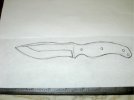
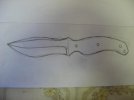
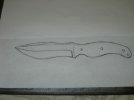
I normally do pretty detailed scale drawings, I'm not real good at calculating radiuses and since this is a curvy knife I just sketched an erased until I was comfortable with the overall look.
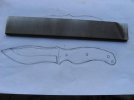
This is the knife I was hoping to trade steel/lignum for. I found a good and dull Nicholson file down in the shop that eclipsed my 1:1 sketch so I figured This will be a good start. if there's anything I don't like about the design, I can fix it on the more expensive stainless version.
Some quick and dirty specs:
OAL: 7 3/4"
handle length: 3 7/8" (to quillion(?))
Material: 1095 File
thickness: about 7/32"
Let me know what you think!
 

Attachments

  • IMG_0972.jpg
    IMG_0972.jpg
    16.2 KB · Views: 136
Hey, that's gonna be a nice looking blade. I'd take a little bit of the down curve out of the spine but other than that I think it looks fantastic!
 
Thanks Erik,
Do you mean toward the handle? If so i can see your point in minimizing the point of failure...
 
The primary grind, as it goes to the tip, goes all the way to nothing. So unless the sides are tapered (distal taper) the end is going to be wide like a screwdriver. Otherwise you have three grinds going on at once on the tip there, which I have never seen before.

The balance may be clunky if you maintain full blade thickness all the way to the end on a blade shape like that. A high grind, distal taper, fuller or false edge might help keep the blade from being clunky.

Overall, I think it is a nice (if unusual) shape.
 
Thanks Erik,
Do you mean toward the handle? If so i can see your point in minimizing the point of failure...

More of a comfort factor was my issue. It will be a thin point between forefinger and your grip I think.
 
The primary grind, as it goes to the tip, goes all the way to nothing. So unless the sides are tapered (distal taper) the end is going to be wide like a screwdriver. Otherwise you have three grinds going on at once on the tip there, which I have never seen before.

The balance may be clunky if you maintain full blade thickness all the way to the end on a blade shape like that. A high grind, distal taper, fuller or false edge might help keep the blade from being clunky.

Overall, I think it is a nice (if unusual) shape.
I may be confused:confused: or my sketch too sloppy... My intention is to do a primary/secondary on bottom and a false edge on top
2+1.....wait a sec... that does = 3 hmmm. I didn't think it all that unique.
Do you think there will be any functional drawback? I'm looking for a real sturdy design. A distal taper probably isn't a bad idea. Convex grind maybe...
 
I played around w/ th' sketch and decided to draw the false edge back a bit, hopefully reinforcing and uncomplicating the tip, I also reduced the drop and moved the uppermost quillion a little more forward.

Not long after my first post, my buddy called and asked if I wanted a chopsaw for free. And he threw in some metal stamps!
Some days are better than others. :thumbup:
 

Attachments

  • IMG_0974.JPG
    IMG_0974.JPG
    19.5 KB · Views: 508
Stupid newbie question alert! Stupid newbie question alert!:D

Does the recurve serve an actual purpose or is it a looks thing?:confused:

Thanks!:D
 
It improves slashing by effectively adding more cutting edge length places the cutting edge in an effective slashing attitude. And it looks sexy!
 
Stupid newbie question alert! Stupid newbie question alert!:D

Does the recurve serve an actual purpose or is it a looks thing?:confused:

Thanks!:D

A couple of functions to go w/ the aesthetic...
#1 "waisting" the blade aids dramatically in penetration. Being a knife combat practitioner, we practice cutting and stabbing on a variety of surfaces including tires, corrugated cardboard, rags taped over dowels and meat w/ bones. A knife w/ a recurve i.e. a Gerber mk II (older) or Ken Onion blur penetrates much easier than a SOG Desert dagger or SOG Pentagon Elite. It's a matter of resistance.
#2 the massive head of a recurve increases the force of contact, which is especially useful in getting those elusive radial and brachial arteries. smashing through tendons and protective tissues as well as putting the cutting edge farther into key recesses. which brings me to
#3 Femoral artery attacks the broad front/narrow back allows you to kind of hook that hard to reach femoral using an outside cut from fencer's grip.
#4 I rarely use the recurve portion of my blades keeping them sharper almost as a second cutting surface for tougher stuff.
I hope this doesn't gross anyone out, I'm really a peaceful guy, I just enjoy what I do.;)
 
I may be confused:confused: or my sketch too sloppy... My intention is to do a primary/secondary on bottom and a false edge on top
2+1.....wait a sec... that does = 3 hmmm. I didn't think it all that unique.
Do you think there will be any functional drawback? I'm looking for a real sturdy design. A distal taper probably isn't a bad idea. Convex grind maybe...

Yeah, you're not understanding me. But I think you will figure out what I'm talking about when you start to grind it.

The way that grind is drawn you have the full blade width at the tip. It won't be a point, it will be a screw driver.

attachment.php


It will need to be something more like this:

attachment.php
 

Attachments

  • mat.jpg
    mat.jpg
    23.6 KB · Views: 494
Thanks Nathan, I'm just a dumba$$. I see exactly what you're talking about. Like Communism it looked good on paper...
 
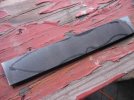
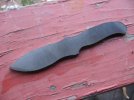
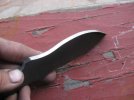
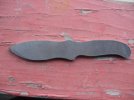
Well I Blanked out and profiled the blade today...

The file was set in the oven @ 500F x2hrs. and allowed to cool over night.

I cut the bar down to length w/ a little over 1/4" on either side to protect the heat treat where the blade will begin.

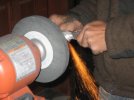
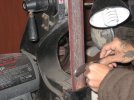
I profiled the majority of the blade w/ a coarse 8" grinder.
Leveled the facets w/ a 4x36" belt grinder and a sanding drum on a dremel.

I ran into a couple of ergonomic issues on the handle, but now I think it feels ok. (Then again I once made rice + chocolate syrup and thought it was ok) We'll see when it has scales.

Tomorrow I start the bevels.
 

Attachments

  • IMG_0981.jpg
    IMG_0981.jpg
    26.5 KB · Views: 34
  • IMG_0982.jpg
    IMG_0982.jpg
    63.8 KB · Views: 47
  • IMG_0985.jpg
    IMG_0985.jpg
    53.2 KB · Views: 43
  • IMG_0990.jpg
    IMG_0990.jpg
    43.2 KB · Views: 42
  • IMG_0996.jpg
    IMG_0996.jpg
    47 KB · Views: 54
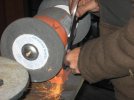
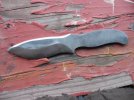
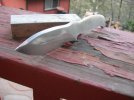
So w/ profiling out of the way... Time to start beveling! First, I removed 99% of the file gouges. Not quite PG, but it came out good so far. I primarily used the side of the med grinding wheel. Next I began the bevels. This was the maiden voyage of my new 4x42" belt grinder I finally figured out that swept ricasso line. Boy, was I stoked. I'm still playing w/ the grinds to even them up. New machine has a bit of a learning curve. I did the false edge and am still tinkering w/ the tip. Right now, it resembles a snakes head, Which I kinda' like, but we'll see how it goes The lines are pretty crisp, but my edge is getting thinner faster than I can get the primary bevel flat. I guess that's why they call it practice. Thanks again for looking! I'm off to the shop...
 

Attachments

  • IMG_0997.jpg
    IMG_0997.jpg
    36.7 KB · Views: 43
  • IMG_0999.jpg
    IMG_0999.jpg
    40.5 KB · Views: 39
  • IMG_1001.jpg
    IMG_1001.jpg
    49.2 KB · Views: 59
  • IMG_1003.jpg
    IMG_1003.jpg
    52.1 KB · Views: 76
  • IMG_1004.jpg
    IMG_1004.jpg
    37.4 KB · Views: 63
I've got it pretty clean now. Just working thru the finer belts. I'll probably hand rub out to 2000gr. I want a nice anti-reflective finish but dont have a sandblaster or parkerizing setup. Any suggestions?
Mexican anodizing just won't work for me this time. (I spraypaint just about everything but knives)
Will I get nice even results from mustard?
 
Back
Top