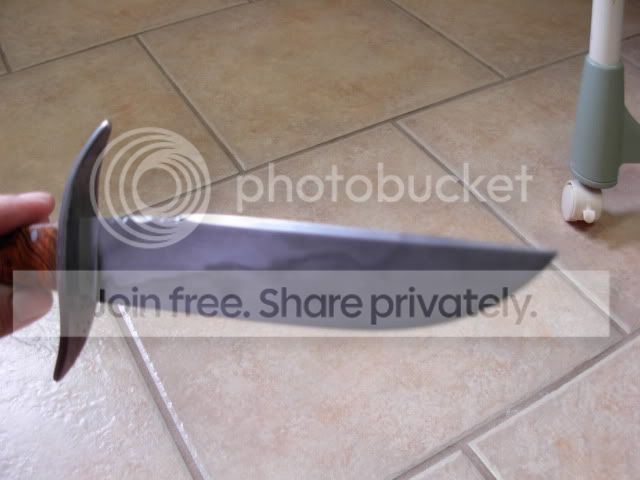
1095...So what's the verdict?

I should add that there is something to be said for fitting the steel to the HT rather than fitting the HT to the steel.

Also, I don't concern myself with any type of "idealism", including metallurgical, because it only exists in the mind,... like "perfection". I don’t use idealism or “pure performance” as a selling point for my knives or as a marketing strategy. There are many other factors to consider with "overall performance" and customer satisfaction,... not just HT.

lol, I have to admit...thats the biggest BS excuse I've herd in a long time for mediocrity.:rolleyes:
 
Perhaps the invention of the Rockwell Hardness tester dawned the age of glass hard hunting knives and the idea of this high degree of hardness being somehow superior. Is it really? I bet this was not always the case.
 
We've been moving from greater hardness to greater toughness since we stopped using obsidian. I suspect we've swung the pendulum back the other way and are heading toward hardness again. I suspect they would have taken glass hard hunting knives if they could get them and not have them break. Now we can have both, and that's how we like it.
 
We've been moving from greater hardness to greater toughness since we stopped using obsidian. I suspect we've swung the pendulum back the other way and are heading toward hardness again. I suspect they would have taken glass hard hunting knives if they could get them and not have them break. Now we can have both, and that's how we like it.

I'm guessing during the middle ages it was more important to have flexibility and toughness...especially in one's sword....lest it break into wee splinters on someones iron clad head.:D I agree with you, it is nice in this age that we can have the best of both worlds. Interesting though how readily cavemen seemed to drop their glass blades for tougher, less brittle material...copper, bronze and eventually iron....or maybe they just liked the shiney stuff.
 
Last edited:
We CAN have the best of both worlds. 1084 is still relatively tough at pretty high hardnesses if tempered right. In the old days knives were often tempered by holding over a fire by eye (according to Stacey's post a month ago), so they were often brittle unless significantly softened. Today we use multiple longer tempers to give it a thorough temper as well as rid of the retained austenite.
 
Since it bares directly on this thread and th OP's questions I thought I'd post this here

SSBowie016.jpg


Lousy pic, but it does show the hamon.

Blade was ground to approx. .010 before HT. Instead of leaving extra "insurance meat" on the thickness of the blade I left it on the height leaving approx. 1/16 to be ground off after performance testing.

Ht process-

Coat blade with anti-scale wash coat.

This is not the powder kind. It is the anti-scale available from Brownells. I dillute the antiscale with hot water. Approx. a few tablespoons worth of water then dip small fantail paintbrush in the anti-scale and mix to what is still basically the consistancy of water.

Clean blade with acetone (thanks Joe Mandt for that tip) then heat with a heatgun and paint a wash over the entire warmed blade. This ends up an extremely thin coating but it's enough to prevent scale.

Put blade in Evenheat when temp reaches 1400 degrees. let come up to 1475 degrees then a 5 minute soak.

Remove and quench point down into a coffee can of canola oil. :eek:
*I am aware that this is not the ideal quench tank or meduim for 1095*

Temper 2 hours 2 times at 400 degrees.

Shapen up blank and performance test edge with chopping seasoned oak 2x4 and brass rod test the entire length of the edge several times. 2thumbs


No attemp was made at getting a Hamon on this blade at all.

This is my interpratation of what I "think" this blade is telling me.

Cross section plays a large roll in quench speed.

As is common knowledge- Canoloa oil is an insuffient quench speed for 1095 in all but the thinnest cross sections. Like 1/8" or under.

ASSUMTION- I have what is basically the same HT that I would have if I clay coated and quenched in Parks #50.

Just because this quench produced a nice and active hamon does that tell me that I have the same properties in my blade as a blade quenched in a faster medium ?

I am by no means advocating this as a proper way to HT 1095 blades and do realize that attempting to get a hamon with this method may or may not produce the desired result and little to no control over the hamon will be possible.

I bring the dead horse of 1095 quench up yet again because I was shooting for a non-differetial HT on this blade so now I'm not really sure if I'm interpreting what this blade is telling me correctly.

What it's really saying is get a proper quench tank and the Parks, LOL.

I'd also like to hear opinions on the variables of 1095 and canola quench.

Thanks, Josh

 
What should the Rockwell rating be with a fully hardened blade of 1095? What is the hardest this steel will get? I think I'm going to take some samples in and get them tested.
 
I think I found the place that carries the Houghton Quench K....Can-Four Industrial Supplies in Airdrie? Thanks Rob!
 
Last edited:
What should the Rockwell rating be with a fully hardened blade of 1095? What is the hardest this steel will get? I think I'm going to take some samples in and get them tested.

1095 would be max 66 rc as-quenched, but often gets 65 rc because of some retained austenite. Please let us know your results.
 
lol, I have to admit...thats the biggest BS excuse I've herd in a long time for mediocrity.:rolleyes:

You might like this too then. I'm not striving for "perfection",... because it doesn't exist.

I don't waste my time with it.

I just try and make a consistently "good" knife… Beyond “good” is where the BS really comes into play.
 
I've known a few guys that strived for perfection. They no longer make knives.

I am confident I could make a very good knife from 1095 quenched in veg oil.

It's not what you use, it's how you use it :)
 
I tend to take a similar tack to Tai's on this issue. One gets awfully discouraged very quickly when chasing the unattainable.

I try to continually improve. If the knife I just finished isn't better than the one before it, that's a problem for me. If my next knife isn't better than this one, that too is a problem. Improvement comes in very small incriminents. Maybe that just means I'm a slow learner, but I don't ever need to get to "perfect" as long as I keep getting better.
 
I've known a few guys that strived for perfection. They no longer make knives...

I sure hope it doesn't happen to me. :(

I thought that striving for perfection meant trying to do the best you can and trying to improve. Sorry if I misunderstood, my grasp of the English language is lacking sometimes.

Patrice
 
If perfection was my goal,... failure would be the only possible outcome.

Cubic zirconia is more "perfect" than real diamond, but which would you rather have?

Perfection to me is boring...

You can do a good job with canola, if you realize that it is not perfect or ideal. Using an engineered quenching fluid is not fool proof or a guarantee that you will have superior results....
 
Patrice Lemée;7878549 said:
I sure hope it doesn't happen to me. :(

I thought that striving for perfection meant trying to do the best you can and trying to improve. Sorry if I misunderstood, my grasp of the English language is lacking sometimes.

Patrice


Trying to improve is good.

"Best" is another absolute like perfection... I don't want to ever do my "best", because then I couldn't improve. If I hit a dead end like that, I might as well hang it up. That will never happen anyway though... it's equally unattainable and abstract. :)
 
Last edited:
You are correct, that "perfection" in our live is unattainable..in anything

BUt improvement and excellence isn't. Merely doing "what works" or what you're comfortable with is a sure way to become stagnant or get left in the shadows .
Just because you can not do something perfect doesn't mean you should quit trying to improve
 
Using an engineered quenching fluid is not fool proof or a guarantee that you will have superior results....

You're right. It does however reduce the number of variables one has to control in order to achieve what I personally strive for which is "the best I can do". As I learn more, I know more about how I can do better. If I do not take advantage of all of the tools I have to work with (my knowledge being key among them), then I am not doing the best I can do.

I have knowledge, based on scientific experimentation and industry testing data, combined with my own empirical evidence that tell me that an engineered quenchant will cool my steel in a more rapid, efficient, and even fashion. This means a greater conversion of austenite to martensite, along with fewer issues with warping and cracking, which means, at the end of the day, a batter performing knife. I know this and can demonstrate it repeatably to anybody who wants to come visit. If I do not use this knowledge in concert with the tools I have available, I'm not doing "the best I can do" and that's not fair to me, or my customers.

-d
 
Trying to improve is good.

"Best" is another absolute like perfection... I don't want to ever do my "best", because then I couldn't improve. If I hit a dead end like that, I might as well hang it up. That will never happen anyway though... it's equally unattainable and abstract. :)


best is not a substitute for perfection........

Good....water

better... canola oil

best.. a commercial quenchant suited for the steel being used.

Best: Superlative of good.
Most satisfactory, suitable, or useful; most desirable: the best solution; the best time for planting.
 
Back
Top