A problem with the GEC #73 and blade play ... and gaps... *Problem solved*

This process will also work on a two bladed slip joint as well. I have done it on a couple with great results!
 
Nice work Andi.
I have a few follow up questions though.
Does anybody have a good cutaway of the entire pin, bolster, blade tang etc assy?
How does peening the pin make the pivot tighter?
Are you actually deforming the metal to make better contact with the hole in the bolster?
Thanks guys.
Lenny

Squeezing the knife makes the pivot tighter. Peening afterwards to deform the pin so it better contacts the bolster is to help keep the play from returning. If you don't, there is nothing keeping the bolsters squeezed in tight.
 
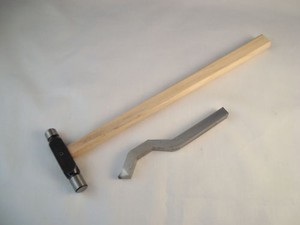
I'm thinking of picking a ball pein hammer and a small vice just for this kind of job, and have some questions ...
What hammer weight would be best, or is not that relevant ? (4 8 16 24oz) leaning towards the 8oz myself.
Would a small vise work ( let's say 2 inch opening) or i'll better find access to a big strong one ?
Thanks
 
Bought a small clapping vice and an 1 oz pein hammer, some sandpaper, and fixed the blade play on my case medium stockman and queen canoe, hopefully for good. The only problem is that after all the squeezing and hammering, though light, the blades are harder to open, but i'm hoping they will break in after some use.
Also, the queen main blade sits very very close to the small blade when closed, a bit of rubbing comes into play if i slightly flex it towards it when closing.
 
Hi Jack!

Thank you for updating.

May I ask you, if you fixed one side with two blades? How does is look now? Are the gaps completelly fitted? I´m interested in how it works, when you are fitting a multi-spring knife. How does this procedere work on the multisprings.

My #73 also closes like a tank now and is a little harder to open, but that´s ok. The knife feels now more safer than before.

:)

Kind regards
Andi
 
Hi Andi,
Two blades or one, it made no difference, gaps are gone, and so is the blade play. It looks good.
The queen had some big gaps, and the blades are thinner than the backspring, thus there was a lot of blade play in both. Now that the gaps are gone, even though the blades tangs are not of the same thickness as the backspring, blade play is gone.
The stockman is the one that's much harder to open, and i'm thinking it's because the thickness is the same both tangs and backsprings, and i've tightened quite nice..:eek:
And with some sandpaper work on the bolsters, i made both knives look like i haven't messed with them.
 
Thank you for the info, Jack. I was just wondering, how it will work, when there is a liner between the two springs. But now I can imagina how it works :)

Which hammer did you get? This seems to be the key (for me), not scratching the bolsters very hard. I don´t have small hammers, which would be right for that work. But I think, that would make a nice addition.

Kind regards
Andi
 
i've used a small 1 oz pein hammer, i think is pretty common in jewellery making. It's similar to this one right here :
$(KGrHqJ,!lYE1FwLJksEBNYSbykW3Q~~_35.JPG

I did scratch the bolsters a bit, but the sandpaper took care of that. I guess it's very easy to make them mirror polished too.
I'll take some pics soon, and post them here.
 
Thank you... now I have a reason haunting the hardware store once again... :) :D

Kind regards
Andi
 
I wonder if using a pin punch would work, it might save some work having to sand the bolsters if you worked carefully
 
I wonder if using a pin punch would work, it might save some work having to sand the bolsters if you worked carefully

I don´t think, that this would work. Because you have to tighten the bolsters/pivot. With a pin punch you would just get the pivot pin through the bolster without tighten the pivot. The loose pivot makes the blade play.

Kind regards
Andi
 
I don´t think, that this would work. Because you have to tighten the bolsters/pivot. With a pin punch you would just get the pivot pin through the bolster without tighten the pivot. The loose pivot makes the blade play.

Kind regards
Andi

Hmm, that is a good point. What if you used a punch that was just slightly larger than the pin (maybe you could also file down the edges of the pin punch to be more rounded so there is no damage to the bolster). I also assume that when you are using the pin punch that the opposite side of the bolster is resting against something hard and metal so that the pin cannot move out of the pivot so the only thing it could do is expand
 
I know what you mean.

But need something to keep the pin punch in straight way. So a vice or something like that is needed. If you use the steel made pin punch and the pivot pin and another steel made pin punch - you have metal on metal. I think there must be something between (like leather) to get any result. There would be no effect, I think. The pivot pin need space to extract so that the pivot can be tightened. The other point is, that the mounted pin punch (in the vice) must hit the small pivot pin to get the job done. Very difficult.

Your idea seems to be nice. But imo, the way of using an leather belt would definitelly fix the problem better.

When my #73 needed some repair, I thought many things how to solve it. But just with help and the ideas of Kevin I was able to fix it.

Kind regards
Andi

P. S. I hope you know what I mean. Technical details are hard for me to explain in english language.
 
Hey Andi, yes I understand what you mean. It's good to get feedback from someone that has actually done this kind of repair. I have 1 or 2 knives I have been thinking about trying this on. Thanks for the comments, I appreciate it. Most likely I will try your tried and true method as its also cheaper since I do not have to buy a pin punch.
 
I´m glad I could help you.

I´m looking forward to hear about the results you´ll get.

As Kevin already said, no big fix. But it can be tricky. While working with the vice. Don´t use to much strength (or force). If the pivot pin just appears a little out of the bolster, the problem should be solved. Do not over-tigthen the bolster/pivot pin area. Imo this could cause some damage on the whole knife. (As far as I understand the whole thing, the blade would be able getting closed or opened is this happens)

Kind regards
Andi
 
Bought a small clapping vice and an 1 oz pein hammer, some sandpaper, and fixed the blade play on my case medium stockman and queen canoe, hopefully for good. The only problem is that after all the squeezing and hammering, though light, the blades are harder to open, but i'm hoping they will break in after some use.
Also, the queen main blade sits very very close to the small blade when closed, a bit of rubbing comes into play if i slightly flex it towards it when closing.

Jack, most likely you've made the knife too tight with the squeezing and hammering, the scales are binding the tang too tightly. There are a couple of easy fixes for that. First, you have to determine at what points the blade is tight, if it's too tight at both the opening and closing positions, you need to free up the blade a bit. Here's how:

First, a word on the knife parts;

The scales are the liners, NOT the handle material. Handle materials are the "covers" or "handles" (of course). This is a big faux pas among collectors and even some handle manufacturers. Anyone working in the knife industry immediately knows a forumite's talking to them when they hear a cover being referred to as a scale. DON'T be one of those people! (I'm referring to everyone here ;):D )

The blade back is the spine of the blade, tang is the flat section that rides in the knife, shoulder is the point at which the tang meets the ground blade, kick is the area on the tang that contacts the backspring, usually raised to a point, choil is the small cutout area at the base of the blade edge just above the kick.

Front edge of a knife is the area of the handle that the blade drops into, back is where you'll find the backspring.

OK, now, to loosen the blade a bit you want to open the knife blade halfway and place the blade at approximately a 45 degree angle against the edge of a hard surface. You want the kick, along with the blade edge, to be in contact with the surface, but it's the kick that absorbs most of the impact. You need some kind of mallet for this, preferably a plastic headed one so that you don't damage the blade, or a smaller headed peining hammer. I've used a regular claw hammer in the pics since that's all I could get my hands on with the light ebbing away, but that's total overkill and not recommended. Strike the blade spine LIGHTLY just above the shoulder, and do it straight down, not at an angle as it looks in the picture. What you're doing is giving the blade a slight jolt, with the angle giving the knife a slight twist and loosening the scales at the bolsters. You want to do this lightly so you don't wind up with a rocker again, or worse pulling the pins through. You can then turn the knife so you're going from the opposite side, and give it a slightly lighter tap to even things up. It shouldn't take much, just a tap, if it doesn't get better try it again a little harder. Work the blades open and closed to see if this helps, and if there are two blades involved try it on the tightest blade first, then work both blades to even things up:

2lxtk5y.jpg
[/IMG]

ht5qg1.jpg
[/IMG]

If you've got a blade that snaps open fine but closes with difficulty, like it's binding up, oftentimes all you need is a little tweek to get things working. You'll need a narrow well tapered blade for this, such as a muskrat blade. Open the problem knife blade halfway and slip the tip of the muskrat blade between the tang and the OUTSIDE scale (I know I've got it against the center scale in the photo but that's just for a clear pic). While holding the tip in tightly, but not moving it, pull the problem blade closed very slightly to approximately halfway to the closed position, or until you feelk a bit of resistance, and then pull the mukrat blade out. This is kind of a fluid motion, don't go too slow. What you're doing is giving the blade very slight amount of room to drop down, unnoticeable but it helps. Don't push the blade too far into the knife or too far into the tang, you just want to catch the tip of the blade closer to the shoulder of the problem blade. The pics should clarify things a bit. Note how I'm holding the subject knife blade so that I can pull it down a bit before pulling the musky blade out. DON"T use any kind of fat blade for this or you'll wind up bending the scale:

n4wby0.jpg
[/IMG]

288vau1.jpg
[/IMG]

For a blade that's a little off center when closed, you can crink it. Normally tangs are annealed to spring temper, along with a bit of the blade, usually about 1/8" or so up from the shoulder. This is the area you want to bend. Open the blade halfway. This is important, opening it all the way risks losening the blade since you're torqueing against the outer edge of the bolster, always a no no. Place the knife down on a flat surface with whatever direction you want the blade to bend facing you. Put something a tad forgiving, like a piece of leather or soft wood like pine under the blade about halfway up the blade or less from the shoulder. The leather should be about 3/8" thick, you want the blade to be fairly parallel to the work surface, doesn't have to be exact. Again I'd definitely recommend a plastic headed mallet for this. Not a tiny one, I'm talking one with heads about an inch and a quarter across, you need a little heft. Now you want to hit the blade just above the shoulder, at the soft spot, and remeber to check that leather piece before you hit. The closer it is to the shoulder the better, but you still need some room for the blade to flex. Too close to the tip and you risk bending the blade too far up or worse snapping it. The area that I have the leather (No I don't use a key chain, but it would work in a snap!:D ) is about where I'd have it for this blade. Small blades don't need a very hard hit, larger blades of course need more umpf. Start light and see how it goes, you can always go harder. If it goes too far just turn it over and hit the other side, although you want to hit it lighter or you'll just keep going back and forth until the blade snaps. There is a bit of a learning curve for all these steps, you need to develop a feel for it, but you'll get it. In the photo below the knife blade points to the area you want to hit, you want to angle the mallet so only the edge hits the blade. This is shown in picture two, again don't use a huge hammer like that, I'll post a pic tomorrow of what I use. Also, there should be nothing in contact with the blade between the bolster and the leather piece. The picture makes it seem that the notch on the stiddy is in contact with the tang, but it's not.


msoieq.jpg
[/IMG]

2n1yqdg.jpg
[/IMG]


Good Luck!!

Eric

PS- Here's a video of Trevor Ablett, note after he assembles the knife the blades are a bit tight and he employes the same methods as above to loosen it. He holds the knife a bit differently but the method is the same. Now HE'S a real master!

http://www.youtube.com/watch?v=Kc9ru-iQnR0&list=UUBzHdUkDWkF49fh3xKeOblA&index=4&feature=plcp

 
Last edited:
ea42, thanks for the tutorial. I have used many of these techniques myself ~ some taught me as a child by a friends father, others learned through doing.

One question though. I have never heard knife folks (collectors or makers) refer to the liners as scales. You have made me go a searching now......will report back later, news at 11!
 
Eric,
Thanks for that, it is appreciated. I love to learn something new almost as much as I dislike being proven wrong. Now I am going to obsess about this, and will feel compelled to correct others. Crud, people will hate me even more than they do now. Hah!
I guess I should have known/remembered this terminology, as a kid I had read through some older repair guides for slipjoints, and later Mr. Harris' book too (which I just looked up and it uses the term scale for the liners). However, even back then the term liner was also used in some of the other published materials (35 years ago). What's interesting to me is that when I just now went a searching I found that even Case now calls the scales the liners.
I wonder when the usage of terms changed in popular use, and what caused the change?
 
Back
Top