
-
The BladeForums.com 2024 Traditional Knife is available! Price is $250 ea (shipped within CONUS).
Order here: https://www.bladeforums.com/help/2024-traditional/
You are using an out of date browser. It may not display this or other websites correctly.
You should upgrade or use an alternative browser.
You should upgrade or use an alternative browser.
Attention Beginner Knife Makers
- Thread starter Burl Source
- Start date
- Status
- Not open for further replies.
I found a link to Northcoast knives they had a Tutorial on Stabilizing Wood. This is what it said:
Stabilizing Wood
I love using stabilized woods: the grain really pops out , they have the consistency of micarta or Corian, and you are assured that they will never be affected by moisture or humidity. This means that they will never shrink, expand or warp,( a small but common problem when using any natural materials for knife handles) . Unfortunately, I'm also cheap and hate the cost of processed stabilized woods. Plus you're at the mercy of whoever you order it from, to pick a piece out of the pile for you. I looked at a lot of different ways to do this yourself to a slab of wood that you've fallen in love with without having to make or buy an expensive vacuum set up normally used. I modified a process that I heard about and found that this works mighty well.
Here's what you need to start: a one pint can of Minwax High Performance Wood Hardener, an airtight jar large enough to hold the scales you're treating , a coffee can large enough to hold the entire jar and a nearby saucepan to keep a constant supply of boiling water at hand. I'm going to do a nice set of maple burl scales here.
Safety note: When I first read about this home process, the writer suggested using a double boiler set up ( The jar sitting in a pan of boiling water) on a hot plate to heat the Minwax Wood Hardener in the jar. I'm not the brightest guy you'll ever meet, but this stuff has ketones in it. Uh...yeah. The fumes from the ketones are so EXTREMELY flammable that I could never bring myself to recommend this particular technique to anyone, no matter how well you think you can sit there and supervise this. IT"S DANGEROUS!!!!. If you really want to do it this way, make sure you do it in the home of someone you really don't like. Use Google to look up "Flash Fires". If you're using anything with ketones in it, try keep it at least seven miles away from any open source of heat.
Set the scales inside the jar and cover with wood hardener. Set the lid on loosely and set this inside the coffee can
Pour boiling water in the coffee can to surround the jar. The object here is to safely heat the wood hardener in the jar. By the way, please make sure the area is very well ventilated. The smell is very strong enough to strip wallpaper and will assuredly lower your IQ by a few points if inhaled for a long time. Outside is best, by an open window is a second choice.
Keep replacing the water as it cools off to keep raising the temperature of the wood hardener almost to the point of the boiling water. You are also opening up the pores of the wood. I put a very small hole in the base of the coffee can to allow the hot water to gradually drain as it cools.
You'll see the wood hardener bubble like ginger ale as the air is displaced in the wooden slabs. Keep doing this for about a half hour until the jar and the wood hardener is so hot that you need an oven mitt to hold it. I didn't say very warm, I said HOT.
Remove the jar and screw that lid down tightly. Remember your high school physics class? As the closed jar cools off, a vacuum will be created inside which will draw the wood hardener into those newly opened pores. Let it cool off slowly and keep the jar sealed for a week or so. The white stuff on the side of the jar is some of the wood hardener that foamed over the lip.
Take the scales out and let them cure in open air for a few more days. You can reseal the jar with the wood hardener in it, and store it for future projects. Wow, look at these things! Beautiful!. You'll also notice that since they soaked up so much wood hardener, they are twice as heavy.
Notes: This works great for 3/8" thick scales and the wood hardener soaks all the way through. I haven't tried this process with blocks yet, but I'm going to assume that it's best if you do some preshaping first to get the block close to a final shape before you do this. This also works best with softer woods ( like redwood ) and open pore woods ( just about any burl ). Some heavy and dense woods ( like cocobolo or ironwood ) won't work well, but they really didn't need to be stablized in the first place.
I am wondering what you guys think of it? Would this be a good way to stabilize the scales? John
Stabilizing Wood
I love using stabilized woods: the grain really pops out , they have the consistency of micarta or Corian, and you are assured that they will never be affected by moisture or humidity. This means that they will never shrink, expand or warp,( a small but common problem when using any natural materials for knife handles) . Unfortunately, I'm also cheap and hate the cost of processed stabilized woods. Plus you're at the mercy of whoever you order it from, to pick a piece out of the pile for you. I looked at a lot of different ways to do this yourself to a slab of wood that you've fallen in love with without having to make or buy an expensive vacuum set up normally used. I modified a process that I heard about and found that this works mighty well.
Here's what you need to start: a one pint can of Minwax High Performance Wood Hardener, an airtight jar large enough to hold the scales you're treating , a coffee can large enough to hold the entire jar and a nearby saucepan to keep a constant supply of boiling water at hand. I'm going to do a nice set of maple burl scales here.
Safety note: When I first read about this home process, the writer suggested using a double boiler set up ( The jar sitting in a pan of boiling water) on a hot plate to heat the Minwax Wood Hardener in the jar. I'm not the brightest guy you'll ever meet, but this stuff has ketones in it. Uh...yeah. The fumes from the ketones are so EXTREMELY flammable that I could never bring myself to recommend this particular technique to anyone, no matter how well you think you can sit there and supervise this. IT"S DANGEROUS!!!!. If you really want to do it this way, make sure you do it in the home of someone you really don't like. Use Google to look up "Flash Fires". If you're using anything with ketones in it, try keep it at least seven miles away from any open source of heat.
Set the scales inside the jar and cover with wood hardener. Set the lid on loosely and set this inside the coffee can
Pour boiling water in the coffee can to surround the jar. The object here is to safely heat the wood hardener in the jar. By the way, please make sure the area is very well ventilated. The smell is very strong enough to strip wallpaper and will assuredly lower your IQ by a few points if inhaled for a long time. Outside is best, by an open window is a second choice.
Keep replacing the water as it cools off to keep raising the temperature of the wood hardener almost to the point of the boiling water. You are also opening up the pores of the wood. I put a very small hole in the base of the coffee can to allow the hot water to gradually drain as it cools.
You'll see the wood hardener bubble like ginger ale as the air is displaced in the wooden slabs. Keep doing this for about a half hour until the jar and the wood hardener is so hot that you need an oven mitt to hold it. I didn't say very warm, I said HOT.
Remove the jar and screw that lid down tightly. Remember your high school physics class? As the closed jar cools off, a vacuum will be created inside which will draw the wood hardener into those newly opened pores. Let it cool off slowly and keep the jar sealed for a week or so. The white stuff on the side of the jar is some of the wood hardener that foamed over the lip.
Take the scales out and let them cure in open air for a few more days. You can reseal the jar with the wood hardener in it, and store it for future projects. Wow, look at these things! Beautiful!. You'll also notice that since they soaked up so much wood hardener, they are twice as heavy.
Notes: This works great for 3/8" thick scales and the wood hardener soaks all the way through. I haven't tried this process with blocks yet, but I'm going to assume that it's best if you do some preshaping first to get the block close to a final shape before you do this. This also works best with softer woods ( like redwood ) and open pore woods ( just about any burl ). Some heavy and dense woods ( like cocobolo or ironwood ) won't work well, but they really didn't need to be stablized in the first place.
I am wondering what you guys think of it? Would this be a good way to stabilize the scales? John

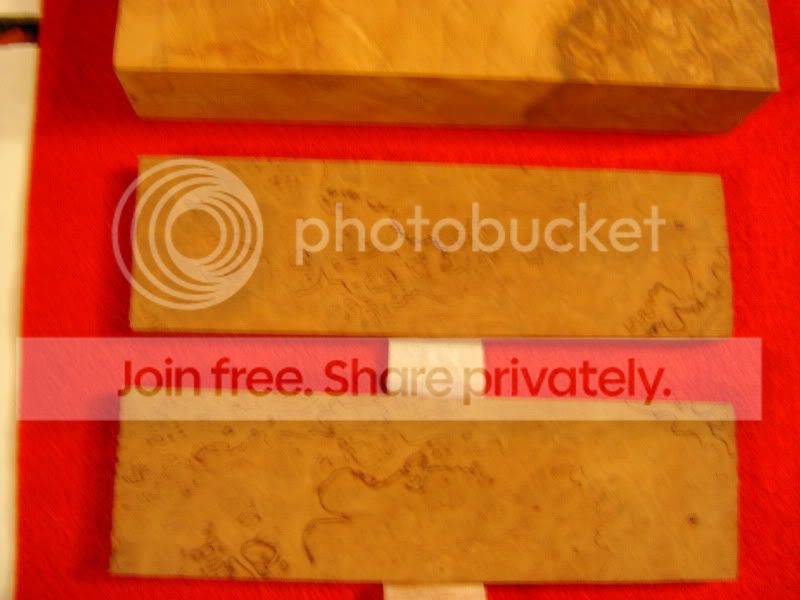
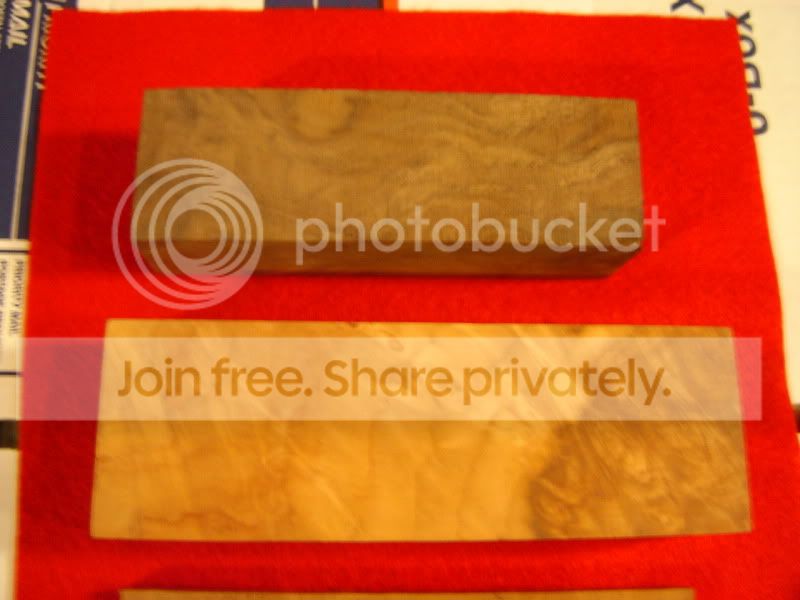
- Joined
- Jan 6, 2010
- Messages
- 125
Shipped some more beginner wood today.
Packages went out to:
Larry Johnston
John Gregory
J Hotinger.
I hope you guys have fun.
Squiggly,
Your knife looks good. In the future with walnut or other open grained wood (visible pores) try wetsanding with tung or true oil. The slurry that is formed will fill the pores for a smoother surface. Don't hesitate to experiment. That's how you figure out what you like best. If anyone messes up their wood or needs a little more, that's ok. I go thru the paypal payments and ship the beginner wood about once a week.
The Knife was a gift to a friend. I didn't like the finish that it had so I asked for it back and redid it. Did a few more Oil applications and did the wet sanding thing. That worked real well, Thanks.
Another thing I did was layer on CA glue in about 15 or so coats. Have to Let it dry real good between coats. But then I sanded her down and did some buffing and now it's like a glass finish on it. helped a lot with the depth
I bought some Nelsonite gonna be experimenting with it some as well.
Also plan on getting some BLO. Been told it takes along time but it's well worth it.
I want to try some stain experiments but afraid of messing up the wood ...LOL. You know just add in highlights and maybe depth. I've seen some beautiful work and would love to do some as well.

- Joined
- Dec 7, 2008
- Messages
- 7,187
Don't be afraid to experiment. Sometimes a mistake can turn into something good. I am doing a little experimenting myself right now with some extremely spalted maple burl. It didn't have much color so I found some aniline dye in one of the workshops here. I mixed it and put it under vacuum for a couple days. After it is good and dry I will stabilize the blocks. They are bright neon orange. I hope they stay that bright after completely dry and stabilized. I figured a knife with this for a handle will never get lost. In the end, when my experiment is complete, I will either have something cool, or maybe just weird.
The Knife was a gift to a friend. I didn't like the finish that it had so I asked for it back and redid it. Did a few more Oil applications and did the wet sanding thing. That worked real well, Thanks.
Another thing I did was layer on CA glue in about 15 or so coats. Have to Let it dry real good between coats. But then I sanded her down and did some buffing and now it's like a glass finish on it. helped a lot with the depth
I bought some Nelsonite gonna be experimenting with it some as well.
Also plan on getting some BLO. Been told it takes along time but it's well worth it.
I want to try some stain experiments but afraid of messing up the wood ...LOL. You know just add in highlights and maybe depth. I've seen some beautiful work and would love to do some as well.
I found a link to Northcoast knives they had a Tutorial on Stabilizing Wood. This is what it said:
Stabilizing Wood
I love using stabilized woods: the grain really pops out , they have the consistency of micarta or Corian, and you are assured that they will never be affected by moisture or humidity. This means that they will never shrink, expand or warp,( a small but common problem when using any natural materials for knife handles) . Unfortunately, I'm also cheap and hate the cost of processed stabilized woods. Plus you're at the mercy of whoever you order it from, to pick a piece out of the pile for you. I looked at a lot of different ways to do this yourself to a slab of wood that you've fallen in love with without having to make or buy an expensive vacuum set up normally used. I modified a process that I heard about and found that this works mighty well.
Here's what you need to start: a one pint can of Minwax High Performance Wood Hardener, an airtight jar large enough to hold the scales you're treating , a coffee can large enough to hold the entire jar and a nearby saucepan to keep a constant supply of boiling water at hand. I'm going to do a nice set of maple burl scales here.
Safety note: When I first read about this home process, the writer suggested using a double boiler set up ( The jar sitting in a pan of boiling water) on a hot plate to heat the Minwax Wood Hardener in the jar. I'm not the brightest guy you'll ever meet, but this stuff has ketones in it. Uh...yeah. The fumes from the ketones are so EXTREMELY flammable that I could never bring myself to recommend this particular technique to anyone, no matter how well you think you can sit there and supervise this. IT"S DANGEROUS!!!!. If you really want to do it this way, make sure you do it in the home of someone you really don't like. Use Google to look up "Flash Fires". If you're using anything with ketones in it, try keep it at least seven miles away from any open source of heat.
Set the scales inside the jar and cover with wood hardener. Set the lid on loosely and set this inside the coffee can
Pour boiling water in the coffee can to surround the jar. The object here is to safely heat the wood hardener in the jar. By the way, please make sure the area is very well ventilated. The smell is very strong enough to strip wallpaper and will assuredly lower your IQ by a few points if inhaled for a long time. Outside is best, by an open window is a second choice.
Keep replacing the water as it cools off to keep raising the temperature of the wood hardener almost to the point of the boiling water. You are also opening up the pores of the wood. I put a very small hole in the base of the coffee can to allow the hot water to gradually drain as it cools.
You'll see the wood hardener bubble like ginger ale as the air is displaced in the wooden slabs. Keep doing this for about a half hour until the jar and the wood hardener is so hot that you need an oven mitt to hold it. I didn't say very warm, I said HOT.
Remove the jar and screw that lid down tightly. Remember your high school physics class? As the closed jar cools off, a vacuum will be created inside which will draw the wood hardener into those newly opened pores. Let it cool off slowly and keep the jar sealed for a week or so. The white stuff on the side of the jar is some of the wood hardener that foamed over the lip.
Take the scales out and let them cure in open air for a few more days. You can reseal the jar with the wood hardener in it, and store it for future projects. Wow, look at these things! Beautiful!. You'll also notice that since they soaked up so much wood hardener, they are twice as heavy.
Notes: This works great for 3/8" thick scales and the wood hardener soaks all the way through. I haven't tried this process with blocks yet, but I'm going to assume that it's best if you do some preshaping first to get the block close to a final shape before you do this. This also works best with softer woods ( like redwood ) and open pore woods ( just about any burl ). Some heavy and dense woods ( like cocobolo or ironwood ) won't work well, but they really didn't need to be stablized in the first place.
I am wondering what you guys think of it? Would this be a good way to stabilize the scales? John
Does anyone think this would be a good way to stabilize the scales? John
- Joined
- Oct 17, 2009
- Messages
- 189
Wow this is an amazing display of generosity, sometimes I wonder why I don't explore more of bladeforums.
I have been starting to get into knife making/modding, and I was hoping I could possibly get in on this. Let me know, thanks.
I have been starting to get into knife making/modding, and I was hoping I could possibly get in on this. Let me know, thanks.

- Joined
- Dec 9, 2003
- Messages
- 4,818
Is the program still available? I made one knife with a japanese knife maker, and I am starting my first knife, from start to finish.
I have put handles on a couple of kit knives and rehandled a couple of knives, am I still eligible.
I need to find the bandsaw source and see if they send out free bandsaws...
This inspires me. Maybe when I am finished with my first knife I will sell it to someone for just the cost of the materials...
I have put handles on a couple of kit knives and rehandled a couple of knives, am I still eligible.
I need to find the bandsaw source and see if they send out free bandsaws...
This inspires me. Maybe when I am finished with my first knife I will sell it to someone for just the cost of the materials...
- Joined
- Dec 7, 2008
- Messages
- 7,187
The beginner wood give away is still going on. I am just a little slower now because I am getting ready for a couple shows.
How to pay for the shipping
For beginning knifemakers I can send a couple pair of scales or blocks. To pay shipping use paypal. My address for payment is itsaburl@hotmail.com Be sure when you make payment to check the payment type goods and in the notes section mention this is for the beginner knife maker wood. Indicate whether you want scales or blocks. Shipping in the US is $5, Canada $10. I will ship the wood about once a week by priority mail so they will get there pretty quickly.
Make a post in this thread as well and I will also make a post when your wood is sent out.
I forgot to post that I mailed some nice blocks to Dan Sabourin in Canada yesterday. I hope you enjoy the wood.
How to pay for the shipping
For beginning knifemakers I can send a couple pair of scales or blocks. To pay shipping use paypal. My address for payment is itsaburl@hotmail.com Be sure when you make payment to check the payment type goods and in the notes section mention this is for the beginner knife maker wood. Indicate whether you want scales or blocks. Shipping in the US is $5, Canada $10. I will ship the wood about once a week by priority mail so they will get there pretty quickly.
Make a post in this thread as well and I will also make a post when your wood is sent out.
I forgot to post that I mailed some nice blocks to Dan Sabourin in Canada yesterday. I hope you enjoy the wood.
- Joined
- Dec 9, 2003
- Messages
- 4,818
paypal sent.
Thank you so much.
Thank you so much.
- Joined
- Dec 7, 2008
- Messages
- 7,187
The next batch of beginner wood will go out on March 1st or 2nd. I need to cut some more scales. This is taking a little longer than normal so thanks in advance for your patience.

- Joined
- Feb 16, 2010
- Messages
- 3,674
What wonderful generosity.
I just wanted to mention to others out there that DEAL SPOTTING is not allowed.
I just wanted to mention to others out there that DEAL SPOTTING is not allowed.
Last edited by a moderator:
- Joined
- Jan 6, 2010
- Messages
- 125
Hey Zaph
I think your signature has alot to do with skill level
I think your signature has alot to do with skill level
I'd like to partake. So far I have a pair of scales I've been working off and on on since last year. Haven't had the time to finish them, but I'd be really interested in tackling some wood. Would you accept a money order or cashiers check? Send me off an email if thats something you could work with.
- Joined
- Oct 9, 2009
- Messages
- 167
id love to partake in this and will send off paypal payment for shipping right away. im astonished by your generosity in helping us new "knifemakers"
paypal payment sent! thanks again
paypal payment sent! thanks again
Last edited:
- Joined
- Dec 7, 2008
- Messages
- 7,187
Today I mailed scales to:
Jjustin Berge
Bradley Thayer
Matthew Uchida
David Jackson
Temporal Treasures
I hope you have fun with these.
I had thought about stopping this for a while, but if you guys can be patient with me I will keep it going. It is real busy right now so it make take up to 2 weeks to send the wood. If everyone is ok with that we'll keep this going.
Now how about some of you guys posting some photos of what you made.
Jjustin Berge
Bradley Thayer
Matthew Uchida
David Jackson
Temporal Treasures
I hope you have fun with these.
I had thought about stopping this for a while, but if you guys can be patient with me I will keep it going. It is real busy right now so it make take up to 2 weeks to send the wood. If everyone is ok with that we'll keep this going.
Now how about some of you guys posting some photos of what you made.
- Joined
- Dec 7, 2008
- Messages
- 7,187
I'm not exactly new to this, but I have been out of the loop for a little over a decade. Do I qualify?
Yes, You Qualify
- Joined
- Jun 29, 2008
- Messages
- 25
Will you send to Australia and if so how much. Thanks Scott Reynolds
- Status
- Not open for further replies.