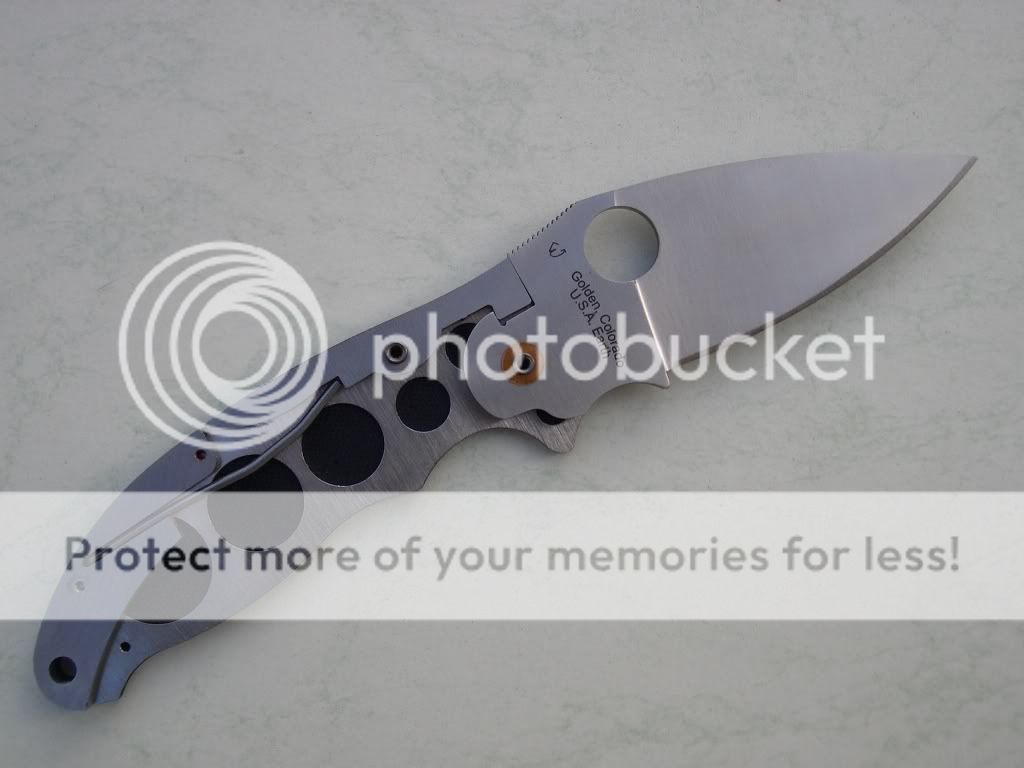
Axis lock opinion?

Some of you guys seem like you're looking too hard to make the Axis lock look bad. I've carried a BM 710 and a 940 in my rotation for years and used them as knives/cutting tools. Like all of my gear - I give them great care, keep them cleaned, lubed, sharp and they still look like new despite having made several 100's of cuts for me.

I think the springs breaking is a remote possibility - something that never enters my mind. I don't shove them into sand or dig holes with them. That work is for my Izula (substitute your favorite small fixed blade) and not for a fine folding knife, be it a BM 710 or a Spydie Military. YMMV.
 
Ultimate, did you watch the video's? I agree with MtnBkr; the sand didn't stop the mechanism any more than it would have most any other folder's mechanism. A quick rinse cleared it right up as did a good shake. The difference in reliability between an axis lock and most other locks including a lockback, in my opinion, are not sufficient to argue conclusively one way or the other.

It would be great to know the failure mode of TxXsB's springs and how that might reflect on the design. I understand his not investigating, however, as BM seems a bit sensitive about owner disassembly as it effects their warranty.

I have little experience with axis locks but have had a failure in both a liner and a frame lock knife. Both were in cheap knives so the quality was more at fault than the design. Except for the knives; there were no injuries.
 
No one is saying you can't use the knife or trying to make it look bad. All that is being said is, why would you choose an axis lock if the only criteria for the decision was reliability? Doesn't make sense to me. Now we're going in circles...
 
Reliability is only one part of the equation, strength, safety, ease of opening/closing, lock-up, and smoothness play an important role as well, and IMO the Axis Lock scores pretty high on all those points.


And it just makes a knife more fun to flip and play with :D

And to Mal2, I was still using the knife just as I would if it had two springs, and I would guess that I cycled the lock maybe 150 times or so before the second spring broke as well. Who knows maybe it was a bad batch of springs? Or aliens....:eek:
 
Last edited:
Why do you think most long distance bicycle campers/tourers use friction shifters? Because brifters or indexed shifters have a lot more that can go wrong and it's much easier to fix a broken bar-end friction shifter than a brifter/lever shifter.

You really think you'd be able to fix a lockback in the "field"?
 
No. The point of that comparison was that a friction shifter is a MUCH simpler design and has less of a chance of breaking than a brifter or indexed shifter.
 
@FlaMtnBkr: Did you hear how gritty it was in every case that he dumped it in sand and mud? All it takes is one bit of sand or anything to completely bind up the lock. Plus, you get a small rock or twig or whatever in there putting the wrong pressure on the springs and you can say bye-bye.

Actually, back locks are FAR more susceptible to the lock being jammed by debris.

CIMG9058.jpg


Are you sure you're entirely aware of how the axis lock works?
 
Actually, back locks are FAR more susceptible to the lock being jammed by debris.

CIMG9058.jpg


Are you sure you're entirely aware of how the axis lock works?

Thanks for the pic. I thought axis locks had two springs. Is that an upgraded one or an older one?
 
I would say that the axis is a good bit stronger, easier, and simplier. Most think the framelock is a pretty simple design, but it's not. There are grind angles, radius, lock relief cuts to worry about. Don't believe me then check out Terzuola's book. Many pages are used to explain how to get it right.

There are a lot of people, including very well known custom makers that have a hard time making a solid framelock

I think the cutout is a weakness
Emerson+HD7.jpg


Here read this about framelocks. STR says that none tested took 100 LBS of force. Scroll down till you see the pic that I posted
http://strsbackyardknifeworks.blogs...-max=2010-01-01T00:00:00-08:00&max-results=34

I have little doubt every bit of your post and the linked post from STR are 100% true. I just don't know that they are relevant to the actualities of knife users. Have you EVER used a knife in such a way as to apply the amount of force to the back of the blade that must have been needed to get the result shown in that photo? I haven't, and I can't even envision a situation where I COULD apply that much force.

Compression, Axis (and the clones), back lock, frame lock are all stronger than I'll ever need them to be. Theoretical maximums of the designs are fun to talk about, but let's not convince ourselves they actually have daily significance to us. Other than flea market liner locks I've never seen a lock fail under actual use. Under abusive testing maybe, but not use.

Basically I rate lock designs as liner locks and then everything else. I'll admit a bias toward the compression lock for the simplicity and brute strength (failure requires either shearing the compression liner or ripping the stop pin from the frame) but I know in my heart it's overkill. I'll never need that added strength for anything.
 
Actually, back locks are FAR more susceptible to the lock being jammed by debris.

Not at all...Close the blade, rinse in water or simply blow the debri out of the notch for the lock. It's 100% again. In the open position, (assuming a properly designed lockback) it is impossible for debris to enter that cut out. An axis lock can pick up junk whether it's open or closed.
 
Likewise, a dunk in the water will clean a lockback. You're telling me if the same exact knife was made with an axis lock and lockback design (ie. that is the only difference) and you had to choose a knife based on reliability, you would still choose the axis lock? I just don't get it...

Why do you think most long distance bicycle campers/tourers use friction shifters? Because brifters or indexed shifters have a lot more that can go wrong and it's much easier to fix a broken bar-end friction shifter than a brifter/lever shifter.

Why do you think that revolvers are recommended for new gun owners or for home protection so often? Revolvers have a lot less that can go wrong (no magazine/feeding issues whatsoever, simpler design)

I have had a lockback from a reputable maker fail on me, never an AXIS lock. I also can fix a broken AXIS omega spring in about 10 minutes with some wire and needle nose pliers. I'm not sure how else an AXIS lock would break but I can fix the only mode of failure I know of where as I don't think I could fix a lockback at all. I have also had a ball of lint get in the notch of a lockback and effect lock up. I have never had anything effect an AXIS lock unless you consider a little bit of grit a huge problem which you may since you pointed out the gritty lock in the video. If the knife locks up fine I don't see the problem if a little water fixes it.

I'm also not sure what a brifter is but I used nothing but Shimano rapid fire shifters since the early 90's and the first models came out. I have also probably logged over 50,000 miles on a mountain bike between riding, training, racing, and commuting for going on 20 years and that is a conservative number. I have never had a shifter break. I have bent a brake lever a few times but they can usually be bent back once or twice. I would also rather have rapid fire shifters than a friction shifter.

I have also shot many guns and between me and my father have more guns than I care to mention. Ultimately a revolver is more reliable but most modern auto loaders don't have a problem. Sometimes a magazine needs tweaking but I would hope you know how a magazine feeds before you need it in a life and death situation. I would think revolvers are recommended because you don't have to think about a safety or whether you need to rack a slide. You just pull the trigger and it goes bang so it is more simple to use in a high stress situation.

All this proves is the saying "Different strokes for different folks" holds true.
 
I have had a lockback from a reputable maker fail on me, never an AXIS lock. I also can fix a broken AXIS omega spring in about 10 minutes with some wire and needle nose pliers. I'm not sure how else an AXIS lock would break but I can fix the only mode of failure I know of where as I don't think I could fix a lockback at all. I have also had a ball of lint get in the notch of a lockback and effect lock up. I have never had anything effect an AXIS lock unless you consider a little bit of grit a huge problem which you may since you pointed out the gritty lock in the video. If the knife locks up fine I don't see the problem if a little water fixes it.
If you're alright with cleaning it with water, why wouldn't you just blow the lint out of the notch? Or clean that with water also?

I'm also not sure what a brifter is but I used nothing but Shimano rapid fire shifters since the early 90's and the first models came out. I have also probably logged over 50,000 miles on a mountain bike between riding, training, racing, and commuting for going on 20 years and that is a conservative number. I have never had a shifter break. I have bent a brake lever a few times but they can usually be bent back once or twice. I would also rather have rapid fire shifters than a friction shifter.
I am not saying you should switch anything. I don't think there is argument though that a simple friction shifter is inherently a much simpler design with much less that can go wrong. By the way, Shimano S.T.I's are brifters. The brake lever and shifter in one.

I have also shot many guns and between me and my father have more guns than I care to mention. Ultimately a revolver is more reliable but most modern auto loaders don't have a problem. Sometimes a magazine needs tweaking but I would hope you know how a magazine feeds before you need it in a life and death situation. I would think revolvers are recommended because you don't have to think about a safety or whether you need to rack a slide. You just pull the trigger and it goes bang so it is more simple to use in a high stress situation.
Yes of course that is another reason but like I said, I think simplicity in the design plays a large role also.


All this proves is the saying "Different strokes for different folks" holds true.
No argument there.
 
If you're alright with cleaning it with water, why wouldn't you just blow the lint out of the notch? Or clean that with water also?

I don't have a problem with a well made lock back and own many of them. But I like the AXIS lock quite a bit more in use. I was just pointing out that I have had a couple problems with back locks, but nothing with an AXIS lock that isn't easily fixed. I just like the AXIS lock the best and have never had anything happen that makes me not trust them.
 
pardue7.jpg
This is the best I could find of the axis lock. Though the springs would indeed appear to be the weak point, they should hold up for more cycles than a lifetime of operation if the material is up to it and the sharp crook and hole that it fits in don't move enough to wear. I suppose it is more susceptible to debris but lack of a proper lock up is fairly obvious and could be cleared easily. I would still be of the opinion that there is no clear difference in the reliability of the different locking mechanisms being discussed.

I like index shifters and auto pistols too but really can't compare them to lock mechanisms on knives....
 
Back
Top