
-
The BladeForums.com 2024 Traditional Knife is available! Price is $250 ea (shipped within CONUS).
Order here: https://www.bladeforums.com/help/2024-traditional/
You are using an out of date browser. It may not display this or other websites correctly.
You should upgrade or use an alternative browser.
You should upgrade or use an alternative browser.
Batoning wood with knives/Nutnfancy
- Thread starter KnifeEnthusiast
- Start date


- Joined
- Nov 17, 2008
- Messages
- 3,654
My awareness of Batoning came with the "SAS survival guide" by John Wiseman, and at the time I took it to be a last-ditch technique with very limited applications. IIRC, in the book he outlines how to start your notch on the top of a log with a knife and then split the rest of the log with a wooden wedge. Of course, similar things have been used for various woodworking and log processing applications for ages, but that's where I became aware of it as a camping/"survival" technique. It definitely seems to have been popularized with folks like Nutnfancy who decided that it was the be-all and end-all of hard use knife applications.

Nowadays, it's become such a fad that makers design huge 9" long, 5/8" thick sharpened prybars which are made specifically to be thumped on with logs. It's become all the rage with people who go into their backyard and wail away at the woodpile, kind of like the hollow-handled survival knives that were so popular a while back. Like the hollow-handled rambo knives, I seriously question the practical applications of purpose-made batoning knives, and I laugh pretty hard every time someone whines about how their knife that wasn't designed to be thumped on in that manner (see: Nearly every production knife in existence) breaks after they baton it through hardwood knots or some such. "Hurrdurrr this is a legitimate use for my Kershaw Leek because I saw some self-professed expert do it on Youtube".
For me, batoning isn't necessary in the first place. I got by for year and years with a cheap hatchet from Canadian tire, a swiss army knife, and sometimes a bowsaw before feeling the need to mix up my knife selection or get a fancier hatchet. Traditional camping and 'bushcraft' techniques still take care of everything I require when it comes to camping and firemaking. Nobody seemed to feel the need to baton before this latest fad came about, but now a whole raft of backyard outdoorsmen can't get by without it.
Nowadays, it's become such a fad that makers design huge 9" long, 5/8" thick sharpened prybars which are made specifically to be thumped on with logs. It's become all the rage with people who go into their backyard and wail away at the woodpile, kind of like the hollow-handled survival knives that were so popular a while back. Like the hollow-handled rambo knives, I seriously question the practical applications of purpose-made batoning knives, and I laugh pretty hard every time someone whines about how their knife that wasn't designed to be thumped on in that manner (see: Nearly every production knife in existence) breaks after they baton it through hardwood knots or some such. "Hurrdurrr this is a legitimate use for my Kershaw Leek because I saw some self-professed expert do it on Youtube".
For me, batoning isn't necessary in the first place. I got by for year and years with a cheap hatchet from Canadian tire, a swiss army knife, and sometimes a bowsaw before feeling the need to mix up my knife selection or get a fancier hatchet. Traditional camping and 'bushcraft' techniques still take care of everything I require when it comes to camping and firemaking. Nobody seemed to feel the need to baton before this latest fad came about, but now a whole raft of backyard outdoorsmen can't get by without it.
- Joined
- Apr 30, 2011
- Messages
- 231
Nice post Quy4n8.
However.....
Is not always true. Wetterlings axes have an RC of 58-59, a point or two above some carbon steel knives.
However.....
Axes, splitting mauls and wedges are made from either plain carbon steels heat treated to a lower value than knives or shock resistant steels. These metals are designed to deal with impact.
Is not always true. Wetterlings axes have an RC of 58-59, a point or two above some carbon steel knives.

powernoodle
Power Member
- Joined
- Jul 21, 2004
- Messages
- 11,982
Nutnfancy has HIS take on things. I think he does an excellent job at introducing this hobby to noobs and half-noobs, but it doesn't make his word final in any way. He constantly reminds us that what he says is what HE believes and that he may or may not be right.
Right on. Words of wisdom.
One is free to watch or avoid Nutnfancy, and to baton or not to baton too. I don't see what the issue is. I like Nutnfancy a lot and watch just about every one of his videos, yet I have never once in my life processed a piece of wood by batoning. Others are just the opposite. Thats what makes the world go 'round.
What I don't get is the desire to call someone names, especially a stranger on the internet who one has never met in his life. Just don't watch him. And baton or don't baton. Its all good.
Nice post Quy4n8.
However.....
Is not always true. Wetterlings axes have an RC of 58-59, a point or two above some carbon steel knives.
Ahh, we have the exception that makes the rule! All kidding aside, I stand corrected, it is, however made from non-stainless steel. I don’t have a Wetterling to look at, but since it is an axe, I’d bet the edge geometry is much heavier than a knife and it certainly is made from heavier stock. As previously posted, it’s a free country and if you want to baton, go ahead. I’ve just seen so many posts about batoning that I felt the need to state my thoughts about it. I am a mechanical engineer with a minor in metallurgy, and have been working with metals for more than 20 years, so at least in my mind, my thoughts carry experience and merit. YMMV.
I also wanted to set this in print as someone may read this and if stuck in a tight situation might remember that knives break when beat on with a big stick and try to come up with a better way of splitting wood to keep warm.
- Joined
- Apr 30, 2011
- Messages
- 231
I also wanted to set this in print as someone may read this and if stuck in a tight situation might remember that knives break when beat on with a big stick and try to come up with a better way of splitting wood to keep warm.
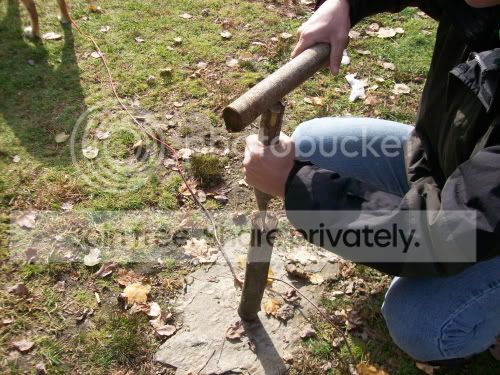
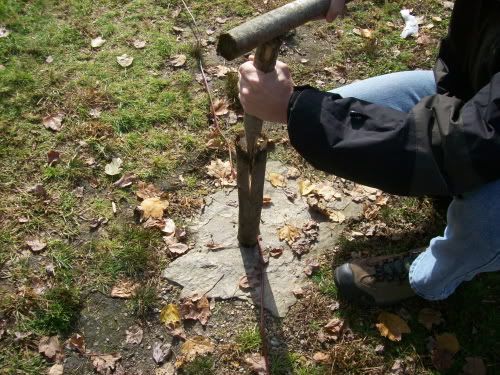
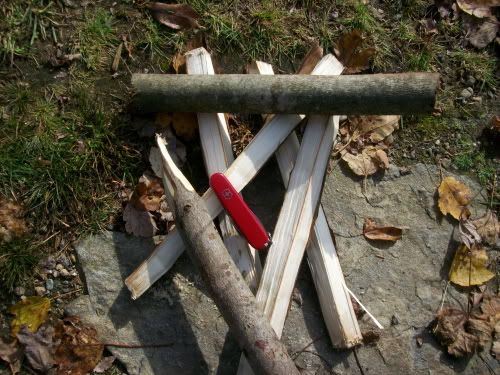
You mean like this?.....

- Joined
- Jun 29, 2005
- Messages
- 16,379
I think he does an excellent job at introducing this hobby to noobs and half-noobs, but it doesn't make his word final in any way. He constantly reminds us that what he says is what HE believes and that he may or may not be right. So, you've gotta take it for what it is.
Good point.
I have no need for his vids, and have never watched a whole one. But like you said, I also feel he has something to offer the newbs... as long as they understand he may or may not be right.
- Joined
- Dec 10, 2009
- Messages
- 325
I consider batoning part of the fun of camping and once ~ only once ~ useful. The wood I bought (pre packaged bundles) was a little too green and wouldn't burn well ~ so batoning them in 1/2 and 1/4's really helped. Batoning is an excuse to play w/ your bigger blades.
one of you said that thick, full flat ground knives are not good for batoning? I don't get that ~ it's a wedge ~ that's how you split stuff...
one of you said that thick, full flat ground knives are not good for batoning? I don't get that ~ it's a wedge ~ that's how you split stuff...
- Joined
- Dec 10, 2009
- Messages
- 325
Continued ~ I would like to try the 'would splitting wood' technique, but can imagine the edge turning to a fibery mush after a few splits... does it? How long does it last?

- Joined
- Sep 17, 2010
- Messages
- 4,583
I don't see why some people are so opposed to batoning. Or hard use with a knife. Its not your knife, and if someone paid for the knife with their money. And decides to screw it up or damage it batoning ect why does everyone else rage about it? If you don't baton with you knives fine. But to make it seem like a blanket statement that knives shouldnt baton I think is wrong. I batoned a Cold Steel Outdoorsman lite with no damage.
- Joined
- Apr 30, 2011
- Messages
- 231
Continued ~ I would like to try the 'would splitting wood' technique, but can imagine the edge turning to a fibery mush after a few splits... does it? How long does it last?
I assume you are asking about a wooden wedge?
Depends on the wood. In my shots it is a partially seasoned wedge of poplar splitting another piece of poplar. You can do this with green wood,but you will have to touch up your wedge after a few splits. The more seasoned, or harder type of wood less so (poplar is fairly soft).
Also I did not show the notch I sawed into the top of the piece I split with my sak. Make a good size notch and the edge of the wedge holds up well.
After you have your fire going you can fire harden your wedge to last longer.

goldie
Gold Member
- Joined
- Feb 18, 2000
- Messages
- 4,609
i can MAYBE see splitting small pieces of wood into smaller kindling,but banging at the big logs that ive seen is such a waste of effort. is it that hard to carry even the smallest or lightest hatchet that you have to resort to banging the blade through huge logs?The recon scout & leatherneck that failed were driven through way too big pieces of wood,& i think the batonning craze is totaly out of hand & un necessary.98% of the people going knowing they are going into the woods should have a hatchet or axe as part of their gear.

- Joined
- Jun 29, 2005
- Messages
- 16,379
Batoning is nothing new at all, I was batoning wood back in the late 70's myself.
Hogwash I tell ya !
Nutinfancy and Bear Grylls wasn't even around telling us how it was done back in the 70's.


- Joined
- Dec 6, 2011
- Messages
- 1,301
I read about battoning on wilderness and survival sites long before I ever saw it on youtube or even found this forum . Most wilderness and survival training sites will state that the most usefull size knife for most tasks is between 4 and 6 inches . They usually go on to say that if you are just out on a day hike or if you are on a hiking camping trip with all your gear on your back , you'd most likely NOT be carrying an axe or a big heavy chopper .
Therefore the technique of battoning is one that they teach in order to be able to process wood to make a fire or emergancy shelter with a smaller blade that you are more apt to have on you . ocnLogan also made a good point that battoning is much safer than chopping with either and axe or a big knife . I'm very familiar with the handling of knives of all sizes and axes , but I still find battoning gives a much greater lever of control over how you split your wood , weather for kindling or just split in 2 .
As far as breaking my knife battoning with it . I wouldn't own any fixed blade knife that might fail me while doing such a typical camp shore .
HOLD MY BEER AND WATCH THIS !
Therefore the technique of battoning is one that they teach in order to be able to process wood to make a fire or emergancy shelter with a smaller blade that you are more apt to have on you . ocnLogan also made a good point that battoning is much safer than chopping with either and axe or a big knife . I'm very familiar with the handling of knives of all sizes and axes , but I still find battoning gives a much greater lever of control over how you split your wood , weather for kindling or just split in 2 .
As far as breaking my knife battoning with it . I wouldn't own any fixed blade knife that might fail me while doing such a typical camp shore .
HOLD MY BEER AND WATCH THIS !

- Joined
- Sep 5, 2010
- Messages
- 2,691
Monkey see, monkey do. The mis-informed can make videos just as easy as they can make babies. Just because someone has a camera, a knife, and a baton, doesn't mean they know how to do anything. Yet, any noob can watch these videos and get the wrong idea about how or when to baton.
If all I need is some kindling, then I only need to split a few small pieces of wood. And, not necessarily down the middle, take some small slices off the outer edge of the log. Or, use a wooden wedge, if it breaks, you can make a new one, all the while preserve your knife, it's edge, and possibly the only sharp tool that you have in the woods.
Keep the knife horizontal, don't put downward pressure on the handle, and choose the right piece of wood,(no knots, pick softer wood).
If all I need is some kindling, then I only need to split a few small pieces of wood. And, not necessarily down the middle, take some small slices off the outer edge of the log. Or, use a wooden wedge, if it breaks, you can make a new one, all the while preserve your knife, it's edge, and possibly the only sharp tool that you have in the woods.
Keep the knife horizontal, don't put downward pressure on the handle, and choose the right piece of wood,(no knots, pick softer wood).
- Joined
- Sep 5, 2010
- Messages
- 2,691
I consider batoning part of the fun of camping and once ~ only once ~ useful. The wood I bought (pre packaged bundles) was a little too green and wouldn't burn well ~ so batoning them in 1/2 and 1/4's really helped. Batoning is an excuse to play w/ your bigger blades.
one of you said that thick, full flat ground knives are not good for batoning? I don't get that ~ it's a wedge ~ that's how you split stuff...
Full Flat Grinds tend to bind up, they're geometry allows the full height to contact the wood, more friction, and the edge has contact through more of the log. A saber grind will wedge that same log apart, with less contact and the edge won't even be touching the wood once the thicker part enters the wood.