Convex grinds

You measure the edge angle at the point where the edges meet...at the point.

....

Where mathematics and reality diverge... the apex is not a point. There is always some finite radius of curvature at the apex. If you want to measure an edge angle on a convex edge, you have to define where you are measuring it. I typically use the tangential angle 3 microns from the apex as I know from experience that this is a useful indicator of blade sharpness. The angle can be much higher nearer the apex and is usually very difficult to define.

stropped_microconvex_02.jpg


stropped_microconvex_03.jpg
 
Look at your red tangent -- that would be the left side of a V edge that you would compare that convex edge to. So you would be comparing that outside convex edge to a V edge with roughly a 120-degree inclusive angle. Of course the convex edge will have less metal behind the apex than a huge 120-degree V edge.

Exactly. And if the angle were 20 degrees, the same holds true. The convex has less metal.

I think you're stuck on the definition of an edge bevel and trying to fit your argument into that. So let's think of it another way. Let's say you have a v grind edge bevel that's at 20 degrees and you put a v grind micro bevel on it at 40. What's the angle of the edge? 20 degrees to account for the whole edge bevel or 40 degrees right at the edge? Or is it at that point you say it's impossible to describe? I think most would say the edge angle is 40 degrees.

A convex edge can be thought of as a v grind with an infinite series of bevels ground into it terminating at the apex of the edge which is where we're taking the edge angle from. Just like the microbevel.
 
And i see that some posters still bring up the tired line that, "you can't add metal back to the edge!" Of course you cannot, but you can remove less metal from the edge via convex-grinding at the same angle of incidence using a soft-backing (i.e. leaving more metal behind the edge) vs. removing more metal via flat-grinding at that angle of incidence to produce a bevel of equal height and equal base-width but with less material behind the edge.

My use of begging the question was from the context of converting a V edge to a convex, since it would be impossible to create a convex edge with a greater effective angle than the V from which it was formed without reducing the height of the blade.
 
Where mathematics and reality diverge... the apex is not a point. There is always some finite radius of curvature at the apex. If you want to measure an edge angle on a convex edge, you have to define where you are measuring it. I typically use the tangential angle 3 microns from the apex as I know from experience that this is a useful indicator of blade sharpness. The angle can be much higher nearer the apex and is usually very difficult to define.

stropped_microconvex_02.jpg


stropped_microconvex_03.jpg
If you want to talk about on a scientific level, then you should understand even on the sub micron level, eventually those two curves terminate at an apex formed by straight lines.

We're talking about from a realistic stand point, from a point of view where you can actually see something being straight or curved with the naked eye or perhaps some low power magnification. We're talking about in a real world, end user situation, not in a lab setting. Is a curve that is .01 micron thick really gonna make a difference? No, for all intents and purposes it is a straight. But guess what, if you intersected two curves (arcs) that were both .01 micron thick, they will terminate at an apex created by two lines. One could use an electron microscope to measure those straight lines that create the apex. They are there and measurable.

But if you want to argue based on science, then even then, two arcs intersect at a point on the apex created by two lines. And no matter how you cut it, no convex apex will have more material than a V apex, unless you make the convex apex point (AGAIN created by two straight lines) more obtuse.

And once again, unless your apex is not an apex (IE: it is a parabola), the apex will be formed by two straight lines.
 
Last edited:
My use of begging the question was from the context of converting a V edge to a convex, since it would be impossible to create a convex edge with a greater effective angle than the V from which it was formed without reducing the height of the blade.

Do you mean simply rounding off the bevel shoulders? I would describe that as a V-grind with rounded off shoulders, not convex. Convexing a blade, by stropping for example, does reduce the height of the blade.
 
If you want to talk about on a scientific level, then you should understand even on the sub micron level, eventually those two curves terminate at an apex formed by straight lines.

We're talking about from a realistic stand point, from a point of view where you can actually see something being straight or curved with the naked eye or perhaps some low power magnification. We're talking about in a real world, end user situation, not in a lab setting. Is a curve that is .01 micron thick really gonna make a difference? No, for all intents and purposes it is a straight. But guess what, if you intersected two curves (arcs) that were both .01 micron thick, they will terminate at an apex created by two lines. Have fun digging out an electron microscope to measure those straight lines that create the apex. They are there and measurable.

But if you want to argue based on science, then even then, two arcs intersect at a point on the apex created by two lines. And no matter how you cut it, no convex apex will have more material than a V apex, unless you make the convex apex point (AGAIN created by two straight lines) more obtuse.

And once again, unless your apex is not an apex (IE: it is a parabola), the apex will be formed by two straight lines.

Do you mean simply rounding off the bevel shoulders? I would describe that as a V-grind with rounded off shoulders, not convex. Convexing a blade, by stropping for example, does reduce the height of the blade.

We're speaking from a theoretical standpoint here, but yes, rounding the bevel shoulders off is the only way to convert a V edge to a convex without altering the blade height. It is possible to convert the V edge geometry to a continuous arc that still terminates at the same effective angle, but it necessarily removes material at the shoulder as a bare minimum and the visual bevel width will increase. But such a converted edge wouldn't be considered a V grind anymore because there wouldn't be any flat left.
 
If you want to talk about on a scientific level, then you should understand even on the sub micron level, eventually those two curves terminate at an apex formed by straight lines.

We're talking about from a realistic stand point, from a point of view where you can actually see something being straight or curved with the naked eye or perhaps some low power magnification. We're talking about in a real world, end user situation, not in a lab setting. Is a curve that is .01 micron thick really gonna make a difference? No, for all intents and purposes it is a straight. But guess what, if you intersected two curves (arcs) that were both .01 micron thick, they will terminate at an apex created by two lines. One could use an electron microscope to measure those straight lines that create the apex. They are there and measurable.

But if you want to argue based on science, then even then, two arcs intersect at a point on the apex created by two lines. And no matter how you cut it, no convex apex will have more material than a V apex, unless you make the convex apex point (AGAIN created by two straight lines) more obtuse.

And once again, unless your apex is not an apex (IE: it is a parabola), the apex will be formed by two straight lines.

I think it's important in such a discussion to be clear about the difference between micro and macro measurements as well...as far as this discussion has been up until this point, we have been referring to geometry at the macro level, not at the micro.
 
Please understand, it is ALWAYS a parabola, ALWAYS rounded - the two arcs "intersect" at a point where the tangent is 90-degrees per side, there is NO "V" edge at the apex and using tangents to establish one at that level (as you are suggesting) is absurd.

ToddS has the images to demonstrate the facts, and the language demands that "convex" be fatter than the flat-grind to which it corresponds, that flat grind extending
 
We're speaking from a theoretical standpoint here, but yes, rounding the bevel shoulders off is the only way to convert a V edge to a convex without altering the blade height. It is possible to convert the V edge geometry to a continuous arc that still terminates at the same effective angle, but it necessarily removes material at the shoulder as a bare minimum and the visual bevel width will increase. But such a converted edge wouldn't be considered a V grind anymore because there wouldn't be any flat left.

Increasing the "visual bevel width" by convex-ing the shoulders establishes a new bevel width and height within which you could grind further (remove more metal) to establish a corresponding flat-grind that is thinner.

Here is a simple schematic of some knives to compare (ignore the Catt225Q for this discussion). The SYKCO 511 has the same edge angle as the RMD and GSO-5.1, ground flat to improve cutting performance, but behind that edge the SYKCO has a convex primary grind whereas the others are flat but all three have nearly the same bevel height/width and you may note the point where the thicknesses intersect to form the base from which the angles of the triangle may be measured:

GSO-5+geometry+comparison.bmp
 
Increasing the "visual bevel width" by convex-ing the shoulders establishes a new bevel width and height within which you could grind further (remove more metal) to establish a corresponding flat-grind that is thinner.

Here is a simple schematic of some knives to compare (ignore the Catt225Q for this discussion). The SYKCO 511 has the same edge angle as the RMD and GSO-5.1, ground flat to improve cutting performance, but behind that edge the SYKCO has a convex primary grind whereas the others are flat but all three have nearly the same bevel height/width and you may note the point where the thicknesses intersect to form the base from which the angles of the triangle may be measured:

GSO-5+geometry+comparison.bmp

Yup. I realize that. However, the effective edge angle would then be thinner on the further reduced flat grind. :)
 
Haha, math class much? I like math as much as the next guy (probably more actually) but I think we're trying too hard. It seems to me like the OP is looking for some personal experience and real world stuff.

In my experience, convex edges work great in certain situations. For example: a large chopper would be great with a convex edge. The edge geometry will help it not get stuck as easily and you'll get a bit of prying action as you chop. A smaller knife used for camp chores like battoning and prying/digging, also great with a convex edge. Combat blades which may be required to slice thick, heavy materials, would be better with a convex edge (in my experience), as they don't get as bound up in heavy duty cutting applications.

Where a hollow grind really shines is on a dedicated slicer of thin materials (aka, most EDC chores). A hollow grind takes a very keen edge and is great for slicing thin stuff, whereas it will get bound up when slicing thicker material.

Full flat grinds are used most commonly in chef's knives because they'll take that slim edge, but will also not get bound up in tough material (like food).

Another benefit of a convex edge is that the maker can typically temper the same steel at a harder level vs a hollow or full flat, while keeping down the risk of chipping. I know the whole edge geometry thing has been beaten to death on the thread, but it's just true.
 
Haha, math class much? I like math as much as the next guy (probably more actually) but I think we're trying too hard. It seems to me like the OP is looking for some personal experience and real world stuff.

In my experience, convex edges work great in certain situations. For example: a large chopper would be great with a convex edge. The edge geometry will help it not get stuck as easily and you'll get a bit of prying action as you chop. A smaller knife used for camp chores like battoning and prying/digging, also great with a convex edge. Combat blades which may be required to slice thick, heavy materials, would be better with a convex edge (in my experience), as they don't get as bound up in heavy duty cutting applications.

Where a hollow grind really shines is on a dedicated slicer of thin materials (aka, most EDC chores). A hollow grind takes a very keen edge and is great for slicing thin stuff, whereas it will get bound up when slicing thicker material.

Full flat grinds are used most commonly in chef's knives because they'll take that slim edge, but will also not get bound up in tough material (like food).

Another benefit of a convex edge is that the maker can typically temper the same steel at a harder level vs a hollow or full flat, while keeping down the risk of chipping. I know the whole edge geometry thing has been beaten to death on the thread, but it's just true.

Yeah just a wee bit of thread drift. :D

I agree with everything you said except hardness. I just don't have experience hardening steel.
 
I do feel as though misconceptions around the durability of convex edges may stem from the way they're often formed. Holding the same angle as you would against a stone on a material that gives slightly like a strop or sandpaper on a mousepad, you'll actually end up with a thicker edge angle because of the deformation of the backing surface. That's both what creates the convex in the first place but is also the reason why many people blunt their blades by pressing too hard on the material. To end up with the same angle as on a stone you have to actually approach at a slightly shallower angle than the effective edge angle you want to produce.

Just some food for thought on that note--I'm sure there'll be some further debate regarding it. :D
 
...To end up with the same angle as on a stone you have to actually approach at a slightly shallower angle than the effective edge angle you want to produce...

The bolded above is the point of contention. What do you mean by the term "effective edge angle"? How do you measure it?

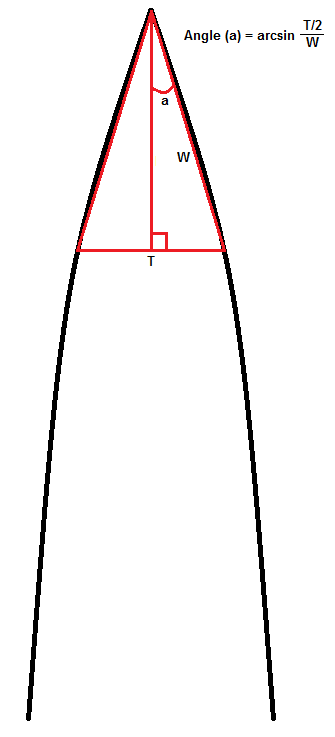
ANGLE is simply an easy way of expressing the distance or thickness between two lines (bevels) at some distance (height/width) back from the vertex (apex).

We have already established through actual micrographs (i.e. reality) that using a theoretical "tangent to the apex" is utterly invalid as the apex-angle is always 90-dps. I do hope people stop bringing it up.

Instead, to establish an "effective edge angle" one must measure the thickness of the blade at some height (or rather bevel-width) back from the apex, usually a distance selected by the presence of an obvious transition point such as a dramatic change in angle (e.g. bevel shoulder) OR as ToddS has done select a height pertinent to the desired cutting performance (he chose 3 microns as that is the approximate thickness of a human hair which razor-blades are designed to cut through with ease).

Once you have these lengths established (width, thickness) you apply geometric principles to give you the "effective edge angle" by drawing a flat sided triangle and then calculating the angle.

Effective%2BEdge%2BAngle.png


As may be noted, the "effective edge angle" is simply "the angle measurement of a flat-grind edge that most closely approximates the cutting efficiency of a non-flat edge", and that corresponding flat-grind will ALWAYS fall beneath the convex grind, i.e. flat is always thinner. The level of precision used to establish the effective edge angle, e.g. ToddS's micrographs at 3 micron blade-heights, can be altered depending on the task for which the edge is intended.
 
The bolded above is the point of contention. What do you mean by the term "effective edge angle"? How do you measure it?

ANGLE is simply an easy way of expressing the distance or thickness between two lines (bevels) at some distance (height/width) back from the vertex (apex).

We have already established through actual micrographs (i.e. reality) that using a theoretical "tangent to the apex" is utterly invalid as the apex-angle is always 90-dps. I do hope people stop bringing it up.

Instead, to establish an "effective edge angle" one must measure the thickness of the blade at some height (or rather bevel-width) back from the apex, usually a distance selected by the presence of an obvious transition point such as a dramatic change in angle (e.g. bevel shoulder) OR as ToddS has done select a height pertinent to the desired cutting performance (he chose 3 microns as that is the approximate thickness of a human hair which razor-blades are designed to cut through with ease).

Once you have these lengths established (width, thickness) you apply geometric principles to give you the "effective edge angle" by drawing a flat sided triangle and then calculating the angle.

Effective%2BEdge%2BAngle.png


As may be noted, the "effective edge angle" is simply "the angle measurement of a flat-grind edge that most closely approximates the cutting efficiency of a non-flat edge", and that corresponding flat-grind will ALWAYS fall beneath the convex grind, i.e. flat is always thinner. The level of precision used to establish the effective edge angle, e.g. ToddS's micrographs at 3 micron blade-heights, can be altered depending on the task for which the edge is intended.

This is the problem of scale. The discussion was up until this point on the macroscopic level rather than the microscopic. It is true that the apex at the microscopic level will be 90° but for practical discussion purposes that's really a moot point. As I already defined it, the effective edge angle is the angle above which an edge will actually engage its target. Drawing a straight line within a convex to approximate the edge angle does not work at the macroscopic level. If you were to try approaching a flat piece of paper or wood at such a calculated angle the edge would almost certainly not engage because the actual effective angle would be greater due to the convexity.
 
We are quite literally getting into the territory of how many angels can dance on the head of a pin.

Somewhere in my back-ground, somebody foisted the label system-engineer on me. I still don't like it.

As fascinating as the pictures of edges are and as cool as the diagrams are, I would like point out the obvious missing parts: the medium being cut and the user holding the knife.

When engineers gaze into the bright light of a single aspect of the problem, no matter how fascinating it may be, we loose focus and perspective.

A knife blade doesn't cut anything.

A knife just sits there until somebody picks it up and pushes it through some thing. So where are the mathematical models for the medium? For the movement of the knife blade? For the dynamics of the medium being displaced?

This discussion would be helped a great deal by those interested in blade performance taking a look at the existing academic research on what keeps a bike upright and how geometry changes on a bike (frame angles, wheel and tire sizes and such) affect handling. Or perhaps the organic chemistry involved with brewing a nice crisp IPA which I have a hankering for right about now because math makes me thirsty.

Beer drinking, bike handling and knife performance are, at their core, based on categories of perceptions of the users. It's about how the beer tastes, the bike handles and the blade works the medium. These are fuzzy human experience categories. Not geometric facts.

As a systems-engineer, my recommendation is to walk away from the microscopes and diagrams and to, instead, pick up the methodology of rigorous QUALITATIVE assessments by qualified expert users in the mediums they work in. Structured taste testing or structured ride testing. Ask meat processors in a structured way which knives work best. Ask chefs. Ask wood workers. Conduct user test and score and code the results.

The results of this approach are neither to find the best edge preparation nor to understand exactly why something behaves the way it does.

It is merely to determine if there are persistent user preferences across different cutting tasks and mediums and if so, to articulate them as known design patterns. BEAN3 was onto it when he noted that in his experience, thin Vs work best for fibrous veggies and a convex better for proteins. This is the right approach, only expand the sets of users.

Let me put this another way... If people want to be rigorous in their knife testing, first get rigorous in producing a categorization/typology of different cutting tasks. This is qualitative stuff, not quantitative. But until you can define the difference between an English and American style IPA, you have no basis to ask any meaningful chemistry question.
 
How well a convex edge cuts -- or what type of things in what kinds of situations it cuts best -- depends entirely on the geometry of that convex edge, which we almost never know.

A convex edge can be virtually identical to a V edge. A convex edge can be acute or obtuse, as can a V edge.

A pure V edge is easy to define, just measure the angle of the edge and the width of the edge at the shoulders. A convex edge is much harder to define because it's bevel edges can be acutely curved or barely curved.

And there there are the hybrid edges: V edges with micro-bevels and rounded shoulders. Or convex edges that are nearly straight until the apex, when they curve slightly or aggressively inward.

We can easily determine the geometry of a V edge, but it's much more difficult for the average user to determine the geometry of a convex edge.
 
We are quite literally getting into the territory of how many angels can dance on the head of a pin.

Somewhere in my back-ground, somebody foisted the label system-engineer on me. I still don't like it.

As fascinating as the pictures of edges are and as cool as the diagrams are, I would like point out the obvious missing parts: the medium being cut and the user holding the knife.

When engineers gaze into the bright light of a single aspect of the problem, no matter how fascinating it may be, we loose focus and perspective.

A knife blade doesn't cut anything.

A knife just sits there until somebody picks it up and pushes it through some thing. So where are the mathematical models for the medium? For the movement of the knife blade? For the dynamics of the medium being displaced?

This discussion would be helped a great deal by those interested in blade performance taking a look at the existing academic research on what keeps a bike upright and how geometry changes on a bike (frame angles, wheel and tire sizes and such) affect handling. Or perhaps the organic chemistry involved with brewing a nice crisp IPA which I have a hankering for right about now because math makes me thirsty.

Beer drinking, bike handling and knife performance are, at their core, based on categories of perceptions of the users. It's about how the beer tastes, the bike handles and the blade works the medium. These are fuzzy human experience categories. Not geometric facts.

As a systems-engineer, my recommendation is to walk away from the microscopes and diagrams and to, instead, pick up the methodology of rigorous QUALITATIVE assessments by qualified expert users in the mediums they work in. Structured taste testing or structured ride testing. Ask meat processors in a structured way which knives work best. Ask chefs. Ask wood workers. Conduct user test and score and code the results.

The results of this approach are neither to find the best edge preparation nor to understand exactly why something behaves the way it does.

It is merely to determine if there are persistent user preferences across different cutting tasks and mediums and if so, to articulate them as known design patterns. BEAN3 was onto it when he noted that in his experience, thin Vs work best for fibrous veggies and a convex better for proteins. This is the right approach, only expand the sets of users.

Let me put this another way... If people want to be rigorous in their knife testing, first get rigorous in producing a categorization/typology of different cutting tasks. This is qualitative stuff, not quantitative. But until you can define the difference between an English and American style IPA, you have no basis to ask any meaningful chemistry question.

To put it in plain speak.
Its how many sharpeners can dance on the Flat ground edge Vs the Convex ground edge?;)

I don't ride my bicycle or sip suds anymore though I use to do quite a bit of both! As far preferences go, I have yet to find a ef that doesn't prefer the convex ground edges I put on Culinary knives. Even the meat and fish fillet knives I sharpen have a slightly con vexed edge with their owners very happy!
 
This is the problem of scale...

What is the problem you are having? I did not give a scale to the diagram/schematic provided. It could be on the order of microns or of inches, all that matters is that it is representative of the actual bevel AND the apex is sufficiently keen.

As I already defined it, the effective edge angle is the angle above which an edge will actually engage its target. Drawing a straight line within a convex to approximate the edge angle does not work at the macroscopic level. If you were to try approaching a flat piece of paper or wood at such a calculated angle the edge would almost certainly not engage because the actual effective angle would be greater due to the convexity.

Yes it does work, it works at any scale while a tangent does not work at any scale. From your description, the problem lies with where your edge is most convex, i.e. what flat-angle best approximates the cutting performance (to pinnah, it is all about performance, the point of the schematics and micrographs is to dispel confusion about the reality of the performance achieved). What you have described - approaching a flat surface with your edge and not engaging - at what angle are you engaging the surface? You have used a wood-plane, yes? Even with a face-razor on pliable skin, you cannot engage the surface with the bevel flat, it must be elevated. The degree of elevation and the thickness of the bevel (be it flat or convex) determines the depth to which it engages in a cut. Planing wood a common angle of engagement is ~50 degrees with a blade sharpened to >30 degrees inclusive, shaving it's commonly ~30 degrees for a blade sharpened to ~17 degrees inclusive, and most other cutting tasks use an even greater angle to engage. That is practical reality.

cutting_diagram_sm.gif


Note in the image that the blade has a wear-profile the forms a less acute microbevel as the cut proceeds.

ProgressiveEdgeWearDiagram.gif


Please note that this diagram was made from a planer on cherry wood (very hard) that continued to engage its target even at the fullest point of wear. Again, since you cannot measure the "tangent" of the convexity, how would you measure the effective edge angle?

ClearanceLossDiagram02.gif


Understand that even planing cherry-wood - much stiffer than paper or a pen which you might be using to pretend to test edge-angle - there is enough flexibility in the surface to allow for some penetration (i.e. engagement) despite the progressive loss of clearance, and that convexity is rather dramatic, MUCH more dramatic than what i present in my schematic measuring effective edge angle. To measure the effective edge-angle of the worn planer, you would do as I did before, calculating the angle from the thickness and height of the worn part of the bevel. If you try doing it your way, i.e. checking for engagement at a specific angle, you are really just measuring clearance and flexibility of the material you are cutting and perhaps the keenness of the edge (i.e. diameter of apex), NOT edge angle "effective" or otherwise. Please note, i can shave/engage my facial hairs as well with a 40-degree edge as with a 10-degree edge so long as the edge is sufficiently keen, what is different is the amount of wedging that occurs after the edge has engaged. In an earlier schematic i showed a thick SYKCO 511 and an RMD with the same edge angle, but the SYKCO had less clearance due to the thickness of the bevel behind that of the RMD, so on some material it would have more trouble planing off shavings because the bevel would be up against the material being cut if i laid the blade at a lower angle than the edge, but the RMD might be able to compress the material with the edge-shoulder enough to allow the edge to engage despite being at the same angle, and both were stropped to a convex edge-angle.

 
Last edited:
We are quite literally getting into the territory of how many angels can dance on the head of a pin.

Somewhere in my back-ground, somebody foisted the label system-engineer on me. I still don't like it.

As fascinating as the pictures of edges are and as cool as the diagrams are, I would like point out the obvious missing parts: the medium being cut and the user holding the knife.

When engineers gaze into the bright light of a single aspect of the problem, no matter how fascinating it may be, we loose focus and perspective.

A knife blade doesn't cut anything.

A knife just sits there until somebody picks it up and pushes it through some thing. So where are the mathematical models for the medium? For the movement of the knife blade? For the dynamics of the medium being displaced?

This discussion would be helped a great deal by those interested in blade performance taking a look at the existing academic research on what keeps a bike upright and how geometry changes on a bike (frame angles, wheel and tire sizes and such) affect handling. Or perhaps the organic chemistry involved with brewing a nice crisp IPA which I have a hankering for right about now because math makes me thirsty.

Beer drinking, bike handling and knife performance are, at their core, based on categories of perceptions of the users. It's about how the beer tastes, the bike handles and the blade works the medium. These are fuzzy human experience categories. Not geometric facts.

As a systems-engineer, my recommendation is to walk away from the microscopes and diagrams and to, instead, pick up the methodology of rigorous QUALITATIVE assessments by qualified expert users in the mediums they work in. Structured taste testing or structured ride testing. Ask meat processors in a structured way which knives work best. Ask chefs. Ask wood workers. Conduct user test and score and code the results.

The results of this approach are neither to find the best edge preparation nor to understand exactly why something behaves the way it does.

It is merely to determine if there are persistent user preferences across different cutting tasks and mediums and if so, to articulate them as known design patterns. BEAN3 was onto it when he noted that in his experience, thin Vs work best for fibrous veggies and a convex better for proteins. This is the right approach, only expand the sets of users.

Let me put this another way... If people want to be rigorous in their knife testing, first get rigorous in producing a categorization/typology of different cutting tasks. This is qualitative stuff, not quantitative. But until you can define the difference between an English and American style IPA, you have no basis to ask any meaningful chemistry question.

Pretty much. There is a sliding scale of how important particular details are for practical application purposes. The microscopic end of things would be most relevant to those working, for instance, on developing the next super-steel, sharpening medium, or heat treatment protocol, but not particularly useful to most other folks. The level at which the discussion was originally taking place was one mostly useful to edged tool designers and tinkerers and was already above the level of usefulness to the average knife user. :D
 
Back
Top