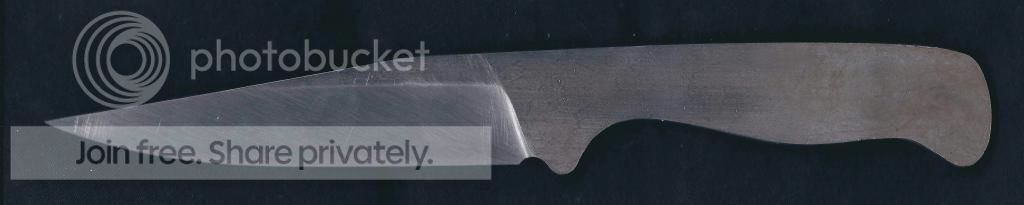
First knife design/plan

Why would I use a half round file if I'm trying to make the grind flat?

I'm not sure if I mentioned this, but I'm using a filing jig I made. I used it to make the bevels and it was very easy to use.

Just to be sure, I'm talking about a flat grind as in not having any dips in the surface of the swedge. I'm still going to make a drawn swedge (the term being taken from this thread).
 
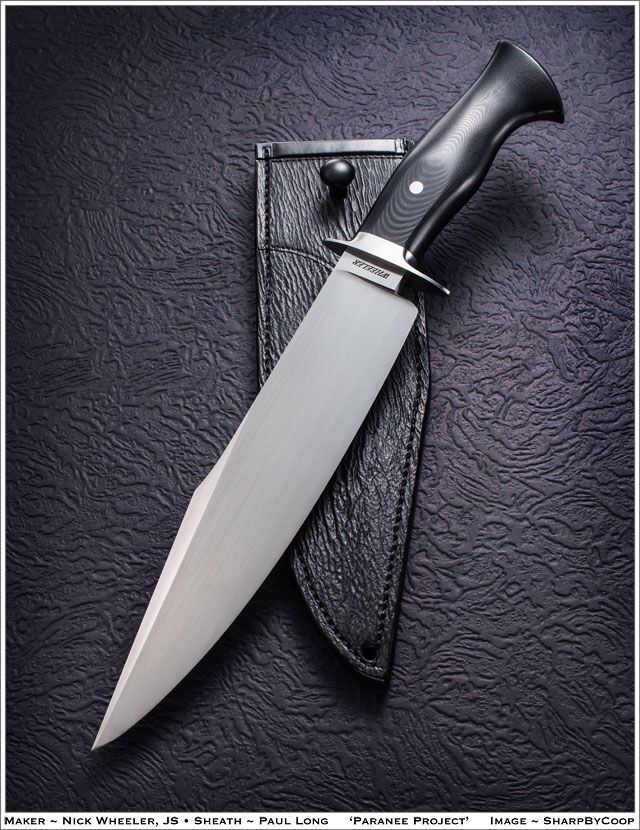
Yo get the shape you are looking for, the swedge will have a curve in it. If you go flat, the curve you drew in the swedge as the knife goes from tip to handle will be a straight line. Here is an example of straight from Nick Wheeler's/ Joe Paranee's excellent thread:

e7f14cf2add2dc0194c6a44b0d67d120.jpg


To get the curved look, imaging filing the inside of a thick walled tube. That is the cut you will be making at an angle along your swedge, but in a compound curve like an oval.
 
Well i really do want the flat grind, so it seems I can do a few things.

- Go with my original design and make the curved swedge. I CA probably pull it off, but I have no idea how it would look.

- Make a straight swedge like on Nick Wheeler's knife. The problem with that is I think the spot when re my point begins to drop is too far back, and the swedge would be too long. I'll modify my sketch and see though.

- Make a straight swedge with a plunge line at the back. If you think that will mess with the flow of the knife though, then I'll stay away.

- Not make a swedge at all. Honestly, it doesn't look bad as it is now, but I do want a swedge if I can make it look good.

What do you guys think?
 
If you are worried it will go too far back, keep a wide angle relative to the blade, and don't worry about sharpening the swedge. I did a 10.5" bowie with a curved swedge and it took a long time to get it right (for me- experienced guys would have had no problem with it ;).) Its all about learning and having fun!

You can do mostly flat, and curve the last portion at the highest point on the spine to blend it????
 
Sorry I haven't been doing much with thing guys, haven't had much time what with finals and the end of school.

I've been thinking more about the swedge, and a drawn swedge like on Nick's knife would look best on a full flat grind, which I didn't do. Also like I said before, the spot where the point begins to drop is a little too far back and would make this kind of swedge very thin.

I drew in a cut swedge swedge, and now I see just how dumb it looks.

0715d258-9545-4e29-b775-9be7fc542ce6_zpsa37ca1b7.jpg


So this leaves me with two options now. Basically same deal as before, but just to reiterate:

- Go with my original design and make the curved swedge. I can probably pull it off, but I just can't see a sideways hollow grind for a swedge looking good.

- Not make a swedge at all. I'm leaning toward this option.

I'll have to think about it more. I honestly don't know what I want, and I know you guys think I should go for it, but I just don't know if I should risk it. I think it looks good as it is now, and I don't want to screw it up by trying something that I haven't experimented with yet.
 
I want to add the fact that after heat treating those files will be of no use. Get the size down almost finish size and sanded to a fine grit so that after heat treat you won't have a struggle. Frank
 
It's a clean design. I've been MIA for a bit lately, but still alive and kickin. Already have something similar laying along side the other several that need to be finished.
Ghost jade and some botle opener/knuckle dusters are getting full attention right now... all I seem to have time for.
 
After some consideration, I think I'll go with the no swedge option *for now*.

I'll experiment with different kinds of swedges on future knives, and I can always go back and modify this one once I've figured out how to do it. It's not like making a swedge once the knife is completely finished is going to mess up the finish of everything else.

And trust me, I'll be making more knives in the future. I just scored some beautiful birdseye maple burl in the form of 106 year old floorboards that I'll be sure to use in some knife handles. At least, with my limited knowledge of wood I think it's burl. It has that 3d effect when light moves across it. I'll take a pic of it later along with the hawaiian mango I got from burl source.
 
Well I started sanding the blade, and I'm on 120 grit. I just checked the edge thickness and it is now 0.005 at the thinnest part. Keep in mind this is before heat treatment.

Is there any way to salvage this knife, or should I just start over before I use up more sandpaper?
 
You can sand/file the edge back but you may have to modify your whole profile to account for the change in blade dimensions.
 
I filed the edge back a little bit to get it back to ~0.020". I might have to bring it back a tad bit more once it's all sanded if it gets any thinner, we'll see. It's definitely lost some of its body, but I'm not sure if that's such a bad thing. What do you guys think about it?

scan0001_zps860d0029.jpg
 
Drilled the holes, sanded it to 320, and heat treated.

I used the 2-brick forge from this thread. It seems to have gone well. I put the canola oil in a green propane tank with the top cut off. I put the oil right behind the forge to heat up a little while I was heating the blade, but I'm sure I didn't get it up to 125 degrees. Oh well.

I got the blade a little past non-magnet (used neodymium magnets). It doesn't look like there's any warping or anything, and I'll do the file test later to see if it actually hardened. I have the blade in the oven at 400 degrees as I'm typing this. I forgot to do the file test right after the hardening, but I just hardened a scrap piece of 1084 using the same method and it seems to have worked.

EDIT: actually, I just felt the oil, and it does feel like it's around 120-ish. Whad'ya know?
 
So the tempering is done. I just clamped the knife in a vise and tried to bend it maybe 5-10 degrees, and it just sprung back. After sanding off the scale and decarb (at least if the decarb is only the dark gray stuff then it was sanded off), the file seems to dig in quite a bit less than on an annealed chunk, but less than the hardened scrap piece that wasn't tempered.

So I think I actually succeeded. Where did I go right!?!
 
Just my 2 cents. I think every knife maker would do it a little different so you will never please every one exactly. I like your original drawing very much and yes, I would make my own little tweaks but it is your knife. It would be very functional as you designed it and I suspect you will make more knives. They cannot all be the same and each one you make will probably be a little different as you design new ones. I say go ahead and make it. Some one will love it even if you don't. I have made some knives that disappointed me when they were finished that I thought would be sooooo great when I drew them on paper. Don't worry so much and start grinding. My opinion only. Larry
 
Umm... What? Not to be rude or anything, but haven't we been through this already? I've already been given the advise to make it how I want and commented on it. I'm also not asking if I should make it, seeing as I've already gone so far as to heat treat it. Please don't just post nonsequiturs like that.
 
I just finished sanding off the scale (took like 30 seconds, thought that was going to be harder) and now I need to take off whatever decarb there is. I do have a question or two about that though.

1) How do you know once you've sanded through all the decarb? As I understand it, it is just the steel, but with lower carbon content, which means it looks exactly like the steel.

2)how much decarb is there normally? 0.002 inches? (Just a wild guess to show what kind of answer I'm looking for).
 
Relative to your last questions on decarb, I would say to try a ‘discovery etch’ with FeCl or vinegar. Look for differences in surface etching due to variances in superficial carbon content. Aldo’s 1084 shows this effect clearly. Keep working your surfaces down until you achieve a uniform etch from ridge to the edges of your profile. Yes it looks about the same - until you etch it. If it’s not your ultimate goal, just remove the etching with your last cleanup.

There will be nobody here that can honestly tell you how deep decarb “normally” is. Too many serious variables (alloy, time spent at given temps, HT atmosphere, quench method, etc). I have seen it over 0.025” deep in a very badly handled 5160 blank (post-HT) and would guess somewhere between 5 and 10 thou for my routine work in 1084FG. Does not really matter though. All blades are unique. Just etch this one and know for sure.

Finally, this has been a solid thread so far. Yet it’s almost ironic - you asking here how much decarb there is on a knife blade. To my mind, that is way closer to the very definition of non sequitur than the sound advice Larry just offered. As far as I can tell, he was not trying for some comic relief and his commentary sure wasn’t irrelevant. I do not wish to speak for him, but IMHO a heat treated blade is a long way from a completed knife.
 
Last edited:
Back
Top