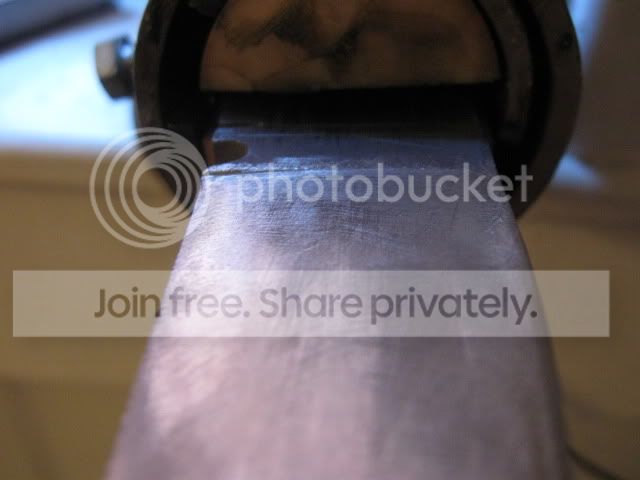
First Knife WIP

Jeff, with a (so called) rabbet tang, the tang is fully enclosed within the wood, so it can be any width/length within reason.

Edit: They call this a mortise tang as well in some threads--perhaps there is a difference.

Edit 2: Here is a page with a good diagram of a rabbet tang--it's about half-way down the page: http://www.knives.com/engnath_handles.html

That is an excellent description, thanks

Jeff
 
Jeff, one might be surprised at how many commercial knives have much less that 3" of tang! If it were mortised in tight, epoxied and pinned (or better, Corby bolted) I think it would be fine--it doesn't strike me that this is intended to be a heavy chopper or the like.


And not to get sidetracked, but what do you have for a radio? I just got a little Yaesu VX-8 I've been playing with.
 
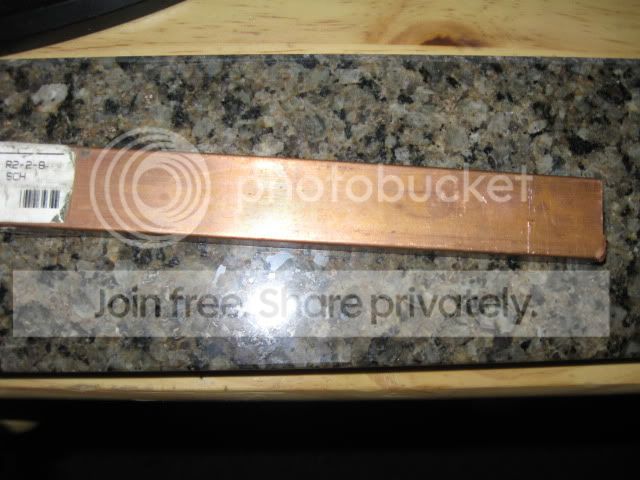
I've got a 101/2" x 1" x 1/2" piece of copper I bought from Les George, that I want to cut a chunk off of to create a nice old school guard. I took a pic below:

005-7.jpg


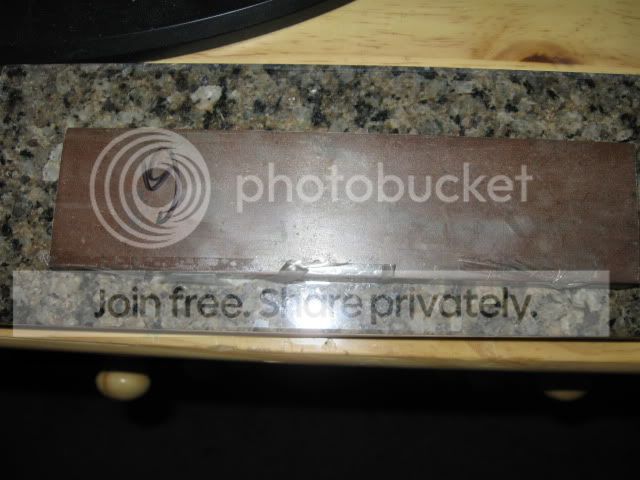
I also have an 8" x 2" x 1/2" piece of brass from him. Pic below:


006-6.jpg
 
Jeff, one might be surprised at how many commercial knives have much less that 3" of tang! If it were mortised in tight, epoxied and pinned (or better, Corby bolted) I think it would be fine--it doesn't strike me that this is intended to be a heavy chopper or the like.


And not to get sidetracked, but what do you have for a radio? I just got a little Yaesu VX-8 I've been playing with.


I have a little 2 meter Icom IC-V8 and I picked up a cool Yaesu FT-897D that covers 160,80,60,40,20,10,2 meters and 73 cm. I still don't have an antenna up yet, I'm negotiating with the super for rooftop access. My apartment is in a dead zone, so until I get that antenna up , I cant receive or transmit at all.

73,

Jeff
 
Ok, the blade is a lot smaller than I was thinking. Saw the bit "bowie" and....

The stag does look a bit big for that blade, even if it's backed off a bit with a spacer and guard. It would work, however, if ground down a good bit to enhance the natural taper of the antler. This would make it look a bit more in tune with the size and shape of the blade.

I'm a bit fan of curved handles. They are more ergonomic for every day use, and the bend is important to the overall look. Andrew Jordan's line of military knives have an almost-perfect handle/blade interface, and the curvature and palm swell look to amazing.
 
Ok, the blade is a lot smaller than I was thinking. Saw the bit "bowie" and....

The stag does look a bit big for that blade, even if it's backed off a bit with a spacer and guard. It would work, however, if ground down a good bit to enhance the natural taper of the antler. This would make it look a bit more in tune with the size and shape of the blade.

I'm a bit fan of curved handles. They are more ergonomic for every day use, and the bend is important to the overall look. Andrew Jordan's line of military knives have an almost-perfect handle/blade interface, and the curvature and palm swell look to amazing.

Bowie threw you huh!!!:D I wanted to make an every day carry Bowie, but to do that in Connecticut legally I had to have a blade that was under 4". Now though, I hosed it so bad, it won't be a Bowie:D:D:D:D
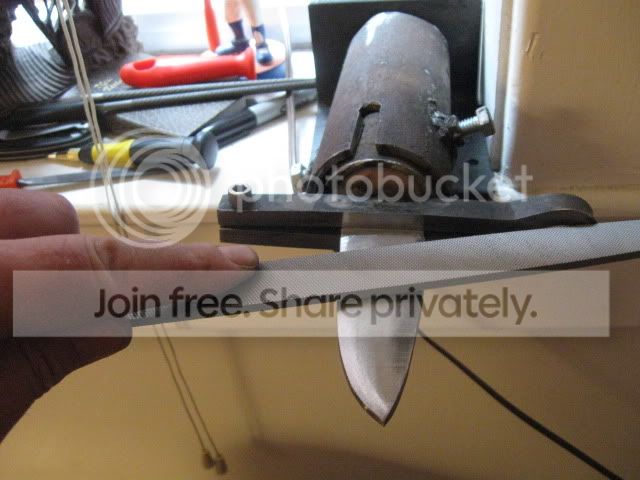
My next knife I'm going to go for an everyday carry Bowie and use the Elk antler for a handle.

Thanks,

Jeff
 
Should I be establishing my plunge line with a small round file and then filing the bevel? Right now I have my file guard right at the plunge line and butting the file against it and pulling it towards the blade point and sliding the file horizontally at the same time. I think it's kinda how Justin King described it to me. I envision the plunge cut just coming up to the halfway point of the blade. That should work, right? Am I going about the filing in the correct manner?

Thanks for your time and patience Guy's, it is really appreciated.

Jeff
 
I cut my plunge with a chainsaw file, as that is how I was instructed to do it. You can go as far as you want with the plunge but most stop just clear of the spine for a flat grind. Scandi and other grinds will vary.

Basically the concept is to make your plunge cut to the depth you want to file down the blade to. It sound easy, but my plunge cuts ended up a bit nasty looking and I ended up grinding into the spine a bit with the belt grinder on my first project.
 
I'm currently in the middle of filing my first side. How will I know, (what am I looking for), when it's time to switch to sand paper? Below are more pics of filing the knife:


007-6.jpg


008-3.jpg


009-2.jpg


Still Filing, so more will be following as I progress.

Thank You everyone for your comments and advice. Keep them coming!!!:thumbup::thumbup::thumbup::thumbup:

Jeff
 
Just a suggestion and this is what Stacy told me when I first started was don't try finishing one side then doing the other. It's apparently a big mistake new makers make and it's very hard to get them to match that way. He told me to to work my way up both sides as evenly as I could. Trying to do one side completely and then the other isn't all that easy. Think of it in terms of when people grind. They don't do all their passes on one side then flip it over and do the other. Granted you're not going to flip your knife with each file stroke but I'm sure you get the idea.
 
Yup, work one side, then work the other. It's going to take a while with just a file. You'll want it pretty much in shape before switching to paper--perhaps 90%? You don't want really deep scratches left when you need to sand. I used a coarse double-cut file at first, then switched to a finer single cut to get out the deep scratches. Then on to the 150 grit paper, then 220 and so on up to 400 before the heat treat. You also want to make sure you don't take the edge too thin before HT or the blade can warp--depending upon the steel, I believe the recommendation is from "dime" to "nickel" thick.
 
Just a suggestion and this is what Stacy told me when I first started was don't try finishing one side then doing the other. It's apparently a big mistake new makers make and it's very hard to get them to match that way. He told me to to work my way up both sides as evenly as I could. Trying to do one side completely and then the other isn't all that easy. Think of it in terms of when people grind. They don't do all their passes on one side then flip it over and do the other. Granted you're not going to flip your knife with each file stroke but I'm sure you get the idea.

Well Fletch and Mr. Example!

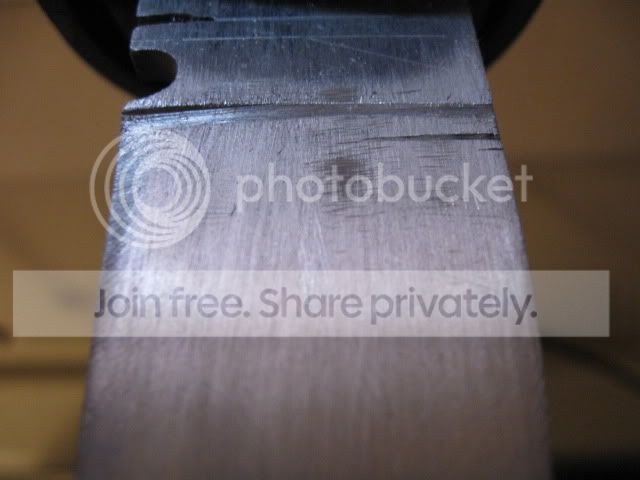
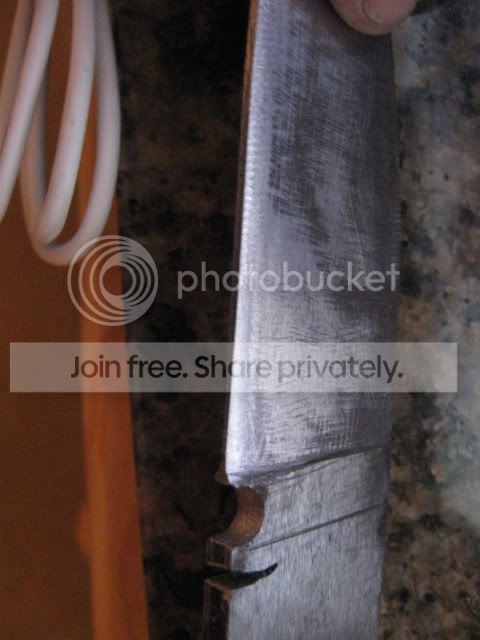
We are now at my first minor crisis. I have begun the other side and after reading your posts, I measured and found that I am at a nickel thick. My other issue is that on the side with the most work, my plunge is still pretty weak and there is a deep gash in front of it up as high as the spine. How would I get this gouge out without wreaking havoc with the bevel?

010-1.jpg


011-1.jpg


Thank you again everyone for all your help, even the ones that just look, thanks for stopping by:o:o:o

Jeff
 
Man, I don't know--that is pretty deep. You can file further up and knock it down a lot but I think the part up by the spine is going to stay (hey, it's your first one--you know it's going to have some issues--I know my first one does). To remove a scratch you need remove all the metal down to the depth of the scratch.

An idea--finish filing the blade and remove as much as you can. You might be able to camouflage the boo-boo in the spine by adding some "jimping" and make the mistake into a feature (just like the software guys do ;-)
 
Remember you're going to have A LOT of sanding to do. The guide Stacy gave me was a nickle thick when you're finished filing and a dime thick when you're finished sanding (to give you an idea how much sanding you're going to be infor ;). Also remember to keep your file clean, a lot of gouges can easily happen if you don't. With any luck you still have plenty of metal and chances are you can erase a lot of that gouge, if not all of it when sanding time comes around. I would work on the bevels the best you could without obsessing over that scratch. I know it's easier said than done but focus on one step at a time. Work your bevels as you have been and deal with the scratch in another step. At least that's what I would do... Who knows if it's right though

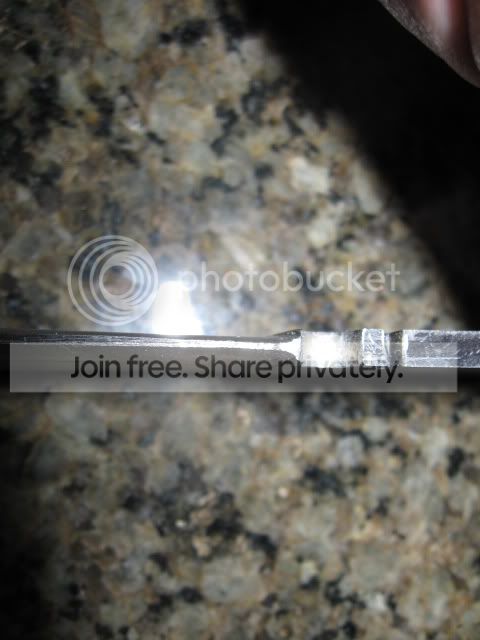
 
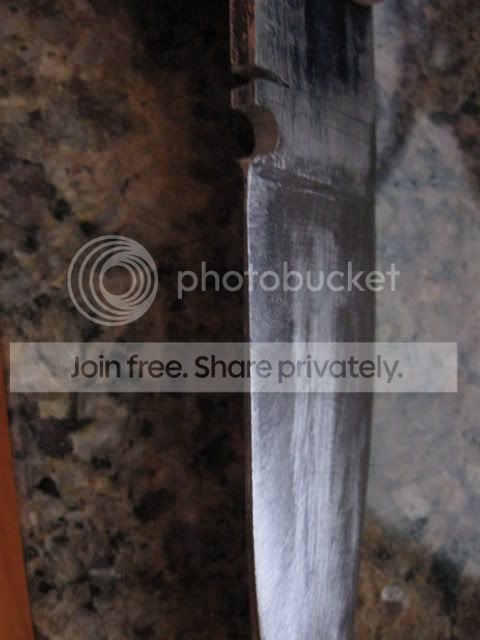
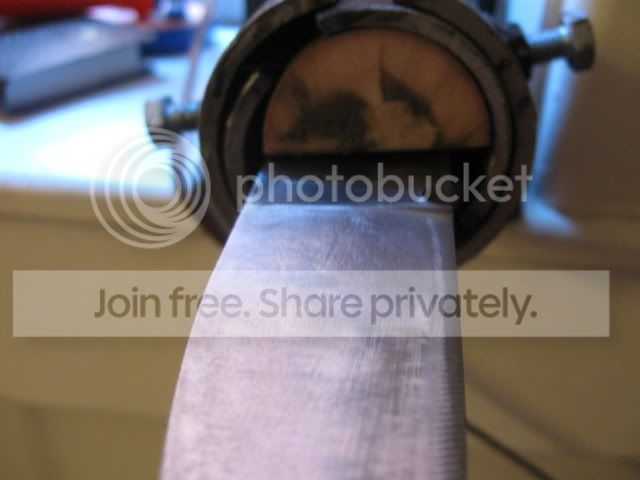
Okay, I'm not sure where I'm at, but I do know that I'm at a dimes width where the plunge lines meet at the blade. Do the plunge cuts start deepening and curving during the sanding stage? Because I have to say that mine are shallow and at almost 90 degrees. I can I tell if I'm ready to start with 80 grit sanding? Here are some pics to kind of show where I'm at:


013.jpg


012-1.jpg


015-1.jpg


014-1.jpg


Thanks Everyone,

Jeff
 
Here is what I would do at the point you are at-Keep filing until the entire length of the edge is the same thickness that you have at the plunges. The thickness you leave your edge before HT depends on a few things, your HT method/equipment is one. A forged blade that is going to be HT'd in a forge will have more decarb than a ground/filed blade that is HT'd in an oven. A blade HT'd in an oven in foil wrap will have relatively little decarb and need minimal grinding, a blade HT'd in salt pots even less.
It may also depend on how you are finishing the blade after HT. If you have a 2 HP grinder you can afford to leave the edges pretty thick, or even leave the bevels totally unground, until after HT. Working by hand, you ideally want to go as thin as you can get away with, and HT in a way that leaves minimal decarb, so that you have less work to do after the blade is hardened.

Since you have the scratch on the one side and it looks like your bevels are a little convex, I would use a marker to color one side of the blade to indicate where you are cutting, and concentrate on trying to file metal off of the middle of the bevel, and get it as flat as you can, then do the other side. The plunges will clean up pretty well on the granite and sandpaper as it is, using the method I showed you. You have to shift the paper over the granite often because it will wear out quickly when you are working just on the corner of the granite. I use 120 grit like it was free and it works pretty quickly.
 
Looking at them looks like you have more of a convex grind.
If you want a flat grind then you are going to have to cut your plunge further up!
I am doing a couple right now I will take a pic in a bit and show you what I mean.
 
Yes,

I have gotten some inside help and I was advised to fix those plunges!!! It was explained to me how I can do this, so that is my next priority. Here's goodbye to more metal!!!

Jeff
 
Ok here is the way I do it now, I make my plunge cuts with a round file, and then grind my bevels. but its the same as filing the bevels.

The first thing I do is make my matching lines on both sides going vertically thats the line I follow I keep my cut center on that line. then I make a line toward the top going horizontally. that's where I want to stop my plunge cut.

It this picture you can see how I start my plunge. I go at an angle and file until I hit my center lines on the edge side, Then I do the same to the other side. then when I get them where I want them I color them black with a sharpie.
004-19.jpg


In this pic you can see I have to go a little deeper on the one side.
010-8.jpg


In the next three pics you can see my vertical and horizontal line where I want my plunge to follow.
Note, the angle of my plunge cut, I file as much as I need to without hitting the end, thats why I paint it with a sharpie to see how close I am.

001-18.jpg

002-14.jpg

003-25.jpg


If you have any questions dont hesitate to ask!!!
I hope I have explained this well enough!
 
Back
Top