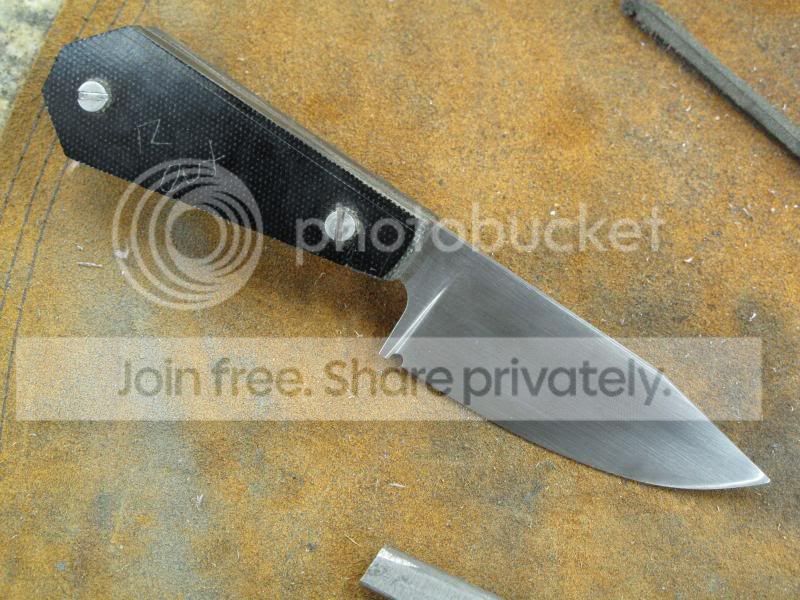
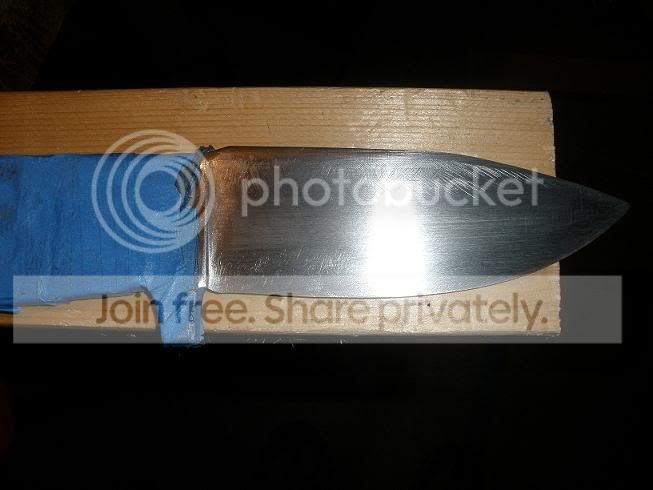
First Knife WIP

It looks to me like you are feeling your way through it pretty well, Jeff. There are a lot of different ways to do plunge cuts, and you might have to try a few before you find one that you are happy with.

The thing I like about the trick I showed you with the granite is that you can leave them pretty rough while you do the bevels and then use the bevel itself as a guide to make sure that your plunge angle matches the bevel and does not over-cut at the spine or the edge. IF you use this method, the first several passes really strip the grit off the paper so you have to use light pressure and you will only get a few effective passes before you have to move the paper to get fresh abrasive at the corner. Once the contour of your plunge starts to match the corner of the granite the paper will not wear out so fast.

If your bevels are very convex you may want to work the main bevels on the granite first to get them flattened out, then dress the plunges. Good-quality 60 grit paper works well for this.
 
Well after talking to Ernie and Bill T, it was brought to my attention that the round files I was using were too coarse and were not cutting the metal clean enough for the plunge cuts. I went out and got two Nicholson files, a 1/4" and 7/32". I was going to redo the plunges Sunday and update the pictures, but my file guide broke!!! A hardened metal file guide and it split right in the middle. I figured I'd redo the plunge cuts without without the file and hope for the best. I will have pics posted once I get going.

Thanks,

Jeff
 
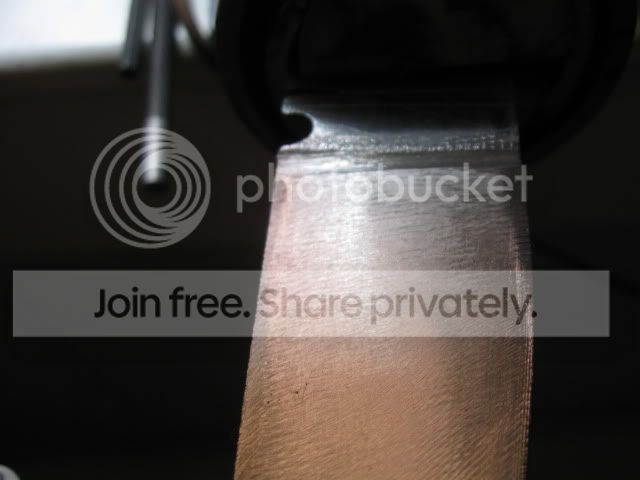
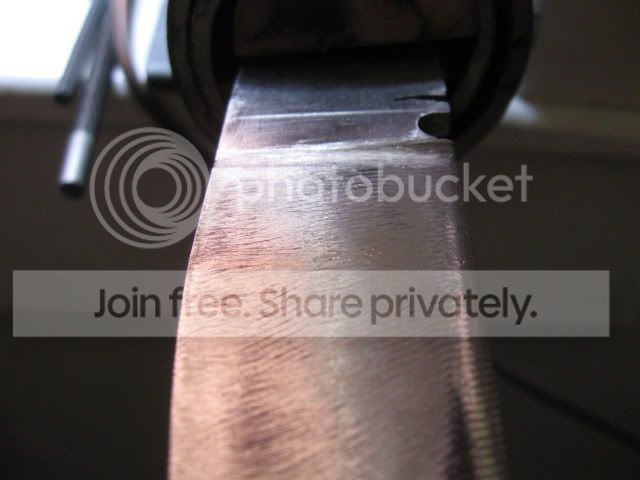
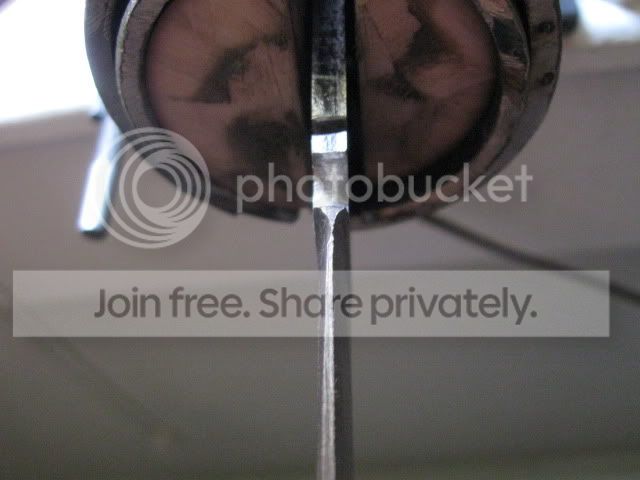
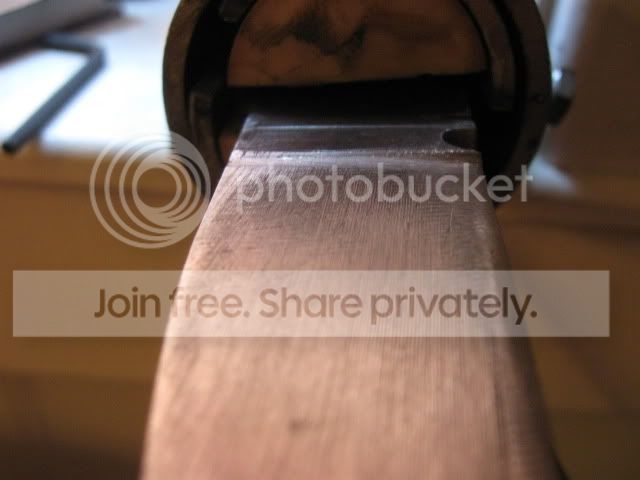
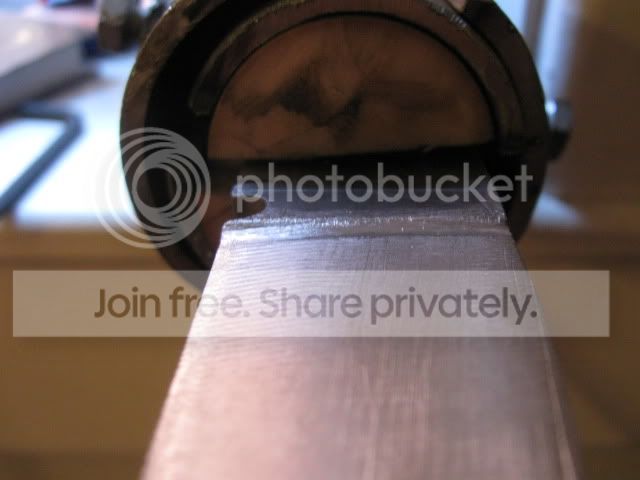
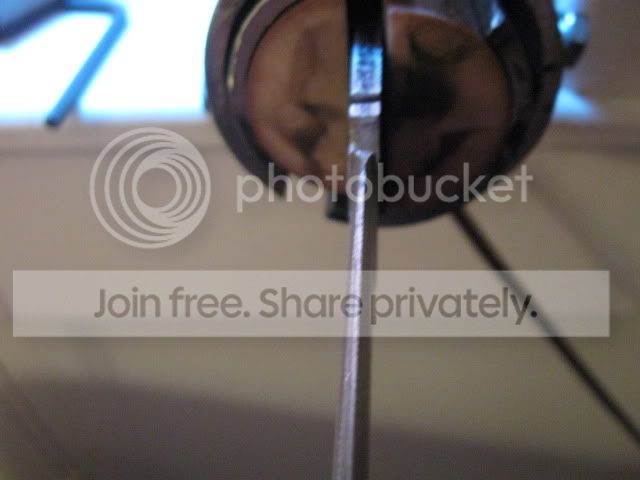
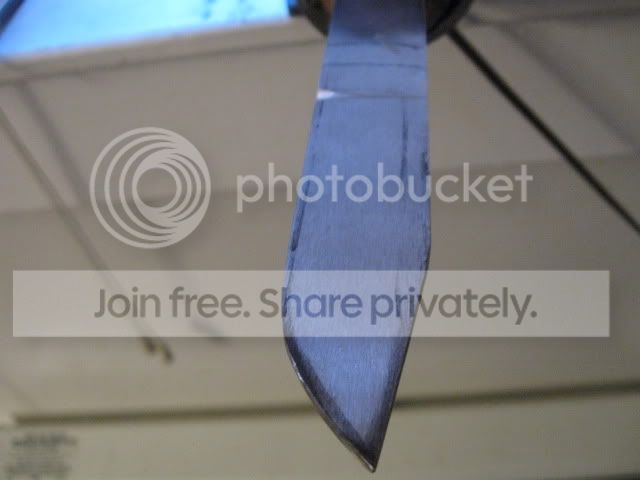
Okay I have issue's!!! Besides my personal one's I mean. I'm afraid my plunge cut's are going awry because I have no file guide anymore. I am also worried about how thin the metal is where the plunge cuts meet. Am I alright the way I'm going or is there something I need to do to avert going beyond a recoverable situation? Advise me please:D:D:D Pics below:


001-8.jpg


002-9.jpg


003-9.jpg


Thanks Everyone,

Jeff
 
After a total of 4 hours today, starting at 9 this morning, I think I might have put a little dent in the convex areas of the blade. The metal where the plunges meet is getting a little too thin. I also think without a file guide, I may have hosed up the symmetry of the plunge lines. I was hoping to get a few opinions on where I stand. Here are the pics of where I'm at as of 1344 EST. Thank you Everyone for your input and advice and just for viewing!!!

Jeff


005-8.jpg


004-7.jpg


006-7.jpg
 
If you get a little too thin in the edge you can always file/sand it down a bit.I don't understand how you got teh metal so thin at the plunge area and nowhere else on the edge. Were you just doing the plunge independently from the rest of the blade? You want to try and do everything as equal as possible whenever your doing anything. Sand one spot too much and you'll get a low spot which you'll pull your hair out trying to even out, same applies to filing only you're removing even more metal. At some point you're going to have to try and get the rest of the blade as thin as the plunge area. Not sure what the best way to go about that is. I'm guessing you can get the rest of the blade that thin then file the edge down a bit to thicken it up. Or I guess you can thicken it all up now and go from there. At some point you have to try and the thickness of the edge fairly uniform regardless.

Hopefully someone with a bit more experience than me will chime in here on the best course of action from here.
 
IG, just gave me the best news of the day, he informed me that my plunge shouldn't be all the up on the spine, so I just spent the last half hour grinding away 3 days work so I could fill in the high plunge. I don't know what to do now...Paper Weight???
 
I didn't think it would happen...But I failed. The tools I have at my disposal aren't enough to bail me out. I need to find another piece of metal I can cut and start over...This blows...
 
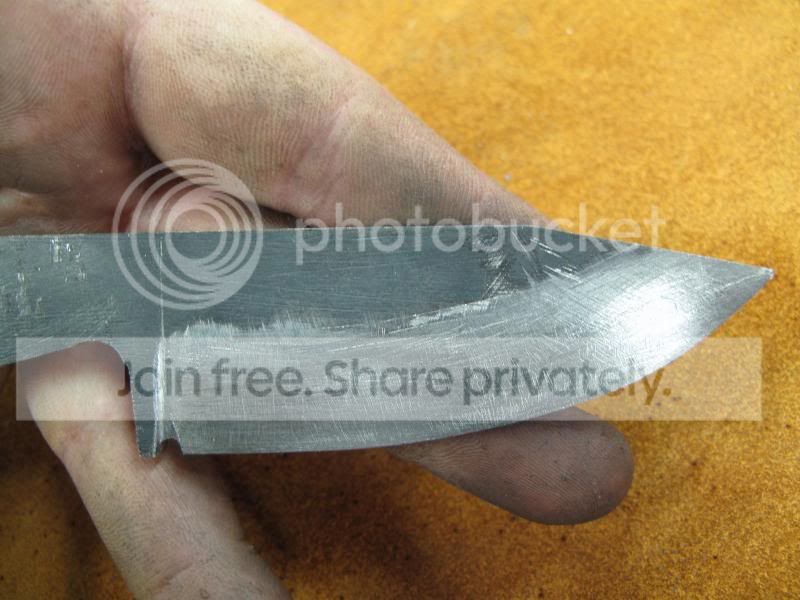
This is attempt number 2 take 1... I expected maybe to come out with a crappy knife, but not a failure. I did a little more work on the profile, but my hearts not in it right now and once again the plunge cuts aren't coming out right. My file guide busted, so ow I'm doing it by eye and that's not working out to well. I guess age has helped me, because 20 years ago, this would all be 3 floors down on the sidewalk!!! I have an updated pic, I figured I'd keep this new attempt in the same thread since there really wasn't a completion of the first knife.


011-3.jpg
 
Keep digging you will get it and don't look at it as a failure but as learning experience. Take your time because if you rushed and had to start over again? It took me 4 days shy of 3 months to make my first knife. I am working on knifes 3-6 right now. 3,4 and 5 are ready for HT and 6 will be ready before the end of next week. I started the last two about 2 weeks ago so it will get faster, if you use the first one to learn on.
 

Any one of those could work I guess, I think the middle one would be most conducive to the space I have. Do you know if there is any plans or parts list available? Maybe where the materials could be procured?

Thanks

Jeff
 
Jeff, what did you fail at? Did you throw the blank away?

From the looks of the pic, your plunge line was a bit forward of the notch thing where the edge stops and the ricasso starts. A whole lot of knives have the plunge line bisecting this notch, and it looks good, so you have a ton of room to move the plunge line back. Saves the whole piece.

As for plunging all the way to the spine, I wouldn't worry too much about that. I did the same thing to my first and second and third blades, but it all worked out when I sanded the ricasso flat. Completely eliminated the upper end of the plunge cut, giving me something of a professional look.

The scratch line on this blade (below) was soon followed by a small file. Big mistake, I thought, but I kept going figuring I would at least learn a bit from the whole mess. Turned out alright, in the end, though.

IMG_3703.jpg

IMG_3898.jpg
 
This is attempt number 2 take 1... I expected maybe to come out with a crappy knife, but not a failure. I did a little more work on the profile, but my hearts not in it right now and once again the plunge cuts aren't coming out right. My file guide busted, so ow I'm doing it by eye and that's not working out to well. I guess age has helped me, because 20 years ago, this would all be 3 floors down on the sidewalk!!! I have an updated pic, I figured I'd keep this new attempt in the same thread since there really wasn't a completion of the first knife.


You could do what I did when I did mine. Draw a line where you want your plunge to be and then start layering painters tape on top of it. You can get it thick enough to have at least a little stop. Although I wouldn't recommend using a whole lot of pressure up against the tape. I peeled it back for the pic and to see how it looked but here was my first file guide


Knife006.jpg
 
No, I didn't throw the blank away, I put too many hours into it. Right now, the issue with the plunge line is that there is a razor of metal where both plunges meet. The way it sits now, it's not recoverable. I talked to BillT last night and he thought that I could cut out a semi-circle in the chiol area, where the plunges meet, and that could get me back to a decent thickness to rework. I think it was the fact that I ground away 3 day's of work because my plunge hit the spine and then found no metal to work with that got me frustrated enough to not even think outside the box. The next day is a new day, and I'm going to take a few to think this through. I would really like to get a file guide before I start again, because even with the new knife, I started going off the reservation rather quickly, but stopped before I hit another crisis.

Thanks Guy's

Jeff
 
I have tried to do plunges with a chainsaw file, and have had more failure than success. I managed to save them in some instances but the only way I get decent results with this method is to do it before I have started the bevels.

That thing I showed you with the granite I think would have worked better in your situation because you already had the bevels done, trying to use a file at that point is much more difficult because you only have the one side of the cut to guide you. The trick to using a chainsaw file is to cut the plunge before you have started the bevels, that way you have metal on both sides of the cut to keep your file straight. If you do it this way and are careful you should have enough control to get decent plunges without even using a guide, once you have enough of a groove cut this will guide the file. The hard part then is trying to keep the same angle so that the bottom of the cut stays flat, and a file guide can't help you with this anyway. The trouble with doing it this way is that after you get the plunges done, you have to worry about keeping your square-edged file off of them while you do the bevels. All in all I have found the granite-lapping method to be the easiest and most consistent. I do the bevels and just get the plunges as straight as I can, leaving them square-edged from the grinder (or file, in your case). I leave them about 1/16" further away from the ricasso area than I want them to be when finished. Then once the bevels are 95% done, I do like I showed you in the pics I emailed. If you have your bevels nice and flat and have something to guide you along the edge of the granite it works like a charm.

Since you were doing well on this one until you got to the plunges I would humbly suggest that you experiment and practice on this blade a little more, so you have a better idea what to do on the next one.

Believe it or not, you will still toss a blade every now and then even when you have a few dozen knives under your belt. It sucks to have to make that judgement call on your first but we all have our pile of junked blades laying around (or buried, as it were) so it's not worth getting too hung up on. The lessons you learn on this one will make your next one that much better than this one ever could have been.
 
Last edited:
Thanks Justin. I figured I need to reevaluate how I'm going to do this. Like I said in the beginning, I don't have a creative bone in my body. While I have plenty of experience utilizing different sets of tools, I don't have any experience using them in finite movements and ways that are needed from knife making. I need to figure out what more I need to add to my tool inventory to get a leg up on the battle with a piece of steel. Maybe I do need to invest in a 2x48 Craftsmen grinder. I don't know. What I do know is that I don't feel right just throwing away metal that people gave to me to get started, so I want to make sure I have a definite plan going forward. That might mean waiting to get a small grinder. I don't know. Thanks Again Justin.

Jeff
 
Jeff, that first blade is far from done, but I understand the frustration you're feeling. It's like everything that can go wrong, is.

The good news, as I've seen it, is that jive like that cleans up to look rather good.

Here's a knife by Andrew Jordan. Great design from a great designer.

4.jpg


Note how there is a big round gap between the guard and the beginning of the edge. This is so you can choke up on the knife for finer work, but retain a longer overall length of 4.3"

The blade you're working on is just calling for a similar treatment. File down a bit on the ricasso and you'll see that plunge line smooth out and start looking entirely too sexy for its own good.


How did you're file guide break? Got a pic? If you have a decent tool store near by, you might be able to get a set of 1-2-3 blocks for cheap. My set cost $10, and I bolted them together to make a very nice, very heavy file guide until I decided I wanted something more "professional" and had the overtime to afford it. Not the best/cheapest decision I've ever made, but I'm a tool junkie! :D

Catch your breath. Think positive thoughts. Come back with some mojo flowing strong!
 
Thanks Justin. I figured I need to reevaluate how I'm going to do this. Like I said in the beginning, I don't have a creative bone in my body. While I have plenty of experience utilizing different sets of tools, I don't have any experience using them in finite movements and ways that are needed from knife making. I need to figure out what more I need to add to my tool inventory to get a leg up on the battle with a piece of steel. Maybe I do need to invest in a 2x48 Craftsmen grinder. I don't know. What I do know is that I don't feel right just throwing away metal that people gave to me to get started, so I want to make sure I have a definite plan going forward. That might mean waiting to get a small grinder. I don't know. Thanks Again Justin.

Jeff


Remember this, you can mess up A LOT quicker with power tools than you can with hand tools. You can do a lot more damage with one pass on a grinder than you can with one file stroke.

IIRC Jeff your file guide looked a lot like Fred's clamp from his bubble jig. If it was it probably was from his first batch. He mentioned it in his thread that the rounded part wasn't annealed and some people had issues with it breaking there because it was so hard and had no flex. He fixed this problem in subsequent batches and mentioned anyone who had a first run to suspend the clamp in water and leave the rounded part sticking out. Then heat it with a torch and let it cool to soften it up a bit.... not that that news helps now.
 
The metal is just food for practice, my friend. Like I said, we have all embarassed a piece of steel here and there:p I probably have as many failed blades as finished ones since I started learning to forge, and this is unfortunately not an exaggeration. A lot of them were finished all they way to HT or beyond before they were rejected, like at 90% completion, so I know what it feels like to throw out a big chunk of your time and effort. Knifemaking is a hobby that is fraught with expectations, frustrations, and lessons that consume many hours in the learning. If you are passionate about it you will curse at your tools and your work (and if you are insane they will curse back at you:D:confused::D) and you will sometimes have to restrain yourself from giving free flying lessons to whatever is handy when things go wrong.

Like Unky Gumby said, you were moving pretty fast on this one. Crash course speed. Most take months to make their first and they don't always turn out pretty. I think you set a pretty high standard for yourself, which carries no fault but does steepen the learning curve a great deal.

From the work you did on this one it is plain that you have the aptitude to make knives, you just have to do some good old trial and error learning to make them to your own satisfaction.
 
Back
Top