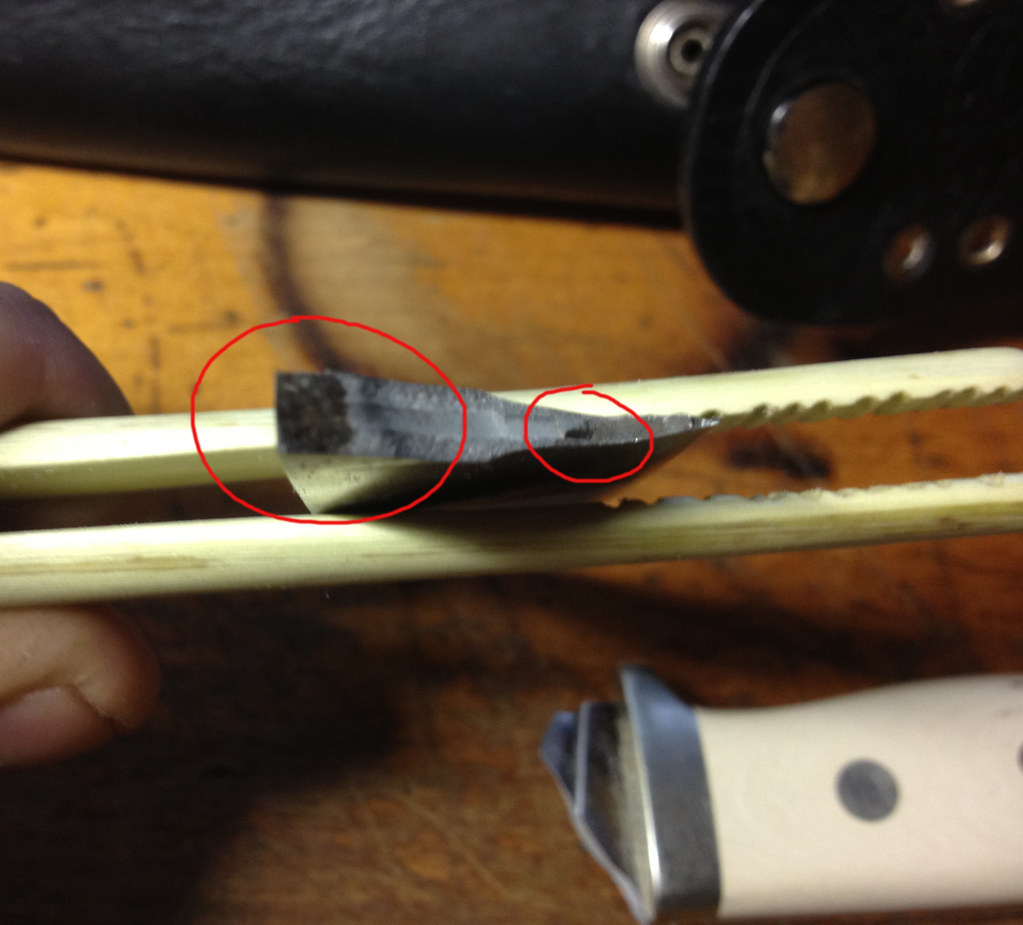
Goodbye my friend....

I wouldn't warranty ANY knife I was using to baton, if it broke, regardless of the brand. Yes, I use my knives to baton regularly. Even stainless steel. All different types of grinds. Folders too occasionally. Only ones I've ever broken were a Buck 639 Field Mate, a Kershaw Vapor, and a Normark Hunter.

I don't know that any knife is really "designed" for being used to baton, even Becker, Busse, or Esee. Some just do a much better job of surviving it.
 
That's too bad, but it sure beats a pristine knife that spends its life in a box or safe somewhere.

+1

Very good observation.

For a future knife for the OP, I'd suggest something in a good, tough carbon steel and not too expensive, since it's clear he likes to use his knives heavily, including batonning regularly.
 
I have the Bravo-1, actually two of them and a Gunny. Both are in A2, but they are coming out with a 3V version. For the uses you describe, you want the Bravo-1. Another good choice as others have stated is an ESEE-4 or 6, (1095) and I'd throw in a Scrapyard War Dog (INFI) which are available on the secondary market from time to time.

I think I prefer the Bravo-1 though, and I have, and used all the knives I listed.
 
and just in case anyone knows...is this how the blade should look like?Burned steel, lamination visible?
6619324733_1eaf5c9b98_b.jpg
 
Smacking the back of any knife makes me wince. A good sized piece of hardwood can deliver a massive amount of force to a small surface area. Like I have preached before, it is called an AXE, use an axe for such chores and you will circumvent all the lamenting behavior. The Swedish knives are beautiful tools, but they are certainly not bullet proof implements. Wonder what the company will say when you contact them?
 
Other than the wooden slabs, the ESEE 4 with the after market handles from TKC would probably work very well for you. That was a beautiful knife and it's a shame. I would want my outdoor blade to perform what you were doing with 100% confidence. Good luck.
 
Smacking the back of any knife makes me wince. A good sized piece of hardwood can deliver a massive amount of force to a small surface area. Like I have preached before, it is called an AXE, use an axe for such chores and you will circumvent all the lamenting behavior. The Swedish knives are beautiful tools, but they are certainly not bullet proof implements. Wonder what the company will say when you contact them?

Thank you very much on the information about the axe. So it happens, that my axe is always by my side when I go outdoors, razor sharp as it should be and resting next to my saw. It has seen a lot of action too. However, for YOUR information, splitting wood with a knife, is a time honored tradition, and a safer way to get dry firewood, WHEN there is not appropriate work-space to operate an AXE safely...that is if you don't have a large enough stump to properly place the firewood and deliver ACCURATE hits WITH A RAZOR SHARP AXE, or at low-light condition, that has been the case in this situation. Please consider this, if you ever find yourself in similar condition.
Moreover, Swedish knives as a term usually refers to Saami puukkos , rat-tail or hidden tang construction belt knives. The F1, is not a "Swedish knife", but a full-tang heavy duty general-purpose knife. It is manufactured in Japan by Fallkniven.
I really cant understand why some of you criticize me for batonning. It might be the case, that you have only experienced batonning as a process through television or Youtube, and decided that a true "woodsman" should never have to abuse his/her knife in that way.
 
That BRKT rampless B1 drop point is the first one I've seen like that, very nice.

Sorry to hear about your falkniven it really sucks when a prized knife breaks. The break does look a little odd but I'm not a expert on broken metal so I would email them to get a better answer.
 
Thank you very much on the information about the axe. So it happens, that my axe is always by my side when I go outdoors, razor sharp as it should be and resting next to my saw. It has seen a lot of action too. However, for YOUR information, splitting wood with a knife, is a time honored tradition, and a safer way to get dry firewood, WHEN there is not appropriate work-space to operate an AXE safely...that is if you don't have a large enough stump to properly place the firewood and deliver ACCURATE hits WITH A RAZOR SHARP AXE, or at low-light condition, that has been the case in this situation. Please consider this, if you ever find yourself in similar condition.
Moreover, Swedish knives as a term usually refers to Saami puukkos , rat-tail or hidden tang construction belt knives. The F1, is not a "Swedish knife", but a full-tang heavy duty general-purpose knife. It is manufactured in Japan by Fallkniven.
I really cant understand why some of you criticize me for batonning. It might be the case, that you have only experienced batonning as a process through television or Youtube, and decided that a true "woodsman" should never have to abuse his/her knife in that way.
Excuse my ignorance on this matter, as I never go camping, but could you not baton with the axe? I could be confusing a hatchet for an axe though, but some axes should have a flat portion in the back that would be perfect for striking with a mallet right?

I don't think batoning is inherently bad. I tried it myself with my ESEE Junglas. I just don't feel a stainless steel blade, no matter how well laminated and heat treated, can handle it for long. Though I wouldn't mind trying it with Elmax or S30V. Had you done it with 1095 I don't think anyone here would have any issues with that.
 
I really cant understand why some of you criticize me for batonning.
simply put, you have hit on a sensitive issue that polarizes many knife communities. There are those that baton, and those that think it is ridiculous.

My opinion is that how a knife should be used is the decision of the knife owner. The decision of if the break is warrantable is the manufacturer's.

When something like this thread is posted, opinions come out of the woodwork. My opinion is to be HONEST with the manufacturer and they will likely be honest and fair in turn.

Understand that manufacturers ALSO are divided regarding the subject or batoning.

Not gonna call right or wrong...it is not MY decision to make for YOUR knife.
 
Excuse my ignorance on this matter, as I never go camping, but could you not baton with the axe? I could be confusing a hatchet for an axe though, but some axes should have a flat portion in the back that would be perfect for striking with a mallet right?

I don't think batoning is inherently bad. I tried it myself with my ESEE Junglas. I just don't feel a stainless steel blade, no matter how well laminated and heat treated, can handle it for long. Though I wouldn't mind trying it with Elmax or S30V. Had you done it with 1095 I don't think anyone here would have any issues with that.

No ignorance at all. Yes you can gently baton with an axe, although many manufacturers specifically state that an axe should not be hit at its butt, or never be used as a hammer, because it can cause the handle to get loose. However, it is not as practical as using the knife, because of the weight distribution and because of the long handle. Also, for splitting small firewood with an axe, you use a different technique, which also asks for a flat wooden surface that was not available at the moment.
And because I don't want to be hostile towards anyone, the situation was like this: a week ago I was camping at -14c in a snowy forest. All the wood was frozen and wet. The sun was going down and I realized that I did not calculate properly the amount of firewood that I would need for the night. I picked up some "dry" (yeah right) wood and instinctively grabbed my knife from my belt and started splitting wood with a temporary "mallet" that I have carved the previous day. Towards the end, the knife broke while trying to split oak or beech I m not entirely sure.
If anyone thinks it was a bad call, then you might be right. Lost a knife, gained some experience...well worth it I think!
 
No criticizing here, most people when they do baton with a knife, they smack the knife with a piece of wood and not a mallet. That might be the keyword bothering people. If it requires such force that a mallet becomes necessary, then the question arises if it is the right tool for the job. As unit said, it's your knife and you can do with it as you like. Posting on a publicly available forum will always draw variance n opinion though, thick skin and perspective assists in dealing with comments.
 
No criticizing here, most people when they do baton with a knife, they smack the knife with a piece of wood and not a mallet. That might be the keyword bothering people. If it requires such force that a mallet becomes necessary, then the question arises if it is the right tool for the job. As unit said, it's your knife and you can do with it as you like. Posting on a publicly available forum will always draw variance n opinion though, thick skin and perspective assists in dealing with comments.

mallet=as in a piece of wood used for batonning, in "bushcraft" terms.
Well you are probably right.
 
I wouldn't warranty ANY knife I was using to baton, if it broke, regardless of the brand.

Could you expound on this statement? I find it confusing inasmuch as it's the manufacturer that warranties their products, not the end user.

I don't know that any knife is really "designed" for being used to baton, even Becker, Busse, or Esee. Some just do a much better job of surviving it.

And I wonder if this statement doesn't perhaps delve a bit too deeply into the realm of semantics. If we have a specific brand whose knives have not only reliably and repeatedly performed a certain task for decades, but are also completely warrantied in the event that they should ever fail performing that task, then the question of, "was it designed for this use?" becomes inconsequential.
 
Back
Top