
-
The BladeForums.com 2024 Traditional Knife is available! Price is $250 ea (shipped within CONUS).
Order here: https://www.bladeforums.com/help/2024-traditional/
You are using an out of date browser. It may not display this or other websites correctly.
You should upgrade or use an alternative browser.
You should upgrade or use an alternative browser.
got my steel in today and started working on my FIRTS KNIFE!!!!!
- Thread starter J.McDonald Knives
- Start date


- Joined
- Dec 4, 2005
- Messages
- 1,025
it may be just how i'm looking at it, but your transition from tang to blade seems kinda sharp, might be a possible stress riser. looks good though!

J.McDonald Knives
Basic Member
- Joined
- Jan 28, 2007
- Messages
- 2,021
well i am now down to hand sanding it to 600 before putting it into the forge. tomorrow i plan to test my forge to see what settings it needs to be on when i HT the blade. good think i made those tongs awhile back. anyone know about what color 1080 should be when it reaches just past non magnetic?

- Joined
- Dec 6, 2004
- Messages
- 6,212
you should be able to see the shadows dancing in the blade when its ready
and no im not joking
and no im not joking
J.McDonald Knives
Basic Member
- Joined
- Jan 28, 2007
- Messages
- 2,021
explain that one to me please, butch.

- Joined
- Apr 9, 2006
- Messages
- 1,499
you should be able to see the shadows dancing in the blade when its ready
and no im not joking
I'm not trying to pick a fight here Butch, but I was told that if you see shadows in the steel, it is not ready just yet. Keep heating until the shadows dissapear, then its probably ready. (I'd probably check it with a magnet too) I don't have my notes handy, but I seem to remember something about not being a full austenitic solution if there are shadows in the blade. If I am wrong here, someone please correct me right away. -Matt-
J.McDonald Knives
Basic Member
- Joined
- Jan 28, 2007
- Messages
- 2,021
someone wanna explain that one to me more please? HEHEHEHE!!!!
- Joined
- Dec 6, 2004
- Messages
- 6,212
could be grease man i dont do much non foil packet sub 2000f heat treating
- Joined
- May 3, 2004
- Messages
- 979
when the steel is in transformation to austenite, very close to complete, that change is visable as shadows or darker regions that appear to move in the blade(dance). this indicates that you are very close to having the blade to the proper temp, a little more until these shadows disappear and you are at the proper temp to quench the blade. I actually trust this indication of trasformation more than the magnet.
I hope this makes it more clear, but if not then you really just have to see a blade in transition to make it perfectly clear.
Del
I hope this makes it more clear, but if not then you really just have to see a blade in transition to make it perfectly clear.
Del

- Joined
- Jan 23, 2007
- Messages
- 3,106
any last minute advice yall want to give me?
A knifemaker at another site suggested not putting your edge on till last. Little easier to attach scales and such not having to worry about amputating a finger in the process.
- Joined
- Apr 9, 2006
- Messages
- 1,499
Jacob, I'm going to explain this the way that I understand it, and bear in mind that I may not be 100% correct and someone may crucify me for attempting to explain this without being a metallurgist.
As you heat the blade the steel will undergo various phase transformations as the heat increases. To heat treat it properly you are going to want a fully austenetized phase or structure in your steel before you quench. If you look closely when you are near non-magnetic, you will see areas of the blade that look darker than others usually in the thicker cross sections and in the middle of the blade. I was taught that if there are shadows in the blade, those are areas that have not been heated thourouly enough to complete the phease transformation to austenite. If you quench before the transformation is complete to austenite, you may end up with structures in your blade that you don't want there. You might anyway, but perhaps a lot less of them quenching from full austenite phase. Hence my post about heating past the shadow stage. Again, if I am wrong, I will fully admit it and someone please correct me as soon as possible. This is just the way that I understand it. Hope it helps! -Matt-
As you heat the blade the steel will undergo various phase transformations as the heat increases. To heat treat it properly you are going to want a fully austenetized phase or structure in your steel before you quench. If you look closely when you are near non-magnetic, you will see areas of the blade that look darker than others usually in the thicker cross sections and in the middle of the blade. I was taught that if there are shadows in the blade, those are areas that have not been heated thourouly enough to complete the phease transformation to austenite. If you quench before the transformation is complete to austenite, you may end up with structures in your blade that you don't want there. You might anyway, but perhaps a lot less of them quenching from full austenite phase. Hence my post about heating past the shadow stage. Again, if I am wrong, I will fully admit it and someone please correct me as soon as possible. This is just the way that I understand it. Hope it helps! -Matt-
J.McDonald Knives
Basic Member
- Joined
- Jan 28, 2007
- Messages
- 2,021
i think i remember seeing something like that when i was making my tongs. ill be watching it closely. anything special i need to do to the blade prior to sticking it in the forge? ive almost got the whole blade sanded to 600.

- Joined
- Oct 26, 2005
- Messages
- 1,179
I'm not going to talk about the shadows (other than to appreciate them and the beauty of metallurgy at work), but I'll say something about quenching. If you're going for a regular quench, warm the oil up first by droping in a small piece of metal that's nice and glowy (nothing huge). Make sure that you have lots of open space (that oil will smoke like no other); try to keep the liquid as still as possible; place the metal in edge down, straight down; don't worry about flaring- it happens and it's not bad.
Good luck!
Good luck!
- Joined
- Apr 9, 2006
- Messages
- 1,499
when the steel is in transformation to austenite, very close to complete, that change is visable as shadows or darker regions that appear to move in the blade(dance). this indicates that you are very close to having the blade to the proper temp, a little more until these shadows disappear and you are at the proper temp to quench the blade. I actually trust this indication of trasformation more than the magnet.
I hope this makes it more clear, but if not then you really just have to see a blade in transition to make it perfectly clear.
Del
Del, you posted as I was typing mine! I think your post may be more unerstandable than mine, thanks for the input. -Matt-
J.McDonald Knives
Basic Member
- Joined
- Jan 28, 2007
- Messages
- 2,021
i have one of those electric 2 burner cook tops im going to use to heat my oil. just need to pick up a turkey roast pan (cheapest i can find for now) and some oil. any suggestions as to which of the cooking oils at the grocery store i should get? remember its 1080.
- Joined
- Oct 26, 2005
- Messages
- 1,179
i have one of those electric 2 burner cook tops im going to use to heat my oil. just need to pick up a turkey roast pan (cheapest i can find for now) and some oil. any suggestions as to which of the cooking oils at the grocery store i should get? remember its 1080.
Have any used motor oil? Otherwise, some new motor oil? I'm gonna run a seach really quick- I'm pretty sure that there's a list someone on here of the best oils to use for quenching.
J.McDonald Knives
Basic Member
- Joined
- Jan 28, 2007
- Messages
- 2,021
im back on a tight budget so i need to stay cheap on price. Peter, you going to be at the Central Texas Knife Show in july?
- Joined
- Oct 26, 2005
- Messages
- 1,179
Looks like my used motor oil method is generally frowned upon, and canola/veggie/olive oil (or any other high viscosity oil) is better for quenches.
It looks like I should be able to make it to the knife show.
btw- My name's Peyton- P_E_R is a nom de plum that I need to get changed to Peyton R.
It looks like I should be able to make it to the knife show.
btw- My name's Peyton- P_E_R is a nom de plum that I need to get changed to Peyton R.
J.McDonald Knives
Basic Member
- Joined
- Jan 28, 2007
- Messages
- 2,021
ok i guess ill just get a gallon of the cheapest of the cooking oils that you listed. if you have seen my pic then look for me cause i will have this knife with me. i look foward to finishing this knife and to going to the show.
J.McDonald Knives
Basic Member
- Joined
- Jan 28, 2007
- Messages
- 2,021
new pics!!!! i havent finished sanding it to 600 yet but here is the lastest updates of it. these pics show the pin holes drilled in the tang.
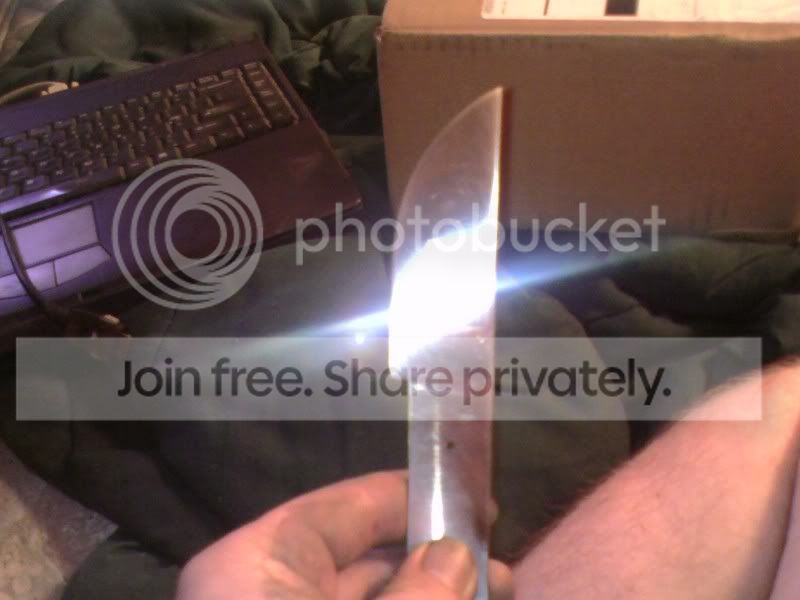

so hows it looking so far?
so hows it looking so far?