Hamon = Great Heat Treat?

Matt,
Those are great examples of cutlers art,… tastefully done and well thought out. Great explanation of how to balance the hamon with blade geometry for "optimum" performance. ... Judging by the etch, it "reads" like you nailed them both!

Hamon, Harmon,... Harmony! :)
 
If you were to try and get an un-differentially tempered full martensite blade to spring close to 90 degrees, without snapping, and taking just a slight set, you would probably be looking at something like a fillet knife with a long, narrow, thin blade and an edge with somewhere around a Rockwell 54. However, if flexing 90 degrees with just a minor set, or bending back and forth in a vise is not part of the intended purpose or criteria for the blade, then a full un-differentially tempered martensite blade is still a great choice,… and there is also always something to be said for differentially tempered full martensite blades…

When the balance between geometry and heat treating are well thought out and well executed… They each have their place and can all make great knives!…
 
Thanks Tai.

Can you tell the difference between a spring tempered back vs a fully hardened blade?

maybe on a sword? Not a thick arse chopper... maybe a paper thin bowie?
 
A spring tempered back is "springier" than soft back or blades un-differentially tempered at higher hardnesses. Not that one is necessarily better or worse, but in essence any difference in heat treat affects the blade's properties.

Edited to say: un-differentially tempered at higher hardnesses instead of full hardened.
 
Last edited:
A spring tempered back is "springier" than soft back or full hardened blade. Not that one is necessarily better or worse, but in essence any difference in heat treat affects the blade's properties.

That's what I love about knifemaking. You can "tune" the heat treat to suit the intended purpose.

Rick
 
What we on the surface of a hamon is not always indicative of what we have developed in the steel. You need to examine a cross section to verify what you see in the surface.
It is simple, just take a file, put a scratch in the blade running from edge to spine, place the blade in a vice with the scratch above the vice jaws and break it. You should be able to see any siginificant differences with the naked eye, a simple magnifying glass is better and naturally a microscope and some one to run it and interpret what he sees is best.
 
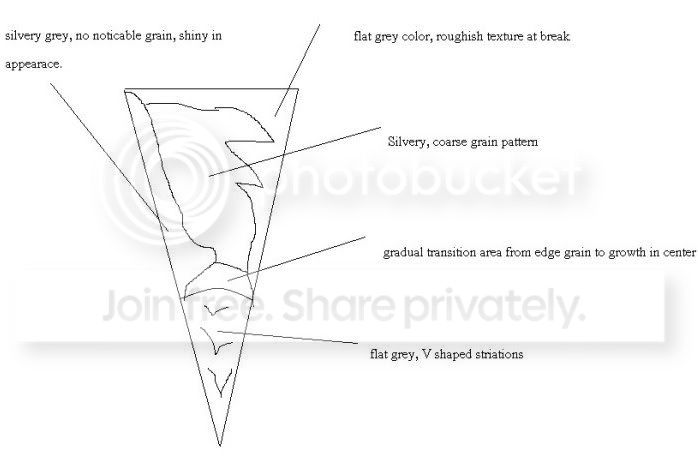
A nicely done zone hardened blade with a hamon is a fantastic thing. It may indicate a superb heat treat and blade with excellent performance, but there are BAD heat treats that look very similar to a hamon yet perform about as well as a lump of mild steel at home depot. I've had a few of the latter a few years ago when trying to harden and quench using an undersized oxy-mapp gas torch on 1095. The very edge of that blade hardened and performed well, and something that looked like a hamon formed after etching(even though no clay was used and no differential hardening techniques were employed). The knife cut well and the edge didn't chip out, and regular use didn't show any notable performance issues. Looking at the grain structure after breaking it with a couple 90 degree bends showed that there were about half a dozen distinct structures present, so just looking nice won't tell the whole story. It was also a wet noodle, with what seemed like less resistance to bending than an unhardened blank of similar shape did. I still have no idea what my edge structure was at that point, instead of being a clean satin grain it was flat in texture with chevron shaped striations pointing towards the edge.
 
Kind of like V shapes, reminded me of a tractor tire almost. Right above that was a small transition area, above that and in the core of the blade an area of huge crystaline grains... I drew a picture back when It happened cuz I couldn't get a good photo of it... lemme find it.

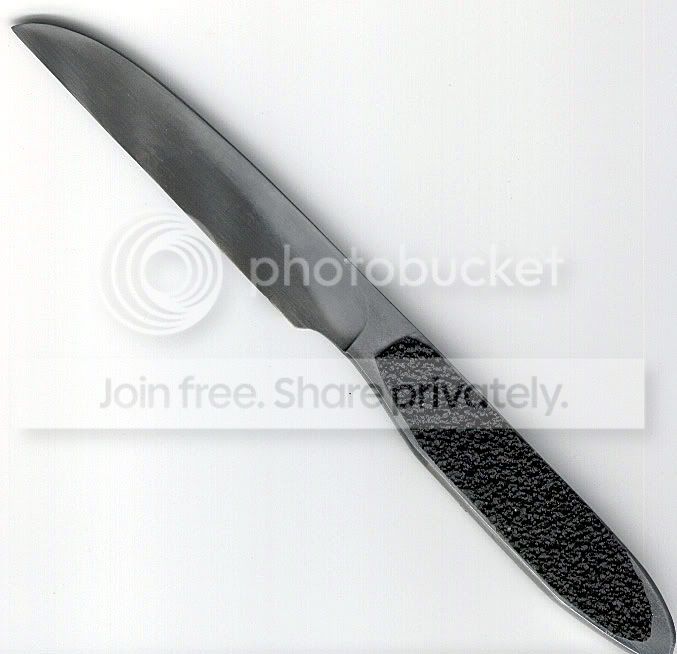
aaaaand here it is along with a scan of the knife before I popped it into the vise. Circa 2002-2003


breakcliffe.jpg


nkyod.jpg
 
Last edited:
I have never seen anything like that, and cannot offer any suggestions as to how it happened. Most of my experience is with jd5160 52100. I only edge quench using a slow oil, Texaco type A, on straight blades and always have pyramid structures in the cross section, you can see the influence of these structures reflected in the etch on the surface.

Thanks for the drawing, it is interesting to see.
 
I learned a few important things from that one, #1 being that heat treating with a torch ain't as easy as you make it look. 2nd one being that a normalizing cycle on admiral steel's 1095 would probably be helpful. That was the last time I tried my own hand at heat treating, kind of fell out of knifemaking as a hobby back then. Next time I get the itch I'll be building a small furnace instead of trying to use a torch.
 
Yoda:
When Bill Moran first demonstrated how to harden a blade with a torch I was in wonder, he used the torch with all the expertise of the great masters of the brush like Rembrandt.
I practiced with a torch and a piece of mild steel and water quench until I could paint the color in the blade exactly as I wanted to to be.

While ovens have their advantages, they also have their disadvantages.
Bills rule on hardening "Never harden the tang" is tough to prevent when using an oven.
Also ovens heat the whole blade, making a differential hardening difficult.

The torch is freedom for me and can be for others who want to practice until they can work it to advantage.

What ever choice you make, #1 is have fun with it.
 
Yoda:

While ovens have their advantages, they also have their disadvantages.
Bills rule on hardening "Never harden the tang" is tough to prevent when using an oven.
Also ovens heat the whole blade, making a differential hardening difficult.

Not if you edge quench.
 
Once again clay gives control over what gets hard and what dont, so im not real clear on why the use of an oven would make it tricky to zone harden a blade, its done all the time... consistently. That to me is the beauty of using clay, the actual "hamon" is a secondary effect of controling the blade during h/t.

Also, and im sure everyone knows this, but if you just watch the temp. come up in the blade and quinch at the right time, you can achieve the same thing.

This blade was done in a h/t oven, just watching the blade come up to temp. and quinching at the right time, gotta watch the shadows.

101_2507.jpg
 
With deep hardening steels like 52100 and 5160, if you were to heat the whole blade in and oven and simply leave the back and tang out of the quenching medium, you would still get some degree of an "air hardening effect" in the back and tang… and not much contrast to speak of in the hamon Theoretically, it also seems like the quenching medium might draw the heat out of the back and tang a bit faster than if it were all just air cooled. Edge quenched deep hardening steels do tend to be somewhat springier than edge quenched simple shallow hardening steels. With the shallow hardening steels you can simply leave the back and tang out of the quenching medium or use clay.
 
Tai ive had the same experience, trying to "watch" 5160 is trickier as it does want to harden a bit even if not up to heat. Ive never forged much 52100, maybe made 2 or 3 knives out of it.
 
Has anyone on this thread ever tested a clay hardened blade to destruction and studied the cross section?
 
hi Ed, I have, and am probably going to do another real soon (probably mid Sept). Other than the naked eye I have no real good way to analyze whats going on. I want to test and look at the differences of a single quinched blade and a multi quinch blade. I sometimes to multi quinches, but have never really studied the differnces between single/multi when it comes to zone hardened blades.

I think I may have a few clay treated blades with hamon that I can destroy, I know I have at least one 10" Bowie blade in W2 that i didnt like the ricasso on so it went in the "bucket". IF I can get my bench cleared of current work I will try and test and post results etc...
 
I’ve tested quite a few very hard, to the point of deformation, but not to the point of total destruction. Enough to get a good idea of how they perform and to see if they would serve there intended purposes well. I’ve looked at some of the main variables to see how they effect the performance and properties of the blade, and see it much the same as Matt. Balancing the geometry with the heat treat for a specific purpose, or purposes, seems like the main thing to me. I’ve done quite a bit of long and short term “field testing” as well.
 
Last edited:
Back
Top