Hatchet vs. Big ol' knife

Hollowdweller,
In 2003 I walked/hiked 800 miles from the south of France, over the French Pyrennese ( in one day ) and then across the rough countryside of northern Spain to Santiago. That trip taught me a hell of a lot about being on the move with a pack and a purpose - moving to a deadline etc. You would be amazed how little you need to carry and what really is a necessity compared to what is simply overkill.

The first thing I thought when I read your post was "He did 800 miles in one day?????" Then I re-read it. :D :eek: :D

The majority of my hikes in Colorado are recreational, maybe 8 - 12 miles in a day. Often, they are climbing one of our many mountains that extend above 14,000 feet, which we call 14ers. Doing this is a significant aerobic activity. But, when hiking such changes in elevation, you can run into almost any weather, from 70's/80's F at the start to a blizzard at the top. Being caught short once almost caused very serious problems, and I vowed to never be without the necessary gear again, and I haven't been. Hence, I carry *way* too much crap, but I'm ready. And since I'm carrying it, it's not affecting anyone else, and I find if I do my part in working out off-season, I don't notice the extra weight. I just think of it as a good workout. I figure I can always go slower or turn back. Or make camp for the night.

But if I don't get back down to tree line, then this is all a moot point! ;)
 
Hollowdweller,

handsaw.jpg

Tiki,

What brand is that one? The handles appear more substantial than the models I have seen.:thumbup:
 
PS- Regarding your comment "you may assume too much" - On the contrary, the heart of my manifesto is to assume nothing and prepare for that. ;)

Amen to that.:thumbup:

Some of the places I have been, I agree with you, a hatchet is useless weight, however other areas, such as the eastern US, a hatchet is handy indeed. Chris
 
Hey guys, you do realize that this thread has veered to talking about real life experiences rather than sitting around discussing the theoretical superiority of our chosen blades. Where's the fun in that? :eek:

j\k
 
What was your basic set of gear?

Sorry AK - I missed this before in the rush of replies ... my personal gear in terms of a pack was and still remains an Australian Army Infantry Alice Pack and aluminium frame in Auscam - I can't recall how many litres but it's the biggy with allot of pockets and very cool webbing arrangements for our conditions. Something the Australian Army specialises in is our counter insurgency Special Forces and my pack is the same as what those guys run.

I will dig out a pic ... that's what I was using in Spain and that is my bug out pack since I know now how best to run the webbing and sort it out. It took me a while to get it just right! :)

The saw chain is called the Saber Cut Saw ... here's the blurb - it's the one I plan to use.

A hand operated chain-saw that weighs less than 200 grams, needs no fuel and slices through hard wood like butter!

Ultimate Survival has developed a lightweight, strong, versatile and low profile hand saw that is ideal for use in the outdoors.

The Saber Cut is designed to cut through the hardest wood and is so flexible that it will work well in tight or confined spaces. Unlike other premium outdoor saws, the Saber Cut has a flexible blade for cutting from a variety of angles and in places where you have little clearance. The 60cm patented flexible chain saw blade has bi-directional, self-cleaning cutting teeth to ensure a smooth, fast action.

While a standard chain saw blade cuts in only one direction, the patented Saber Cut blade cuts in both directions. The result is more efficient and less strenuous cutting. In addition, the cutting teeth are self-cleaning and require little maintenance beyond standard care and occasional sharpening. When sharpening is needed, use a standard chain saw blade sharpening kit. Saber Cut is specially treated to help retard rust and corrosion.

Web loop handles are bar tacked securely to custom designed steel clips that help prevent the chain from twisting while you cut.

The saw comes with an injection moulded, flexible foam carry case. The case is about the size of an eyeglass case, weighs less than 200 grams and floats (with the saw in it), yet is exceptionally strong and durable.

Use the Saber Cut saw for anything from pruning branches in your back yard to cutting shelter materials in an emergency. To cut high branches off a tree, just attach a light rope to each handle and toss one of the ropes up and over the limb. !!!!!!!

( You won't be doing that with a hatchet or axe mate ... ;) )

Specifications:

* Blade and handle clips: Black oxide coated steel
* Case Colour: Black
* Weight (saw and case): 170.1 grams
* Chain Length: 60 cm

Features:

* Lightweight and compact
* Bi-directional, self-cleaning cutting teeth
* Flexible chain
* Treated chain to retard rust and corrosion
* Case floats (with saw in it)


:thumbup:
 
I like that model better than this one

http://www.pocketchainsaw.com/

Joe and Rob from KF used one of those to cut thru a very tough oak log when we went backpacking together.

One thing I noticed though is with 2 it is way better than with 1. With 1 you really have to watch to prevent it binding up, but with two you can cut thru stuff in about one fifth of the time it would take you to do it with a hatchet.

You can't split wood with one but if you had a knife along too you could baton with it.
 
I think there's a lot to learn from your experience - I'm already giving it some deep thought about my own bug-out plans. Although I've increasingly tried to emphasize lightness (from my own backpacking experiences), I think you're pointing to a whole new level to consider.

Perhaps you should give your skill set a cool "Zen" name - like "The Art of Not-Packing".... :D

Ak, - I found a pic of an Aus Army Alice Pack - it's not the same config as mine but the Auscam is there and the overall style is very similar but mine is slightly different type - you get the idea though. 85 litre

mk3%20alice%20pack.jpg


This is the Alice Frame itself ... it works a treat - 800 miles prove it.

rack01.jpg


I think it's great if you give serious additional thought to your bug out pack and what that really might require of you in terms of distance vs weight vs utility and tools you might require for real tasks. My whole purpose here was not to say hatchets or axes are bad or not useful - nobody loves the look and feel of a Tomahawk or British battle axe more than I, but they aren't quite suited to the extreme requirements of the bug out. :thumbup:
 
I like that model better than this one

http://www.pocketchainsaw.com/

Joe and Rob from KF used one of those to cut thru a very tough oak log when we went backpacking together.

One thing I noticed though is with 2 it is way better than with 1. With 1 you really have to watch to prevent it binding up, but with two you can cut thru stuff in about one fifth of the time it would take you to do it with a hatchet.

You can't split wood with one but if you had a knife along too you could baton with it.


True but being an old salt I have my knots down from growing up on Sydney harbour - if you tie a bowline at one loop and throw it over the other side you can configure a long angled pully system with the other length across another tree or branch to simulate the 2nd person and still cut that sucker down in no time. You ofcourse wrap something around the rope to stop it fraying but if you were in a hurry you'd get the job done a bit faster.

The Saber Saw is the best I've seen and the one we sell in OZ at one of the Aus Survival sites I visit ... it's about $65 AUD. :thumbup:
 
Hollowdweller, carrying water is no fun. twenty pounds of water would make me drink very fast:) I would carry just iodine tablets but worry about the effects on my thyroid of extended use. So I either boil water or filter it with an MSR mini works. I carry a snowpeak giga power stove when I am in an area where fires are prohibited. It is super small (probably still the smallest stove on the market, even after four or five years)and light weight except for the fuel canister. Which actually goes a long way, and like food gets lighter as you use it. As for clothes I carry only the bare essentials. And food is moutain house freeze dried foods most of the time. The items I stuggle with the most in terms of "should I leave it or not" are
#1 my glock 17 with hi cap
#2 my surefire M6
#3 Large knife
These three items get me. I either leave them and want them or take them and dont need them. They get me everytime.
 
Hollowdweller, carrying water is no fun. twenty pounds of water would make me drink very fast:) I would carry just iodine tablets but worry about the effects on my thyroid of extended use. So I either boil water or filter it with an MSR mini works. I carry a snowpeak giga power stove when I am in an area where fires are prohibited. It is super small (probably still the smallest stove on the market, even after four or five years)and light weight except for the fuel canister. Which actually goes a long way, and like food gets lighter as you use it. As for clothes I carry only the bare essentials. And food is moutain house freeze dried foods most of the time. The items I stuggle with the most in terms of "should I leave it or not" are
#1 my glock 17 with hi cap
#2 my surefire M6
#3 Large knife
These three items get me. I either leave them and want them or take them and dont need them. They get me everytime.

The North Fork Mt Hike was bad in that there was no water. Plus then you kinda got to re think your food bringing because so many foods require water to prepare.

What we did was got some of the heavy but boil and eat dinners and then made tea with the water in the evening and then in the morning we boiled eggs for breakfast in the coffee water. We purposely waited till Sept for the hike so we wouldn't sweat as much but it was still warm and we sweated.

As far as gunnage I switched to a tiny NAA mini master. In 20 years of backpacking I have never had the occasion to need a gun so I figured go with the most tiny one.:rolleyes:

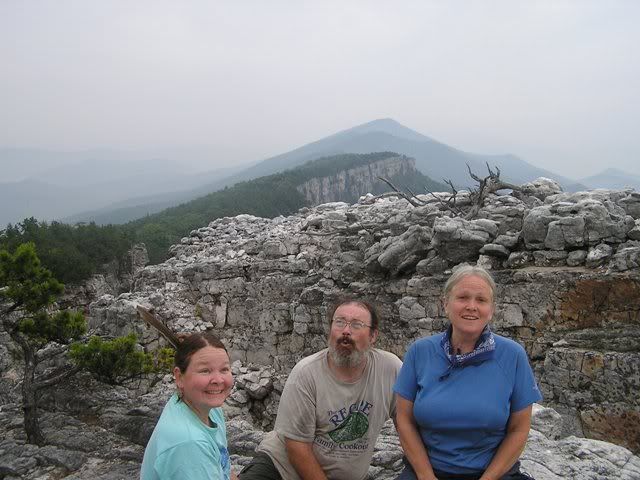
Here's North Fork it's really pretty. All 24 miles are mostly on the ridge and has a rock face like this
chmny.jpg
 
For those who abhor the thought of carrying an extra 3.2 grams of weight, keep in mind the poster began this thread by saying "Given what you do in the outdoors...," this is not necessarily a thread about ultralight back packing. If that's what you happen to like doing in the outdoors, then of course this will matter significantly to you. I do not have to "bug out" to evade natural disasters or TEOTWAWKT on a regular basis. I will certainly try to keep all your advice in mind if I ever do though. (but chances are the next person to come along will still score some sweet gear as I learn the lessons. :) )

So, given what I do in the outdoors, I said what has worked for me. I have tried both, and both could work despite my preferance for the long blade, but I don't plan to enter the woods without at least one or the other.
 
Cliff I have used many different choppers. i am not talking soley based on using 1 or 2 choppers. I have great opportunity to handle knives from different manufactures which may not be obvious to you.

while you have experience with blades I do as well, not to the degree you do, but from a user standpoint. I will add this, I would put a hatchet up against a cinderblock before I do a chopper, if you catch my drift.

Tiki, GB mini is lighter than many choppers out there and the space it takes up is equivalent to that of choppers.

I also am an ultralight advocate. I can tell you this, most of the crap people carry in a bugout bag I would not carry. Nor would I carry a lot of the crap ultralighters do, in a bugout bag that is.

Secondly, in my opinion, many peope don't know how to effectivly pack bugout gear.

tell me Tiki, do you pack ti cookware in your bugout bag?

Alan
 
I also am an ultralight advocate. I can tell you this, most of the crap people carry in a bugout bag I would not carry. Nor would I carry a lot of the crap ultralighters do, in a bugout bag that is.

Secondly, in my opinion, many peope don't know how to effectivly pack bugout gear.

tell me Tiki, do you pack ti cookware in your bugout bag?

Alan

G'day Alan,

Nice to have you chipping in again ( no axe remark there! ) ... we are in agreeance regarding what people pack for a bugout in terms of most of it being impractical - content may be another issue and is at times dependant upon situation and circumstance certainly.

Regarding cookware - I am in the midst of a very serious think about all that right now so you have caught me inbetween a few options as I weigh them up. I am not a fan of carrying pots and pans and large cookware, no ... the full extent of my bugout utensils for cooking are a mess tin that can be used for drinking and eating both with a small Canteen stove attachment for heating just the tin ... thus. It is totally wind proof.

ccstove_sml.jpg


Something else I am looking at is this Hexamine stove ..

hexi_sml.jpg


Basically it folds up and fits into the pouch on the front of the issue water bottle pouch and you can even store the fuel bricks inside it. I'm all for keeping it minimal/light if at all. Here's another example ...

esbit_pocketstove.jpg


Yourself?
 
Tikirocker. Mate that Alice packs looks like an Aus Web pack, I work for them and manage SAS Equipment. We have 4 sizes of Alice pack and that looks like the big MK2, a very good pack. I use a similar set up.

P.S, I love the Clives Knives, he is a good mate of mine.
 
Tikirocker. Mate that Alice packs looks like an Aus Web pack, I work for them and manage SAS Equipment. We have 4 sizes of Alice pack and that looks like the big MK2, a very good pack. I use a similar set up.

P.S, I love the Clives Knives, he is a good mate of mine.

Hey Persky!

Nice to hear from a resident of my home state! ;) - You are close mate, that alice pack is the MKIII - but as I said mine is slightly different to that packs configuration. You may even knoiw my pack if I describe it though I couldn't find a pic of it to hand. Mine has the mini detachable day pack backpack that clips on or off from the back and I have the extended pop out section at the bottom of the pack for a long bedroll or bivvy/swag. Does this ring any bells?

Good to hear another thumbs up for Clive - I'm still waiting to hear back from him since I last sent a couple of specs through on the Tusker - I love his Skinners! :)
 
Mate there are so many alice pack configerations out there, old and new, but it sounds like you have got it sorted.

Clive definatly makes a good knife. He realy specializes in hunters and skiners, but i recon he could make something along the lines of that tusker. I would recomend A2 or O1 steel in a knife this size though.
 
No doubt mate - the guys that do the pack above also do custom jobs which I am SERIOUSLY considering - basically design your own Alice pack - I'd be able to configure a hydro pack into the Alice pack for on the go also which could be left empty in times of the need for extra space or filled in emergency when required. Do you guys do custom jobs for customers too?

As to the knife - fill me in on why A2 or 01 would be better in a knife the Tuskers size than D2 tool steel mate? I was under the impression that D2 would hold a great edge for a long time - take more effort to sharpen but would be a tough blade in the bush - you saying A2 or 01 has the edge? Seems from a bi of reading that D2 has a bit more chrome than A2 and A2 will show stain more readily and need more looking after. It seems the A2 vs D2 camps are pretty even in terms of what might be better ... 01 I know nothing of really.
 
Great discussion. Tikirocker, I know where you are coming from. In my hiking days I found each trip going lighter and lighter and lighter. Just to think, we started out packing a bottle or two of beer! ha :) The we figured aluminum cans were lighter than the bottles :) Then we realized, though it was nice to have a beer, or share one the first night out, just carrying the extra pound , uphill to the trail system, on day one, was enough to make you swear off beer forever. Our hiking shoes were the heavy weight vibram soled hikers, like cement blocks compared to todays selections.

Our only knives carried back then were pocket knives. No chopping, no extra expenditure of calories. Firewood was picked up, or broken by hand, or simply laid across the fire as a long piece, until it burned into to pieces.

I've carried a machete on 3 continents and can't say enough good things about them. i don't mean to knock those supporting the hatchet, I am with Longbow, if you like it, and that's what you use, then I support that.

However, in my case, I never once, while carrying a good machete wished I had a hatchet. I have, on occasion, wished I had the machete with me.

I have tried to outsmart , out-buy and out-think the military's approach to packs, and to gear in general, but, in a lot of cases, they really spent the time researching and testing. Example, pots and pans, and cook wear.
I've used it all, packed it all, now, where am I? Back to realizing that the good old canteen cup is about the best , lightweight pot/bowl/cup you'll need to survive. The fact it fits right under the canteen, even better. the great thing about military items is that they are typically affordable, as well.
Where am i going with the military angle? They don't carry hatchets.
They carry knives, bayonets, entrenching tools, but not hatchets.

Again, just making a casual observation, as a continue to re-look and re-think my own case.

Those little trioxane stoves mentioned above, military. Just another example.
I am not trying to draw a 100% direct correlation between hiking, bugging out, surviving and the military, but there are enough similarities it is worth looking at how backpackers/hikers such as Tikirocker handle their gear, just as looking at how a soldier is equipped, can be helpful.

Personally, I think that somewhere in between is a hybrid set-up, and that is what we consider the wilderness-survivor.
Equipped to survive. Equipped to stop and set up semi-permanent digs, but, yet, lightweight enough to pack it all up, and move along as necessary.
He is not so specialized that he will be caught without proper gear.
The soldier and the hiker/backpacker being more on the specialized end of the spectrum. The wilderness-survivor is not going to outpace the hiker. But, perhaps the hiker, when he runs across the wilderness-survivor will be most pleased that there is some water, food, and shelter to be shared.

 
Back
Top