Help me MAKE a fixed blade... please?

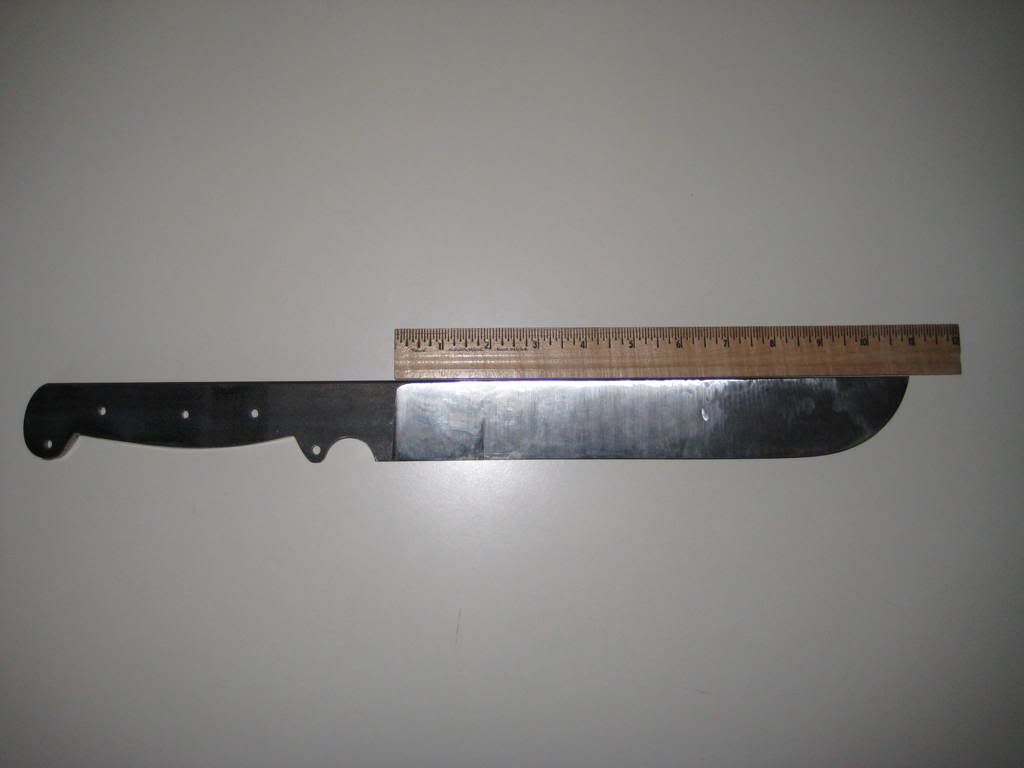
Now the skinner...
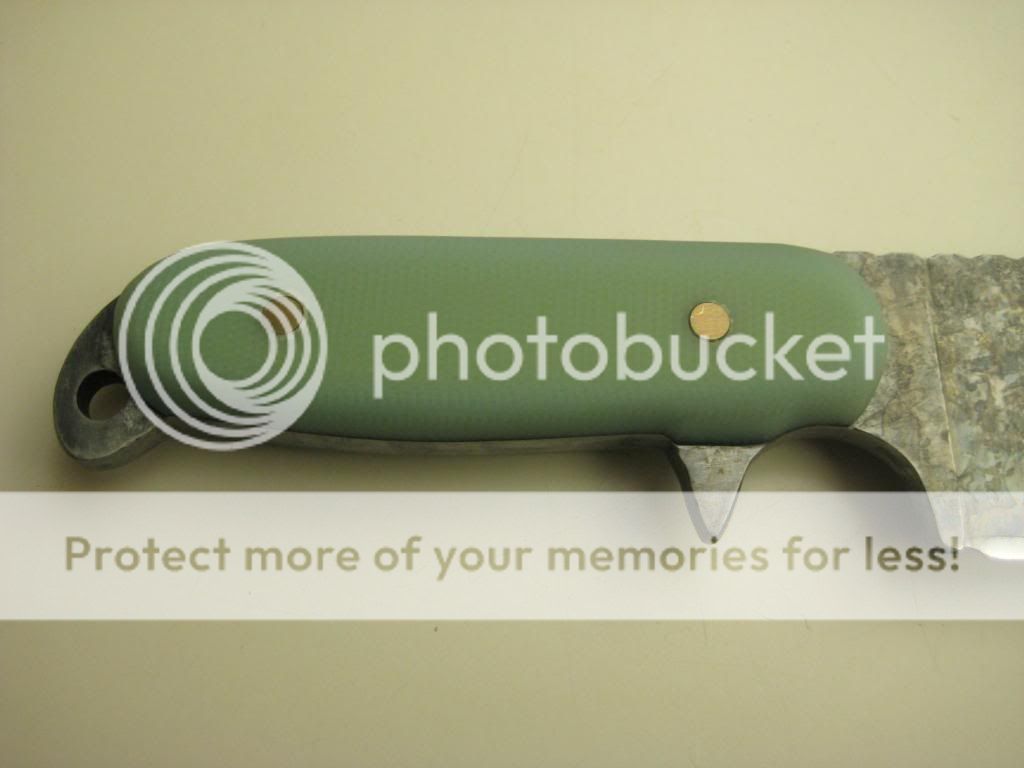
I'm happy with everything about the shape/style except for the "thumb divot" I ended up with along the back spine (above the serrations). I initially wanted to put some jinks in there, tried to, didn't like them, so had to grind them out. The result is the divot (:mad:). Trying to make the best of a bad situation though (the blade now seems kinda' thin there now... what with the grind below and the divot above), so I'm working on a handle shape that might minimize the thinned look... might even try to do something with a brass bolster to help the thinned appearance. Decisions decisions;). (I see what you guys mean about saying enough is enough and walking away from the grinder!!!):D

I still need to do something to add "thumb grip" at that spot since my jinks didn't work out... I have an idea I'd like to run by you all. Has anyone ever tried making "invisible jinks" using a drill bit? This is kind of hard to explain, but I'll do my best... By "invisible" I mean that the jinks wouldn't affect the profile appearance of the blade because they would be drilled down into the centerline of the blade at that thumb point. The jinks themselves would be created via the spaces between the drilled holes. Using a fairly small bit, I'd drill into the thumb area to just a 1/16 or so... just enough to give some texture for the thumb to grip. They'd really be more like drilled "dents" than actual holes. I'd try to lay out a bit of a pattern for the "holes/drilled impressions", not to over do it, but just enough to provide grip. Thoughts? Ideas?

attachment.php
 
I've pretty well finished up the file work (I like doing file work:D)... just a bit of cleanup left.

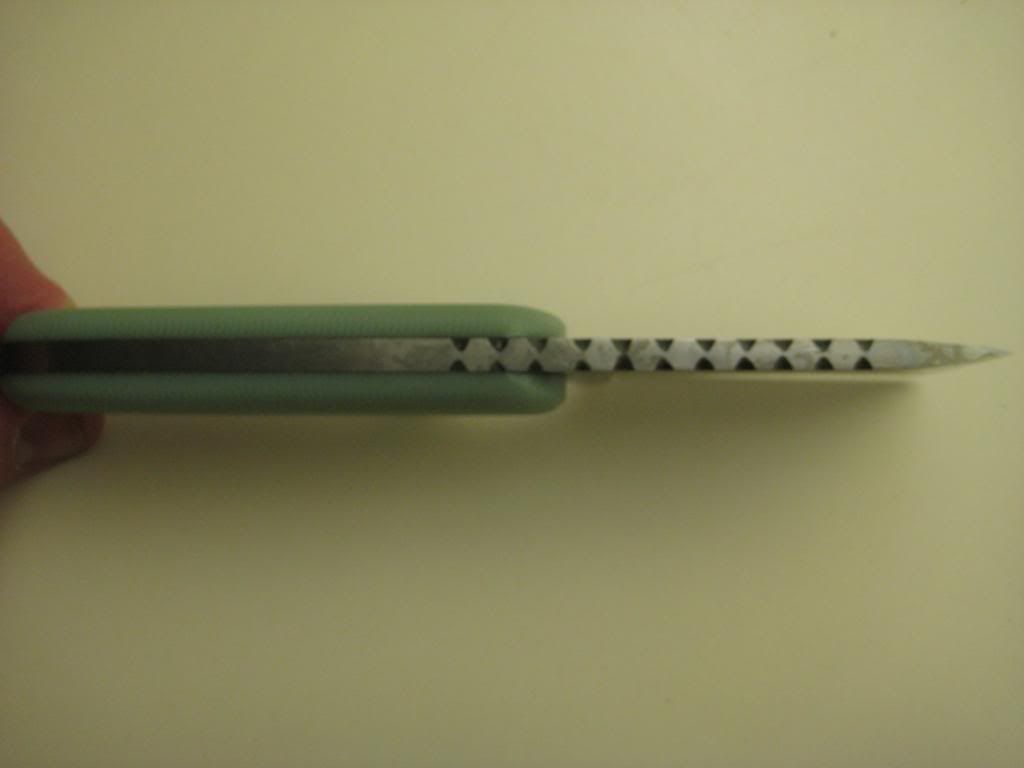
I've tried a few ideas concerning file work on some scrap steel... as shown on the handle back spine on this skinner, I've blackened the recesses using "Brass Black" to make the vine stand out from the recesses. It helps me to see area's that need touch up, and I actually like the looks of the contrast it provides on the finished blade. I use a sharpie to do the blackening as I'm actually doing the filing, and then I use the Brass Black when I think I've about got it. I've also tried a similar method that involves an additional step to create this contrast... After blackening with Brass Black, I glue on the scales and start to shape them. I leave quite a bit of extra wood along the back spine and then mix up some epoxy with a bunch of black toner powder added (from an old printer toner cartridge). I then fill the back spine with black epoxy until I can't even see the file work underneath. Once it's set up, I finish shaping/sanding down the wood along the backspine.... VERY CAREFULLY removing the excess wood, and overlaid black epoxy until the vine work begins to appear through the epoxy. It creates a very nice, crisp display of vine work with the epoxy, steel and wood all smooth to the same surface.

I'm probably not telling any of you 'ol timers something you didn't already know, but who knows... you've all been so helpful to me, that I just wish I could give something back.:o:o

attachment.php


attachment.php


attachment.php


In the pic above, you can see the "thumb divot" where I'm thinking about drilling a pattern of "dents" in to act as "invisible jinks".:D

attachment.php
 
Wood handles were used without stablilization for hundreds of years. Just look at all of your old kitchen knives.

That said, stabilized wood is simply more durable and has little movement. It will last longer and it won't shrink/swell with the weather.

Your choice. Nice looking wood, by the way.

Thanks for the info on stabilizing... I'll ponder how to proceed.

Cutting into a burl for the first time is like opening a Christmas present!!!:thumbup::D

ON EDIT: I just checked out the pictures of your work you linked... WOW. Love your wood. Do you mind if I PM you with a couple questions about how you modify your factory folders? I'm really a "wood guy" and have thought about modifying a couple of my own Kershaws and others knives.
 
Last edited:
IIRC there are special powders you can buy to color epoxy without weakening it. But if you're just coloring it for decorative effect, the toner idea is probably fine.

Invisible jinks... hmmm that's interesting. The only major problem I see with it is keeping them clean. I don't think it would significantly weaken the blade.

Keep it up; you have a fresh approach and some cool ideas. :)
 
I have a couple more questions before I proceed to the next step with these blades.

I finished up all of the grinding, hole drilling, sanding to 400, and cleanup on the blades while they are in an annealed state (I fired them to non-magnetic and let them cool slowly over night as the fire went out). As can be seen in the pics in my previous posts, the blades were clean and "shiny". Since those pics were taken, I've put the blades back into the fire to non-magnetic and again cooled overnight to normalize them (if I understand "normalize" correctly... essentially, re-annealing the blades to bring them back to an even "softness" before final HT.)

So now, the blades are of course all black and ugly... do I need to clean them up, sand them again, and try to get them clean and "shiny" again BEFORE I put them back into the fire to quench?... or can I just re-fire them "as-is" and quench them?

Thanks again for the help and input!

ON EDIT: By the way, the "invisible jinks" came out alright I guess... I did find that I really don't have the best tools necessary (or eyesight) to properly lay out a fine pattern of holes though... I think with the right tools, "dents" made with a drill to create jinks would look and work quite well (I'll post some pics of how they came out after I get the answer to my question above...).
 
Last edited:
Just to update;

Put both blanks into the fire 3 times today. First two fires I took them up to non-magnetic and then let them air cool. After the third fire and non-magnetic for 5-10 minutes, they went into the quench oil. I'd been reading about Hammon's (SP?), and thought I'd play with that a bit so I coated the blades with some furnace cement and tried to remove a pattern along the blade edge... I have no idea how it will turn out. The cement came right off in the quench.

Right now, both blades are in the oven cooking at 400 for 2 hours. After they are done, I'll let them air cool to room temp. and then heat them again to 400 for another 2 hours.

I think, at that point, they'll be ready for cleanup/scale removal/sanding. After they come out of the oven for the last time, I'll take a couple pics and edit them into this post.
 
Heading down the home stretch!

Into the "S's" (Sanding, shaping, smoothing and shining).

attachment.php


attachment.php


attachment.php
 
I'm taking this one out of the shop before I tinker it to death and screw it up!:D

Thanks to Jason and all those who provided input into this, my FIRST "made" blade. As I've noted before, I've been modifying blade blanks from other makers and have been doing handles, scales and such, but wasn't comfortable saying that I actually "made" a knife.

Well... I now feel comfortable saying "I've MADE a knife."

This is my first. The blank came from a leaf spring. The handle came from a cherry burl I've had for 10 years. The brass bolsters came from bar stock. The pins I purchased.

I did the heat treat in a bon-fire, and quenched in oil. I tried to create a hamon during heat-treat, but it really didn't turn out. Additionally, the thumb grip holes didn't come out as clean as I'd hoped... but they work pretty well.

I have no idea how hard this thing is... I do know that putting the final edge on it wasn't real easy, so I hope it will hold an edge. Time will tell.

Though it isn't up to par with the "Master's works", frankly, I'm quite proud of how it turned out for a "newb".

I'll now start on the other blank I've pictured in this thread, and once it's finished, I think I'll be done "making" knives.

During the entire process, I've learned a great deal, and unfortunately, I've learned that I don't like "working steel". I don't mind the minor steel work I've done when modifying others blanks, but creating my own blanks is just too tough on me... I have some disabilities which limit my ability to do this kind of work. I guess I'm just a "wood guy" at heart.:D

These projects have tremendously increased my awe, and respect for those who do this for a living... I'm talking to all of you "master makers" and others who turn out such beautiful work... you are true artisans!

Thanks again to all those who helped me with this (pics of the other blade will come as I get to work on it).

attachment.php

attachment.php

attachment.php

attachment.php

attachment.php
 
A few more...

The vine file work is supposed to end up with a thistle flower there at the end of it... please use your imagination:D.

attachment.php

attachment.php

attachment.php

attachment.php
 
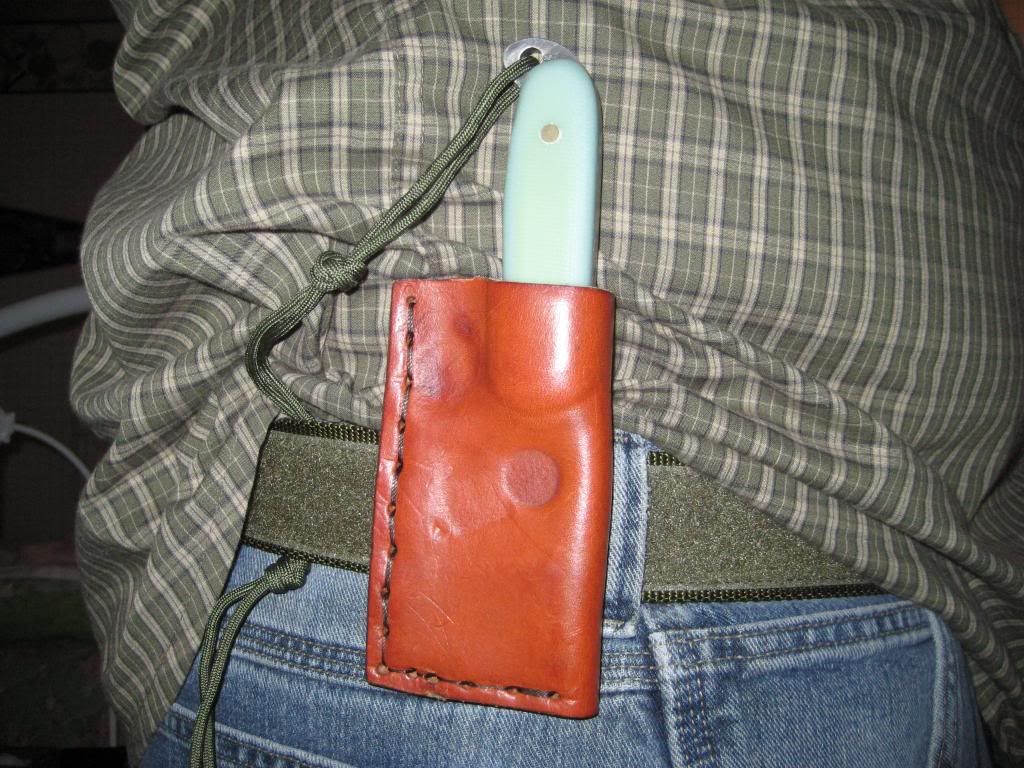
This is my attempt at a "Graham Knives Razel". I liked the idea of the multi-use design. This is the second blade I made from the same piece of Leaf Spring as the previous. I've been carrying this one for a couple of weeks now. I should have taken some pics before using it but I just couldn't wait.

It has a hollow grind and some simple diamond file work. I intended this to be an all purpose user and I'm quite happy with it. It's just about a half inch larger than Graham's original. The handle wood is the same cherry burl I used in the previous blade.

I'm still debating one possible change to this knife. The only thing it's missing that I'd like to have, is some sort of saw-back or at least a few serrations on the spine. Yea, yea, I know... but I find serrations useful. I don't know if I'll go for the saw-back or not... I like the profile of the blade as it is. I don't know?....I'll ponder it...

I did the grinds on this using a bench grinder and a jig to keep things in line. I can see why the pro's DON'T do grinds the way I did... it's stinkin' hard, and they really don't come out even.

The edge turned out like I'd hoped... I used a long bevel and it cuts like a razor. The chisel front works well and it's obviously more acute. I liked everything about Graham's Razel right down to the "pry bar" near the finger hole, so I did the same. Of course as anyone can see... Graham Knives doesn't have to worry about MY example of their Razel competing with theirs... Mine is mine and (thankfully? :D) it's going to be THE one of a kind!

attachment.php

attachment.php

attachment.php
 
Whoa! great grind lines on the razel!

Jason

Thanks Jason. I greatly appreciate your comments and help with these two knives.

Like anyone who's ever made a knife via stock removal, we of course, see all the errors, and imperfections... that no one else (except another knife maker) might see.

The grinds aren't quite even, but they are pretty close for having done them on a bench grinder and 4X36 belt.:D

Having used it for a couple weeks, I'm satisfied how well it sharpens and holds and edge--- this was one of my greatest concerns having done the heat treat in a bon fire and the wife's oven.

I did find a fairly quick and relatively easy tool to remove scale after the quench though. Dremel makes a sanding disk, that kinda looks like a round, fuzzy/rough donut, that comes in a couple of different grits. Spin those babies into the scale and it "sands" away post haste! The same "donuts" come in a fine grit and actually put down a pretty nice surface to prepare the blade for hand sanding... If other makers haven't discovered these Dremel "donuts", I highly recommend them!!

Thanks again for the kind words.

When I annealed the two pieces of leaf spring to make these, I also threw an old rasp into the fire as well. One of these days, I may tackle it and see what kind of blade "lives within the steel".:D

All the best to you and yours!
 
Last edited:
I just caught this thread. I made my first (and only finished knife) based on a Gram'esque square blade.

I had no power tools on this one. Just hand files, and mini hack saw. Heat treated in a $15 dollar hibachi grill with natural hardwood charcoal, and a fan for air supply. Quenched in old motorcycle racing oil. Next time I will try better oil.

G11 handles. All the holes were drilled with a hand crank drill. When I made this one, I had no vice either. Just c clamps.

IMG_1735.jpg

IMG_1729.jpg

IMG_1720.jpg

IMG_1721.jpg

IMG_1722.jpg

IMG_1725.jpg


I love these wip threads. Especially newbies (because I find I learn a lot as a newbie from people using less than ideal equipment). Your first two were much harder designs than mine.

I have one in the works, where I actually had access to a 2x72 grinder. It has been unfinished for two years because I have no way to heat treat a blade this big. I need to clean up the main bevel, and reduce the height of the handle, as it will be too big when scales are attached.

fistset024.jpg


I actually had a few offers from real makers to heat treat this big one for me, but my computer crashed, and I lost the saved messages. I was thinking about trying a differential heat treat on this one, since is will be a chopper with more stress on it.
 
Last edited:
This is my only one I've done with an annealed bar. I did a dropped point hunter from a power hacksaw blade in M2 HSS that was full hardness. Man did that thing grind slow!

DSC_3866.jpg


I realize mine is totally crappy, but it cuts well and I don't think it's terrible for a first attempt. I also used hardwood charcoal and a fan to heat it, then quenched in used motor oil. The finish looks that bad because I've been using it in the kitchen for a few months.
 
Back
Top