
-
The BladeForums.com 2024 Traditional Knife is available! Price is $250 ea (shipped within CONUS).
Order here: https://www.bladeforums.com/help/2024-traditional/
You are using an out of date browser. It may not display this or other websites correctly.
You should upgrade or use an alternative browser.
You should upgrade or use an alternative browser.
Hossom Forester!!!!111!! BBQ
- Thread starter zenheretic
- Start date

mschwoeb
Gold Member
- Joined
- Jan 31, 2001
- Messages
- 3,743
Alright, just got home after picking up my Forager, the 7 1/2" version. Wow what a knife, very very good craftsmanship all the way around. Am going to work on some pictures of this to show it off. Great job getting this knife out Jerry and Spyderco!
- Joined
- Aug 8, 2005
- Messages
- 1,730
sweet pics Zen and Effigy, love the "nasty" recurve on these... :thumbup: 
 ZOMG thats one sexy knife :thumbup:
- Joined
- Sep 2, 2006
- Messages
- 16,703
I tested that and concluded the logo did not appreciably interfere with the knife's ability to cut and chop.
A few have commented that the knife looks huge, and I guess by Spyderco standards it is, but I think you'd be surprised by its easy handling for such a large chopper. In any case there are three smaller sizes that some may prefer. Has anyone here received one of the other sizes or are only the collector editions being shipped now?
I'm saving my pennies...

Cliff Stamp
BANNED
- Joined
- Oct 5, 1998
- Messages
- 17,562
Balance? Why a high carbide steel for a chopper?
-Cliff
-Cliff

- Joined
- Aug 1, 1999
- Messages
- 3,036
F = MA
You have two variables in play with a chopper that influence the force delivered to a cut, acceleration and mass. Since on any given knife mass is a constant anything that increases acceleration increases the force delivered to the cut. Better balance increases acceleration. Alternatvely, you could build a lot more weight (mass) into the blade and throw accelleration out the window, but that makes the knife a lot less comfortable to carry and isn't something a lot of people find pleasant to swing around for long periods of time.
Newton was a heck of a guy.
Why high carbide? Wear resistance, corrosion resistance.
People need choices Cliff...

I knew you couldn't leave this subject alone for very long...
You have two variables in play with a chopper that influence the force delivered to a cut, acceleration and mass. Since on any given knife mass is a constant anything that increases acceleration increases the force delivered to the cut. Better balance increases acceleration. Alternatvely, you could build a lot more weight (mass) into the blade and throw accelleration out the window, but that makes the knife a lot less comfortable to carry and isn't something a lot of people find pleasant to swing around for long periods of time.
Newton was a heck of a guy.
Why high carbide? Wear resistance, corrosion resistance.
People need choices Cliff...
I knew you couldn't leave this subject alone for very long...
Cliff Stamp
BANNED
- Joined
- Oct 5, 1998
- Messages
- 17,562
F = MA
This does not mean what you think it means.
Since on any given knife mass is a constant anything that increases acceleration increases the force delivered to the cut.
You would apply the above equation during the impact as has been discussed before in detail during threads by possom on balance. In regards to mass and acceleration they are not independent either as you have proposed in the above. The relationship is actually quite complex and not even linear due to how muscles in people respond to loads.
Better balance increases acceleration. Alternatvely, you could build a lot more weight (mass) into the blade and throw accelleration out the window, but that makes the knife a lot less comfortable to carry and isn't something a lot of people find pleasant to swing around for long periods of time.
This as Possom has described in detail is far too simplistic a viewpoint. It isn't about the mass but the balance, and specifically the inertial moments vs the center of mass/mass.
Why high carbide? Wear resistance, corrosion resistance.
High carbide reduces corrosion resistance, don't know why you would want wear resistance in a chopper, they don't blunt by wear. In reality did you actually test any other steels available for that model, specifically a low carbide stainless such as 12C27M?
-Cliff
- Joined
- Aug 1, 1999
- Messages
- 3,036
Cliff, you spelled my name wrong. It's Hossom, not Possom. Common mistake though.
As to the rest of it, you're wrong/Newton's right.
As to the rest of it, you're wrong/Newton's right.
Cliff Stamp
BANNED
- Joined
- Oct 5, 1998
- Messages
- 17,562
Now, I got the name right, he understand balance as has been described in detail in several threads. As for your attempt to use physics, what you quoted isn't the actual equation Newton proposed. The actual equation is the time rate of change of momentum, if you used that you would understand the issues I noted, and as well, again as noted, you look at the impact mechanics as they are what determine cutting power. This has actually already been done in detail in the threads I noted in the above. As for the rest of it, the actual facts, as always, are on my side and you as always resort to personal counters.
-Cliff
-Cliff
- Joined
- Nov 16, 2002
- Messages
- 9,948
Try "the possum." He's one of those guys who likes quasi-bainitic choppers and swords and high-hardness martensitic small blades.

- Joined
- Aug 7, 2003
- Messages
- 3,330
Nice knives Mr. Hossom.
I could care less about trying to quantify knives through Newtonian physics, Einsteinian physics, or through quantum mechanics.
Looks to me like what we have here are a breed of more or less "all arounders" designed by a guy who happens to make a living at designing such things.
I have yet to handle any, but it does look as if their primary tasks in life are to cut acceptably, not require too much maintenance, and also accomplish a "less than a machete" amount of chopping in a light yet "tough enough" package.
Then again, what do I know? I just buy knives, but only those that look like they will be useful. These make that cut.
I could care less about trying to quantify knives through Newtonian physics, Einsteinian physics, or through quantum mechanics.
Looks to me like what we have here are a breed of more or less "all arounders" designed by a guy who happens to make a living at designing such things.
I have yet to handle any, but it does look as if their primary tasks in life are to cut acceptably, not require too much maintenance, and also accomplish a "less than a machete" amount of chopping in a light yet "tough enough" package.
Then again, what do I know? I just buy knives, but only those that look like they will be useful. These make that cut.
- Joined
- Aug 1, 1999
- Messages
- 3,036
F = m * (v1 - v0) / (t1 - t0)
Can't argue with the textbooks, can we? Doesn't really need to be done in too much detail.
(v1 - v0) / (t1 - t0) = a
Therefore, F = m * a
QED, I believe.
As for getting "personal", Newton and I aren't actually "personal" friends, even though we're about the same age, but we are pretty close.
Are you saying impact mechanics, specifically force, don't apply to chopping tasks?
Forgot to ask this earlier, are you also saying a "chopper" doesn't need to be sharp and possess some measure of wear resistance? Are you saying "blunting" (assumed to mean dulling - loss of sharpness) does not involve wear resistance, and that plastic deformation and microchipping are the only causes of "blunting"?
And yes, high carbide content reduces corrosion resistance so long as it's not associated with Chrome. That's why they call them stainless steels, most of which possess high carbide content.
Thanks Boats!
Can't argue with the textbooks, can we? Doesn't really need to be done in too much detail.
(v1 - v0) / (t1 - t0) = a
Therefore, F = m * a
QED, I believe.
As for getting "personal", Newton and I aren't actually "personal" friends, even though we're about the same age, but we are pretty close.
Are you saying impact mechanics, specifically force, don't apply to chopping tasks?
Forgot to ask this earlier, are you also saying a "chopper" doesn't need to be sharp and possess some measure of wear resistance? Are you saying "blunting" (assumed to mean dulling - loss of sharpness) does not involve wear resistance, and that plastic deformation and microchipping are the only causes of "blunting"?
And yes, high carbide content reduces corrosion resistance so long as it's not associated with Chrome. That's why they call them stainless steels, most of which possess high carbide content.
Thanks Boats!

- Joined
- Oct 28, 2005
- Messages
- 742
does anybody have a group shot of them with some other spydies in there for comparison. lets say a temperance, or a military? i am trying to make up my mind between the woodlander and the forrager. thanks.
- Joined
- Nov 16, 2002
- Messages
- 9,948
i am trying to make up my mind between the woodlander and the forrager. thanks.
Isn't the correct answer to buy both?
- Joined
- Aug 1, 1999
- Messages
- 3,036
Isn't the correct answer to buy both?
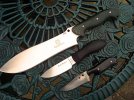
Not really. I tried to answer this question elsewhere. If I were to have just one for general use, I would get the Woodlander. It's a good all around knife. The Forager is a smaller version of the Forester and is a better chopper, so if you plan on a lot of chopping the Forager would be your choice. The Woodlander does chop pretty well, but it doesn't bring as much power to the party. I don't have the photo you want, but I do have a pic of the Forester with a couple other Spyderco offerings. That blade is 9"; the Forager is 7-1/2 with pretty much the same shape.
BTW, I stole this pic from another forum (BB)
Attachments
- Joined
- Oct 28, 2005
- Messages
- 742
Thanks for the reply Jerry. the woodlander it is. now if i could just get a hold of my dealer!!! i'll post some comparison pics after i receive it for some of you guys sitting on the fence.
Cliff Stamp
BANNED
- Joined
- Oct 5, 1998
- Messages
- 17,562
Can't argue with the textbooks, can we?
What you are doing illustrates a fundamental problem with how physics is taught and learned at the novice level. You are citing a forumula with no understand of when and how it can be applied. In specific, that is to do with average forces applied in a linear manner.
Your first point also implies that speed decreases as mass increases, this is also not true because in the human body you will apply more force under a heavier load. This is obviously false to anyone who uses hand tools dynamically. Any carpenter for example knows he can swing a 16 oz framing hammer just as fast as a light finish hammer. So the relationship you implied is trivially negated.
And as noted you should not be talking about mass at all when dealing with acceleration but the inertial moments because the motion of the knife is primarily rotational.
Are you saying impact mechanics, specifically force, don't apply to chopping tasks?
Not in the way you are applying it. As I noted, this was discussed in detail with the real math/physics in threads started by possum where he both makes, uses and modifies knives according to those principles. In those threads the relevant math is noted and discussed as well as specific knives which were constructed according to those principles, with the relevant references and specific user test data by the maker.
Forgot to ask this earlier, are you also saying a "chopper" doesn't need to be sharp and possess some measure of wear resistance?
All mine initially shave and the included edge angles are <20 degrees outside of the microbevels. A high carbide volume by the way also DECREASES push cutting sharpness, again this is a published fact.
Yes, they don't need significant wear resistance because the major source of dulling will be deformation/fracture. There are also heavy downsides to high wear steels in that they are very brittle and prone to fracture in the sudden and violent contacts that you can get when actually using blades outside, vegetation hides rocks etc. . Now all that wear resistance did was cause more damage to be induces and make it take much longer to repair.
And yes, high carbide content reduces corrosion resistance so long as it's not associated with Chrome. That's why they call them stainless steels, most of which possess high carbide content.
A high carbide content itself will not enhance corrosion resistance because that is only dependent on the free chromium in the steels. Carbide will actually deplete chromium in the area around the carbides thus reducing the corrosion resistance, and yes, even vanadium carbides have chromium in them. In particular the steel being used in the above knife is actually a high chroimum carbide steel.
If you want a high corrision resistance in a stainless steel you go with something like 12C27M which has no primary carbides and MUCH higher corrosion resistance than 440C and its variants. It is also much tougher at the same hardness, easier to grind and cheaper. It is ideal for such a knife given that it is optomized for the exact critical properties. It is essentially a stainless version of the carbon/low-alloy steels the ABS guys use.
Now the obvious question would be if you need high carbide in a stainless for a chopper, why are all the ABS guys not using high carbide in the non-stainless. Would anyone argue because they are using low-wear steels that the performance of a 1084 steel from Cashen is a low performance chopper. Of course not, that would be absurd. But that is exactly the claim made when it is said that high carbide steels offer superior performance.
They of course don't which is why no traditional working blades of that type are ever made from high carbide steels. It is also why no one complaints of problems with edge retention from knives from Kirk and company in spite of the fact that they use steels which have very low wear resistance, in both their choppers as well as their utility knives. As Landes has noted in detail, the edge retention of high carbide steels is actually INFERIOR in regards to retaining a high sharpness. Again, measured fact, not vague opinion. High carbide steels just allow a knife to stay dull for a longer period of time.
-Cliff