how tough??

As far as toughness or strength I guess the two things I think about are is the steel good enough to hold an edge for several days w/o resharpening and is the handle tough enough to not get dented.
Well put :thumbup:

I add "comfort of the handle in extended use" to my considerations.


Kind regards
Mick
 
A general consensus believes that most of the "old-timers" used thin steel for their knives, backed up by an axe. There is something that both side are missing here. The steel that we have available today is much MUCH toughter than the simple carbons used say from 1880 to 1960's. Think about 1/16th O-1. I have tested it in my shop after heat treat by bending it 45 degrees and it sprang BACK to the original shape! Then there is the 3v steel offered by crucible and it nears the toughness of s7 tool steel while exceeding d2 in edge hardness.
I have have seen 1/8 1084 heat treated in my shop hold until it reached 90 degrees. SO once again we are back to the heat treat making the knife. I would rather have a thin piece of simple carbon well heat treated than a thicker more exotic steel poorly treated...

I think Mark nailed this one with his comments.

Most of the people in the jungles of South America are getting along fine with low cost machetes and simple kitchen knives pressed into service for a multitude of "whatever needs to be done" knife tasks.

I have yet to meet a task I couldn't get done with a Tramontina machete and a simple Mora. I have never broken either in the bush, though the machetes do get dinged up quite a bit.

IMO many of today's blades can handle more punishment than would be wise or safe to exert with the unaided human hand. I often wonder what in the world some guys are doing in the bush that requires so much force. Mac
 
It really gets a bit tiring when you keep hearing - more skills = smaller, thinner knife. In once sense, it is true that most of us start out this hobby with tastes that gravitate to the larger/thicker knives and in those beginning stages we kind of use the large knife as a mental crutch to compensate for lack of skills.

Yet, not everybody chooses to go the thin knife route even after they have acquired skills. You can learn how to effectively use a larger to mid-sized knife and use this tool in extended ways (like chopping) that you simply can't use a smaller thin knife for.

Misanthropist, no disrespect to your father and grandfather who got along completely fine with just a thin pocket knife. By your own admission, they were also probably unaware of what you could do with a larger knife. If they had that knowledge, one of them may have chosen to carry something larger, or maybe not. The point is they had their way and other people have theirs. Nobody actually needs a knife to survive, but everybody recognizes that a knife is a good thing to have in a survival situation. The knife you choose really depends on how you use a knife.

Really folks, we have this debate perhaps 4 or 5 times a year, whether it is chopper knife verses axe etc. In the end, we almost always end up settling with a to each his own or different landscapes require different tools or you do it your way, I'll do it my way.

Personally, I like knives and I tend to like 'em small and thin, mid-sized and mid-thickness and large and thick. I think it is great to learn how to use different types of knives, figure out how each one does certain things better then others. I should think that being able to use a wide variety of different knives for different tasks as well as to interchange knives across tasks is skillful also, more so then narrowing my point of view to what a single knife can do and focusing everything on it. Afterall, I might not actually get to chose which knife I have with me, if I have one at all, when that survival situation rears its ugly head.
 
Good stuff kgd. I agree. Ive used em all, in all lengths and thickness. It doesnt matter, as long as it works for you. Im a 3/16 guy, and probably in the minority. I have a skillset, and can use thick or thin the same. It goes back and forth around here. 1/8 is all the rage, then 3/32, then it goes back to 3/16 or 1/4. In the end its what works for you, and not what the current trend is.

Same as the trends twoards Traditional, then to tactical, then to scandis, etc. Not complaining, thats how some of us find what works for us. However, some will never be satisfied.
 
Good stuff kgd. I agree. Ive used em all, in all lengths and thickness. It doesnt matter, as long as it works for you. Im a 3/16 guy, and probably in the minority. I have a skillset, and can use thick or thin the same. It goes back and forth around here. 1/8 is all the rage, then 3/32, then it goes back to 3/16 or 1/4. In the end its what works for you, and not what the current trend is.

Same as the trends twoards Traditional, then to tactical, then to scandis, etc. Not complaining, thats how some of us find what works for us. However, some will never be satisfied.

Me too:thumbup: Both my EDC and personal Kephart are 3/16" "chubbies" :D
 
Mmh. Must have been one of them flatland rich kids. :D Growin' up in the hills of Missourah, ten bucks was a fortune, and the ONLY times you were allowed to cry wuz when yer dog died or yer knife broke...
I meant in today's dollars, show me! ;)

No, I wonder why people keep dredging this issue up. It's almost like they need constant affirmation from like minded people. To each their own...
 
I know I have said this on here before, but my dad was a prospector for years, and he kept an axe in his base camp, but never carried it. He carried a folding knife and nothing more. In fact his first fixed blade that wasn't a kitchen knife was probably around the time I was born, in the late seventies, and it was a mora.

He used to spend a lot of time away from base camp (which was a solo camp supplied every three weeks by helicopter) and just packed a pocket knife. A couple of years ago I asked him what kind and he said, "oh, whatever, you know. A pocket knife, that had pretty springy steel."

I have his father's knife...it is a Kabar folder with a clip point and a skinner/filleter. He lived in the back country of BC for about 80% of his life and didn't carry an axe or a big knife. He would have laughed at the idea that axes are for carrying.. . .

In a round about way we're saying the same thing.

1.) He got the axe to base camp. . .how? He carried it there. Never said it had to be attached tot he hip 24/7. In my example mountain men. . .carried their axe in. Maybe on a mule or horse, but it was carried in. Didn't say they carried it 24/7. If we're going to get hung up on "carry" then say "brought with".
2.) Remember I lump hatchets in with axes. It's really not hard to carry an axe (er, hatchet).
3.) I bet he didn't use "any old pocket knife" to build a cabin, chop wood, split wood, do heavy chores like say, split a pelvis. Like I said, an axe (or other big blade for heavy duty use) was brought for heavy chores.
4.) Again, IF an appropriate heavy suty tool was brought, then the knife doesn't have to be strong at all.
5.) The ONLY time I said a knife HAS to be strong is if it's the ONLY cutting tool you're going to bring and use it for all chores. If others want to cut, buck and split firewood for the prospecting camp with a Mora or Buck 110, go for it. Not me.

Once you have the problem of heavy duty uses out of the way, the knife doesn't have to be much. A Mora, SAK, kitchen knife, or sharpened piece of sheet metal will all work provided you keep them sharp for knife chores (see the "Knifecraft" section of Mors Kochanski's Bushcraft book for knife chores).
 
Once you have the problem of heavy duty uses out of the way, the knife doesn't have to be much. A Mora, SAK, kitchen knife, or sharpened piece of sheet metal will all work provided you keep them sharp for knife chores (see the "Knifecraft" section of Mors Kochanski's Bushcraft book for knife chores).

Completely agree. Added to this. You may be engaged in an activity that doesn't even require a heavy tool. Consider the modern backpackers of today who hump their shelter, stove and fuel with them. They don't need a big tool, a SAK is perfect. In fact many places, don't even allow fires so if you are taking in a stove/fuel with you then that cuts out a major use for a larger chopper. Similar to the case with bringing in tarps and bivvies. You are using a different tool to circumvent the need for a large knife.

I think this debate always gets caught up in circumstances that aren't specified up front. What is the totality of tools that you have on hand (pack, shelter, stove, axe etc)? What are the activities involved - base camp, long distance treking etc.

Why even attempt to make generalities e.g. how tough does your knife need to be? Answer - as tough as the circumstances dictate!
 
KGD hit the nail on the head, most modern backpackers really have no need for any knife, a SAK at the most.

Whenever this topic is brought up it is a bit of a loaded question, it is never specified exactly what you are doing in the woods or how much equipment you have, tarps, tents, stoves etc.

I think peoples choices would be much different if you told them all they could have is the clothes on there back, what they can comfortably carry in their pockets and one sharp for say a one month stay in the back country. The decision would also be influenced by where this stay would take place and when. If I were going to have to spend a month in the north woods in cold weather I think I would choose some sort of chopping tool, if it was the desert southwest a nice 4" or smaller fixed blade might be my choice.

I have always been an advocate of smaller blades for where I live and have lived. I also routinely carry much more gear than just my knife, take that gear away, although I really can't come up with a logical scenario where that would happen, and my choice might change. Chris
 
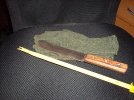
This is about the only knife that my wife's grandad had. He used it about 100 years ago when he was a cowboy living in a line shack on the Chyenne River in western South Dakota. It's ours now and we still use it to cut meat and about anything that requires a bigger knife. He also carried a Barlow as almost everyone did in his day, and of course every house hold had a double bit ax.
 

Attachments

  • knife and gun 086.jpg
    knife and gun 086.jpg
    138.3 KB · Views: 49
hey Jim, I made the same knife from a Green River blank. It mostly sees time in the kitchen now. The thin steel is razor sharp and works like a charm. Surprisingly durable. Mine's now about two decades old and still going strong. Cost me about $7.00 in materials. Now that's a mountain man knife.
 
now i have a stick tang puukko style knife. it is quite thick, around 3/16", but i wouldn't call it "heavy duty" like i would refer to a JK or Koyote. i take care of it, but i don't baby it, and it has held up fine for me (and its previous owner).

That made me chuckle. The primary Koyote made bushcrafter is only .095 thick! Okay, granted, as I am keen to point out, toughtness and thickness aren't the same thing.

I pretty much make the types of wilderness knives that I think can do the job. Truth is, there's a lot that's personal preference and style. By style I mean preferred style and usage style. About the only thing I am adamant on is that I don't use knives as heavy prybars.- I apply that just as rigorously to something like a SOG military field knife as I do to my SAK.

I like to know that I can do pretty much anything in the wilderness if I need to- short of a full log cabin- with my 'heavy' belt knife. But I do carry finer blades and special purpose blades, all the time.
 
It depends on the situation and environment.

Typically I will only need a thin, small knife, ground to a very acute edge (8-16 degrees inclusive depending on the steel) for my cutting. Carving basic tools and traps out of wood, cutting rope, minor food prep like slicing some meat or cutting up an apple, roughing up some tinder and so forth can all be done with one of my EDC Spydercos or a smaller fixed blade. Obviously these things do not require much toughness, or else I wouldn't favor ZDP189 blades ground as thin as straight razors for this job.

However if it's very rainy or snowy / icy out, a large fixed blade or axe can be handy, though not required, for getting a fire going. It's often easier to baton split the first well seasoned log I see and get everything from tinder by making wood shavings to larger chunks of wood to toss on once the flames get going, from that single log. For this my favorite tool is a kuhkuri. This isn't so much because of how tough they are as it is their length and good wood splitting blade characteristics (Compared to say, a machete). I've batoned with everything, including Opinels, Spyderco folders, Swiss Army Knives, Axes, Puukkos, Kuhkuris etc. Not much toughness is needed, certainly not as much as some would expect. The blade length and thick spine of the kuhkuri however let's it split larger pieces and break them apart more quickly than a thinner knife.

If I'm going somewhere with thick undergrowth, especially if it's lots of thorns, I'd love to have a machete with me. Nothing is as effective for quickly clearing brush and small limbs blocking a path. This is a task that requires little in the way of toughness as well. Even chopping at branches, it's going to take a tough knot at least to even induce the most minor blade damage outside of regular dulling from use. Even so it could be sharpened out in a minute.

I guess the short answer would be, not very.
 
I think that my knife needs change upon the application. Even the steel changes for me.

For instance my PSK would include a 4" Koster's bushcraft in 3V. That is about it - for the space and weight - I can get that to do about everything. I don't need to worry about sharpening it, and I want it thicker than other knives so that I can use and abuse it. 3 days is what I have on average to get the hell out of there - and I don't care about nicks and scratches or shaving hair. I know I can get the knife to do that again when I get home.

However, were I to be in the bush for a month or more - I would want a trio of blades and each would have to be a bit easier to sharpen. I am looking forward to getting a Koster's in ATS 34 for that reason - but a nice knife in 01 or D2 would be great too.

For my every day (which is suburbia) I use a SAK farmer - modified. It has everything I need on it - a multitool is in my vehicle to help out with the rest.

I agree that the application dictates the knife thought. However, for an all around knife - I will take a 4 inch or so bushcraft style. It seems a great compromise.

TF
 
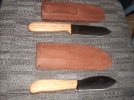
My first two JK's Either one or both would be all the tough I would need.
 

Attachments

  • knife and gun 261.jpg
    knife and gun 261.jpg
    95.1 KB · Views: 16
I saw my dad gut and skin a deer, with an old worn out barlow slip joint. I ask him if he want another knife, and he looked at me funny, and said why would I need it? He done alot better job than I do, with my dozier or SAK. Go figure.
 
This is about the only knife that my wife's grandad had. He used it about 100 years ago when he was a cowboy living in a line shack on the Chyenne River in western South Dakota.

Side note-
That knife sure doesn't look like it's 100 years old. Brass handle rivets weren't in common use like that back then, were they? Granted, he may have used a very similar knife earlier than he got this one.
 
In a round about way we're saying the same thing.

1.) He got the axe to base camp. . .how? He carried it there. Never said it had to be attached tot he hip 24/7. In my example mountain men. . .carried their axe in. Maybe on a mule or horse, but it was carried in. Didn't say they carried it 24/7. If we're going to get hung up on "carry" then say "brought with".
2.) Remember I lump hatchets in with axes. It's really not hard to carry an axe (er, hatchet).
3.) I bet he didn't use "any old pocket knife" to build a cabin, chop wood, split wood, do heavy chores like say, split a pelvis. Like I said, an axe (or other big blade for heavy duty use) was brought for heavy chores.
4.) Again, IF an appropriate heavy suty tool was brought, then the knife doesn't have to be strong at all.
5.) The ONLY time I said a knife HAS to be strong is if it's the ONLY cutting tool you're going to bring and use it for all chores. If others want to cut, buck and split firewood for the prospecting camp with a Mora or Buck 110, go for it. Not me.

Once you have the problem of heavy duty uses out of the way, the knife doesn't have to be much. A Mora, SAK, kitchen knife, or sharpened piece of sheet metal will all work provided you keep them sharp for knife chores (see the "Knifecraft" section of Mors Kochanski's Bushcraft book for knife chores).

I am sure neither of them did this with a pocket knife...mainly because I am sure neither of them did this while living in the wilderness.

I know my dad never built a cabin anywhere because he wasn't in any place long enough to warrant it, and I know my grandfather built a few houses, but they were entire houses in isolated places, and he was living there while working at a mine close by, not surviving in the woods.

And I guarantee neither of them split a pelvis while on extended trips into the woods, because they would have both been alone and wouldn't have shot anything big enough that they were unlikely to eat over the course of a few days.

I get what you are saying - an axe is a superior tool for heavy work. But my point is that in terms of surviving day to day out there, unless you are feeding a fire to stay warm in the serious cold, or chopping up ice to get to water, there are fewer heavy chores than most people would think.

I know the only situations I've needed an axe for were in long term severe weather, where I had to cut about 8" into standing deadwood to get stuff dry enough to burn.

But these are extreme conditions...most well prepared people (hopefully all of us!) would have sufficient clothing and gear to create microclimates that meant we didn't NEED to burn a cord of wood a night to stay warm, didn't NEED to light fires from whatever was around on day 50 of a rain storm, didn't NEED to supply a large camp with so much water that chopping through river ice was necessary.

Of course it's pretty possible that you would need to do all of that stuff, but to my mind that would also be pretty predictable. If I was going somewhere long term in heavy weather I would ABSOLUTELY take a tool for heavy work. If I was going somewhere temperate I think it would be less critical. And for sure, neither my dad nor my grandfather would have thought twice about it.

But I definitely get what you are saying - if it's the only cutting tool, AND you are out somewhere long term, having a lot of fires, setting up a stationary camp (dad wasn't at his base camp often enough to make it nice and his base camp moved every couple of months anyway) then I definitely agree, under those circumstances you would want an axe.

I just don't think that's very many of us here, is all.

 
Back
Top