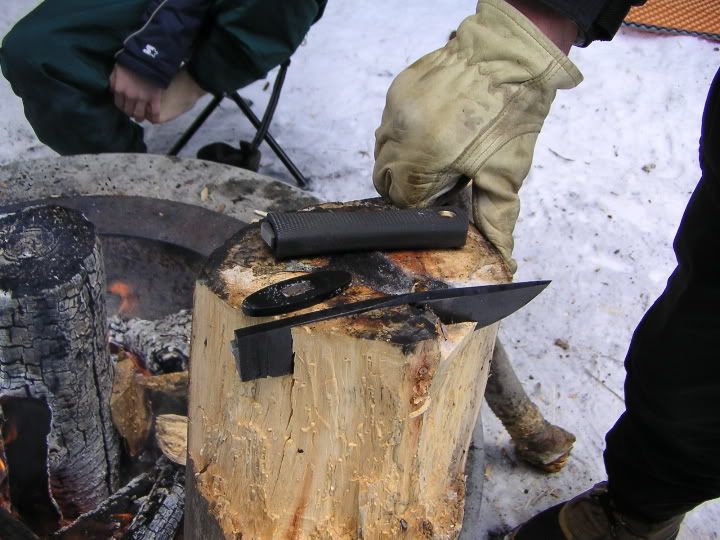
My survival knife is a Newt Livesay RTAK. 3/16" 1095, flat ground, differentially hardened, with a micarta handle. I have 8 acres of trees, and do more chopping than a lot of people, not as much as some. In the year that I have owned it, I have never sharpened it. It is used for cutting. It's not a prybar, though I could do some light prying. It's not a shovel, though if need be, I'm sure I could use it for light digging. It's a knife, it is designed for cutting stuff, and that is what I do with it. The testing I put it through is the stuff I cut. WHY would I try to break it? That doesn't make any sense. My grandfather was one of the last real cowboys. He rode open range in Wyoming in the 1920s and 30s. His SURVIVAL knife was a Case Trapper, with carbon steel blades. One of the things he taught me was, use the right tool for the job. Unless you are parachuting into enemy territory with only what you can carry, why NOT have a light shovel for digging? Why NOT have a light prybar? WHY tear up a perfectly good cutting tool using it for something it was NOT designed to do? Yeah, it's cool to see just how much abuse a piece of steel can take. But it's NOT the best way to figure out what knife works best for you. The steel in any good knife is much less important than good heat treatment. I have knives made of 440A, 440C, SK5, 12c27, AUS8A, AUS6, 1095, 5160, VG10, ZDP-189, and various unknown carbon steel alloys, and NONE of them have failed when used as knives. If I need a shovel, I'll USE a shovel.