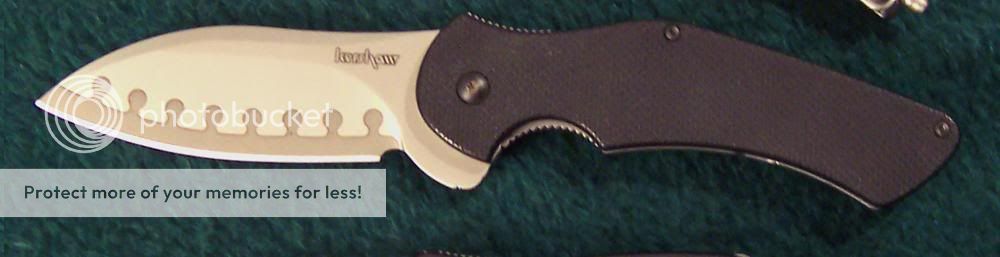
Is liner lock that bad?

Please re-read my original post. The UNSHARPENED base of the blade or the finger flipper make contact with my thumbnail.

And again, if you cut yourself closing a linerlock, you are doing something wrong.

Not all linerlocks have an unsharpened base, mine have the cutting edge running throughout the entire length of the blade. That's actually the way I prefer my knives, but I've cut myself once when closing.
 
There are more liner type locks than any other lock types out there so of course odds are that based on this fact you will also see a higher number of people talking about them since more of them are in the hands of end line users than any other lock type. This talk can be both good and bad of course. There is a lot to say good about a liner lock. Its been said if they were never invented we would not have half the knife makers or manufactures we do today and perhaps knives or at least folding knives in the tactical industry as we know it would not even be as prevalent as they currently are.

When the liner lock first came out many people raved about them and it was quite nice to finally have a one hand opening one hand closing folding knife that could be clipped to a pocket for convenient carry. Over time some noticed that while the liner lock offered a lot it fell short in some areas. Other strongly contend otherwise to this day and feel its just fine for hard use. Personally I disagree and feel like the inventor of the frame lock that liner locks, good as they are are not quite heavy duty enough to really take all that is dished out by some individuals. When I made liner locks about one out of every ten or so would just be too hard on it and I learned from that over time that beefier locks really helped to increase the wear and durability. Of course this was once I moved to titanium from stainless. When I used stainless I hardly had any reports of vertical play developing or extreme wear or quick lock travel where it traveled in all the way or most of the way across the contact.

Initially when I started using titanium I was using the same thickness in that as I was for stainless (that being .050) and learned right quick it was not panning out. As a result I bumped up and began making frame locks. Now I am a big fan of frame locks and feel personally that they are the ticket. I make liner locks still but they are beefy lined ones compared to most and so far they are holding up just fine. I don't claim them to be "hard use" folders though. If someone wrote me and wanted hard use I'd suggest a frame lock or if they are dead set on a liner lock I'd say get one in titanium that is beefy and stainless too if you can find it. Hardened stainless locks in .050 or more really hold up quite well though providing of course that the contact is done correctly.

This is the main concern when a liner lock defeats in my experience followed by twisting flex and how much that can affect the way the lock behaves because in tough uses when the lock is stressed or flexed it can at any time spring forward or backward in the contact. I've watched them do this in my own testing. Granted this is far from normal use to do this though. In my experience a more rigid frame, IE, beefy liners like a JYDII, Hossom Retribution etc etc are a plus here for longer knives because the longer ones add a lot more leverage for the user. Obviously this enables the user to really twist and bend the handle in ways that would be very hard to do with a shorter folder and particularly during hard uses. As an example though, I've had a lot of folks write me saying their trusted liner locks defeated after years of use doing something so simple as cutting down a card board box. Usually it was thinner liner longer bodied folders based on the input received from them.

After years of owning and using the liner lock I do prefer the frame lock for anything deemed hard use. Personally I'd sooner hard stab a frame lock than any liner lock and I'd feel much more assured with a frame lock in a defensive situation over a liner lock but again, if the liner lock is made well with a good contact that does not allow the lock to slide under load they can certainly work for this. The only way to know this of course is through testing to make sure you can trust your lock but also giving it time for a proper break in to assure all is smoothed out and any issues have been found long before a situation like this comes up. If you like the liner lock and thats what you want there are good ones out there and some great ones. Most of the guys here can guide you to which and I'm sure you can find something that will sit well with you.

STR
 
Some of the best selling knives are liner locks. The Military from Spyderco, Emerson's including my CQC-7A. The ZT 0350/0200 Several other Kershaw's and the list goes on. I for one have never had a liner lock fail me. I trust the ones I have 100%.

The ZT 0350 looks like a Frame Lock it's so thick.
DSC06431.jpg

DSC06433.jpg


The CQC-7A Locks up like a tank!
DSC06435.jpg

DSC06436.jpg


Get the ZT0350 and enjoy!:D
 
I've had linerlocks for years and never had one to fail in use. I did have a few, early on, that were not used hard because the linerlock had not been properly done. There is more to it than just cutting and bending the liner to match up with the blade tang. A well made linerlock should not close on the user and if it does fail the liner should slide all the way to the right causing the blade to lock open. A lot of the cheap linerlocks around do not take the geometry of the blade tang and liner into account and since the linerlock is the cheapest, and easiest way to produce a lock, there are many, many linerlocks out there that may fail and cause the blade to close on the users hand.

As my knowledge increased about linerlocks I begin to be very picky about the ones I bought. I've found that Kershaw, to include ZT, Spyderco, Strider, and I'm sure there are others I have not used, to have the construction of the linerlock down pat.

I know there is some debate about the usefulness of the "Spine Whack Test", yet I do this with every linerlock or framelock knife I get. Though as I've said before, I do not WHACK anything, well knifewise at least:eek::o:), rather I administer the "Spine Tap Test" wherein I give the back of the blade about 4 or 5 rapid taps on a wood table. I think that this tells me whether or not the liner will slip left and allow the blade to close on my hand.

Anyway, my thoughts on the linerlock.:D
 
This is very useful commentary.

I moved away from liner locks myself because I didnt trust them totally. From experience, though it was a cheaper knife and from others experiences. Since then I have tried carrying every locktype out there.

I finally decided the Axis lock was the ultimate and strongest lock out there but now I have doubts. It hasnt failed me yet but I have read of some experiencing spring failures. Also truthfully , I dont think the Axis "bar" travels far enough up on the blade tang to me. It takes very little movement of the buttons to disnegage this lock. I dont understand why Benchmade doesnt allow the locking bar to travel way up on the tang and have the unlock travel be significant. Right now it is like 1 1/16th of an inch or less. I am sure they have tested the hell out of the lock system and deemed it adequate but I find myself not trusting it in all situations.

So now I find myself also looking at the ZT350 . I like the looks of it and the lock is the beefiest liner I have ever seen. What I like the most is that it seems the finger choil will protect the users fingers during closing and if the lock did fail the choil would contact the index finger first , is that correct? On my Benchmade if the lock fails the edge will come down on my fingers. I dont like that at all.

So I contemplate going back to the linerlock. But I am still trying to get myself past what I thought was the weakness of this system , I always thought during hard use that I would inadvertantly disngage the lock by the way I held or used the knif it would "squeeze: it just right. But with the ZT350 even if this did happen the choil would prevent injury?

Also is the weight of the ZT350 really that bad for EDC? and Can the lock be adjusted bythe user when /if it wears? Is it hard to disnegage the lock with the thumb?

I saw a YOUtube vid where one of these ZT folders failed when the guy rammed it into a car hood. Excessive abuse I know but the lock did fail. And he couldnt explain why and noone else can either it seems. Is this a case of my greatest fear and during the thrust he disngaged the lock via the grip he had on the handle? what caused it to fail?
 
nothing wrong with liner locks. definitely something wrong when people use their folder's though like a fix blade then cry and whine that their liner lock failed, thru knife abuse.
 
So now I find myself also looking at the ZT350 . I like the looks of it and the lock is the beefiest liner I have ever seen. What I like the most is that it seems the finger choil will protect the users fingers during closing and if the lock did fail the choil would contact the index finger first , is that correct? On my Benchmade if the lock fails the edge will come down on my fingers. I dont like that at all.

Almost any knife with a flipper or choil will provide this protection.

Like my Skyline and JYDIICB for example:
dskyline.jpg

JYDIICB.jpg
 
Perish the thought but today I cut up cardboard with no lock at all!

I used to worry about liner locks but not any more.
 
So now I find myself also looking at the ZT350 .

What I like the most is that it seems the finger choil will protect the users fingers during closing and if the lock did fail the choil would contact the index finger first , is that correct?

I always thought during hard use that I would inadvertantly disngage the lock by the way I held or used the knif it would "squeeze: it just right. But with the ZT350 even if this did happen the choil would prevent injury?

Also is the weight of the ZT350 really that bad for EDC? and Can the lock be adjusted bythe user when /if it wears? Is it hard to disnegage the lock with the thumb?

The "choil" or what I call the thumb flipper (since it is a flipper knife), does hit the index finger first. This is actually how I close my knife. I move my finger out the way after the flipper contacts my index finger. I suppose I could always move my finger out of the blade path before the flipper hits my index, but it's habit (because I trust that my finger won't get cut on the 0350 because of the design and location of the flipper).

The ZT site and many vendors list the 0350 as 6.2 ounces. It's actually 5.8 ounces according to my kitchen scale. To me, I don't notice it and often check my pocket to make sure it's there. Then again I work out and minor weight doesn't bother me.

It's not hard to disengage the lock using your thumb. I have not yet been able to disengage the lock by death gripping it.
 
i am a construction worker & have abused liner locks for years.no problems.although i prefer axis
 
I have yet to have any liner lock fail on me, and i've been collecting and using for more than ten years.
 
though i like LL's i have had a couple fail on me, good quality knives too, thats not even counting the CRKT's i have had to send back, but they can fail as anything made by man can, i personally prefer frame locks but nothing wrong with a well made/well fitted LL made of the right materials, imho if ya inertia open or wave LL's they fail faster, sometimes, maybe, i have a bud w/a '99 commander which probably 99% of the times its been opened its either been waved or inertia'd and its been opened a lot lol, and its still fine with good engagement, go figure, but generally waving/inertia'ing speeds wear.,
 
If locking liners were bad, the huge majority of sporting folders wouldn't be made with them. But they are. Any lock can be made to fail with abuse. Few locks ever fail with normal use.
 
I prefer other lock types to the liner lock, but I've never had a lock fail on me regardless of type. The only knife I've ever had close on my finger was a slip joint.

The ZT will probably be fine for anything you want to do. If you're using it for something where there's a serious chance of lock failure then you probably should have picked up a fixed blade.
 
The ZT is a collaboration between Strider and Kershaw. Both don't make liner locks that fail, because they understand what it takes to make them work.

Take a long look at that last photo in the post above - 1) the liner leaf is a long radius, which minimizes the arc it transverses 2) it's thick, which increases the amount of contact, friction, and stiffness 3) the ramp on the knife base is shallow, which prevents the liner from walking back out from twisting and pressure.

Cheap makers, US and imported alike, violate those features and make questionable linerlocks. It's not whether the feature is questionable - it's whether the actual construction and engineering is proper.

Millions own "plastic" guns and swear on their reliability and durability - but if the plastic isn't applied correctly, or a cheap substitute used, I doubt they would be on the market after all the lawsuits.

Same for linerlocks - the best use a titanium liner, which has high frictional resistance in combination with stainless cutlery steels. If you substitute stainless, it doesn't work as well. Make it thin stainless, even less friction and the preset tension is weak. Make it a short leaf liner and the arc/ramp lockup is worsened to the point of promoting disengagement.

Knives are a lot more than a collection of parts - they must be put together to function as a whole, and each part has more than one thing to do. The blade cuts, supports the edge, is shaped to assist cutting by not being in the way, has the pivot located to maintain strength and proper opening, and often has one half of the lock formed on it. So goes each part, and they better work together or the whole mess is junk. And - they have to have artistic appeal, too, or they won't sell.

It's a tough game - and much more complicated than it looks.

 
I've seen a 0200 fail the spine test several times. My experience is that liner thickness has nothing to do with liner-lock reliability. I've seen liner-locks of all types, thicknesses, price-points, ect. fail spine tests so frequently that that there is no way I'll ever trust that type of lock for anything but simple cutting. Many may say that that is all you should trust a folder for to begin with, but the fact is, there are other locks available that are very near to 100% reliable. Others say that spine test are pointless and abusive. I disagree. My opinion is that a liner-lock has no place on a "heavy duty" or "hard use" knife. Additionally, I feel that the liner-lock itself is an out-dated knife feature that often gives people a false sense of security. If you only use the knife for straight on cutting, a liner-lock, or any lock (or no lock at all) will work fine. If the knife'll see other types of use, I would look for something else. -I also urge those who fully trust thier liner-locks to use some extra caution.
 
I have two liner lock knives. An Al Mar SERE 2000 and an Emerson SOCFK. Both are rock solid and I trust them to do the job. I have never had a problem with either one.
 
I mentioned before that I had a liner lock fail on me, nicked my pinky. Admittedly though it was on a Smith and Wesson SWAT model (Taylor Cutlery POS!) as I was new to knives back then ('99). I moved on to Spyderco Endura and been happy.

Now, I have a Boker+ M-Type, one of the BEST VALUE frame-lock designs ever.

FWIW though, there are a few liner locks that I would be confident in. Someone was trying to sell me a Buck/Strider 880 once and was more frame lock with scales! As was previously mentioned, many folks hold the Al Mar SERE as the standard.

Another, I've also been trumpeting the Blackhawk Crucible that I was able to hold once. It was thick and flush with the handle, I really can't see how it would accidentally disengage (here's a harsh test it was subjected in -
http://www.borelliconsulting.com/recevals/toolknife/bhcrucible.htm).
 
Last edited:
I have never owned a liner lock knife until recently when I purchased a Buck Vantage Pro. The lock up on this knife is as solid as any of the many frame locks I own. Up till now I was prejudiced against liner locks and wouldn't try them, I am now glad that I did.

Vantage Pro - S30V steel, Bos Heat Treat, G10 scales, shipped for under $50.00, a true bargain.

Made in the U.S.A.!!!!!
 
Last edited:
The ZT is a collaboration between Strider and Kershaw. Both don't make liner locks that fail, because they understand what it takes to make them work.

Just to clear up any misconceptions, if memory serves me correctly, for the ZT line the 0200 was Kershaw and Ken Onion, the 030x was Kershaw, Onion and Strider, the 0400 was an Onion design, and the 0500 was done by Grant & Gavin Hawk. For the fixed blades, the 0100 was Onion, and the 0121 was Strider.

All of them are tough as nails and built like tanks. You shouldn't have any worries about the liner strength of the 0200.
 
Back
Top