John White “Old Glory” D Guard WIP

Great to see this WIP back on track.
John, the precision and attention to detail that you have in your work never ceases to amaze me.
Thank you Kevin for posting this.
 
With the blade flat and at 220 grit, sharpening and testing the cut come next.

The edge is at .020, all right for a big Bowie or chopper to get a "Moran" edge.
It could go as low as .010, and still be strong, but the originals would have
been expected to encounter cartridge belts, musket slings and stocks. Lets see
how this works out.

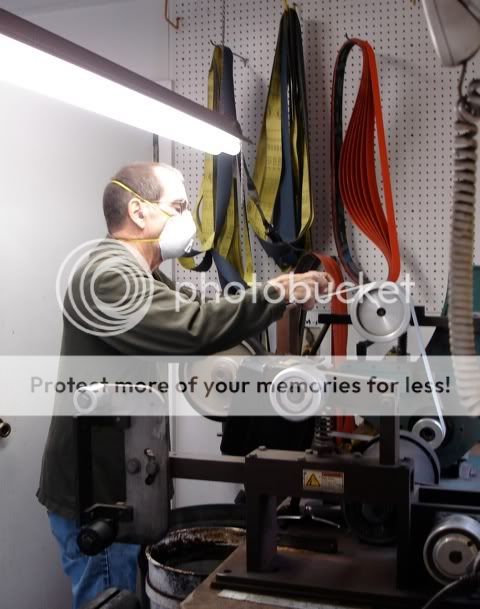
I'll sharpen on the slack belt jig on my Bader, starting with a 60 Micron belt,
then 30, and 15, finishing with a buff on a cloth belt with pink "no scratch"
compound.

Damascus38.jpg


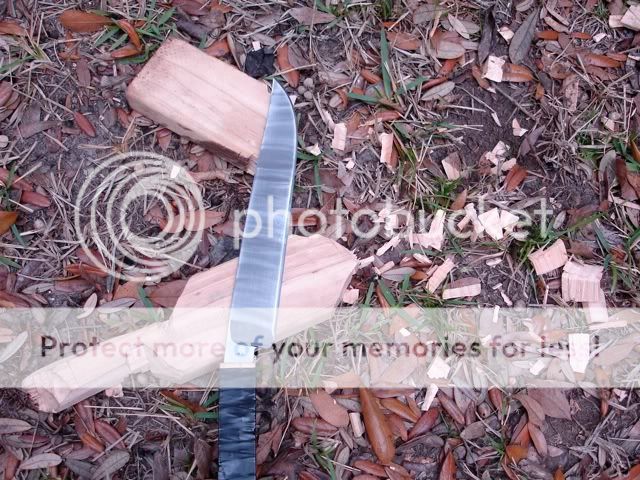
A quick and dirty temporary handle from a piece of wood inlet for the tang,
free-hand on the router, a nut for the threaded tang, stir stick, and electrical
tape. High tech!

Damascus39.jpg


Chop a hard pine 2x4 a couple times. You can see the buff marks on the blade
from laying it down on the higher grit belts for the "Moran" edge.

Damascus40.jpg


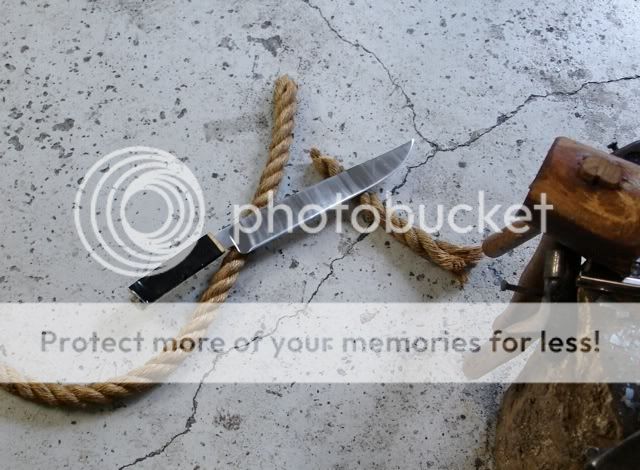
Cut a 1 inch, free-hanging rope.

Damascus41.jpg


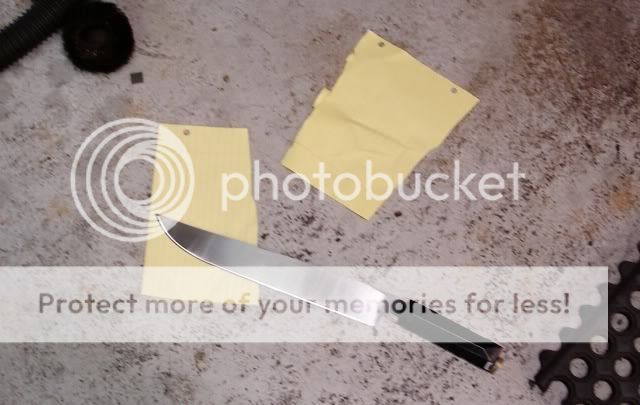
Then, after the 2x4 and rope cuts, try the edge on a sheet of paper dropped in
the air, and free-floating.

Damascus42.jpg


Finally, check the area where all the chopping occurred.

Damascus43.jpg


We hear a lot about "super-steels," and even my favorite W-2 , strictly
speaking, should "Out-Perform" plain old 1084, but this 1084 &15n20 damascus,
(after all the welding probably closer to 1075 than 1084) ain't too shabby.

I mean, do we really have to hold out for Scarlett Johansson when that sweet
little girl down the street is so easy to get along with?
 
After testing the edge geometry, I'll finish sand the blade through
1000 grit, wet-sanding alternate grits vertically, and at an angle
so I can see that all lower grit scratches are gone, with each
successive higher grit.

I use a simple leather covered wood support, and a c-clamp for
the tang. It's fast to clamp up, and with the tip resting on an 1/8 inch
raised end, protects me from stabbing myself, and supports the
entire blade.

With the vertically swiveling vise, I can angle the work so as to
put my back into it.

Damascus44.jpg


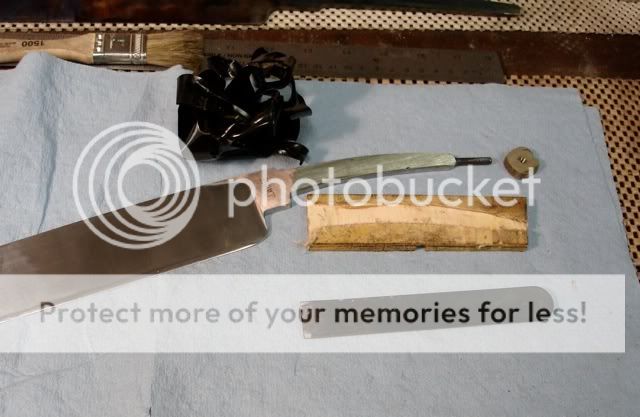
I work the flats with a piece of 3/8ths x 1 1/14x 8 inch Micarta,
cutting strips of sandpaper to fit.

Damascus45.jpg


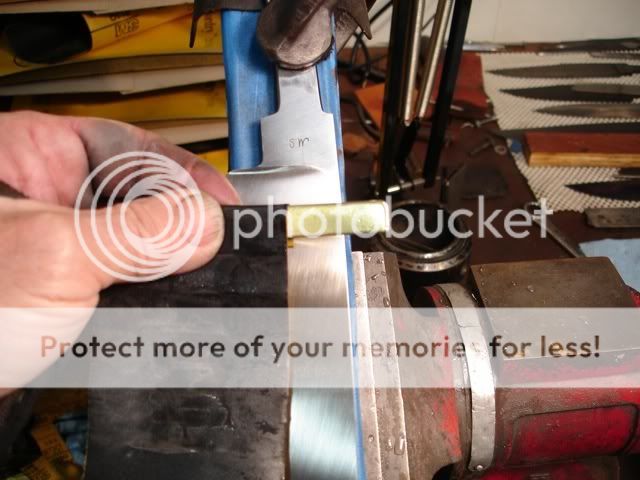
And work the plunge line with a brass strip and the next higher
grit paper at each stage, so that by the time I've sanded the
flats with 1000G, the plunge lines are at 1200.

Finally, I'll "pull" the flats with sandpaper wrapped around a
rubber-backed brass strip, using Windex as a lubricant.

Damascus46.jpg


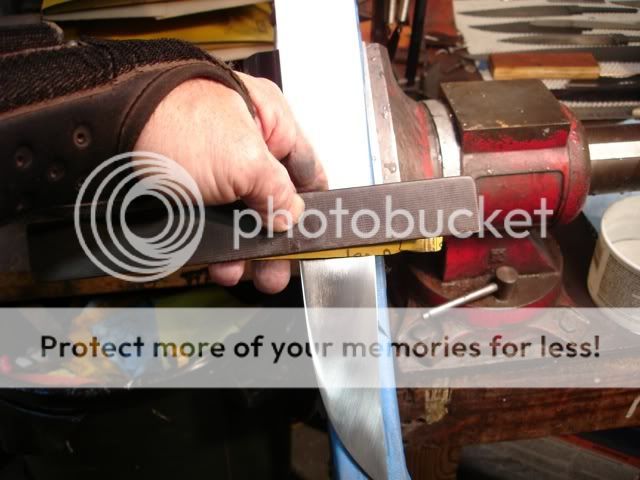
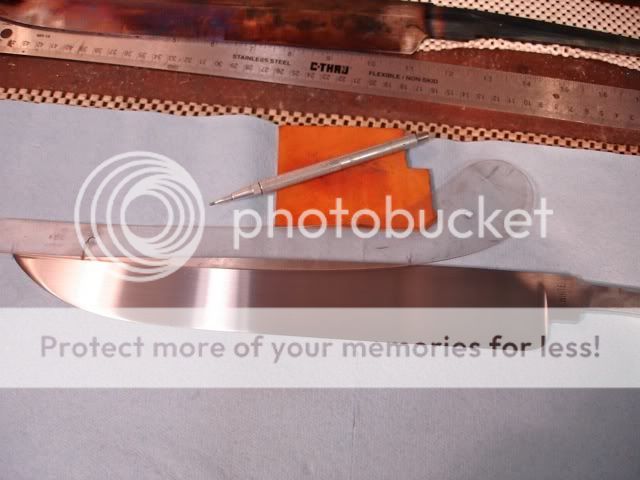
When the blades sanded, I'll mark out the clip with a long
French curve, and the carbide scribe,

Damascus47.jpg


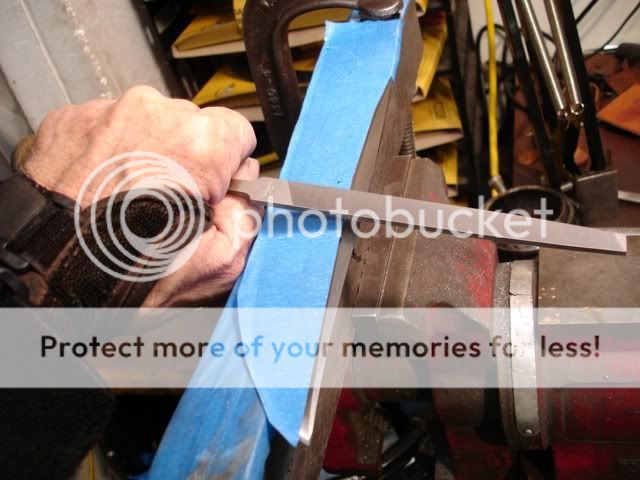
Cover the rest of the blade with blue tape to protect the surface,
rough out the clip on the grinder, and start the draw-filing.

Damascus48.jpg


It's gotten dark and stormy outside, and I'll quit til tomorrow,
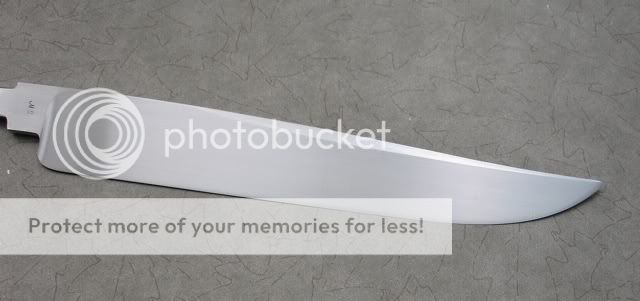
but here's the sanded blade with cilp in place.

Damascus49.jpg
 
I mean, do we really have to hold out for Scarlett Johansson when that sweet
little girl down the street is so easy to get along with?

Leave that girl down the street alone - she's mine!
(Great WIP John. It takes nearly as long to do all the photos and editing as it does to make the knife - which is sweet! Inspiratonal.)
 
John, I didn't know that you draw filed hardened blades. I was wondering why you said that you went through three files making that little leaf blade dagger.:D
 
Having seen John's HT forge in action, I can tell you that it is ridiculously good at holding temperature and the welded on handle is a real slick trick.
Had a PM question about the heating for quenching, and the strip tacked to the blade tang.

The bar I tack it to is a 1/8 x 1 inch strip, which is tack-welded to the tang and cut loose after quenching. The reason is to be able to let it the blade come up to heat in the drum forge, and soak for 8 minutes without the thermal mass of tongs. The drum forge is running at 1500 F for 1084/15n20, and it takes about 10 minutes for the blade to come up. I can quench past the hot part of the thin strip. The one time I tried using tongs took forever to come up to heat, and the mass of the tongs made the Parks 50 flame up.

I don't have to use any anti-scale, which is a side benefit of controlled temperatures. Scale doesn't form until around 1675-1725 F, and, of course, I'm running a reducing atmosphere in the drum forge. There's a thin black film of burnt oil on the blade after quenching that you need to "gummy-sand" off so it doesn't bake on during the temper, but you can see from the pics in post #50 how clean the blade is.

John
 
John, I didn't know that you draw filed hardened blades. I was wondering why you said that you went through three files making that little leaf blade dagger.:D

I was thinking the same thing Joe, that's like WORK :eek:
 
No, it's work when you do it before hardening. It is MASCOCHISM when you do it in a hardened state.:eek: File marks in hardened steel are the DEBIL even if you have EDM stones.:D
I was thinking the same thing Joe, that's like WORK :eek:
 
Wow Kevin and John!! just read through this whole thing. What a great thread.

Thank you so much to the both of you!!
 
GREAT thread and glad this blade is looking as good as it is. I too am curious why a file are being used to draw file the clip once the blade has been hardened?

Of course there must be a valid reason, or Mr. White would do it another way.

Peter
 
.........................John White's build


Esteem ^^^^

Coop
 
Aww, come on, you wimps. It's a easier to shape the clip before hardening,and I often do, but I still like to leave it a bit thick, and draw-file off any de-carb. I can grind about to the same shape after hardening and tempering, and draw off the same amount pretty quickly.

It's true that it used up a six inch mill file on this clip....

Peter, there's no valid reason. I got a little obsessive about this particular blade, and couldn't bear thinking of a long tapered tip going in the quench...

Joe, draw-filing ought not leave deep marks. Talk nicer to the file.

John
 
Last edited:
John I never get tried of watch you work and I learn a good bit every time I do. Thank you.
 
Peter, there's no valid reason. I got a little obsessive about this particular blade, and couldn't bear thinking of a long tapered tip going in the quench...

John

That sounds like as good of a reason as any John! This blade will undoubtedly be exceptional.

Peter
 
Peter and Joe,

Just sanding out the clip and realized i should have given a better answer about draw-filing in a WIP.

The most common mistake in filing with a mill file, especially on hardened steel, is to put too much pressure on the file, (and not clean the file constantly with a file brush.) Whether straight or draw-filing, lighten up on the pressure, and keep the file flat on the metal. You'll be astonished at how fast and smoothly the file cuts, and how fine a finish is left. You should be able to go directly to 220 grit on hardened steel. If there are deep grooves in the filed finish, either you're not keeping the file clean, and/or you're using too much pressure. Again, try really lightening up on the pressure, and letting the teeth pull the file into the metal.

It's almost easier to file hardened steel SMOOTHLY than annealed.

Sometimes I think too much about the fancy stuff, and forget the grunt techniques.

John
 
Back
Top