Looking to mirror polish blades Loveless style... Any advice?

Read “The Art of Japanese Sword Polishing” by Setsuo Takaiwa. After that get yourself some powdered abrasives, makeup sponges and felt blocks and polish it by hand. The best mirror finishes I’ve achieved so far never saw a buffer.

Also, get an optivisor with at least 3x magnification to use while hand sanding and don’t ever put a final finish on anything without checking it in good daylight. Honestly the last hour or two of decent light in the evening is best.

That has become my process and I only do it when I’m trying to develop a hamon. It takes hours upon hours to get a finish I’m satisfied with. Given the fact that most normal folks won’t pay over $150-$200 for a knife it has to be a labor of love because it’s a net loss financially.
 
I had problems with felt when I tried it. I know others have used it successfully, but I haven't. (I have particular uses for the felt, but not for the face of the blade). Part of the reason I've held to six inch wheels, is I can ride inside the (hollow) bevels and not soften the grind lines (so long as I'm careful). The felt may be part of your problem with the orange peel, your are certainly applying way more pressure from felt than you would be from cloth.

Hopefully someone who likes felt will chime in around how they use it.

The last buff wheels I bought were these : https://www.amazon.ca/dp/B08YJRTJ7M?ref=ppx_yo2ov_dt_b_fed_asin_title&th=1

The shaft on my buffer is 7/8, I just drilled them out with a step drill.

Hmm, I don't like the idea that I spent $100 on wheels that I can't use, but oh well. I have some stitched cotton wheels I haven't used yet so I could experiment with those as well...
 
Given the fact that most normal folks won’t pay over $150-$200 for a knife it has to be a labor of love because it’s a net loss financially.

I'm absolutely doing it out of my own desire, otherwise I wouldn't be doing it. :p And if I was interested in appealing to cheapskates I wouldn't have changed my style up!

A close friend of mine is really into Japanese polishing as well, maybe he would have some advice.
 
I'm absolutely doing it out of my own desire, otherwise I wouldn't be doing it. :p And if I was interested in appealing to cheapskates I wouldn't have changed my style up!

A close friend of mine is really into Japanese polishing as well, maybe he would have some advice.

I kind of enjoyed your utilitarian tool approach before. Was super clean and beautiful in function.
 
I kind of enjoyed your utilitarian tool approach before. Was super clean and beautiful in function.

I'm making a pretty dramatic shift to be sure, and I don't expect everyone to understand because even to me it's a little bit crazy, but rest assured I'm not interested in art knives. :p
 
I'm not trying to change your direction, but a perfect satin grind is both lovely and lasts well. It is easier than a mirror polish by far, but still takes practice. Using Scotch-Brite belts as a final finish has made mine much more even. Touch-up is also WAY better than fixing a goof on a mirror polish.
 
We are on page 4 with zero photos so far. This is all speculation. One good photo of the blade after say 400 grit would likely tell us what is happening.
 
I'm not trying to change your direction, but a perfect satin grind is both lovely and lasts well. It is easier than a mirror polish by far, but still takes practice. Using Scotch-Brite belts as a final finish has made mine much more even. Touch-up is also WAY better than fixing a goof on a mirror polish.

I agree that it would be easier, and that it does look quite nice on its own, but I'm very determined to not only figure out mirror polishing, but also to offer it as my standard finish. :) I'm nothing if not ambitious.
We are on page 4 with zero photos so far. This is all speculation. One good photo of the blade after say 400 grit would likely tell us what is happening.

I often get so focused on what I'm doing that I forget to take pictures, if I'm being honest. And by the the time I have the stuff I need to make my next attempt, photos of the blade in its current condition will be irrelevant. I'll absolutely try to take some pictures of the blade next time, however--for feedback if it goes well, and for diagnosis if it doesn't.
 
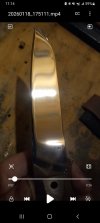
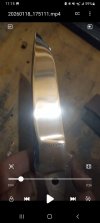
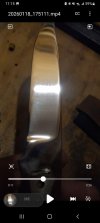
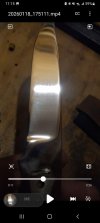
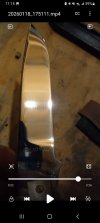
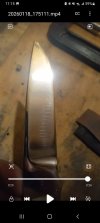
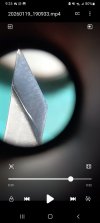
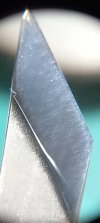
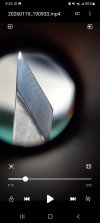
Okay, I have pictures this time--screenshots from a video, since a finish like this is difficult to photograph.

I re-finished the hollow grind on the grinder at 400 grit, used the same 800 grit cork belt with Gesswein Greystar, then thoroughly hand sanded with 1000, 1500 and 2000 grit using Rhynowet, and a piece of rubber from an old tire as my backing, and in all I spent 4 hours diligently hand sanding.

On my 3600 rpm buffer I used 6" diameter medium-hardness felt wheels, one loaded with Black Magic compound and one with conventional green chrome oxide, both from Maverick.

The Black Magic had the odd effect of not really erasing the 2000 grit scratches while also leaving its own scratches, while the green compound behaved as expected. However, aside from a few rogue scratches left over from hand sanding, I'm still experiencing the pin-prick marks and other odd inclusions.

At this point I'm thinking that either my sanding scratches are too deep since Rhynowet is aluminum oxide, or that the felt wheels are the wrong tool for the job, or that this could even be a fault inherent to AEBL, which doesn't make sense since other people can get a perfect mirror on AEBL and its adjacent cousins.

Anyway, here's some pics to hopefully shed some light on the situation...

Screenshot_20260119-111454_Video Player.jpg
Screenshot_20260119-111506_Video Player.jpg
Screenshot_20260119-111513_Video Player.jpg
Screenshot_20260119-111539_Video Player.jpg
Screenshot_20260119-111552_Video Player.jpg
 
In my experience if you get all the previous scratches out with a # 5 Norax it won't take much buffing to get a mirror finish. I see no need to do any hand sanding.
I think you are buffing before all the previous scratches are removed.
 
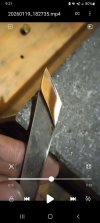
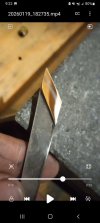
Small kiridashi made from a repurposed AEBL puukko tang, S Seedy Lot heat treat (unlikely to be a factor, but worth mentioning) same hardness as the blade above (61-62)

Ground with 60 grit ceramic, 120 grit ceramic, 240 and 400 AO, 800g cork belt with Gesswein Greystar, then hand sanded 1000, 1500, 2000 with Rhynowet on a granite surface plate, then buffed with felt wheels using Black Magic and green chrome.

First two pictures are no magnification under normal light, others are 10x magnification under direct lamp light

Screenshot_20260120-092200_Video Player.jpg
Screenshot_20260120-092207_Video Player.jpg
Screenshot_20260120-092444_Video Player.jpg
Screenshot_20260120-092502_Video Player.jpg
Screenshot_20260120-092707_Gallery.jpg
 
Small kiridashi made from a repurposed AEBL puukko tang, S Seedy Lot heat treat (unlikely to be a factor, but worth mentioning) same hardness as the blade above (61-62)

Ground with 60 grit ceramic, 120 grit ceramic, 240 and 400 AO, 800g cork belt with Gesswein Greystar, then hand sanded 1000, 1500, 2000 with Rhynowet on a granite surface plate, then buffed with felt wheels using Black Magic and green chrome.

First two pictures are no magnification under normal light, others are 10x magnification under direct lamp light

View attachment 3081983
View attachment 3081984
View attachment 3081985
View attachment 3081986
View attachment 3081987

Looking fairly good? Are you using the green chrome at an angle to the Black? If so are all the microscratches in the Black magic direction gone? I would think pressure needs to be really light with felt to avoid sleeks, but I haven't done enough with felt to know. For me chrome would be intermediate, not final, but the first thing is to get all the black scratches gone. How much polishing is it taking to get rid of the Black (ie number of passes or minutes)?

So much easier to look in person compared to photographs.
 
Looking fairly good? Are you using the green chrome at an angle to the Black? If so are all the microscratches in the Black magic direction gone? I would think pressure needs to be really light with felt to avoid sleeks, but I haven't done enough with felt to know. For me chrome would be intermediate, not final, but the first thing is to get all the black scratches gone. How much polishing is it taking to get rid of the Black (ie number of passes or minutes)?

So much easier to look in person compared to photographs.

I'm using both compounds in the same direction which may also be a mistake. A friend suggested that I try felt wheels, but the more I use them the less I like them... I have some stitched cotton buffs I'll need to drill out to fit the 5/8" arbors on my buffer but I plan to experiment with those, as the felt wheels are very aggressive and generate far too much heat.

I really wish I had someone to look at it in person who could give me meaningful criticism, but everyone I show in person is amazed by it, even with obvious flaws... I appreciate their enthusiasm and support though.

I'm getting there though. I re-ground the same kiridashi and plan to work it with waterstones (King 1200 or maybe Shapton 1k, then King 6k) and then buff, to see what data I can gather from that, and if necessary I may go to a jnat polish.

A recent hypothesis I have is that the tiny pin-pricks are the remnants of lengthwise scratches that weren't completely removed and went by undetected, masked by the higher grits. For example if you had a dry erase board covered in marker and erased it all, except left behind a few little spots

I sincerely hope no one feels like I'm ignoring their advice, I'm just trying hard to treat this like a science lesson and figure out why these things are happening, as just learning how to avoid them has proven ineffective on my part...
 
I'm using both compounds in the same direction which may also be a mistake. A friend suggested that I try felt wheels, but the more I use them the less I like them... I have some stitched cotton buffs I'll need to drill out to fit the 5/8" arbors on my buffer but I plan to experiment with those, as the felt wheels are very aggressive and generate far too much heat.

I really wish I had someone to look at it in person who could give me meaningful criticism, but everyone I show in person is amazed by it, even with obvious flaws... I appreciate their enthusiasm and support though.

I'm getting there though. I re-ground the same kiridashi and plan to work it with waterstones (King 1200 or maybe Shapton 1k, then King 6k) and then buff, to see what data I can gather from that, and if necessary I may go to a jnat polish.

A recent hypothesis I have is that the tiny pin-pricks are the remnants of lengthwise scratches that weren't completely removed and went by undetected, masked by the higher grits. For example if you had a dry erase board covered in marker and erased it all, except left behind a few little spots

I sincerely hope no one feels like I'm ignoring their advice, I'm just trying hard to treat this like a science lesson and figure out why these things are happening, as just learning how to avoid them has proven ineffective on my part...
The difference in direction does not need to be large to be useful, in terms of seeing whether you've succeeded in taking out all of the previous grit scratches. Even 10 degrees will do it. My experience with Black Magic is that is actually a bit coarser than I'd prefer for a first compound. I doubt very much whether you need to go finer than 1200x for the prep to get to a finish that the black will handle. I did find it was somewhat prone to sleeks if used with too much pressure. (One of the things I like about the diamond I'm using now is that it seems not to sleek even with quite a lot of pressure.)

By "sleeks" I'm referring to tadpole shaped scratches formed during buffing with a dot at one end and a drag mark away from the dot. I used to think that they were caused by carbide tearout, but I've produced sleeks with too much pressure on AEB-L and 14C28N neither of which have much in the way of carbides (most carbon is in solution). My reading in optical polishing is that sleeks happen with glass as well (which rules out carbide as a factor). The old optical sources I used seemed to regard the mechanism behind sleeking as mysterious. It may be better understood now. (Some of the best amateur optical references date back to 1910-1945.)
 
The difference in direction does not need to be large to be useful, in terms of seeing whether you've succeeded in taking out all of the previous grit scratches. Even 10 degrees will do it. My experience with Black Magic is that is actually a bit coarser than I'd prefer for a first compound. I doubt very much whether you need to go finer than 1200x for the prep to get to a finish that the black will handle. I did find it was somewhat prone to sleeks if used with too much pressure. (One of the things I like about the diamond I'm using now is that it seems not to sleek even with quite a lot of pressure.)

By "sleeks" I'm referring to tadpole shaped scratches formed during buffing with a dot at one end and a drag mark away from the dot. I used to think that they were caused by carbide tearout, but I've produced sleeks with too much pressure on AEB-L and 14C28N neither of which have much in the way of carbides (most carbon is in solution). My reading in optical polishing is that sleeks happen with glass as well (which rules out carbide as a factor). The old optical sources I used seemed to regard the mechanism behind sleeking as mysterious. It may be better understood now. (Some of the best amateur optical references date back to 1910-1945.)

Perhaps what I'm experiencing is similar to what you're talking about in terms of "sleeks", which manifest more as dots or pin-pricks for me? I've been trying to be gentle with my pressure, but the felt wheels make that difficult due to them being hard and nonconforming. Perhaps a stitched cotton buff would be better after all...

I did read in an article written by Del Corsi for an issue of Knife Magazine, which was generously gifted to me by S.R. Johnson, that such an affect is caused by too much pressure on the buffer.

Perhaps my own heavy-handedness is a major factor at play here...?
 
Perhaps what I'm experiencing is similar to what you're talking about in terms of "sleeks", which manifest more as dots or pin-pricks for me? I've been trying to be gentle with my pressure, but the felt wheels make that difficult due to them being hard and nonconforming. Perhaps a stitched cotton buff would be better after all...

I did read in an article written by Del Corsi for an issue of Knife Magazine, which was generously gifted to me by S.R. Johnson, that such an affect is caused by too much pressure on the buffer.

Perhaps my own heavy-handedness is a major factor at play here...?
Very likely (too much pressure). The dots can be apparent after the streak is polished out. The dot is much deeper than the streak. Someone else may be able to comment on whether it could be carbide tearout.

(It sort of doesn't matter which it is though, same adjustment either way: different angle and less pressure, and/or softer polishing substrate.)
 
Very likely (too much pressure). The dots can be apparent after the streak is polished out. The dot is much deeper than the streak. Someone else may be able to comment on whether it could be carbide tearout.

(It sort of doesn't matter which it is though, same adjustment either way: different angle and less pressure, and/or softer polishing substrate.)

I don't think it's carbide tearout due to AEBL not having large carbides (if any? I'm not a metallurgist) but the dot being left behind after the streak is washed away does make sense to me. I've been quite careful, but it's quite difficult to determine how much pressure is too much.

This would all be extremely fascinating if it didn't give me a headache and keep me up at night...
 
I use the black magic for satin finish on a cork belt. I wonder if there is grit contamination in it, or a wider range since it's a lower grit compound that guys often use for satin finishing, not mirror. Maybe try another low grit compound geared towards buffing to a mirror?
 
I use the black magic for satin finish on a cork belt. I wonder if there is grit contamination in it, or a wider range since it's a lower grit compound that guys often use for satin finishing, not mirror. Maybe try another low grit compound geared towards buffing to a mirror?

Do you have any recommendations?
 
Back
Top