michalmelichercik
Knifemaker / Craftsman / Service Provider
- Joined
- May 13, 2024
- Messages
- 37
Last edited:
The BladeForums.com 2024 Traditional Knife is available! Price is $250 ea (shipped within CONUS).
Order here: https://www.bladeforums.com/help/2024-traditional/
Right.....I got some serious LUST going on here...Holy smokes!! These are absolutely stunning!!! There are no words. WOW!! I’m now following this thread…and we need to talk.![]()


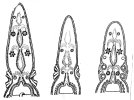
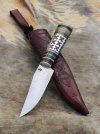
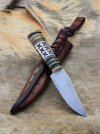
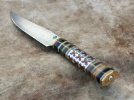
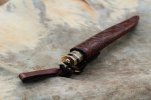
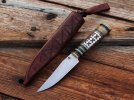
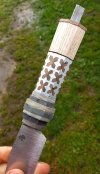
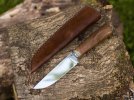
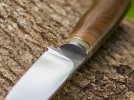
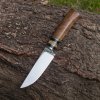
What an unbelievable looking knife. Modernized versions of historical european shepherds blades is an incredible concept. Thank you for making these.A shepherd’s knife from central Slovakia, 19th-century. The original is preserved in the ethnographic museum in Budapest. The handle features a combination of two decorative styles: stacked construction and pewter inlay. The handle has an octagonal shape, but the cross motif is repeated around the circumference only six times. The tin decoration had to be measured very precisely so that it would not appear distracting in relation to the facets.
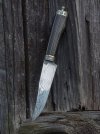
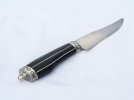
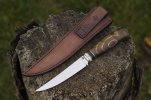
The blade material is stainless Balbach steel. The handle is made from sheep, cow, and horse horn. The central part is made of walnut wood and tin. The guard is made of brass.
I can’t publish a photo of the original old piece here because I don’t have the copyright. Only through a direct message.
View attachment 3041087
View attachment 3041088
View attachment 3041089
View attachment 3041090
View attachment 3041091


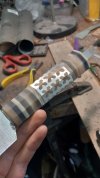
Did you have to learn that trick the hard way????? Like I would have....I found a few photos from the production process. You can see how I proceeded. Horn (horn material) is not suitable for contact with hot molten tin because it changes shape and color at high temperatures. It contains oily substances that evaporate at temperatures above 150 °C. That’s why I chose this procedure: first, I made the central part, and then I replaced the temporary wooden pieces with horn.
View attachment 3041164
View attachment 3041165
Exactly. It took a few tries. Sometimes it gets on your nerves — that’s when a beer helpsDid you have to learn that trick the hard way????? Like I would have....![]()
It’s often a trial-and-error method. Since very few people know this decorative technique, there’s no one who can really advise me. But what I wrote in the post is not a general rule. I’ve managed to cast a tin inlay even into horn. It has to be an old, properly dried piece. However, the result is always uncertain.Exactly. It took a few tries. Sometimes it gets on your nerves — that’s when a beer helps![]()


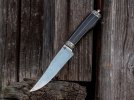
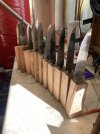
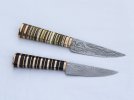
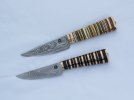
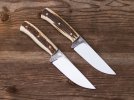
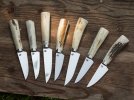
When making these knives, I chose a different approach. The knife made from black horn is an exact replica of a traditional shepherd’s knife from central Slovakia, while the white knife is only inspired by this historical model. In the past, shepherds often made the handles themselves, which was reflected in the accuracy as well as the overall quality of the workmanship. The surface of the knives was not usually perfectly polished.
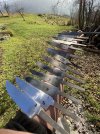
My goal is to take the original designs one step further. That is the only difference compared to the original pieces; otherwise, the knives meet all the attributes of authentic craftsmanship in terms of construction and materials used. The blades were made by swordsmith Róbert Môc, who works with historical iron—he reforges old axes and tools, creating a unique and wild steel pattern.
The handles are made from cow horn sourced from local native breeds, specifically Slovak Spotted cattle and Hungarian Grey cattle.
Overall length: 190 mm
Blade: made by Robert Môc from old recycled steel
Handle: cattle horn, brass sheet, copper sheet
Robert Môc a Henrieta Môcová - start
Robert Môc sa už 15 rokov zaoberá tradičnými technologiami výroby historických zbranÃ, najmä stredovekých a starovekých mečov. Pracuje damaskovou technikou a ovláda zdobenie zbranà rytinou, tauziou, filigránom, granuláciou.www.robert-moc.sk
View attachment 3043665
View attachment 3043666