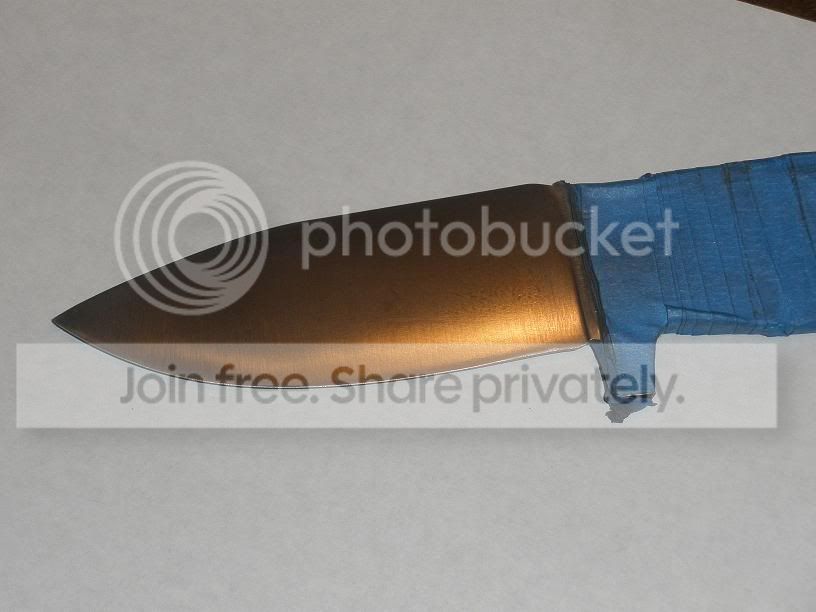
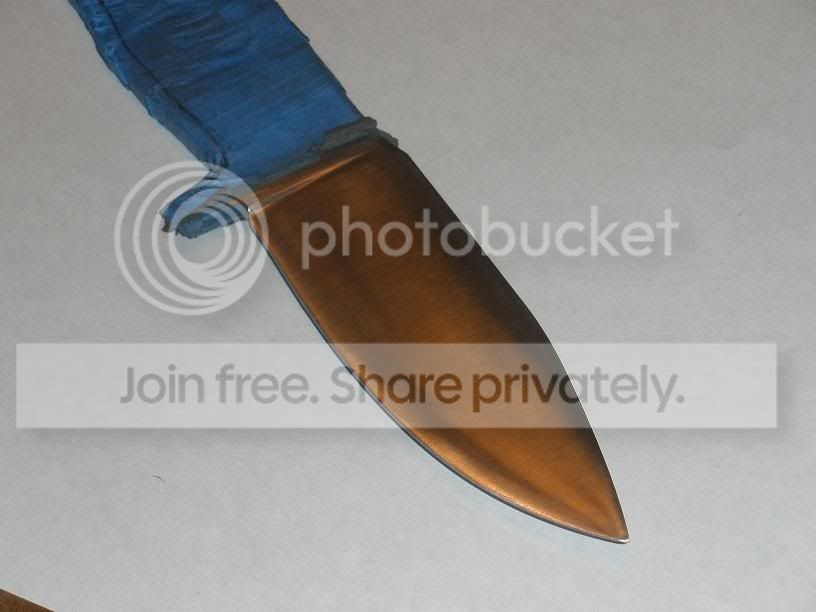
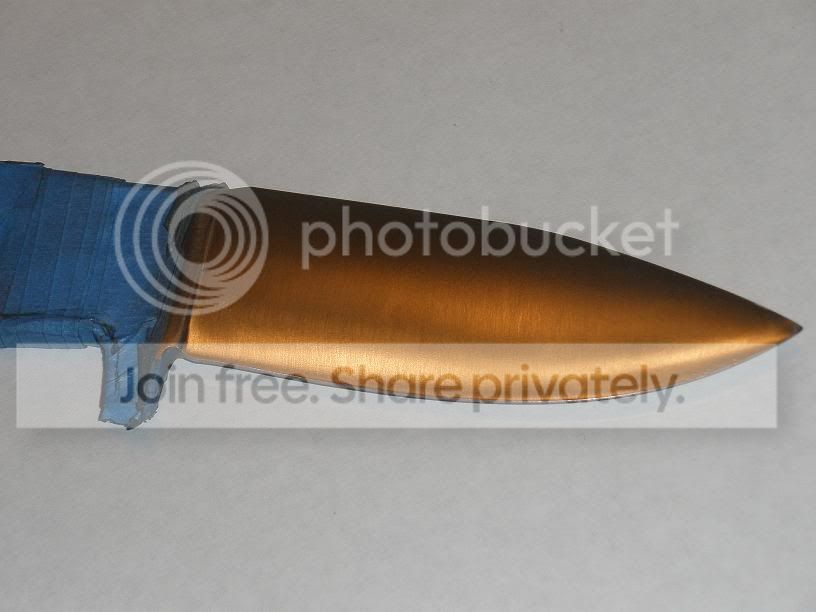
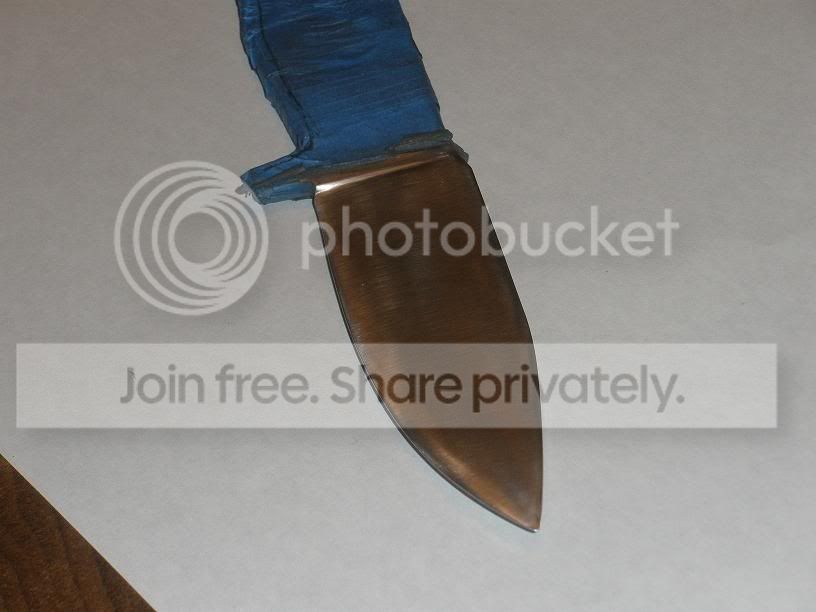
My first knife design. Critiques and Comments welcome

Relax, breath...breath... deep breaths..... it's OK.
You are not in a panic spot. Because the knife is ATS-34 the edge can be much thinner. If it was 1080, you would have to file back the edge and thicken it, but the stainless steel will be heat treated in a sealed packet in the oven, and can be much thinner. I gave you the target thickness, but figured you would overshoot it. Most everyone does. The way to avoid taking too much off the edge is to file more toward the spine and less on the edge area ( I know, that sounds easy). Blackening the blade with a marker is good. You just don't want to file much black away from the edge. Go to the sand paper, and don't fret the edge too much. Just watch that it doesn't get sharp and cut you.

Stacy
 
I've found out 2 things in the last 2 days. Sanding out the file marks by the plunge line is not fun. And another point related to that.... No matter how small a scratch is in the blade, it will never come out as fast as you think it will.

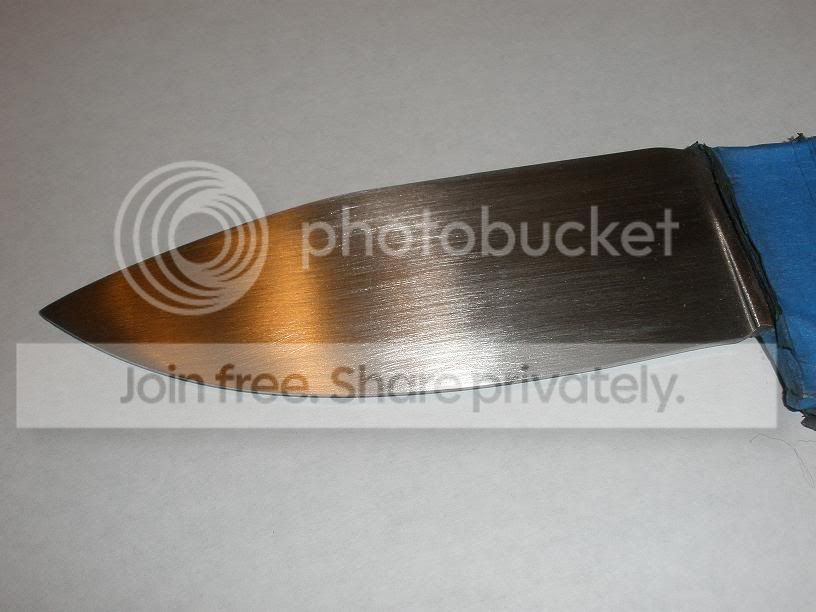
I worked the one side of the blade for about an hour + tonight getting out a scratch that couldnd've been more than 1/8" long and it looked like it was barely there. I had my iPod on and was just sanding and sanding for a few songs and said to myself, "that should do it". Take a look :eek: still there. Repeat that process about 12 times and that was where all my time went :). I think, THINK I got all the file marks out of one side. I got started on the other side for a bit before I stopped and tomorrow I'll look at it again with a fresh eye. Here's a pic

Knife001-1.jpg
 
First off I like what your knife is coming out to be. I also like all the other photos as well. I don't really see anything wrong with the handle material being smaller than the tang as long as it blends and is comfortable. If it will be used you don't want an uneven surface between the handle and the tang. I agree with fishface 5 . I had a lot of saw dust rather than metal chips in my shop for a long time while working on designs. I used scrap hard board. Doesn't splinter as much as plywood. You look like your coming along just keep refining that tang. So far it looks like a masterpiece compared to my first blade. Best of luck to you.:thumbup:
 
Fletch,

I think you are doing a fine job. It looks better every post.
You can chase a scratch for hours some times,:mad: sooner or later you will get it.
Same with the plunges, you just have to keep fussing at it till you get it cleaned up.:mad::mad:
I made my first several knives by draw filing and sanding. It's worth the effort.
It teaches you things that you cant learn on a grinder. And if you are stubborn enough to do it by hand you just may be a knife maker.:D
Good luck and keep those pics coming.

Greg
 
I went through the same thing, I was at 80grit for ever, but each grit after goes faster. You still get the anoying little scratches that just take for ever to go away. I enjoy the hand sanding part though. Keep it going though it looks good
 
Thanks for the input guys. I'm really enjoying the whole process so far and I think I can safely say I'm hooked on doing this. I have another one already waiting that I got started on while waiting to get this one back from Stacy. It's here http://www.bladeforums.com/forums/showthread.php?t=693818. That one I cut out on my own but put the bevels on with a grinder. So once I send this one back to Stacy for the HT I can keep busy working on that one.

So yeah no doubt about it right now. I'm addicted :D
 
Looking good Matt.
Get it sanded to 400 grit and it is ready for HT. The thing to learn is that doing a knife right will take time. Spending an hour sanding a scratch out is fast, not slow. Resist at all cost the temptation to just sand the scratch.....it will make a low spot on the bevel that will be a B!t@h to get out ( it can make a permanent depression that will ruin the blade in some cases). Sand the whole side in long strokes until the scratch is gone. Once the surface is flat, the progress goes much quicker. Also, once a flat surface is established, the next grits are much more successful. As with the file scratches, when going up the grits, get all the scratches out before moving to the next grit.
Stacy
 
You're doing just fine! I really want to commend you for putting this all out there to show people what can be done with minimal tooling and a lot of "want to"! :thumbup:

Spend the time BEFORE Heat treat to get things right, mistakes after HT take three times longer to fix.
 
Well I'm glad I went back and looked at that side again more closely today. Found a few small scratches at the tip and got them out. The other side of the blade though I really did a job with during filing. I knew I had a bad side and that was it. I have a few scratches basically in the center of the plunge line that were pretty deep in there. I managed to get them down a decent amount tonight to where they're considerably less noticeable. So that means I have a few more days of sanding on that side. :D
 
While sanding tonight on the side I know I did a number on I've noticed a few SNAFU's. It appears when I was filing I somehow created what looks like a low spot smack between the spine and the edge of the blade. It also appears I clipped the ricasso a few times with the fule when putting the plunge line in on that side. Also at the end of the plunge line (near the spine) there is another small gouge that is on the bevel a fraction of an inch off the plunge line.

I'm guessing the only way to eliminate the low spot on the bevel is to just keep sanding the center of the blade?

But what about the gouges on the ricasso and the bevel? I can't just sand them out in that one spot can I? I'm assuming I'll create a low spot if I did that.

Also I'm getting some sanding scratches on the ricasso from the sanding block occasionally hopping up over the plunge line a bit. Will that be much of a problem to get out?
 
All I can say is that we are going to have some flaws, even if no one else can see them. We stare at these things for hours on end and see every little thing wrong with them. For first knives I think we are doing a heck of a job. I know for my self that mine isn't messuringup to what I think I can do, yet all of the people I have shown it to in person are amazed at the job I am doing and can't beleive that I can see faults in it.
Just remember that every mistake we make here will be a lesson learned and the next on will be easier and better.
 
Try and get the bevels as flat as you can before HT. It will save a lot more work later. The ricasso should be no big deal to flatten up after the bevels are done if the scratches are minor. I would concentrate on getting the bevels right,and then trim up the little spots here and there last. I am glad you realize that you can't sand out a small spot directly without having it make the blade bevel look like a fun house mirror after the knife is done. However, keep in mind that you will sanding again after HT, so tiny surface problems may not be too big an issue.

On the subject of 80 grit scratches, I noticed the first sanding scratches looked rather large in the photos. Are you hand sanding with 80 grit? I did not realize I sent any paper that coarse. I sent files up to a very fine number ( #4 or #6?), which will file as smooth as a 220 grit paper.
Nothing is wrong with starting with very coarse paper, but you will make deeper scratches that will take a lot of work to get out. I usually start with 120 grit after filing, unless I am removing a lot of metal, like on a sword.
Remember that the size of the sanding scratches is a product of the grit size.......but the scale is not linear. An 80 grit scratch is about 200 microns wide, and about 50-70 microns deep; but a 120 grit scratch is only 100 microns wide and 25 microns deep. The difference between grit sizes gets to be less and less as you approach 14,000 grit, which is 1 micron.For hand sanding purposes, the grits that matter are between 100 and 800 ( above 800 you are polishing, not sanding). A good chart is :
http://home.comcast.net/~rexmill/sharpening/grit_sizes/Abrasive_grit_sizes.htm

Stacy
 
On the subject of 80 grit scratches, I noticed the first sanding scratches looked rather large in the photos. Are you hand sanding with 80 grit?

Nope I'm only using the 120 you sent me. Maybe it's just the photo but all that sanding is done with the 120 grit you sent.

The only thing I "cheated" on so far was the filing. When I was going to start that other knife i went and got a 12" Nicholson Mill bastard file, which I used a lot in getting the plunge lines in with. I think the thing that bit me though is because it does a great job of eating metal I made some of the cuts on this side a bit too deep with it. Then I was worried about the thinning edge thing and went to the sandpaper without using the finer files as much as I probably should have.
 
Last edited:
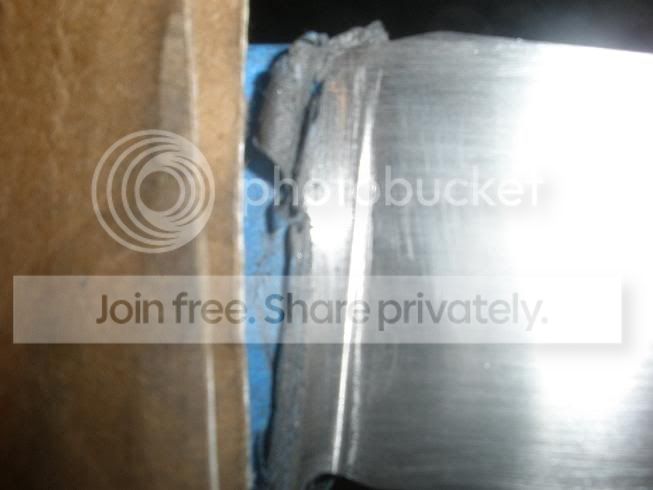
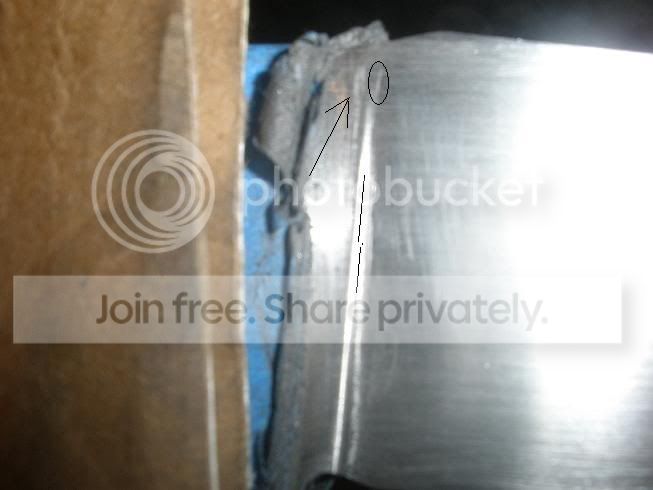
Well I've been working on what is now known to me as my "dammit spot" From what I can tell I must have made a low spot right by the plunge line in the middle of the blade. The picture doesn't really show it but I'll post what the camera shows and I'll draw in what it looks like in person.

Here is about the best close up I can get of the side.

Knife-2.jpg


Here is a lame attempt of drawing in the scratches. Also the oval at the top of the plunge line is another scratch that veers off to the right of the plunge line. And the arrow is a scratch in the ricasso which I'm assuming I can sand out in another step.

Knife4-1.jpg


That scratch is like basically in the worst possible spot it could be... combine that with I'm fairly certain that it's in a low spot makes me think it's in the absolute lowest possible spot it could be. And I'm still kinda dervous about making the edge too thin as well.


Also here is another question, if there is a small scratch mark right where the blade will be sharpened do I need to be overly obsessive about getting it totally out?
 
fletch your doing a good job dont let stacey tell you other wise lol. But seriously are you using a flat stick while sanding a good sanding stick is very important. Some of my first knives ide spend 5 hours hand sanding before i got my bigger belt grinder.Now I use the structured abrasive belts up to 3000 grit they are pretty awesome. I also use a 3/8 round dowell it helps on curves. kellyw
 
Matt,
Looks good. As to the small scratches in the edge area, as long as they are not too deep, they will come out later in final sanding after HT. As you suspected, the ricasso scratches are a quick fix when the bevels are done. But, aren't you glad you put the tape there....or there would be a million of them.

Sometimes you have a small scratch that really bugs you, and can't seem to get it to go away without messing everything else up. If you have worked the scratch to the limit, you may need to let it go and try to remove it after HT. It will take more work then, but you will be looking at the finished surface, so you will know when to quit. After HT I'll talk more about trade-offs in finishing ( deciding what to leave and what to pursue).

In some cases, especially at the plunge line, using a piece of flat metal as a backing stick can help, but he bocote block I sent should do just fine.

EDM stones are a real champ at cleaning up the plunge area, but careful attention with sandpaper will get it done,too.

A trick for cleaning up the very corners of the plunge ( where you are having the problem) is to fold a 4X4" piece of sandpaper twice, making a 2X2" pad. Flatten it well, and place a square of 1/4" thick hard material ( Micarta or hardwood) on it, with the folded edge aligned (The pad and backing block are separate, not folded around each other). Wet the pad and place the folded edge in the plunge corner. Carefully sand the plunge, applying slightly more pressure within the edge of the backing block at the plunge. Use a few up and down strokes along the plunge, and then several lengthwise strokes down the blade. Don't over do it, or you may make a dip, but this will usually take care of those last little buggers before you do the final grit on the bevels.After getting everything flat and smooth at 120, I try to get the plunge clean at 220 grit before sanding the bevels ( at 220). Then at 400 the problem is usually gone.

Photos only show so much, and I can't hold the knife, turning it in the light, but it looks like it is near ready for HT.

More general notes:
When using a belt sander to clean up the plunge, new makers often have the same problem....only the sandpaper is moving a lot more SFM. This creates what Burt Foster likes to call "two inch lines , which are the dip marks exactly two inches away from the plunge - caused bu moving the blade up and down along the ricasso and not drawing it in a continued motion toward the tip. The way to avoid this is to not start at the plunge, and not sit still there when sanding. Place the blade just barely into contact with the belt starting at the tip, slowly move it into the plunge and then move it back toward the tip all the way off the belt. This will avoid removing too much metal in any area than the others.

On filing - the deep scratches left in filing are from two sources...galling and gouging.
Galling is caused by pieces of metal filings getting lodged in the file teeth, and then becoming hard by friction. They then are little cutting teeth sticking out and making deep grooves in your steel. You should brush off the file every few strokes with a file card, which is a stiff wire brush with 1/4" bristles. Chalking the file with plain drawing chalk will help keep the filings from getting lodges tightly, and aid in allowing the card to remove them.Re-chalk as needed.
Gouging is caused bu getting rambunctious with your file ( usually up and down strokes) which allows the edge or end to cut deeply into the metal surface, making a deep cut. Filing slowly in down strokes, and using a file handle will help eliminate these marks.
In both cases, a file is not a power tool. Let it do its work with normal hand pressure. Don't bear down on it to make the metal come off faster, as this will make more work ,not less.
File only as much as is needed on the coarse bastard. Then move to a smoother double cut, then a single cut. Also, files come in fineness numbers. A #00 is a lot rougher than a #2,and leaves much deeper scratches, so having the right teeth sizes is a real help.

Stacy

 
I have been going back and forth between the sanding block and a small piece of metal. What I cut out that other blank I had a small narrow piece left over that I was using at times. Problem is it's not much wider than the blade so my hands get kind of cramped after a while. I'll double check both sides tonight to make sure I got all the file marks out and move up to the next grit and sand again.

I'm also going to narrow up the handle area on it a bit because it feels a bit too wide in my hand.
 
Quick update no pics though, went to the next grit tonight. Just about finished up one side of the blade with the exception of a few small scratches. Then went over to do some work on the side I haven't been happy with. Still a ton of work to do on that side but seemed like it's starting to clean up that spot by the plunge line a bit. Either that or I'm just willing myself to believe that it's starting to look better. Hopefully tomorrow I'll be able to p both sides.

I'm also finding I'm becoming more obsessed with this whole knife making thing. I haven't even finished this knife, I have another one I started before this one even arrived and I'm already thinking about what to make as a 3rd. I'm also debating on putting Burl Source on my ignore list for a while so I can't see what blocks he's putting up :D. I'm squirreling away wood and constantly teeter-tottering about whether or not to keep adding more the more I keep looking at the pictures.
 
I started cutting the bevel on knife #2, figured I could save some money shipping them together to be heat treated, and while they are away I will be starting #3, should have it ready to go by the time the fist 2 get back. So yes this is addictive, I will be real torn come riding/race season, I will just have to find a way to spilt up 12-16 hur work days riding and knife making. Darn I will be converting the garage into a shop too, going to be a busy spring and summer for me.
 
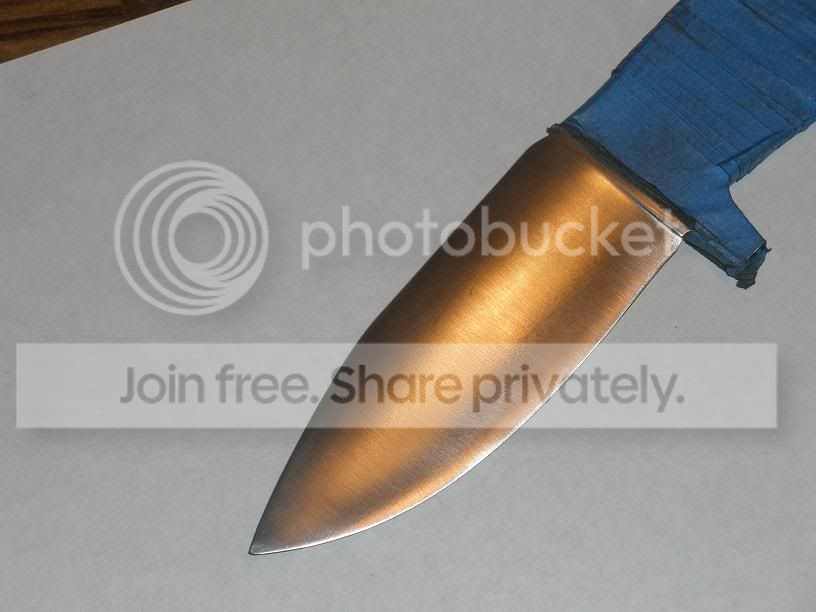
Here's where I'm at with 280 timeto bump it up to 400 and that should finish the blade part. Then I just have to narrow up the handle, cut in my choil, clean up the ricasso..... Not sure if there is anything else after that at the moment :D.

Going to go hit the blade with some 400 now. Lighting makes it appear golden in some pics but it's not.

Knife008.jpg

Knife007-1.jpg
Knife006-1.jpg

Knife005-1.jpg

Knife004-1.jpg
 
Back
Top