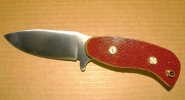
Some notes on mounting scales with Corby bolts and with thong tubing:
Finish the blade completely except the final sharpening. It should be completely sanded and polished to its final finish. Check it over carefully in a bright light for scratches you missed. Get it right now, because you will have a lot harder time once the handle is mounted.
Fill the thong tube with wadded toilet paper. That way the epoxy won't get inside the tube. When you have filed/sanded the tube down to the scales surface, the paper will push out easily.
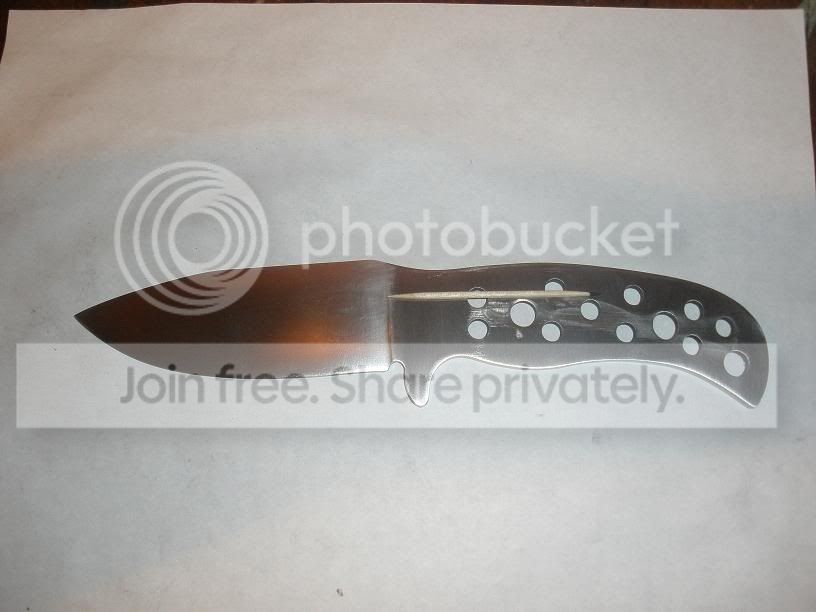
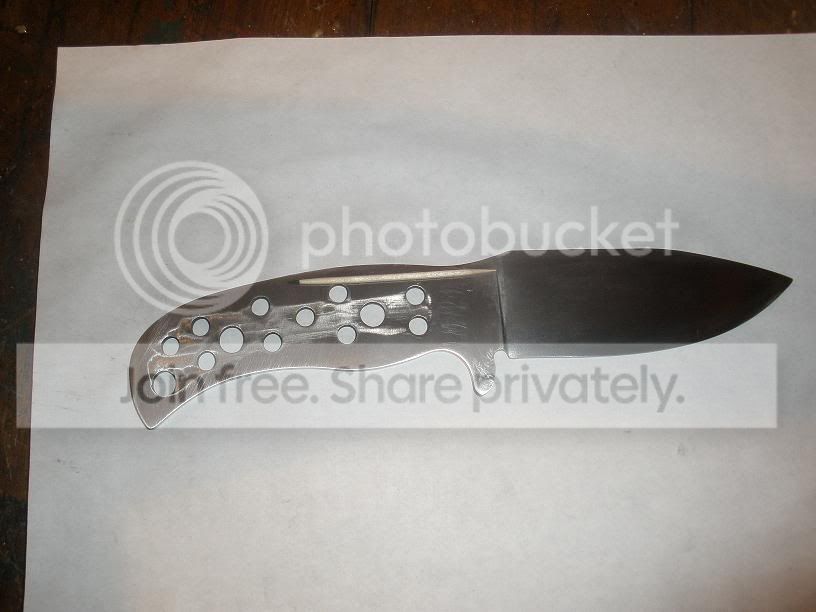
Your scales should be a little larger than the tang, but a reasonable outline of the desired shape. About 1/8" excess is good. The front area at the ricasso needs to be the exact shape you want, as this can't be shaped after handle assembly.
Make sure you have sanded and buffed the front surface of the scales to 400 grit or higher before assemble, or you will never get that area smooth without scratching the heck out of the ricasso on your blade.
Dry fit everything a couple of times to get the procedure down, making any last adjustments needed. If things don't line up ( especially the thong tube) back off the bolts about a turn,and move the scales until all the holes line up. That is one of the big reasons you drill the tang holes 50% larger than the rivet/bolt shaft size.
When you are ready to assemble the handle with epoxy, mix up your preferred brand of slow set epoxy. It needs to be at least a one hour type, and 24 hour is better. I like System Three T-88. Dye it to match the scales if you wish.
Put on a pair of nitrile gloves for the assembly work ( place a spare pair nearby). Lay out a stack of paper towels, have your acetone can handy, cover the work area with newspaper. Get two old screwdrivers that you don't mind getting epoxy on the handles ( you probably will only use one). Check that all parts and things you need are there and ready to use.
Put a small amount of epoxy in the bolt holes on one scale, and slip in the female bolts with a turning motion. I usually put a little epoxy on the outside of the bolts to assure a completely wet joint.Do the same thing for the other scale with the male bolts. Use a toothpick to remove any epoxy that got in the female holes, but don't worry about the male threads. Turn the scales over, and apply a thin layer of epoxy to the inside of the scales. Place the female scale on the tang. Align the male bolts scale to the shafts of the female bolts, and using a screwdriver, give each bolt a starter turn. Don't turn more than one turn until you know that both bolts are started and not cross threaded. Tighten the bolts down ,alternating from one to the other, until the scales are just about snug to the tang, but will easily move a little. Put epoxy on the toilet paper stuffed thong tube, and in the handle thong hole if needed, and insert the thong tube with a twisting motion. If it hits the tang, move the scales a tad to allow passage through to the other scale. Once all is in place, tighten the bolts just to snug. You don't want to crank down on them and squeeze out all the epoxy. Wipe the excess epoxy off the handle sides, and take care to get all the run out off the ricasso area. Check that the handle is sitting where you want it and that the tang isn't projecting out beyond the scales anywhere. Loosen the bolts and adjust if needed. When all is well, take a paper towel with some acetone and wipe off the blade and ricasso area to remove all epoxy.You can give the handle scales a quick wipe down, but don't worry about excess epoxy here since you will be grinding/sanding it all away. Set it down until the epoxy is just barely set up ( check the epoxy cup you mixed in to see when it is no longer sticky or movable) . This is about 20-30 minutes if using a one hour epoxy, and usually a couple hours for the twenty-four hour variety. Being gentle to not apply any strong pressure to the still not cured epoxy joint, wipe the blade and ricasso down again, as there is often a little additional squeeze out that seeped while the epoxy was still liquid. Pay attention to the front area of the scales that you pre-sanded, and remove any epoxy on that area ,too. It is a lot easier to get it off the ricasso and front of the scales now than later when fully cured.
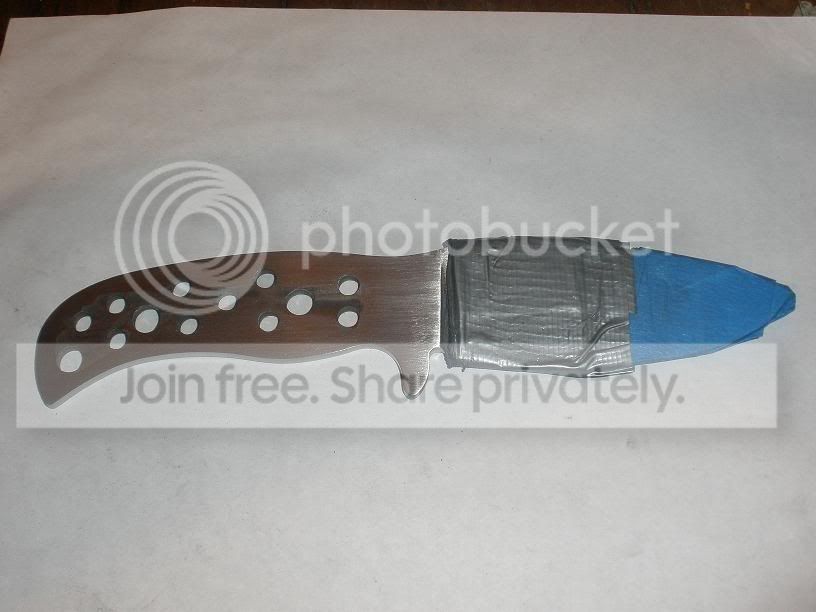
If you are happy with everything, set it down and let it cure for a day. After it is cured, clean the blade and tape it up to the ricasso with masking tape ( blue painters tape is best). Put on several layers to protect the blade from damage or scratches.
To shape the handle, first cut off the excess bolt shaft and thong tube sticking out. If you have a grinder, the temptation is to just grind them down with a 100 grit belt.....DON'T do it. The heat will conduct down the bolt and not only break down the epoxy, but discolor the scale around the bolt. Always cut off the excess with a band saw or hack saw, and file down to the surface before any grinding is done. When shaping the handle, grind with care as to not heat up the bolts. Stainless bolts are the worst for heating up, brass and nickel somewhat less, but still require care.
Once the bolts and thong tube are cut down, start shaping the handle. Using either rasps and files, or a belt sander ( preferably one running on a lower speed), start by knocking off the edges, making the handle somewhat octagonal, then rounding the surfaces into graceful curves. Try and avoid the blocky "square looking" handle that many first knives have. Decide where the handle needs to be thiner and reduce the thickness in those places. Do a little at a time, as it is easy to take a little more off, but impossible to add any back on. Work the handle all over, not in just one place, shaping as you go.
Slowly bring the handle into the shape and feel you wish, stopping when it is still a little larger than desired. At this point the scales should be nearly flush with the tang all around, and the knife should be looking like what you want. If using a file ,switch to 100 grit sandpaper now, and refine the shape more. Pay attention when sanding the tang/scale joints not to undercut the scale material and leave the tang proud. Using a backing block in this area is a good idea.
When the shape is just about there, switch to 220 grit and go up the grits to at least 400 grit. Make sure you get all the scratches out of the tang . Higher grits and buffing may be needed on some materials, but 400 works fine for many materials. If the material requires a finish, apply it and work it down to the required/desired gloss.
Remove the tape, clean the blade off ( avoid getting acetone on the handle as it may affect the finish), and sharpen your knife.
Stacy


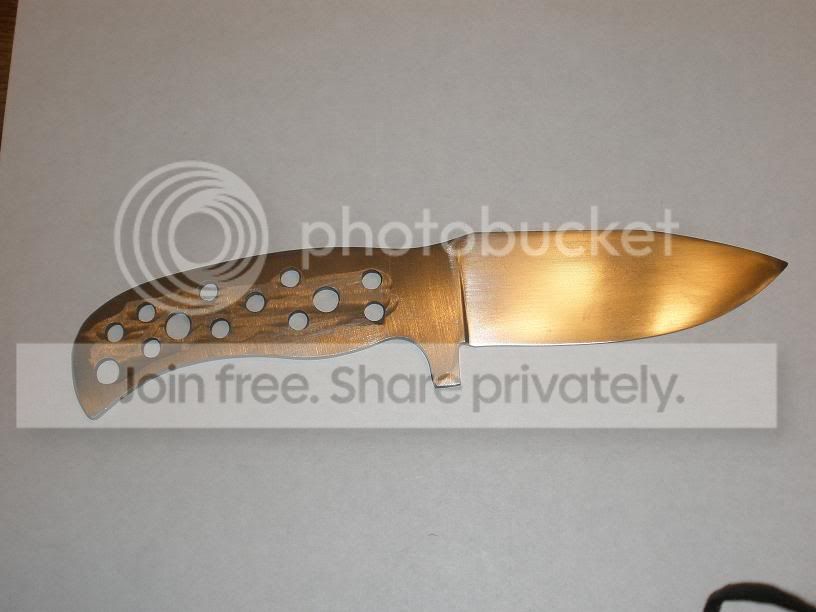
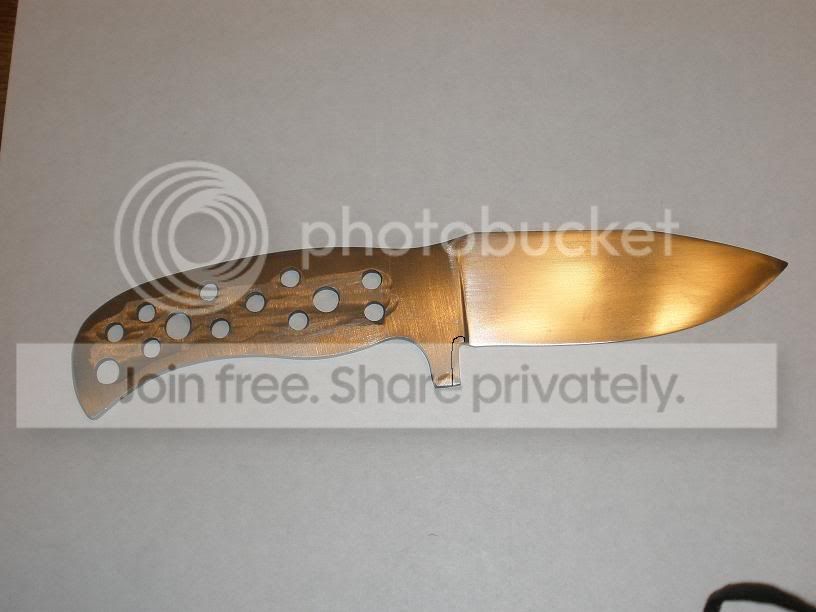


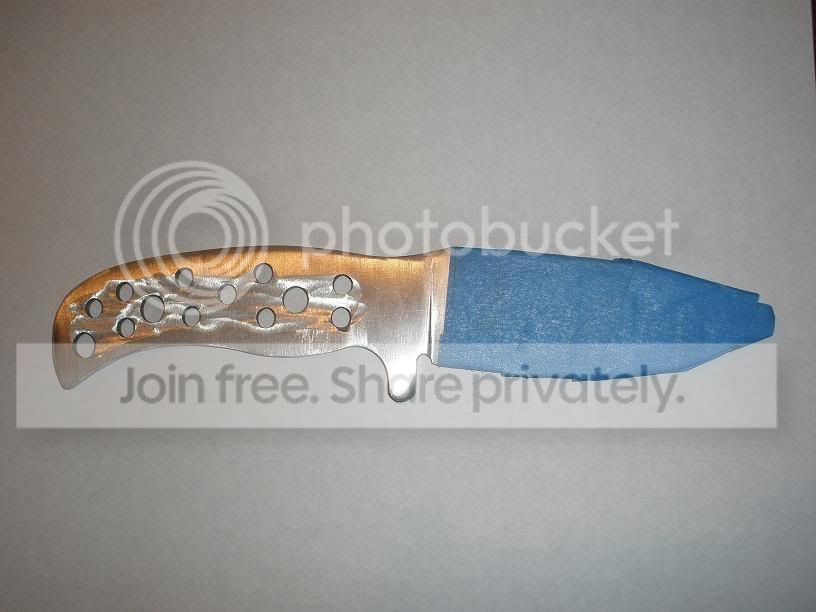
 . I got started working on the ricasso a few days ago. On one side I had 2 low spots one where the guard curves into the handle which likely was a result of my narrowing the handle. And one almost smack in the middle of the ricasso which I have no idea how it even got there. I got them out along with the rather deep file marks I put in near the plunge line, which I finished up tonight. Also got to work for a bit on the other side which doesn't seem like it should be as bad.