
Philosophy of expensive large thick chopper?

"Batoning with an axe". That's crazy talk!
http://www.bladeforums.com/forums/showthread.php/1296598-Nessmuking-Around?highlight=Nessmuking


Times change. People change. Techniques change.

I find it pays to keep one's mind open. In reality, there isn't any right or wrong way. Just different ways of doing things.

Choose your poison, use your choice, and enjoy life.

An excerpt for my thread above. I know I had fun, and to me, that was all that mattered.

Enjoy,
Suppose for a minute Nessmuk was transported to today. 2015, Sunday, June 7th, somewhere up here in his old stomping grounds. Why he'd be laughed at by all us guys with big choppers. I mean knives, not Harleys.

I can hear it now. "Hey buddy, why don't you get a real knife" "How are you going to baton with that thing?" In response, he might hold up his hatchet. And say, "I'll use this"

Again he would be mocked. "That thing is sharp on both ends, it is going to eat batons" they will say. But the "Mukster" that is probably what we would call him in today's woods. Does have some woods savvy. He may actually know more than some give him credit for.

He takes his hatchet, and sticks in a block of wood. Something like this,
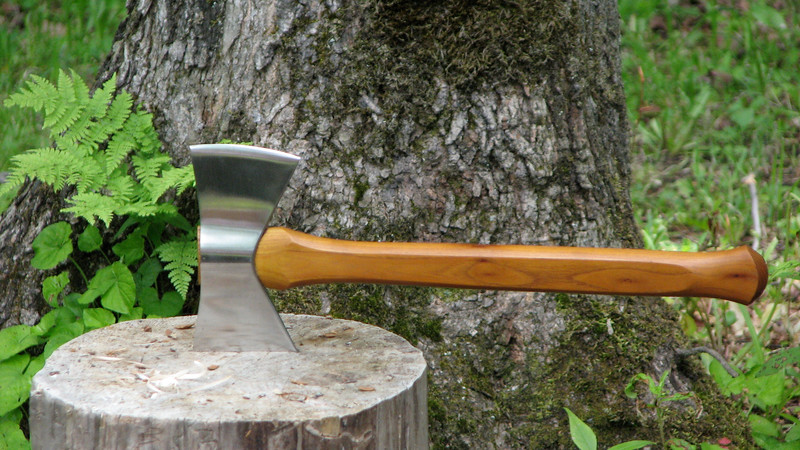


Then he grabs a more manly sized hunk of wood. Suddenly, the modern folks that were mocking him get a little curious. He sets the block of wood on top of his hatchet blade. Takes his baton and pounds the wood down onto the hatchet. Which is way tougher than his knife and considerably wider too.
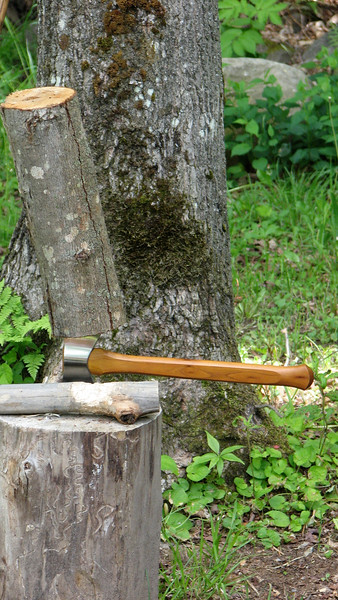


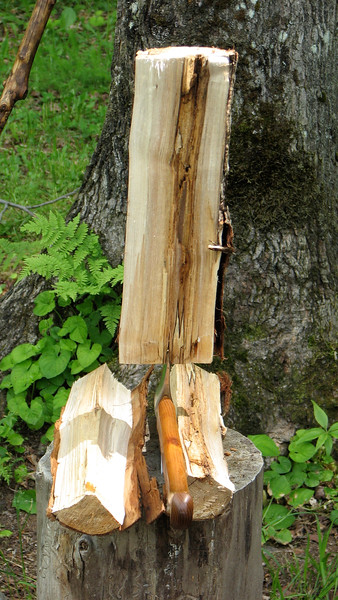
After about three or four whacks, everyone hears that tell tale pop. He takes it off the hatchet. Sure enough he split that piece of wood right up the middle.


He repeats this process as many times as needed to get to the size wood he wants.


One of the modern woodsmen points out that just because he can baton, with that stupid hatchet. Doesn't me he can make feather sticks with it. So he needs more tools.

But the "Mukster" points out the his hatchet is actually two tools. With one end sharpened for splitting, and the other sharpened to fine edge for cutting tasks.
He says it and his knife work great for processing game too.

He promptly demonstrates how to make a few feather sticks with his hatchet.
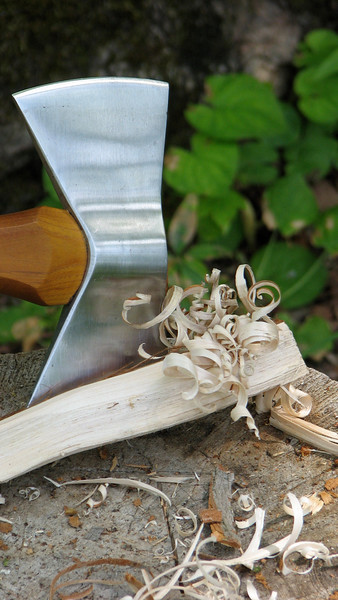


Upon close examination, they appear to be quite good. Especially if you consider they were made by a hundred-fifty year old dead guy.
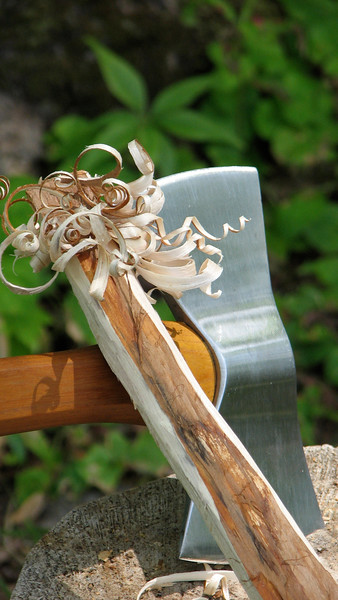
 
Last edited:
If I am in a park some where and the open woods, I don't carry a machete. But if I am in a brushy area watching for snakes with every step, getting caught in thorny vines, and so forth, that is when I like to have a machete with me. But I seldom carry one with me unless I have the forsight that I am going to need to do some bush wacking.

I wish I'd had the foresight to buy a 1000 lumen flashlight...probably could have navigated our way through more easily. :)

stabman,

I LIKE!
And I bet "she will coot" especially when on a rampage :-)

Just be careful or ... you could end up like my good friend (happened a long ways from anywhere, in the first few minutes of field use after I reprofiled the primary and secondary bevels on his chopper).

Luckily, I managed to avoid injuries from my silly mistakes when I was getting into large knives...there were a few close calls until I learned the right way to do things. Luck was with me, thank God.

Stabman,

Thanks for finding more on the Hudson Bay knife. I didn't find that first one, and it is interesting in that it depicts a flat ground knife, rather than the saber grind more common to the knife style in the OP.

A nice flat grind is a great way to have good cutting efficiency while having the strength of thick stock at the spine. Also keeps it from being a boat anchor tied to your side. :D

A wide blade and flat grind can have good performance.
 
Excellent technique and humorous dialog. What kind of axe is that?
"Batoning with an axe". That's crazy talk!
http://www.bladeforums.com/forums/showthread.php/1296598-Nessmuking-Around?highlight=Nessmuking


Times change. People change. Techniques change.

I find it pays to keep one's mind open. In reality, there isn't any right or wrong way. Just different ways of doing things.

Choose your poison, use your choice, and enjoy life.

An excerpt for my thread above. I know I had fun, and to me, that was all that mattered.

Enjoy,
Suppose for a minute Nessmuk was transported to today. 2015, Sunday, June 7th, somewhere up here in his old stomping grounds. Why he'd be laughed at by all us guys with big choppers. I mean knives, not Harleys.

I can hear it now. "Hey buddy, why don't you get a real knife" "How are you going to baton with that thing?" In response, he might hold up his hatchet. And say, "I'll use this"

Again he would be mocked. "That thing is sharp on both ends, it is going to eat batons" they will say. But the "Mukster" that is probably what we would call him in today's woods. Does have some woods savvy. He may actually know more than some give him credit for.

He takes his hatchet, and sticks in a block of wood. Something like this,


Then he grabs a more manly sized hunk of wood. Suddenly, the modern folks that were mocking him get a little curious. He sets the block of wood on top of his hatchet blade. Takes his baton and pounds the wood down onto the hatchet. Which is way tougher than his knife and considerably wider too.


After about three or four whacks, everyone hears that tell tale pop. He takes it off the hatchet. Sure enough he split that piece of wood right up the middle.


He repeats this process as many times as needed to get to the size wood he wants.


One of the modern woodsmen points out that just because he can baton, with that stupid hatchet. Doesn't me he can make feather sticks with it. So he needs more tools.

But the "Mukster" points out the his hatchet is actually two tools. With one end sharpened for splitting, and the other sharpened to fine edge for cutting tasks.
He says it and his knife work great for processing game too.

He promptly demonstrates how to make a few feather sticks with his hatchet.


Upon close examination, they appear to be quite good. Especially if you consider they were made by a hundred-fifty year old dead guy.
 
It is a Lee Reeves Nessmuk,

He has retired so they are getting harder to come by.

I was just hoping to illustrate there are always different paths to the same objective.

Some days I take the Nessmuks, some days the KA-BAR, some days the Muley. It's all fun, and they all get the job done. Just in different fashions.

If you like big choppers, and get used to using them. They sing a great song. But never discount a competent guy or girl with an axe. They make nice music too.
 
Fine looking tool, thanks for the info on it.
 
That Lee Reeves is spectacular. I am officially lusting after a double bit hatchet! :cool:
 
LostViking,

Thanks for dressing up this thread with great thought and imagery. Proper use of a tool, is being smarter than the tool (otherwise you will be made the tool).
I would expect Mr. Sears would close by throwing napsack over shoulder, hat on head, bending to pickup his 11 lb canoe and gently placing into water before paddling back into history.
I do believe that there would be some quiet observers that would watch that svelte old man in appreciation for simple solutions.

I would really like to experience some recreations of his super-lightweight canoes.
 
That Lee Reeves is spectacular. I am officially lusting after a double bit hatchet! :cool:

I second that!
Really puts a hurt on the Condor Double Bit I have been playing with. Many of the things I would change (on Condor) are reflected here. Very Nice!
 
Sometimes we forget, there is more than one way to skin that cat. I just learned how to baton with my CRKT Woods Kangee hawk. I've been pondering that little problem.
 
A nice flat grind is a great way to have good cutting efficiency while having the strength of thick stock at the spine. Also keeps it from being a boat anchor tied to your side. :D

A wide blade and flat grind can have good performance.

Yeah, that grind is the equivalent of a 15/16" tall 1/8" thick knife - a good slicer with 3 times that mass sitting above it. It's pretty much like something between a Trail Master and short machete due to the very shallow grind.
 
Fads in "trendy wilderness thinking" come and go.

I'm not a leave no trace, nor am I an ultra-light person.
My philosophy is leave no garbage. :)

If someone wants to build a wilderness castle with an axe they lugged 20 miles into the bush, more power to them.:thumbup:

That's great.

On your private land.

But please don't bring that sort of practice to public lands in New England. I hike deep into Wilderness Areas and it's a total bummer to find hacked up areas, abandoned shelters and unremediated fire rings.

Public lands are public. They belong to all of us. If you're not practicing Leave No Trace on public lands, you're stealing the right of experiencing undamaged lands from the next guy or gal.

If you're on private land, have at it.
 
That's great.

On your private land.

But please don't bring that sort of practice to public lands in New England. I hike deep into Wilderness Areas and it's a total bummer to find hacked up areas, abandoned shelters and unremediated fire rings.

Public lands are public. They belong to all of us. If you're not practicing Leave No Trace on public lands, you're stealing the right of experiencing undamaged lands from the next guy or gal.

If you're on private land, have at it.

No.

Just be smart about it.

Clean up and hide all traces that a fire and shelter was made and stay out of sensitive areas like Meadows that can be damaged for years.
Don't make a fire or shelter in an area that can't support it.


Yet, standing dead, forest floor clutter and over crowded fast growing trees are free game.

It's a part of a well managed forest.

If we didn't, the forest fires would

Yet the forest fires are fought and prevented to protect surrounding property and timber resources

So that stuff just piles up,

It's nice to help out forest.
 
I really do agree with the philosophy of leaving as little trace as possible but there are still things that need doing like making a small fire, clearing a particularly rough patch of trail, or some camp craft. All of these things when done correctly and responsibly leave little to no trace and are easily handled with a large fixed blade. I prefer a good Leuku, or on colder trips where more fire will be built the ESEE Junglas. Both are very handy tools for wilderness trekking.
 
That's great.

On your private land.

But please don't bring that sort of practice to public lands in New England. I hike deep into Wilderness Areas and it's a total bummer to find hacked up areas, abandoned shelters and unremediated fire rings.

Public lands are public. They belong to all of us. If you're not practicing Leave No Trace on public lands, you're stealing the right of experiencing undamaged lands from the next guy or gal.

If you're on private land, have at it.

Crown land.
If the Queen don't like it, she can leave her castle, cross the ocean and say something about it. ;)
 
I see very little practicality of the very thick knife like 5/16 inches thick with 8-12 inches blade lenght.

They are weight pretty much the same to a good axe while the axe will out chopped/out batoned them by large margin.

They are also not very good in the kitchen and too big to put in the bag and go hiking.
Well made medium size fixed blade can get the baton work done too while being much more comfortable to carry.

They barely a good self defense tool


Or just because some people have buck to spend on some cool zombie behead gear?


Indeed. Zombie behead gear, much good, and twice popular.


But what happens when the zombie gets the knife?


And once a zombie gets a hold of a big chopper......the horror.......


And for good measure........


Big choppers are fun.

I have hawks, axes,big knives, machetes, swords, pole arms. If I need them, I also have access to chain saws.


I use what I find fun.

Am I hiking the wilderness with 30 lbs of knives? Nope.


One fun thing I do is canoe camp with scouts. On the waterway we paddle, we are encouraged to trim Russian olive trees. There is a never ending supply of the choking, noxious trees. We use them for firewood, and try to trim them back when we can. They actually choke off the waterways.


Some times, I bring the medium sized knife, and a saw, or a machete and a hawk.


Last edited:
Okay, I'm with you once again. For quick limbing a large knife or machete can just be tons easier than an axe.
Exactly what I like a large chopper for. I use the large choil on my modified western bowie to just slide down a branch and pop off all the twigs; the weight and size make it a one pass job with no work. Other wise, a hatchet, bow saw, and mora do 99% of my firewood prep once a branch 7" in diameter or less is down.

Connor
 
Exactly what I like a large chopper for. I use the large choil on my modified western bowie to just slide down a branch and pop off all the twigs; the weight and size make it a one pass job with no work. Other wise, a hatchet, bow saw, and mora do 99% of my firewood prep once a branch 7" in diameter or less is down.

Connor


In the mountain areas here (but also in other regions in Italy) we have a dedicated tool for these tasks: the Roncola. It’s a centuries old tool but we have also some very recent upgraded versions :).

dr9onp.jpg

v6uhzd.jpg


The Roncola is a kind of mix between a sickle and an axe. Its use is directed precisely to the cutting of “medium density” woods, the most common type of vegetation we have around here. It’s perfect for cleaning the wood undergrowth, those small to medium branches, thick grasses, all those woody climbing weeds, where an axe would be too heavy and a sickle too light. It is usually operated with one hand but two hands versions also exist. The Roncola is just perfect for the vegetation type we have here, a variety of trees and shrubs that could hardly be pruned without a hook. It differs quite much from machetes and parangs, which were born in regions with a tropical vegetation (e.g. banana trees or bamboo type), so, a “softer” vegetation typical of junglas. Roncola is a quite dedicated, specific tool, used by farmers and growers since centuries. As a curiosity, the Roncola has its origins back in the Bronze Age. The existence of the Roncola in Italy is documented also from small bronze statues from third century BC of Etruscan origin. Today it is generally made with carbon steel with a rather low HRC and it's relatively cheap to buy. The edge can bend, it happened to me as well, but it’s easy to hammer (literally) it back to working condition and easy to sharpen, even with a river stone. It can work decently for camp set-up activities (shelter, fire), the hooked tip allows for to create a clean zone for bivouac or to prune dry branches easily for fire set up, but it has several limits for all the other tasks (e.g. food preparation) :D.
 
Back
Top