Powered metallurgy to AEB-L?

The stainless steel in your kitchen sink or tableware may have 20% or more chrome, but I assure you it has very few if any carbides. ;) Because it has very little carbon. The chromium is mainly there to form a self-perpetuating oxide layer for corrosion resistance, to protect the iron.

Similarly, there's less than .7% carbon by weight in AEB-L/13C26 to begin with, and it's nearly all tied up with iron, forming good hard martensite structure. There's simply not enough "extra" carbon in AEB-L/13C26 to ever form many carbides with the chromium. That what makes it so stain-resistant; almost all the chrome is "free". It's a brilliant and very cost-effective way to make steel that's tough and fine-grained yet highly corrosion-resistant.

Understanding this explains why you see other "stainless" and tool-steel alloys with so much carbon... nearly always over 1%, many around 1.5%, some approaching 2%! The additional carbon doesn't make the steel any harder, it's there to form wear-resistant carbides with the large amounts of chrome, molybdenum, vanadium, etc.

Yeah, AEB-L/13C26 has a very low chromium carbide percentage due to the reasons that you stated.

Less than 5% is the general number that is used normally.

But being they would be Chromium Carbides and very small normally they are just more of the outcome of the HT process.

Nothing to get excited about really as those 2 steels aren't exactly the pillar of edge retention nor were they developed to be in the 1st place.

Basically nothing more than inexpensive stainless strip steels developed to make razor blades out of.

Some like to make them out to be more than they really are for various reasons, but that's not to say they don't make good knife steels. Easy to work with for the makers and sharpen for the customers due to the very low carbide content. Low material cost for the makers and low tool wear and tear helps keep the overhead cost low. Makes good kitchen knives due to the reasons stated.

I wouldn't want a knife in those steels for use on more abrasive materials though as they just don't have the wear resistance.
 
Last edited:
The stainless steel in your kitchen sink or tableware may have 20% or more chrome, but I assure you it has very few if any carbides. ;) Because it has very little carbon. The chromium is mainly there to form a self-perpetuating oxide layer for corrosion resistance, to protect the iron.

Similarly, there's less than .7% carbon by weight in AEB-L/13C26 to begin with, and it's nearly all tied up with iron, forming good hard martensite structure. There's simply not enough "extra" carbon in AEB-L/13C26 to ever form many carbides with the chromium. That what makes it so stain-resistant; almost all the chrome is "free". It's a brilliant and very cost-effective way to make steel that's tough and fine-grained yet highly corrosion-resistant.

Understanding this explains why you see other "stainless" and tool-steel alloys with so much carbon... nearly always over 1%, many around 1.5%, some approaching 2%! The additional carbon doesn't make the steel any harder, it's there to form wear-resistant carbides with the large amounts of chrome, molybdenum, vanadium, etc.

Warning, misleading info there!

1) your stainless steel kitchen sink is probably made from 304 stainless steel, an austenitic steel containing <0.08% carbon and >18% chromium along with ~10% nickel and some other elements. That is NOTHING LIKE a martensitic steel with 10X more carbon and less chromium besides. 0.7% carbon is enough to form carbides when 13% chromium is present as in 13C26.

2) chromium really really "wants" to form carbides, that's why AEB-L is at 12% carbide in the annealed state and not very corrosion resistant. Honest question: how much (% weight) free chromium is left for corrosion resistance after HT?

3) you should sort those carbide-forming elements: vanadium first, THEN molybdenum, THEN chromium. Chromium carbides dissolve the easiest and require the most atoms to form, those other elements use up carbon at a much higher rate, leaving less available for the chromium to bond with.
 
Yeah AEB-L really isn't something to get excited about unless one uses safety razors to shave with, the ones that use double edge razor blades.

And there are plenty to choose from in various price ranges.
 
Warning, misleading info there!

"Misleading information" perpetrated by whom? Carbide content of un-HT'ed AEB-L is indeed around 12%... but what you conveniently overlook is the fact that the highly iron-rich carbide structure breaks down very quickly in austenization and frees up nearly all of the chromium involved. That's the whole point of this class of steels. They were designed that way on purpose. Sandvik is very clear about that, in the very same link you posted.

Likewise, my example of "your kitchen sink" is exactly accurate when it comes to chromium carbide content. Your further examination of the chemistry involved only proves my point. Which has been proven time and time again by engineers and metallurgists far more qualified than I. This is not a theory, it is a proven fact.

Actual micrographs of properly HT'ed AEB-L clearly show an extremely fine and consistent microstructure, equal to and in some cases finer than common "carbon" steels like 52100 and 1095. In nearly all cases, that structure is finer and more consistent than the very best powder steels. Again, that's not a theory, it's a fact.

I like CPM/powder steels, too, for various reasons. In fact, I use them more often than not in the knives I make! But let's not muddy the waters with half-understood baloney sausage.
 
Yeah AEB-L really isn't something to get excited about unless one uses safety razors to shave with, the ones that use double edge razor blades.

That's a reasonably fair comment. AEB-L is certainly not "something to get excited about" if a knife aficionado is interested in maximum edge-holding/wear-resistance in a very thin edge under tightly-controlled experiments against abrasive materials. It will never match powder steels, or even some of the really high-end "carbon" steels in that regard.

But where it is something to get excited about, is thinly-ground cutters that are tempered between 60-62Rc. For use by people that cut meat fish and vegetables all day, every day, and need a thin tough edge that is very easy to keep very sharp... and just happens to resist corrosion very well.

Don't ask me. Ask the many, many professionals that pay big bucks for high-end kitchen blades made of this "cheap" steel. ;)
 
I am not a steel expert by any means. But my understanding is that PM technology is used to increase toughness. It produces much smaller grain sizes than otherwise possible, which makes steels tougher. I don't think it has anything to do with carbides or hardness.
Toughness and hardness are opposing characteristics of a steel. It is very difficult to achieve high scores on both. Hence, any steel will benefit from PM as toughness is a problem for all hardened steels. With PM we are talking "super steels" getting good marks on both. Here is a great reference: www.hybridburners.com/documents/verhoeven.pdf
 
I am not a steel expert by any means. But my understanding is that PM technology is used to increase toughness. It produces much smaller grain sizes than otherwise possible, which makes steels tougher. I don't think it has anything to do with carbides or hardness.

You are, at best, half right. You would do yourself a service to research the topic more thoroughly before repeating such claims.
 
That's a reasonably fair comment. AEB-L is certainly not "something to get excited about" if a knife aficionado is interested in maximum edge-holding/wear-resistance in a very thin edge under tightly-controlled experiments against abrasive materials. It will never match powder steels, or even some of the really high-end "carbon" steels in that regard.

But where it is something to get excited about, is thinly-ground cutters that are tempered between 60-62Rc. For use by people that cut meat fish and vegetables all day, every day, and need a thin tough edge that is very easy to keep very sharp... and just happens to resist corrosion very well.

Don't ask me. Ask the many, many professionals that pay big bucks for high-end kitchen blades made of this "cheap" steel. ;)

That's why I posted that it makes good kitchen knives. :)
 
Normally made steel has difference in toughness with and perpendicular to the rolling direction. A CPM steel has the transverse toughness much closer to the longitudinal direction. That's the major toughness difference.
Toughness of steels is often dependent on the carbide size .Large carbide size ? Fracture goes from carbide to carbide . Small carbides ? Fracture only sometimes goes from carbide to carbide !!
 
I dont know if PM would ad to anything with AEB-L, nor am I willing to rack my brain about it at this stage and leave it to those that know more than me.

I just find it interesting that most of the steels developed for knives in the food industry and medical industry put emphasis on its resistance to chipping, rolling and corrosion resistance rather than shear wear resistance as they need to comply with ISO standards within those industries. Yet we keep chasing wear resistance like its the pot of gold at the end of the rainbow. Don't get me wrong, I love me some M390 and S90V on its day but do know its limitations in my use.

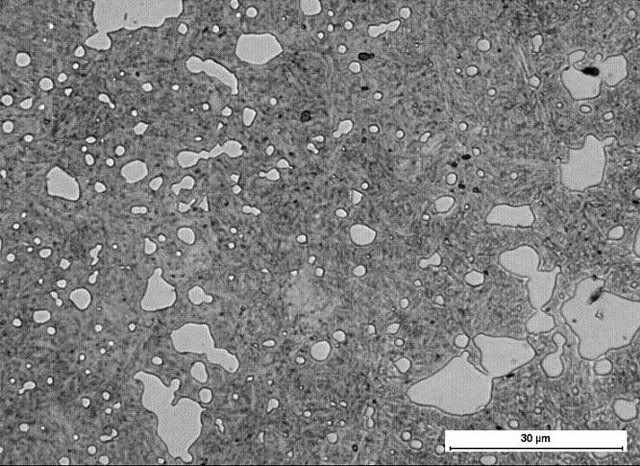
These are images available from Devin Thomas.

This is 154CM

154cm.jpg


This is CPM 154. It does not have the carbide segregation, however, the percentage of carbide volume remains the same.

1181826784-CPM154.JPG


Compared to.

AEB-L

index.php


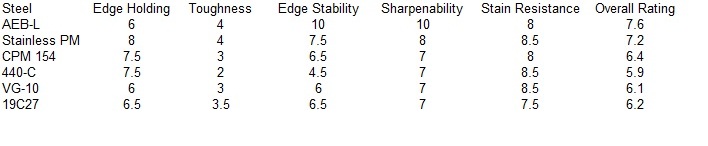
Devin Thomas use to have the following graph on his page, found it digitized on the forum somewhere.

chart.jpg


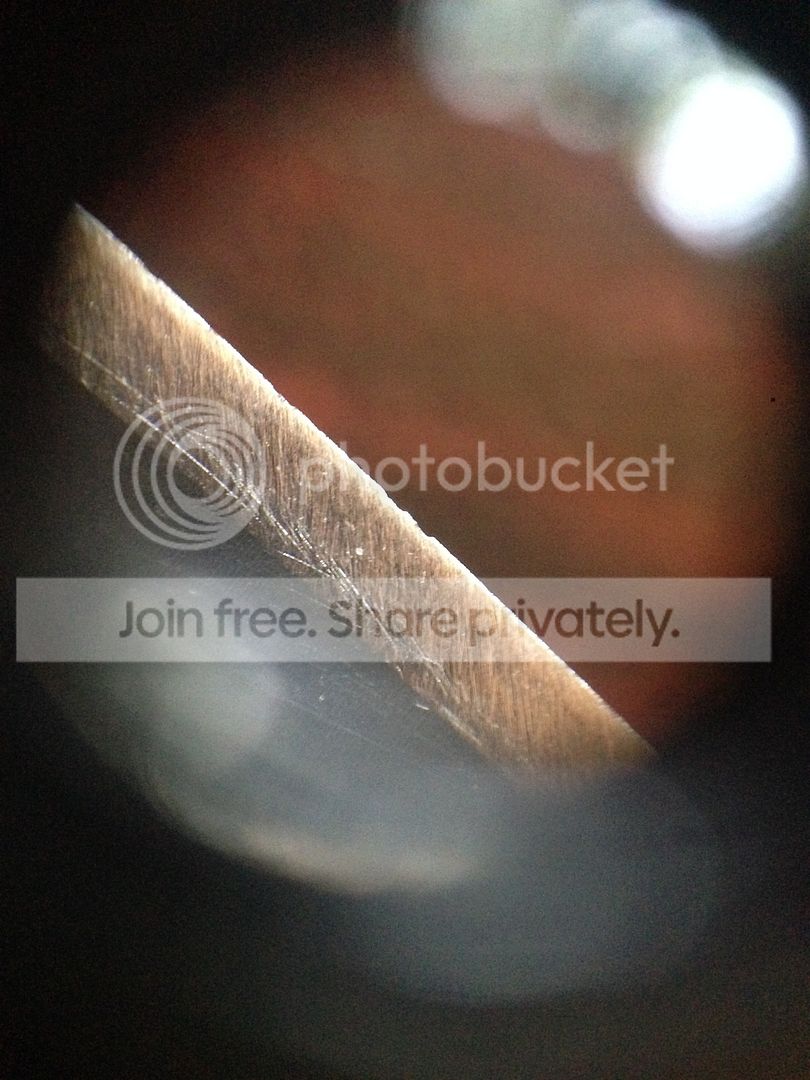
For some fun, here is an image of S30V ran at stupid low angles that I cut some twine with. Edge failure appears to be by carbide tear out rather than edge rolling. To resolve issues like that just increase your angle. I have done lower angles on steels like Nitrobe-77 and 14C28N with no such chipping issues.

IMG_7452_zpsfbc6945c.jpg


Final thought, use what you like and enjoy it. Time is short.
 
Last edited:
I knew this would be a good thread. A lot of heavy hitters checking in. Misconceptions, ruffled feathers, but has the original question been answered?
Russ
 
This thread is like a grudge match! I should have gotten my popcorn first!

Lots of very nice information for the steel nerds. I love learning all of the useless metallurgy stuff that will never factor into my knives, because it makes sense to me for some reason. Always fun to learn.
 
...has the original question been answered?

The original question being, would PM technology improve AEB-L?... the answer is no. Powder metallurgy is simply not required for such a simple alloy.

That's the beauty of this whole class of steels... their relative simplicity of manufacture, processing and machining keeps costs under control, but their performance is quite high. I like to describe AEB-L as " the stain-resistant steel for people who don't like 'stainless steel'."

These are images available from Devin Thomas...

Thank you for linking/posting those micrographs! They show very clearly what we're talking about. Mr. Thomas is one of the people who has researched this alloy in depth, and has shared his findings with all of us. :thumbup:

That's why I posted that it makes good kitchen knives. :)

Right on. My only "problem" with AEB-L is, I wish it was available in thicker bars, so I could make heavier (urbancraft/survival/tactical) knives with it. ;)
 
Last edited:
AEB-L characteristic is pretty much like stainless plain carbon steel... tough, easy to sharpen and hold very acute edge much better than most PM steel.

There are reasons why most of the world class custom kitchen knife/razor makers prefer steel like AEBL, 52100 or Paper stuff over steel like S90V...

And I'm sure it not the reason of cost saving.

To said one steel is nothing to get excite just because it has low carbide content, is just a plain ridiculous :rolleyes:
 
AEB-L characteristic is pretty much like stainless plain carbon steel... tough, easy to sharpen and hold very acute edge much better than most PM steel.

Not from my testing it doesn't, that's actual measurements using a sharpness tester.

There really is a smaller difference than most people would actually believe, or what people want to believe for various reasons.

Has more to do with sharpening talent etc than much else.

Has more to do with low cost, easy to work with, easy to sharpen for the masses etc.

Good for kitchen knives.
 
"Misleading information" perpetrated by whom? Carbide content of un-HT'ed AEB-L is indeed around 12%... but what you conveniently overlook is the fact that the highly iron-rich carbide structure breaks down very quickly in austenization and frees up nearly all of the chromium involved. That's the whole point of this class of steels. They were designed that way on purpose. Sandvik is very clear about that, in the very same link you posted.

Likewise, my example of "your kitchen sink" is exactly accurate when it comes to chromium carbide content. Your further examination of the chemistry involved only proves my point. Which has been proven time and time again by engineers and metallurgists far more qualified than I. This is not a theory, it is a proven fact.

Actual micrographs of properly HT'ed AEB-L clearly show an extremely fine and consistent microstructure, equal to and in some cases finer than common "carbon" steels like 52100 and 1095. In nearly all cases, that structure is finer and more consistent than the very best powder steels. Again, that's not a theory, it's a fact.

I like CPM/powder steels, too, for various reasons. In fact, I use them more often than not in the knives I make! But let's not muddy the waters with half-understood baloney sausage.

"Misleading" because AEB-L contains MUCH MUCH more carbide volume than a kitchen sink with 10X less carbon. The two are NOT comparable. I overlooked nothing, I actually pointed out in point 3 that chromium carbide breaks down easily, I mentioned specifically that HT of AEB-L drops the carbide volume from 12% in the annealed state to ~5% in the hardened/tempered state, but 5% is NOT "very few if any carbides" as you claimed in your post. It is not the 10% of M2 of the 12% of 440C or D2, but it's also not the 2% of a steel like S7 (which STILL has a lot more carbon than a kitchen sink). So yes your post was "misleading". You compared an austenitic steel to a martensitic and then talk about "proven" and "facts"???

You want to compare the microstructure of AEB-L to a PM steel? Show me micrographs comparing it to a steel with similar carbide volume. THEN we can talk about "proven" and "facts". What do you consider the "very best powder steels"?? Are you comparing it to something like CPM-154 with its 17.5% carbide volume??? That's ridiculous.
 
This is 154CM....

This is CPM 154. It does not have the carbide segregation, however, the percentage of carbide volume remains the same...

Compared to AEB-L...

Again, seriously? You are comparing micrographs of a steel with <5% carbide to those of s steel with >17% carbide? To what end, to show that one has more carbide than the other? We already know that. We also know it has much lower wear-resistance. We ALSO know that CPM-3V has the SAME carbide content as AEB-L/13C26 but MUCH higher wear-resistance. I have still not seen any Chrapy data on AEB-L, but the ranges i have seen for 420HC (similar chemistry) are 20 - 40J depending on HT, which is pretty much where D2 & M2 fall while those steels possess MUCH higher carbide content. Compare that to CPM-3V with a similar 5% carbide volume and achieves ~100J impact-toughness. CPM-3V has also been demonstrated to have higher edge-stability and wear-resistance than A2 steel which has slightly lower carbide volume, but at angles lower than 15-dps ALL of these lower carbide steels suffer edge-rolls and chips on tasks like, for example, planing hardwood.

What is my point? AEB-L is a low-wear stainless steel that is cheap to produce, easy to HT, easy to sharpen. It does not have the wear-resistance of higher-carbide steels with similar toughness, nor does it have the toughness of similarly low-carbide steels with higher wear-resistance. It most certainly DOES HAVE CHROMIUM CARBIDES, indeed that is the whole point of using it over lower-carbon 12C27/420HC, both of which STILL HAVE much more chromium carbide than a kitchen sink. The carbon is there in sufficient quantity, the chromium is there in sufficient quantity, no amount of magic will keep those two apart when the temperature drops. What WILL keep them apart is having OTHER more potent carbide-formers present, e.g. vanadium and molybdenum and niobium and tungsten, ALL of which form stable carbides more readily and maintain them at temperatures above what chromium-carbide can handle.

EDIT TO ADD

Here is CPM-M4 with 12 - 14% carbide volume (much higher wear than 13C26) and at ~65 Rc (much higher strength) presents Charpy impact values equivalent to those of 420HC and AEB-L at only 58 Rc (i.e. just as tough).
https://ir.library.oregonstate.edu/xmlui/bitstream/handle/1957/54906/LianSidi2015.pdf?sequence=4
https://www.crucible.com/eselector/prodbyapp/highspeed/cpm4hch.html

CPM-M4 microstructure.jpg
 
Last edited:
AEB-L is just a super fine structure steel not just because it has low percentage of Cr carbide.

The carbide type of AEB-L (Cr7C3) are also much smaller, harder than 440C or D2 (Cr23C6).

Not including that Cr23C6 often occur along grain boundaries while Cr7C3 are occur inside grain boundaries...

dd_zpsspkqhopl.jpg~original
[/URL][/IMG]
 
but at angles lower than 15-dps ALL of these lower carbide steels suffer edge-rolls and chips on tasks like, for example, planing hardwood.

Really? have you ever try using high carbide steel like D2 or S30V sharpen to acute zero edge, something like well made scandi knife to carving hardwood?

I guess you just never try that... I will tell you that the edge will fail much sooner than a similar blade made of lower alloy like O1 or 52100, this is not theorizing either...

The very edge stability are about the strength of martensite structure not carbide.

Thinking of edge of 2 concretes block, one made of cement+ very fine sand... while another one made of cement + courser sand +crushed rocks.

Sharpen these brick to the same degree, which one going to have stronger acute edge? which one going to be stronger overall? that 2 different attribute right?

The lower carbide steel will hold the very acute edge better than higher one and it just the fact.

The different of edge structure between low and high carbide are much vast than most people think.

ddd_zps4oigbtqa.jpg~original
[/URL][/IMG]
 
For some fun, here is an image of S30V ran at stupid low angles that I cut some twine with. Edge failure appears to be by carbide tear out rather than edge rolling. To resolve issues like that just increase your angle. I have done lower angles on steels like Nitrobe-77 and 14C28N with no such chipping issues.

IMG_7452_zpsfbc6945c.jpg
Why do you think it is a carbide tear out vs. chiping? Carbide sizes(sub micron) and even grain size is much smaller than the magnification on the image above would allow to see.
 
Back
Top