Powered metallurgy to AEB-L?

I might have missed it but whats the difference for you between a carbide tear out and chipping?
Chipping in this context is a broken piece of the edge due to lateral load, and it can also be induced by simple metal fatigue, i.e. rolling/steeling cycles, when eventually the rolled parts breaks away due to metal fatigue.

My train of thought: carbide tear out is micro chipping. A cluster of carbide tears out at such low angles resulting in micro chipping resulting in a visible chip.
Carbide tear out probably can be described as micro chipping, although I wouldn't say tear equals chipping, however the second part of your assumption: "A cluster of carbide tears out" is really improbable. Carbides are way too small compared to the size of the damaged sections of the edge you posted. Either a single carbide can tear out chunk of the steel matrix 100 times bigger that itself, or in another equally unlikely scenario, you'd have to tear out very specific set of carbides, a lot of them, next to each other, to cause continuous "tear out"...
Let's assume your chip is 0.5-1mm long, and carbide size is 0.2-0.5micron. You do the math, how many of those you'd have to tear out, and how precisely too.
Lateral load causing the break is much more likely. In other words, you tore out a chunk of steel, not a group of carbides mysteriously aligned next to eachother. Look at the images posted above, do you see anything clustered in a chunk which could be 1mm or even 0.5mm? That's 1000 or 500 micron for the record.
 
Wow. Just... wow.

Back on-topic... AEB-L is good tough steel, and it's very easy to put a really fine, crisp edge on. It also happens to be highly resistant to corrosion.

I don't think anyone was debating that, it was more when some tend to try and make it out to be more than it really is for various reasons.

That's when things usually start to go sideways fast...... Like now....
 
"The fact" is that edge-angle relates to edge strength through edge thickness at a given distance behind the apex, and that thickness relates cubically to strength, i.e. an edge sharpened at at 10-inclusive is ~8X weaker (more susceptible to folding/breaking) than one sharpened at 20-inclusive, and the 20-inclusive edge is ~3.5X weaker than the 30-inclsuive edge. Rather than mess around with the sharpening angle, you're better of sticking with 30-inclusive and then just thinning the blade at the bevel shoulder to achieve the performance desired, which can be seen in Jim's edge-retention thread. Please note again where well-done AEB-L falls compared to high-carbide steels with similar geometry.


That actually does say a lot once things are really apples to apples, but then some don't like to see that.... ;)

Kinda puts things more into perspective... You know Reality....
 
Wow. Just... wow.

Back on-topic... AEB-L is good tough steel, and it's very easy to put a really fine, crisp edge on. It also happens to be highly resistant to corrosion.

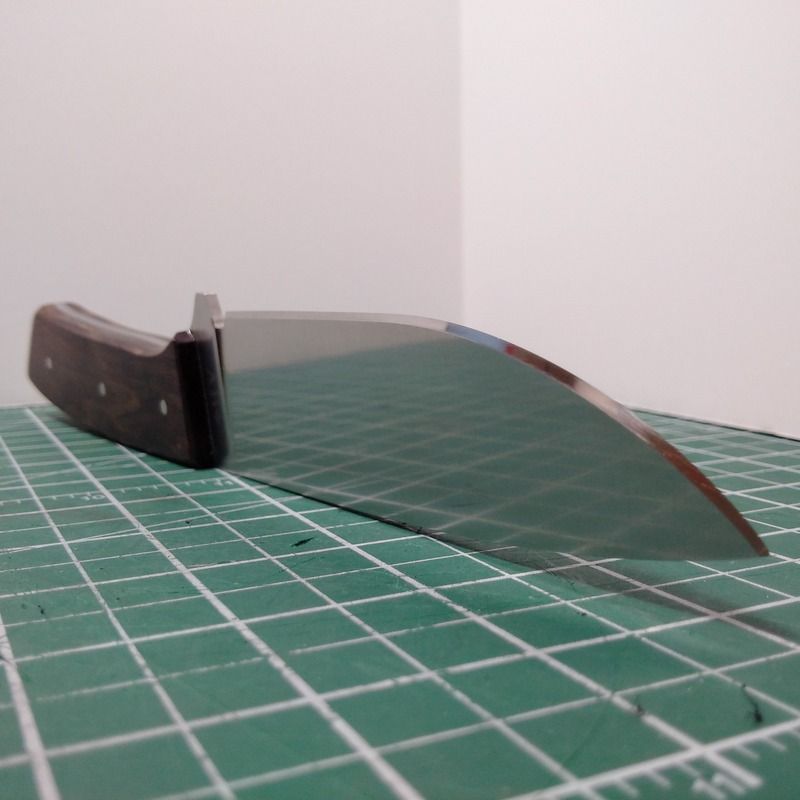
I made this knife out of AEB-L for a buddy of mine. I heat treated it to 62Rc and the edge bevel is 20DPS using an Angle Cube and my Wicked Edge. It has been used to process two bull moose so far this year and he sees no reason to sharpen it yet as he says it is still 'scary sharp'. Based on that I would say it's a good steel and I will continue to use it.

IMG_20150809_205911_zps5cbfhrxx.jpg
 
Thanks for all the great info!
In daily use (in the kitchen) AEBL seems to be very close to my beloved 52100, with terrific stain resistance. It's not as fun to sharpen, but not difficult, either.
I find it entertaining that just in the the last few years AEBL has become the sexah new steel, but it was patented the year before my dad was born- 1927. :rolleyes: Tee Hee Hee
I've sharpened D2 (HT according to Nathan) to the point that it will cut a spiral in free hanging newsprint. That's really freeking sharp.
 
Simple:
1) technique and equipment for producing and maintaining the edge is greater
2) Hard-metals are expensive to produce in such sizes as knife-users like
3) they have very low ductility, they don't respond well to being dropped ;)
4) knife users don't require edges or edge-retention like that

In other words, no benefit to knife users, may even be detrimental, a poor choice.

Tungsten carbide will maintain the edge greater than steel only in some type of work, when the edge angle is large enough to surpass brittleness issue... also need to be minor impact and stress.

There are only reason why tungsten are no use on knife application, its suck.

Have you ever hand drill a sheet of hardened steel with solid tungsten carbide? its will fail because it just too brittle to withstand any inaccuracy movement from man hand.. you need precise drill press when you work with it.

This characteristic of fragileness also apply on very thin edge application. The material that too brittle to withstand various angle of force are not suit for as thin cutting edge. Your dream ">90% carbide edge is da best edge" also nothing close to reality...

I don't know why you keep theorizing... you seems not having a real experience with what you pretended. To theorizing base on random datasheet number are worthless. Sound pretty similar to saying that a drink with 10% sugar much absolutely better than the 9% one... how thing works are not that simple.

Real unfortunately I have language limitation unless I would like to discuss to the deeper subject.
 
Last edited:
I just read through this thread and... Wow. Here I am on college chem and everyone around me says "when will i use this in real life?" As it turns out, when you are trying to win an argument about how to make the best knives! Keeping this forum alive guys.
 
Would the CPM process allow AEB-L to attain a higher hardness like say ZDP-189 at 65hrc?
 
I am not here to debate the chromium carbide issue. I will repeat what I was told by the Uddeholm metallurgist:

"The point of AEB-L was to make a steel with enough carbon to get hard, but not enough carbon to make chromium carbides. This results is a very fine grain steel with good corrosion resistance."​

One point I will debate is "AEB-L is easy to heat treat". It is easy to heat treat AEB-L to HRC 59. But this is not where this steel is optimum for blades. It takes a serious dedicated effort to get AEB-L to HRC 62-63. Again, quoting the Uddeholm metallurgist:

"If cryo is delayed by even a couple hours, the steel can loose up to 30% of its edge holding ability."​

In my own personal testing with an AEB-L knife made by Devin Thomas at HRC 62, the edge holding and stability are excellent. The last time I abused the knife, I was deburring freshly machined dies from shop. I was interested to see if the knife would chip. After deburring for a couple hours the edge was dull, but there were no visible chips.

One comment that I feel was not responded to:

Don't ask me. Ask the many, many professionals that pay big bucks for high-end kitchen blades made of this "cheap" steel. ;)
Many professional chefs/cooks who use knives all day are happy to pay big money for a properly made and heat treated AEB-L knife. Why are they willing to spend their hard earned money?

My response to the original post; using the PM process to make AEB-L will not result in finer grain.

Chuck
 
AEB-L has between 3 and 5 % carbide volume, depending on heat treatment.
The composition of AEB-L lies just off of the carbon saturation line, which allows all of the carbides to disolve in manufacturing and precipitate back as secondary carbides, which are very small. Steels with more carbon and alloy develop large primary carbides upon casting that are hard to break up and disolve in the forging and rolling process.

Grain size is affected by the size and distribution of carbides. The smaller the carbides and the more evenly distributed they are, the finer the grain in the finished knife. Also, the carbides formed in aeb-l are the m7c3 type, which are harder than the m23c6 type found in steels like 440c, which adds to aeb-l's wear resistance.

The PM process is used for steels that have large primary carbides to make the steel tougher and respond to heat treat more consistantly. The carbide size of a PM grade is in the 2 -4 micron size, the carbide size in the same grade cast and wrought is between 20-50 micron in size. The carbide size in aeb-l is ~ .5 micron. The diameter of a keenly sharpened edge is ~.4 micron.

Carbide pullout happens more with chopping than slicing.

Aeb-l is a very good steel and is the best choice for some knives.

Hoss
 
I haven't read this whole thread, but I wanted to put in my .02

The PM process is for steels that tend to form large carbides and isn't applicable to AEB-L.

These carbides go back to when the original ingot was cooling. Just like chilling super sweet tea the carbides precipitate out of solution as the molten metal begins to cool. In a steel with a lot of carbides you get these large clumps that are present as plates and stringers after the ingot is rolled out.

There's not much you can do about these primary carbides because they don't dissolve in a normal HT. And here's the kicker: even if they did dissolve, they'd go right back because the carbide forming alloys can't move around like the carbon does.

The PM process creates a more even distribution of the carbide forming alloys by addressing the issue of the difference in melting temperature of iron and the things that go into it. A steel like AEB-L is not going to benefit from it like a high carbon high alloy steel.

People think PM steel is cleaner, but it's not. It tends to be, because it's an expensive material, but you can see trash in PM steels all the time. And you can get electro slag remelt A2 that's probably cleaner than anything coming out of Crucible (their QC is not spectacular).

People think PM steel is finer grain, but it's not. It tends to be because the company rolling it out (who have control over the final heats, not the steel manufacturer) tend to take good care of the material because it's a premium steel. But there is nothing inherent to the PM process that just automatically makes it a finer grain steel. There are prequench techniques for complex steels that refine their grain much finer than industry standard, but guess what, it actually tends to work better with conventional steels, and unless there was something wrong with the grain in the first place, even finer grain doesn't have as much effect in toughness and edge retention as people expect. That's more an issue with very course grain that people who forge simple steels can run into.

The PM process makes high vanadium steels better, but a simple steel like AEB-L doesn't need it. Depending on the austenitizing temperature, quench rate, and tempering temperature, what little bit of carbon it has is tied up in martensite. A quench that forms a highly tetragonal martensite is going to leak carbon back out in temper at temperatures too low to form much chromium carbide.
 
great post nate ans here is were i have to step in as aebl vs m4 is silly whren it should be XHP
ESR steel is fantastic stuff but cost can come close to PM stuff
my issue with aebl i have heard (never worked with the stuff) that if it is not heat cyceled jsut right will bow in HT. more then one person has told me that hey have to "fix" a warp in HT nearly 50% of the time
XHP is clean even and flat can be HTed to 62-63 no problem and can take a true razors edge at total edge angle of about 16 degrees. hard to beat that
 
I believe the HT warp problems in AEB-L come from thin sections and uneven grinding. Post HT grinding of bevels eliminates almost all this problem.

For a thread with a one sentence question that could have been answered in one word - "NO" - this sure went wild.


I have discussed AEB-L with Roman Landes and listened to his talks on it, and I felt the simple "martensite with almost no chromium carbides" explanations were correct.


I have watched this thread with interest, as there seems to be different arguments on different topics and they are not apples and oranges. Some comparison were really specious. I won't add my final thoughts, because Nathan's remarks are pretty much identical.

What I will say is that the level of information and photographs in these discussions was pretty high. Kudos to all who participated.
 
was under the impression that the warping was due to the steel coming into the US as a roll and then may or may not get all the proper steps to remove the stressed imparted.
and yes alot of info even if at times it was a bit all over the place
other steels to look at PM vs aebl woudl be if you can find it cpmD2 it made for a geat steel that no one wanted due to the removal of the one thing that the D2 user wanted (large toothy carbide)
 
I am not here to debate the chromium carbide issue. I will repeat what I was told by the Uddeholm metallurgist:

"The point of AEB-L was to make a steel with enough carbon to get hard, but not enough carbon to make chromium carbides. This results is a very fine grain steel with good corrosion resistance."​

Chuck

I have discussed AEB-L with Roman Landes and listened to his talks on it, and I felt the simple "martensite with almost no chromium carbides" explanations were correct.


Personally I believe the above needs to be shouted at the top of the tallest mountain and sky written as big as it can possibly be, and tattooed on some peoples foreheads.....

Much, much more realistic than some would have people believe for various reasons. ;)
 
Last edited:
...and unless there was something wrong with the grain in the first place, even finer grain doesn't have as much effect in toughness and edge retention as people expect. That's more an issue with very course grain that people who forge simple steels can run into.


Best information in this whole thread, right here. Not sure why this isn't pummeled into people's heads yet.
 
Dang it... earlier, I said 'I bow out' because this turned into a free-for-all of nonsense. But since then, I've been quoted by someone whom I genuinely respect, so I will chip in once more...

One comment that I feel was not responded to:

Don't ask me. Ask the many, many professionals that pay big bucks for high-end kitchen blades made of this "cheap" steel. ;)

Many professional chefs/cooks who use knives all day are happy to pay big money for a properly made and heat treated AEB-L knife. Why are they willing to spend their hard earned money?

Because it cuts. And it's easy to keep it cutting.

My earlier quote was not responded to (and neither was yours :() because this thread is chock-full of people who sit around and postulate about knives, not people who actually use knives all day, every day because it's not only their hobby but their job, and moreso, their passion.

Not just occasionally on "X" inches of rope or "Y" pounds of cardboard or knocking down a half-dozen saplings to make a survival shelter once a year; I mean the people who use their knives on things like cleanly cutting many pounds of meat fish and/or veggies for their living. Or actual logging operations . Every. Single. Day.

Those are the people to ask about edge geometry and ease-of-sharpening and wear-resistance.
 
Last edited:
my issue with aebl i have heard (never worked with the stuff) that if it is not heat cyceled jsut right will bow in HT. more then one person has told me that hey have to "fix" a warp in HT nearly 50% of the time

I've heard exactly the opposite. I grind pre-HT, I do not do my own HT, and I have never gotten a crooked/bent/"wobbly bacon edge" AEB-L blade back.

I raised that question face-to-face with my HT guy a few months ago, by saying, "I really like AEB-L, I only wish it was available in thicker stock for other style knives. But there's plenty Sandvik stuff that's very close in chemistry, in thicker bars, so I'm looking into that."

His immediate response was, "Please don't! The Sandvik stuff nearly always gives me warpage problems. Actual AEB-L has never given me warpage trouble."

I'm not gonna call him out here, or paraphrase what he thought the reason for that is, but he was very adamant about it.
 
Great thread!

Right on. My only "problem" with AEB-L is, I wish it was available in thicker bars, so I could make heavier (urbancraft/survival/tactical) knives with it. ;)

If you can find Sandvik 14C28N it comes in 4.5mm (almost 3/16") sheet, is that thick enough? This steel its almost identical to AEB-L with the addition of nitrogen for more corrosion resistance.


Pablo
 
Back
Top