Powered metallurgy to AEB-L?

We posted together :D

His immediate response was, "Please don't! The Sandvik stuff nearly always gives me warpage problems. Actual AEB-L has never given me warpage trouble."

This is true, this steel is sold in sheets, but the moment you cut them they begin to warp (see my warped blades thread). But, I keep using it, its readily available here, its almost identical to AEB-L and it just works in the kitchen and for BBQ knives.

[edited to add] I do my own HT and straight the blade during cooling between alu sheets and weight on top.


Pablo
 
If you can find Sandvik 14C28N it comes in 4.5mm (almost 3/16") sheet, is that thick enough? This steel its almost identical to AEB-L with the addition of nitrogen for more corrosion resistance.

See above ;)

My HT guy (who I trust VERY much) doesn't like that stuff. Therefore, I am unwilling to play with it until I have a chance to consult with him.
 
I've heard exactly the opposite. I grind pre-HT, I do not do my own HT, and I have never gotten a crooked/bent/"wobbly bacon edge" AEB-L blade back.

I raised that question face-to-face with my HT guy a few months ago, by saying, "I really like AEB-L, I only wish it was available in thicker stock for other style knives. But there's plenty Sandvik stuff that's very close in chemistry, in thicker bars, so I'm looking into that."

His immediate response was, "Please don't! The Sandvik stuff nearly always gives me warpage problems. Actual AEB-L has never given me warpage trouble."

I'm not gonna call him out here, or paraphrase what he thought the reason for that is, but he was very adamant about it.
i have only talked with a few makers not a pro HTer his info is likly muc better do to sample size
im still not moving from XHP for powder steel and have soem BD1 from car-tec for testing (said to be much like aebl and is a wrought product so cost should be down a good bit vs XHP)
 
We posted together :D

Indeed! I send my blades out for HT in batches, for various reasons. If I hardened/tempered/cryoed them one-at-a-time myself, I might be more interested in dealing with that kinda wobbliness. In my little world, I just try to avoid alloys that piss off me and/or my HT guy.

I got 99 problems, and a warp ain't one ;)
 
...im still not moving from XHP for powder steel...

Nor should you. AEB-L will NEVER compare to CTS-XHP or Elmax for wear-resistance. The chemistry just ain't the same.

I know nothing about BD1. Sounds interesting, though!

Again, I like to describe AEB-L as the "stain-resistant steel for people who don't like 'stainless' steel." It sharpens like "carbon steel", it's tough like "carbon steel". It just happens to have a boatload of free chromium.
 
I personally can get steels like S35VN etc. to the same level of sharpness as steels like AEB-L without much trouble, that's actual measured sharpness using a sharpness tester.
I doubt there is an alloy that can't be sharpened to the same 1 micron level. For a while I was really into super fine edges regardless of the alloy content, you know that, we've discussed enough on that subj :) I can easily get CPM 10V and CPM 125V to the same level of sharpness as plain carbon/Low alloys steels like 1095 or Aogami/Shirogami series. The point is what the alloy can do at that level of sharpness and for how long.
For A11 class and bunch of other high carbide volume steels it's simply not worth the effort and it's detrimental for the performance. So, yeah you can make CPM 10V as sharp as 1095 or AEB-L, but how long that lasts on different mediums and what type of cutting is used would make the difference.
 
yes thats it i missed the z
the necker tester i made in bd1 suprized me in its edge holding in drywall cutting (was putting the walls up in my shop)
i was on facebook and there was a post kind of like this when i brought up XHP. carpenter let me know they now had a wrought product that was much liek aebl. they sent me a small piece to make a test blade out of i just have not got around to it yet. i have a 204p tester folder blade i want first cause i knkow about what that will perform liek
i dome make many knives for my self and less folders for sure so i need it in a steel i can use a few years in my EDC
BDZ1 jsut didnt have the specs i wantd in a folder tho it looks like it might be good for some things (steak knives for one )
 
I've heard exactly the opposite. I grind pre-HT, I do not do my own HT, and I have never gotten a crooked/bent/"wobbly bacon edge" AEB-L blade back.

I raised that question face-to-face with my HT guy a few months ago, by saying, "I really like AEB-L, I only wish it was available in thicker stock for other style knives. But there's plenty Sandvik stuff that's very close in chemistry, in thicker bars, so I'm looking into that."

His immediate response was, "Please don't! The Sandvik stuff nearly always gives me warpage problems. Actual AEB-L has never given me warpage trouble."

I'm not gonna call him out here, or paraphrase what he thought the reason for that is, but he was very adamant about it.

With regards to the part underlined, my first question would be do they plate quench? Sandvik steels are still very popular in South Africa and almost everyone is doing plate quench to stop the warpage.
 
Let's assume your chip is 0.5-1mm long, and carbide size is 0.2-0.5micron. You do the math, how many of those you'd have to tear out, and how precisely too.
Lateral load causing the break is much more likely. In other words, you tore out a chunk of steel, not a group of carbides mysteriously aligned next to eachother. Look at the images posted above, do you see anything clustered in a chunk which could be 1mm or even 0.5mm? That's 1000 or 500 micron for the record.

Your post got me thinking.

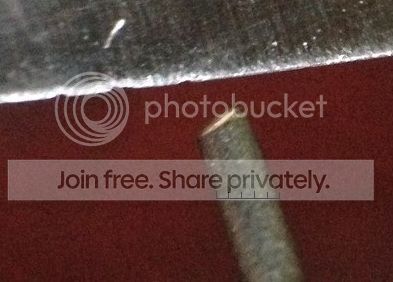
So, I reprofiled S30V to 7 degrees per side. Used it over the weekend for all my general chores and yardwork and here was the edge.

I experienced similar chipping as previously with some chipping that I felt at the edge, but not really visible in the image below. I could only capture the bigger chips @ 20X magnification. To the left of the pencil is the larger chips. To the right the edge feels jagged on the nail but unable to take pictures of it.

chip_zpsmnd8a9v3.jpg


The led pencil is 0.5mm that I split into 0.1mm sections.

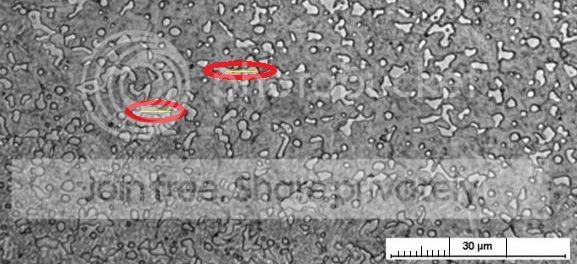
I found an image of S30V on another forum (sure hope it really is) that I modified. The sections that I highlighted in red is 10um (0.01 mm). Yellow lines are 5 um.

1181826860-S30V2_zpse2prsvei.jpg


I just do not have the capability to take images of the smaller chips but the larger chips are around 100um (0.1mm).

I wonder if the smaller chips might not be some form of carbide cluster or such.

Either way. Fun experiment. Done for now, time to use my knives again and stop worrying about the little things.
 
I doubt there is an alloy that can't be sharpened to the same 1 micron level. For a while I was really into super fine edges regardless of the alloy content, you know that, we've discussed enough on that subj :) I can easily get CPM 10V and CPM 125V to the same level of sharpness as plain carbon/Low alloys steels like 1095 or Aogami/Shirogami series. The point is what the alloy can do at that level of sharpness and for how long.
For A11 class and bunch of other high carbide volume steels it's simply not worth the effort and it's detrimental for the performance. So, yeah you can make CPM 10V as sharp as 1095 or AEB-L, but how long that lasts on different mediums and what type of cutting is used would make the difference.

Yeah, we talked about different edge finishes a few times. :D
 
Hope I'm not derailing the thread by asking whether we see a similar effect in "plain" carbon steels.

If AEB-L has fine carbides because it's (as Devin puts it) just off the carbon saturation line, at .6%, is there any reason to think that 1060 would have an optimal carbide structure for fine edge structure and retention when compared to 1095?
 
I found an image of S30V on another forum (sure hope it really is) that I modified. The sections that I highlighted in red is 10um (0.01 mm). Yellow lines are 5 um.
...
I just do not have the capability to take images of the smaller chips but the larger chips are around 100um (0.1mm).
Cool pic, I don't think I've seen that before, and thanks for scaling the chip, like I said it was hard to guesstimate their size.

I wonder if the smaller chips might not be some form of carbide cluster or such.
I'd guess if that happens it's be the size of the cluster. Although, even 10um is quite a cluster considering individual carbide size. Botched HT can produce large clusters, but I have no idea how large, fun stuff :)

P.S. FWIW I've checked several blades, all low carbide content, high hardness (Aogami 1, 2, Shirogami 1, etc) they all have microfractures or microchips, edges vary from 15dps to 5 dps. In the end, chipping due to stress is far more likely than due to series of consecutive carbide tearouts.
 
Last edited:
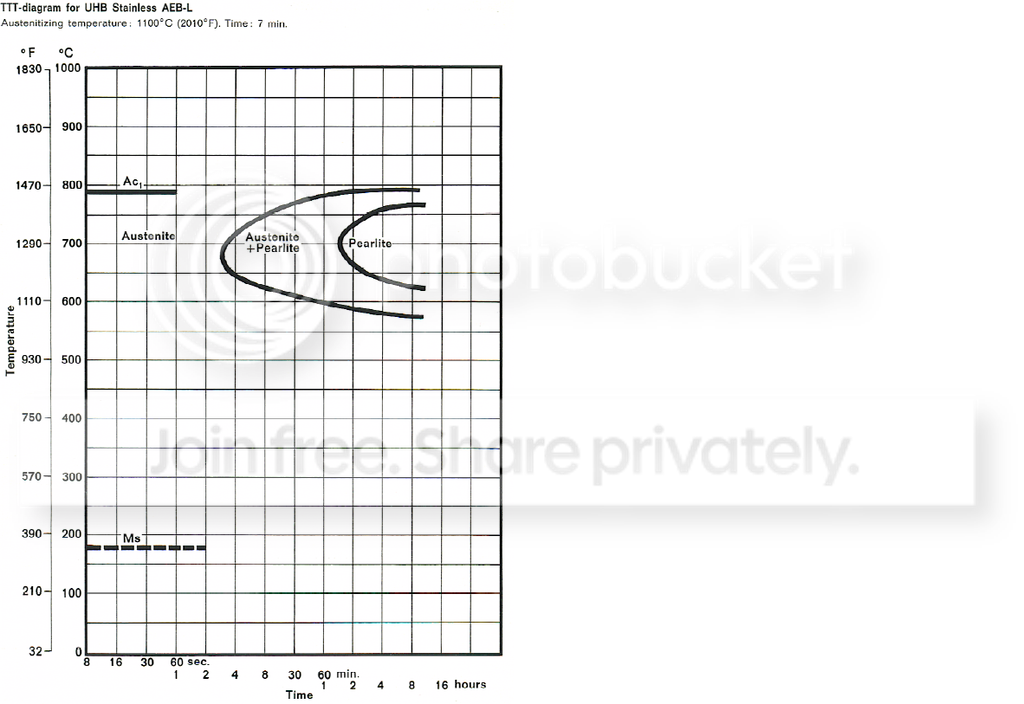
Speaking of AEB-L, is there a TTT chart of it? The Uddeholm DS I found speaks more about razors than metallurgy...


Pablo
 
The really good news is that the Mf point for AEB-L is well within the range of the old dry ice Slurpee cryo treatment. That is not always the case with the "super steels" assuming you want to eliminate as much RA as possible. The guy from Uddeholm at Blade a few years back told me that the desired cryo temp for Elmax is about 15-20 degrees F below what you can expect to get with the dry ice and acetone or kerosene mix.
 
Hope I'm not derailing the thread by asking whether we see a similar effect in "plain" carbon steels.

If AEB-L has fine carbides because it's (as Devin puts it) just off the carbon saturation line, at .6%, is there any reason to think that 1060 would have an optimal carbide structure for fine edge structure and retention when compared to 1095?

Unfortunately, 1060 won't have left over, undissolved carbides like AEB-L and 1095 will. The carbon saturation line is the point at which the austenite will not dissolve any more carbon, and undissolved carbides start to form. The carbon saturation line is variable and depends on composition of the steel and the temperature used prior to quenching. Even though AEB-L has less carbon than 1095, both will have undissolved carbides when austenized and quenched at usual temperatures. 1060 will not, and this difference is mostly due to the chromium in AEB-L. Another term for carbon saturation line is the eutectoid point, though that term is mostly reserved for alloys simpler than even AEB-L. Changes in composition move the eutectoid point up or down, though mostly down to lower carbon concentrations, as seen with AEB-L vs. 1060 (some carbides vs no carbides).
 
Back
Top