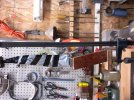
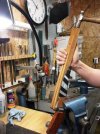
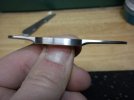
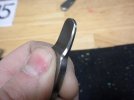
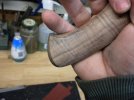
Random progress pics

Thanks for posting this, Nick. Your photos and info are always greatly appreciated.

I highly recommend the waxed tang technique. It works flawlessly and makes a dead solid handle fit. NOTHING moves when assembled.
 
When you're waxing, are you applying and polishing off too?

How many coats do you do before you feel safe about it ?
 
I will give the wax a try. Petroleum jelly always makes a mess.
I have a hard enough time with pins so I would probably mess the screw thing up but I'll give that a try when I get a bit better at it. For now I use CA.

Good stuff Nick, thanks for sharing.
 
Back around 2004 at the BLADE show, Ron Newton (Ms) explained to me how he did bedded tangs and at that time, he was using bearing grease as a release.

Sometime later I heard of guys using Vaseline.

Both methods worked for me, but I always got kind of a funky "bed" left in the cavity with those.

I saw in one of John White's awesome WIPs, that he used the paste wax. I have used the wax as a final step on my handles for years, so I gave it a shot. For ME, it has worked so much nicer. Big THANK YOU to my friend John for sharing this. :) :thumbup:

I don't know if there's a right or wrong way, but here are a few things I do----

-be SURE the all parts fit together nice and tight BEFORE bedding. This is not the kind of thing where you say, "Well, it almost fits tight, I'll adjust it after it has been bedded." That is just asking for trouble!

- do a dry run INCLUDING the clamp-up before putting epoxy anywhere. I promise you, if you don't, something will go wrong and it will come back to bite you.

- make sure the tang is smooth (I prefer to have any sanding marks running with the tang just to be on the safe side)

- do not drill the tang pin hole before bedding, it will just create a small cavity for the epoxy to try and find its way into.

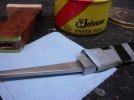
- clean all the parts thoroughly, then apply the wax with my finger or a Q-tip. I like the finger method because the heat from my finger makes the wax melt a little which allows a nice, thin coat.

- apply wax to everything you DON'T want the Acraglas to bond to

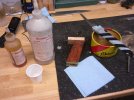
- I mix the Acraglas in a plastic condiment cup from WalMart under a heat lamp. It makes it nice and smooth---and runny. ;) You can squeeze the plastic cup on the rim, so that the epoxy can be poured right down into the center of the tang hole. This is where being sloppy will only make things harder. I don't fill the hole to where it's pouring out the top. I pour enough in so that WITH THE TANG in there, it will fill the hole ALMOST to the top of the block. There is no reason to put so much in that it gets forced up into the spacers and out all over the handle.

I have heard of a lot of guys using 5 minute epoxy to do this. I won't use 5 minute epoxy for my normal bonding needs, because it breaks down much easier/faster than slow set epoxy... so I won't use it for bedding purposes either.

The wax+Acraglas combo will give you a cavity that fits the tang LIKE A GLOVE. :)

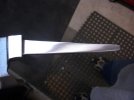
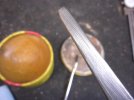
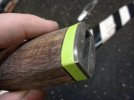
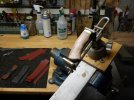
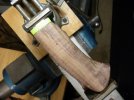
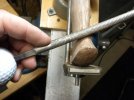
I found some pics I took while doing this stuff to an integral.
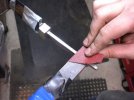
dennis35.jpg

dennis36.jpg

DSCN5431.jpg

dennis37.jpg
 
The difference between a newb WIP and a Nick WIP, no onelearns from a newb's wip but even when Nick doesn't even do a wip, everyone learns something :D

Interesting thing about the waxed tang and acraglass!!! i like that big fat tang too Nick.
 
A few more...

DSCN5432.jpg

dennis34.jpg

Do not do this and think that you're going to just pull the handle block off with your hands. If you can, you either did something wrong, or you are Lou Feriggno. :eek: ;)
D1.jpg
 
But Sam, remember that you BEAT Lou Feriggno in an arm-wrestling competition.

Great stuff, Nick. I'm curious. Wouldn't the acraglas release agent that you use for bedding rifle actions work just as well? Is it just that you had the wax around already? I have several bedding kits worth of release agent I think I could use if so.

--nathan
 
Nick, I think I am finally on the same page with you on this one.

I sit here trying to figure out how to word the questions that were popping up in my mind, as to why you choose to go thru this process! I was trying to word those questions in a way that the questions would not sound stupid. As I did that I begin to think of the problems I have had in the past doing something similar to what you are doing and the answer begin to become obvious too me!

In the past since this was not a take down I would have more than likely fitted the handle as close as possible and then glued and pressed the handle tight, intending to pin once the epoxy was set. Then begin the final fit to the handle and the epoxy clean-up! That has proven to be a long and very tedious process.

That is when the light bulb went on. In the past the clean-up sometimes was a PITA because you have all these surfaces you are working against at the same time, plus even though I thought I had it all fitted up correctly I have had the handle to move off slightly when pressing it up with epoxy, and this was not discovered till too late. I am now seeing the advantage to doing it the way you are doing.

I still have to work on my gut telling me I had a double lock on the handle with the epoxy locking up against the tang and then pinning it! But the advantage of being able to work out the clean up problems and the final fit problems seem to out way the double lock I have always been looking for! After all if the fit is that tight then the pin ought to do its job well!

I know I am getting the cart before the horse here but do you put epoxy in the pin hole as you set the pin?
 
<snip...>
I saw in one of John White's awesome WIPs, that he used the paste wax. I have used the wax as a final step on my handles for years, so I gave it a shot.

I don't know if there's a right or wrong way, but here are a few things I do--

- clean all the parts thoroughly, then apply the wax with my finger or a Q-tip. I like the finger method because the heat from my finger makes the wax melt a little which allows a nice, thin coat. <...snip>

I have used Mothers car wax for years as a release agent when doing mold work with fiberglass or carbon fiber. Works well.

But, can I borrow your finger to try out the past wax method on a stick tang I'm doing now? I promise I will take good care of it, I might even have the wife polish up th nail too...:p I hoping that be exactly replicating your process I am increasing my chance at success! :D

Most excellent post!

-Xander
 
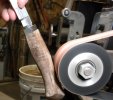
This is what I was talking about with the shaping of the guard.

a4.1.jpg

a4.2.jpg

Took the tape off the spacers to make it easier to see what was going on here.

a7.jpg

a8.jpg

a9.jpg
 
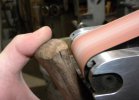
As close as I dare get to the spacers with power tools.
a10.jpg

a11.jpg

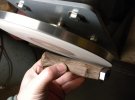
Another wheel I thought I had invented... Only to see the same thing in Tim Hancock's book right after I bought it.

a12.jpg

a13.jpg

a14.jpg
 
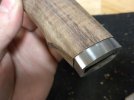
I figure you can try to get fancy with shapes and lines and such, but one of the most important goals is making a handle that feels "right" to people when they pick it up. A little off here or there can make a huge difference...

a15.jpg
 
I do not really understand "bedding the tang". Is it just making a socket that is extremely true to the shape of the tang? Are you filling all the extra area with epoxy for a better fit? If I have this right, do you use epoxy for the final assembly or is the peened pin the only retention method? Sorry for the questions, but I have never messed with a stick or hidden tang before.
 
Chris, bedding the tang is the same as bedding a rifle barrel/action to a stock. It creates an exactly true-to-form fit. Basically, it's a 100% contact tight fit; no slop anywhere once it hardens up. I'm also curious if there is a light coat of epoxy for final assembly, though it doesn't appear that there would be much room.

--nathan
 
Back
Top