
-
The BladeForums.com 2024 Traditional Knife is available! Price is $250 ea (shipped within CONUS).
Order here: https://www.bladeforums.com/help/2024-traditional/
You are using an out of date browser. It may not display this or other websites correctly.
You should upgrade or use an alternative browser.
You should upgrade or use an alternative browser.
Random progress pics
- Thread starter NickWheeler
- Start date


- Joined
- Dec 3, 1999
- Messages
- 9,437
So far I think just posting some photos without much or any description is a pretty solid way of starting some dialogue.
If I don't explain what I'm doing in the pics as they're posted, it forces guys (if they care) to figure out what I'm doing and why. I think it increases the possibility that somebody might question something and force ME to rethink it, or at least make me better understand why I do something the way I do.
Nathan, I think the release agent would work really well. Like you said, I happened to have the paste wax. I actually have the Acraglas release agent somewhere, but can't find it.
Dixie- I'm not exactly sure what you're asking. Maybe if I throw out a few things I'll get lucky and answer ya
  It should help answer Big Chris too. I think. LOL
The reason for the extra mechanical bits here.... the pins and the screws, are to ensure that all of the pieces can be assembled, worked, shaped, sanded, filed, fluted, disassembled+reassembled 300 times in between, and in this case (damascus fittings)... etched and hand polished before final assembly.
I really can't think of anything to add about why I bed the handle beyond the things that I wrote earlier.
Although I can't pull the handle off after the initial "bedding glue-up," once you clean the wax off the tang, the handle block can be shoved on and pulled off by hand.
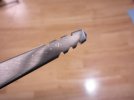
On final assembly, I do put more epoxy in the hole. Not very much, because there isn't much room. Remember, during the bedding part of this, I leave a little bit of room at the top end of the cavity, so there's some room there. Also, right before the final assembly, I file some grooves in the end of the tang to give some room/surface area for the epoxy. Like in this photo.
There will also be some epoxy that gets forced into the tang pin hole, especially since I drill the hole in the tang a few sizes bigger than the size of the actual pin. But during final glue-up I put a dummy pin through the handle, and don't want the epoxy to adhere to it. So I put wax on the dummy pin.
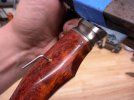
On a final note to this post--- If you skip ahead to 1 minute and watch for about 10 seconds... I think you will see why I like a bedded handle. But don't bother watching any of the rest. But that handle is very similar in design to the one on this bowie.
[video=youtube;N99qQ7KgQBs]https://www.youtube.com/watch?v=N99qQ7KgQBs[/video]
If I don't explain what I'm doing in the pics as they're posted, it forces guys (if they care) to figure out what I'm doing and why. I think it increases the possibility that somebody might question something and force ME to rethink it, or at least make me better understand why I do something the way I do.
Nathan, I think the release agent would work really well. Like you said, I happened to have the paste wax. I actually have the Acraglas release agent somewhere, but can't find it.
Dixie- I'm not exactly sure what you're asking.
Maybe if I throw out a few things I'll get lucky and answer ya It should help answer Big Chris too. I think. LOL The reason for the extra mechanical bits here.... the pins and the screws, are to ensure that all of the pieces can be assembled, worked, shaped, sanded, filed, fluted, disassembled+reassembled 300 times in between, and in this case (damascus fittings)... etched and hand polished before final assembly.
I really can't think of anything to add about why I bed the handle beyond the things that I wrote earlier.
Although I can't pull the handle off after the initial "bedding glue-up," once you clean the wax off the tang, the handle block can be shoved on and pulled off by hand.
On final assembly, I do put more epoxy in the hole. Not very much, because there isn't much room. Remember, during the bedding part of this, I leave a little bit of room at the top end of the cavity, so there's some room there. Also, right before the final assembly, I file some grooves in the end of the tang to give some room/surface area for the epoxy. Like in this photo.
There will also be some epoxy that gets forced into the tang pin hole, especially since I drill the hole in the tang a few sizes bigger than the size of the actual pin. But during final glue-up I put a dummy pin through the handle, and don't want the epoxy to adhere to it. So I put wax on the dummy pin.
On a final note to this post--- If you skip ahead to 1 minute and watch for about 10 seconds... I think you will see why I like a bedded handle. But don't bother watching any of the rest. But that handle is very similar in design to the one on this bowie.
[video=youtube;N99qQ7KgQBs]https://www.youtube.com/watch?v=N99qQ7KgQBs[/video]
Last edited:
- Joined
- Jun 20, 2007
- Messages
- 1,361
Nick, I wasn't really asking anything except for the info on the pin. It was really more of a revelation to me! I realized their is an easier and probably a much more efficient way of doing this than I have been doing in the past.
In the past I would have 95% finished everything and then done a glue up. The result is that other 5% is one PITA because if the handle moves even slightly, then I have problems I have to solve with everything in its final position. The glue clean-up was always tedious and if that handle did shift then I had to refit in place! You see I too always fit and assemble parts many times to make sure it all goes together correctly but without bedding the handle. Well lets just say sometimes it moves and once the epoxy sets, well you are left to deal with the mess. I guess I never thought of bedding the handle to eliminate that problem, DUH! You know sometimes its the simple things that when you are learning it yourself you miss!!!!
Doing it your way everything is fitted including the handle where their is no way it can shift! So I figure doing glue up at that point is about 99% complete. Mostly just a minor cleanup or a spit/shine so to speak! So like I said I really am not asking anything. The light bulb just switched on and I realized I have been doing this the hard way. Thanks for the insight into how you are doing it. Your method is going to make this a much more easy process for myself!:thumbup:
In the past I would have 95% finished everything and then done a glue up. The result is that other 5% is one PITA because if the handle moves even slightly, then I have problems I have to solve with everything in its final position. The glue clean-up was always tedious and if that handle did shift then I had to refit in place! You see I too always fit and assemble parts many times to make sure it all goes together correctly but without bedding the handle. Well lets just say sometimes it moves and once the epoxy sets, well you are left to deal with the mess. I guess I never thought of bedding the handle to eliminate that problem, DUH! You know sometimes its the simple things that when you are learning it yourself you miss!!!!
Doing it your way everything is fitted including the handle where their is no way it can shift! So I figure doing glue up at that point is about 99% complete. Mostly just a minor cleanup or a spit/shine so to speak! So like I said I really am not asking anything. The light bulb just switched on and I realized I have been doing this the hard way. Thanks for the insight into how you are doing it. Your method is going to make this a much more easy process for myself!:thumbup:
Last edited:

- Joined
- Dec 6, 2010
- Messages
- 1,154
Great Q&A and pictures. This thread really gets the wheels turning. The one thing this thread screams to me is that sometimes the long way is the shortcut.
Thanks Nick.
Thanks Nick.

- Joined
- May 18, 2009
- Messages
- 1,831
Hey Nick,
Great thread, thanks! One problem I'm running into as I've been doing more hidden tangs. If I have a wood handle block with bronze and g10 spacers when I start to shape the handle I always seem to wash out my transition line from ricasso to handle. The wood basically disappears around the spacers. I'm trying to use hand files/rasp and I run into the same problem. How do you keep such a smooth transition line from ricasso to guard to spacer to handle?
Great thread, thanks! One problem I'm running into as I've been doing more hidden tangs. If I have a wood handle block with bronze and g10 spacers when I start to shape the handle I always seem to wash out my transition line from ricasso to handle. The wood basically disappears around the spacers. I'm trying to use hand files/rasp and I run into the same problem. How do you keep such a smooth transition line from ricasso to guard to spacer to handle?
- Joined
- Oct 4, 2011
- Messages
- 1,043
I've read on a different forum about using an epoxy putty to do a tight fit. Dave Stephens posted this a couple of years ago:
I used to burn the handle onto my the hidden tang knives I made, but had several handles crack or warp from the heat.
I recently started using this technique instead of the drill, file, file some more, file yet some more, needle file, needle file, etc.
Step 1: Drill a hole whose diameter is slightly larger than the widest part of the tang.
Step 2: Fill the whole with a two part epoxy putty. You can usually buy this at Lowes or Home Depot. It comes in small tubes like this:
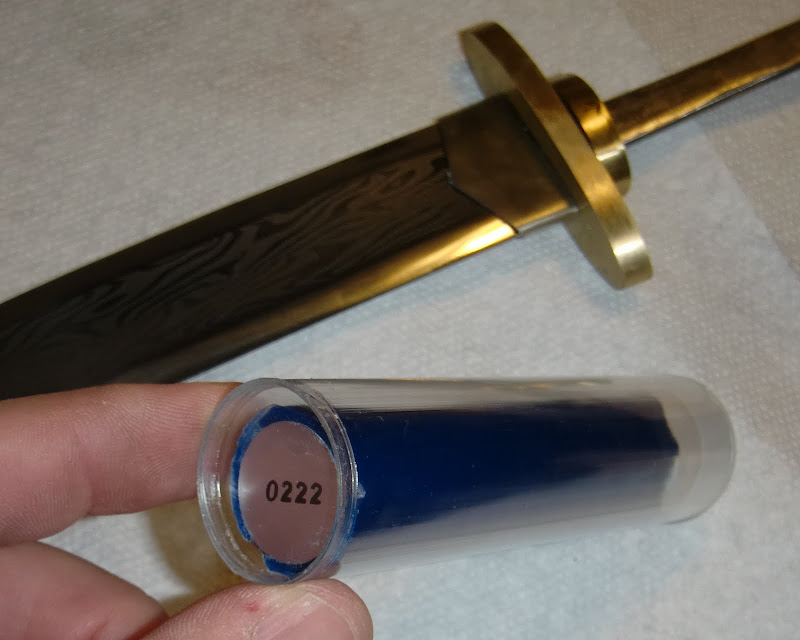
You break off a chunk and knead it together. It hardens in about 20 minutes. We use this stuff to repair boats in the commercial fishery. It even hardens underwater.
Step 3: Coat the tang with petroleum jelly, and slide the tang into the putty filled hole. Then remove it.
Voila. Perfect fit.
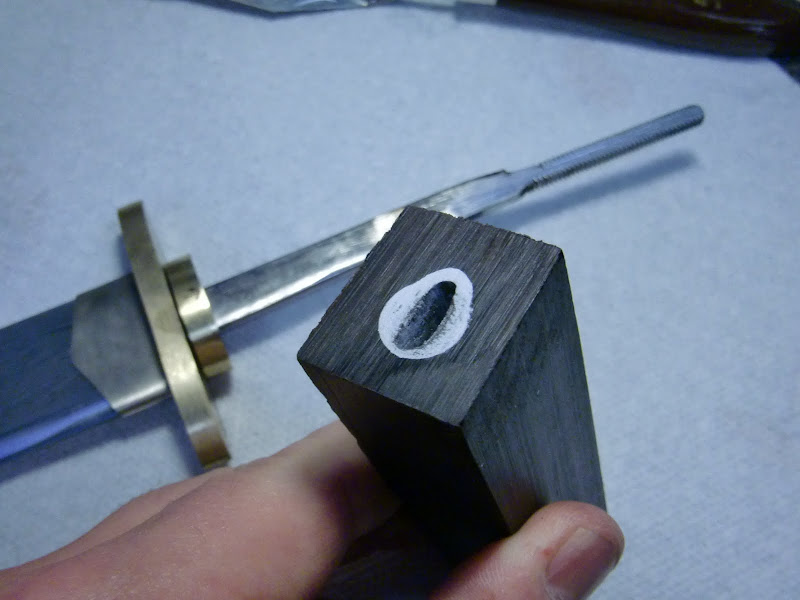
I like this stuff a lot more than using regular epoxy because you can form it and remove the tang before it sets.
Hope you guys find this useful.
Cheers!
--Dave

- Joined
- Feb 18, 2005
- Messages
- 321
I wanted to try to avoid adding the "great thread, thanks for the info, Nick" comment, but it really is a pretty cool thread. It's a great approach to give a bunch of info on how your process works, while ferreting out questions from readers. Kinda WIP, kinda not. I am just glad that you didn't stay away  The half silhouette guards are a great idea, and regardless if you found out that you WEREN’T the first to come up with that, you were the one to give the idea to a bunch of guys who haven’t seen it before (me included)… this is one that I will be stealing from ya!
The half silhouette guards are a great idea, and regardless if you found out that you WEREN’T the first to come up with that, you were the one to give the idea to a bunch of guys who haven’t seen it before (me included)… this is one that I will be stealing from ya!
- Joined
- Jan 2, 2011
- Messages
- 1,286
I just fell out of the epipha-tree and hit every branch down and everything just clicked! Great info.
Nick, have you ever had problems with getting the tang back out after you create the mold or problems with the wax staying in the handle hole?
From what I could tell you drilled the handle pin after the embedding, are you still using the torch method and the bucket to allow shaping of the shoulders and the drilling of the pin?
Nick, have you ever had problems with getting the tang back out after you create the mold or problems with the wax staying in the handle hole?
From what I could tell you drilled the handle pin after the embedding, are you still using the torch method and the bucket to allow shaping of the shoulders and the drilling of the pin?

- Joined
- Nov 29, 2011
- Messages
- 1,396
Hey Don thanks for the post. I was curious how well that stuff holds up in the longrun as a bedding agent. I have used those putty things for repairs at work occasionally but never on anything that was meant to last a longer time. Good idea though as its pretty easy to work with.
Thanks a bunch Nick. I am working on a hidden tang knife right now (my first real effort with proper tools), and these bedding tips will make all the difference in the world. I learn something new from you guys every day, sometimes more than once a day.
- Joined
- Oct 4, 2011
- Messages
- 1,043
Hey Don thanks for the post. I was curious how well that stuff holds up in the longrun as a bedding agent. I have used those putty things for repairs at work occasionally but never on anything that was meant to last a longer time. Good idea though as its pretty easy to work with.
I was wondering about that too. The idea itself is very cool though.
- Joined
- Dec 3, 1999
- Messages
- 9,437
Thanks fellas
Don, that's a neat idea, I hadn't considered the epoxy putty before. Sounds like a solid option. I can't do the big drilled hole though, this knife would require over a 1" hole.
I did get scared with the first knife that I bedded the handle... I thought I would be able to pull it off by hand but when I couldn't, I kind'a freaked out. But driving them back off like in that photo has not been a problem.
I drilled the pin hole after everything was fit-up, but before I started shaping the handle.
BTW guys, I wouldn't worry about doing all this stuff on your first hidden tang.
Don, that's a neat idea, I hadn't considered the epoxy putty before. Sounds like a solid option. I can't do the big drilled hole though, this knife would require over a 1" hole.
I did get scared with the first knife that I bedded the handle... I thought I would be able to pull it off by hand but when I couldn't, I kind'a freaked out. But driving them back off like in that photo has not been a problem.
I drilled the pin hole after everything was fit-up, but before I started shaping the handle.
BTW guys, I wouldn't worry about doing all this stuff on your first hidden tang.

- Joined
- Feb 4, 2011
- Messages
- 1,429
Thanks fellas
BTW guys, I wouldn't worry about doing all this stuff on your first hidden tang.
 . NOW you tell us! Lol. I'm doing my first two hidden tangs now.
I'm sticking to a one piece guard this time on these but I like your tapped threads in your guard. I was using a through bolt and on that knife I showed you. I shaped the wrought and copper spacers with the ironwood very slowly to avoid heat buildup. This method would really help keep the handle from cracking or washing out on a softer wood.
I understand about taking the piece apart 300 times. I think I've had these 4 guard spacers apart at least 100 times and I've got a hundred more to go! I apologize if I missed it and am asking an already answered question.
What's your method of drilling and tapping the guard?
Here's how I would do it.
Surface grind(if I get mine wired and learn to use it)...
Or, what I will likely do. Flatten the pieces on the disc and hand lap smooth then superglue or clamp and drill 2- 1/16" holes on my small drill press add 1/16" pinstock to help assure alignment.
Drill two proper sized holes for screws and hand tap using the drill press spindle and bit to assure alignment.
Something like that?
Btw, I really appreciate your time here and honestly hesitate to ask questions as I know I am only one of many people you generously help.
- Joined
- Oct 16, 2001
- Messages
- 1,917
Nick,
Thanks for a great comeback!
Just wondering where you get your 1/16" pin stock (and if you got my last email?
Thanks for a great comeback!
Just wondering where you get your 1/16" pin stock (and if you got my last email
?Nick,
I know you use the Acraglass from Brownells, I am wondering if you have ever used the Acraglass gel? It's a bit thicker than the glass is and it seems to take dye better, we use it a lot in bedding rifle stocks, so I was just curious if you had ever used it.
Also, another thing that you can use for a release agent is clear shoe polish, I've used it when bedding rifles and it works great. It just seemed to clean up easier than the paste wax, I've never liked the release agent that comes with the acraglass but I think I may be slightly allergic to it, it gives me a headache real bad.
Also, great thread, I will reiterate what has been said to you before, but you need to take all of your posts with pictures and turn them into a Big Book of Wheeler!
I know you use the Acraglass from Brownells, I am wondering if you have ever used the Acraglass gel? It's a bit thicker than the glass is and it seems to take dye better, we use it a lot in bedding rifle stocks, so I was just curious if you had ever used it.
Also, another thing that you can use for a release agent is clear shoe polish, I've used it when bedding rifles and it works great. It just seemed to clean up easier than the paste wax, I've never liked the release agent that comes with the acraglass but I think I may be slightly allergic to it, it gives me a headache real bad.
Also, great thread, I will reiterate what has been said to you before, but you need to take all of your posts with pictures and turn them into a Big Book of Wheeler!

- Joined
- Oct 30, 2002
- Messages
- 3,974
Jake, in some glue tests done a good while back (can't remember if it was here or on KnifeDogs), Acraglas gel didn't hold up as well as regular Acraglas. Of course, those tests were done to simulate handle scales as opposed to hidden tangs. My guess is that the Acraglas gel would probably work just fine to bed the tang, but if I'm doing full-tangs with scales, I go for the regular Acraglas.
--nathan
--nathan
- Joined
- Dec 3, 1999
- Messages
- 9,437
Thanks guys. Sorry for the delay, I've had some more pressing issues around here lately.
I have a lot more pics I can throw on here later.
Brian- Just to make sure we're on the same page here--- the pins go through all the spacers and into the wood, the screws only go through the spacers. I have heard of guys putting the pins and/or screws up into the guard, but I haven't ever tried that (or felt the need to actually).
I don't even know if the screws are THAT important. A LOT of makers don't use screws, just pins. I just like to be able to screw the multi piece spacer stack together for shaping and sanding. The pins will align them, but won't actually hold them together like the screws do.
Your projected plan is very solid, but I wouldn't bother with the drill press for tapping the holes. An 0-80 screw is about the same size as the screws in a lot of sunglasses--- itty bitty, LOL. They will snap with any side load. I just used a little pin vise for hold the tap and turned it through by hand. A machine shop would most likely use a drill press or mill with a tapping head (with a clutch) . A lot of folder guys have told me they use a small hand drill for the little taps.
I'll try to remember to take a couple pics of the giz-wizzes I use for drilling the spacers.
John- I did get one from you not too long ago! I'm taking this as a reminder that I forgot to write you back.
I get the pins from Enco. They ruin about $6-7 for 100 Here's a link FWIW-
http://www.use-enco.com/CGI/INSRIT?PARTPG=INSRAR2&PMAKA=325-2759&PMPXNO=5807724
As per Acraglas Gel, I have never tried it Jake. I've seen it in Brownell's catalog but I have been using the same set of Acraglas BIG bottles I got from Chuck Bybee at Alpha Knife Supply a few years ago! Thank you for the shoe polish tip!!! I'll have to give that one a try!
Thanks again guys
I have a lot more pics I can throw on here later.
Brian- Just to make sure we're on the same page here--- the pins go through all the spacers and into the wood, the screws only go through the spacers. I have heard of guys putting the pins and/or screws up into the guard, but I haven't ever tried that (or felt the need to actually).
I don't even know if the screws are THAT important. A LOT of makers don't use screws, just pins. I just like to be able to screw the multi piece spacer stack together for shaping and sanding. The pins will align them, but won't actually hold them together like the screws do.
Your projected plan is very solid, but I wouldn't bother with the drill press for tapping the holes. An 0-80 screw is about the same size as the screws in a lot of sunglasses--- itty bitty, LOL. They will snap with any side load. I just used a little pin vise for hold the tap and turned it through by hand. A machine shop would most likely use a drill press or mill with a tapping head (with a clutch) . A lot of folder guys have told me they use a small hand drill for the little taps.
I'll try to remember to take a couple pics of the giz-wizzes I use for drilling the spacers.
John- I did get one from you not too long ago! I'm taking this as a reminder that I forgot to write you back.
I get the pins from Enco. They ruin about $6-7 for 100
Here's a link FWIW-http://www.use-enco.com/CGI/INSRIT?PARTPG=INSRAR2&PMAKA=325-2759&PMPXNO=5807724
As per Acraglas Gel, I have never tried it Jake. I've seen it in Brownell's catalog but I have been using the same set of Acraglas BIG bottles I got from Chuck Bybee at Alpha Knife Supply a few years ago!
Thank you for the shoe polish tip!!! I'll have to give that one a try! Thanks again guys

- Joined
- Oct 20, 2008
- Messages
- 5,547
I'll try to remember to take a couple pics of the giz-wizzes I use for drilling the spacers.
That would be great. In the past I've made a template spacer of SS, then superglued it to the back of the guard, then the other spacers and handle material in turn to drill holes through. I bet you have a way niftier method that I would love to "steal."