
Nathan the Machinist
KnifeMaker / Machinist / Evil Genius
Moderator
Knifemaker / Craftsman / Service Provider
- Joined
- Feb 13, 2007
- Messages
- 19,483
wow, kind of lost for words right now. RIP Kyle Busch.
That sucks a lot. What the hell happened?

The BladeForums.com 2024 Traditional Knife is available! Price is $250 ea (shipped within CONUS).
Order here: https://www.bladeforums.com/help/2024-traditional/
wow, kind of lost for words right now. RIP Kyle Busch.

TimmykadzeIf those kamikaze drones had titties they'd be way more effective

Only report was admitted to the hospital Thursday with a severe illnessThat sucks a lot. What the hell happened?

Not sure…just read that he was rushed to the hospital this morning for an illness. And just now read he passed away just now.That sucks a lot. What the hell happened?


So there are only two scenarios in which your choice changes the outcome:Is there some kind of an upside to Blue?
Like, if half the population selects blue, and blue wins, does something good happen?
Because, if the outcome is the same regardless of red or blue, why wouldn't EVERYBODY just select red? What would be the harm in everybody just selecting red?
Maybe I don't understand this thought experiment
If all else is equal, you could either have a real risk of peril by selecting blue and hope a whole bunch of other people also take an unnecessary risk and also select blue, for no reason. Or everybody just selects red.
Maybe I don't understand this thought experiment.
I'm selecting red. Everybody can be responsible for their own safety. I don't understand taking a risk of death to select blue if it doesn't accomplish something, other than saving other people who also selected blue. For no reason.
Somebody explain this to me, it seems really dumb.


Most people select blue = everybody is fineEverybody selects red = everybody is fine
People start selecting blue, then a whole bunch of other people also need to select blue, to save dumb people from themselves. These are people who created an unnecessary problem and they need a bunch of other people to rally and put themselves at risk to save them when they could have just everybody select red.


In minecraft means I'm ninecraft broI like how you call the historical-themed amusement park.
We're talking about buttons here!
What did you think we were talking about?
All coincidences are accidental.
All characters are fictional.
Except Timmy. He’s actually serious.

Where exactly are these buttons?
I wanna be the first to push them both at the same time.
 Sharp & Fiery
be like:
Sharp & Fiery
be like: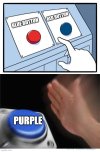
That should say Blurple. If ya know, ya know.
If your vote isn't decisive then you die if the other voters prefer red.What if my vote isn’t the decisive one?
Do I die?
There are more than 7 billion people in the world right now.
I’m still going to press the button that gives safety specifically to me.
Man, people vote for communists and shit like that anyway.
Lol, dude, of course in Minecraft.In minecraft means I'm ninecraft bro

Now or in general?If your vote isn't decisive then you die if the other voters prefer red.
As an example, let's say every voter besides you has a 50% chance of choosing blue. Then the probabilities of the voting outcomes follow a binomial distribution.
If n=population of earth then the expected number of deaths from choosing red is going to be P(tie) n/2
P(tie) = binomial(n, n/2) / 2^(n/2+1)
binomial(n,n/2) ~ 2^n / sqrt(pi*n/2)
So expected number of deaths is n*2^(n/2-2) / sqrt(pi*n/2)
Probability of your own death from choosing blue is P(blue < n/2) = sum from k=0 to n/2-1 of binomial(n, k) / 2^n
sum from k=0 to n/2-1 of binomial(n, k) = (2^n - binomial(n, n/2))/2
So P(blue < n/2) = 1/2 - binomial(n, n/2) / 2^(n+1) ~ 1/2 - 1/(2sqrt(pi*n/2))
The ratio between expected deaths and your chance of dying is how much value your life would need to have to choose red ~ n/(sqrt(pi*n/2)-1)
If n=8,298,979,488 then the ratio is 72,686.3
So in this example, choosing red is the same as saying that your life is more important than 72,686 strangers. It's kind of like that scene in The Sum of All Fears when they realize the nuclear bomb is in the football stadium and start rushing the President out without telling anyone else to leave.
You left out wings…. Just sayingRED RED RED RED VAGINA RED RED RED BOOBS RED RED VABOOB RED

