Re-examining the steel snobs.

Status
Not open for further replies.
Once again we are getting side tracked, perhaps because I wasn’t specific enough as to whom this thread was addressed but we have subsequently focused on the more experienced guys using scrap; I see self professed steel snobs, I see proud recyclers, but I seen very few self proclaimed “newbies” here. Because of this I did direct my questions to the guys who have been doing it long enough to have the opportunity to equip a shop in any manner then may need, and was trying to get a better understanding of where they are coming from. I chose the novel approach of trying to see it from the other guys perspective for a second instead of digging in and lobbing incendiary one liners, forgive me for that transgression. If that approach gets too out of hand perhaps I could help the discussion along with some inane one person inside jokes, post some song lyrics or an image that just leaves everybody scratching their head, you know, the real constructive and relevant stuff.


i see a couple problems in the approach, that are obviously not intentional, but might help with understanding some of the responses. You sort of set up two categories initially, neither of which I actually feel that I have 2 feet in- completely random workers and steel snobs. You put a bit too much definition on the 'other side' instead of asking for them/us/whomever to define them/ourselves. I recognize this because I do it a lot :D

I don't know what a newbie is at this point. i can give you some easy boundary sets- someone who has been making blades for less than 6 months is almost certainly a newbie, someone with over 10 years is almost certainly not. In between there.... I *feel* like a newbie in many respects, but I also feel like a solid professional at least in my given areas of focus (those "silly little undecorative convex bushcrafters", people keep hammering through logs and skinning deer with for example :D )


I'll try to get it really succinct: known steel is a must have, but unknown steel is often a must have. I will never tell someone to wait until they have every part together, if they've got heat, quenchant(s), a bench grinder or files, sandpaper, and a piece of presumed hardenable carbon steel, they should absolutely just simply START. While waiting for their first order of Aldo's 1084 or Kelly's 15N20 to arrive, of course!!!
 
Last edited:
Hi Kevin

i would have liked to have answered this earlier but had to run out and pick up parcels in sault ste marie, michigan.... I'd would like to say that i don't mind some of the junkyard steels but that is just because i started out with them ... not what i use nowadays on a regular basis by any stretch...

I don't like my part of MI right now I think I would hate the Sault today! Winter:barf:

Greg, I think you know that we think more alike than we do differently. Thanks for that last post, it gave me one of them smack yourself in the forehead and ask what you were thinking kind of moments. I have allowed the extreme polarizing tone of this thread to actually pigeon hole myself into an all chemical analysis steel snob, when I have been actively diversifying my activities and study for many years. I started out with less than much of what has been described by many newcomers. One thing I certainly didn’t start out with is metallurgy books, I moved on to them when I needed to know more about what I had seen that the knifemaking books either couldn’t address or made worse

Anyhow I worked with many reused and scrap items before I moved onto control freak mode, I remember the last knife I made from a spring that got more than share of ink in a few publications before I gave it to friend. But I still use scrap items to make period knives and tomahawks for my friends in the rendezvous circles, I don’t put my name or normal stamp on them because they are not examples of the work I want to be known for.

In the near future, I will probably do a crucible melt of my own just to say I did it, but I have been doing my own bloomery steel smelts for a couple of years. So far it has been for testing and comparisons but eventually I will make some items from it in order to produce some very old style blades in an authentic material. I may not stamp them with my usual mark even though they will be of no less value or cost than my other work, but will have a different focus, more on the materials than on performance. Not that the stuff is terrible, it will reach a very nice 61 HRC, just not everywhere, every time, and they will be sold with that made clear up front. But the work I am known for are my intensive, tightly controlled and meticulously heat treated tool steel blades. They are the ones that get my mark on them and that I cannot compromise in any way without betraying my customers.

I think you may agree that crucible or bloomery steel are not a shallow learning curve for a beginner, many folks have pointed out that we have to start somewhere, I can’t think of a friendlier start more conducive to a positive outcome for learning than a nice bar of 1080 or 1084. With that I got excellent results as a beginner and still get them today, so the skills learned last a lifetime.
 
...Most newbs, I believe, feel that we have so little to add we say nothing!
WE DO APPRECIATE IT VERY MUCH THOUGH!!!!!!!!!!!!!!!
This is my first rant so y’all
Flame On

And the worst thing is that they are the ones that kind of get trampled when the rest of us start a tussle:(.
 
<SNIP>I have allowed the extreme polarizing tone of this thread to actually pigeon hole myself into an all chemical analysis steel snob,<SNIP>

Anyhow I worked with many reused and scrap items before I moved onto control freak mode, <SNIP>
In the near future, I will probably do a crucible melt of my own just to say I did it, but I have been doing my own bloomery steel smelts for a couple of years. So far it has been for testing and comparisons but eventually I will make some items from it in order to produce some very old style blades in an authentic material. <SNIP>
I think you may agree that crucible or bloomery steel are not a shallow learning curve for a beginner, many folks have pointed out that we have to start somewhere, I can’t think of a friendlier start more conducive to a positive outcome for learning than a nice bar of 1080 or 1084. With that I got excellent results as a beginner and still get them today, so the skills learned last a lifetime.

I'm not really sure how much is actual polarization and how much is perception. I am probably at least as much of an "only use known new steel" advice offender as anyone on this forum, yet for just playing I will sometimes use scrap spring, and I can get old bandsaw blades from work that are looking like they will preform similarly to 15n20 (yes i cheated, I had them gun radioanalysed, not quite as good as spectro, but free and almost accurate) that I will likely be using in pattern welded, and someone challenged me to handforge out a piece of John Deere torsion bar that was over an inch in diameter so I did. so I will use scrap stuff for goofing around , but that is not something I would wish on a novice. I have seen the utter disappointment when someone's first blade that they put huge amounts of time into cracks during final finish and falls apart.
I have done the bloomery thing and it's hugely satisfying when it works, on the other hand, it's a whole lot of work for naught when it becomes cast iron :mad: I think the whole thing of strongly encouraging newbies to use known material is to save them the frustration many of us have experienced when "golly I done evrythin' right and it still don' work"
Yes people get defensive about "I have made knives all my life out of scrap and they're perfectly good knives" but I hope they will understand when I try to spare a new person the unnecessary part of the learning curve.

I am a strong enough believer in sparing the new folks the frustration that I have donated some of my own steel to the cause, I know Stacy has as well.
I think those of us who have an idea of what we are getting into should use whatever steel we feel like, those who know me know that I have become a convert to 1084, 15n20, 1095, wrought and 5160, but that isn't all that you will find on my anvil.

-Page
 
Koyote: Never worry about being flamed, if someone does not agree with you you are not doing much.

When I earned my mastersmith stamp I thought I knew it all, today, around 29 years later I realize how much I had to learn and look to the future knowing there is much learning left.

When we decide we know it all we are dead in the water.

The only way to learn is to read, practice and test your results relentlessly accept nothing for ganted, but learn to work around the variables that await, the more you test your knives for the purpose you make them for the greater your knowledge gainted.
 
I've been watching this thread closely, but not saying anything because other folks are covering many of my thoughts better and more completely than I myself could. There are a few things that I would like to chime in with though.

First, I would like to take the time to thank Kevin, Mete, Fitzo, Stacy, Bruce Evans, Greg Obach, and everybody else who have worked hard to try and teach us all through providing information, insight, and results of their own testing. Not that I completely trust everything I read on the Internet, but when I can see an explanation of something from Kevin, or Mete in terms I can understand, and then I can compare that new knowledge to other sources, and verify the claims by working in my own shop, it certainly teaches me a lot, not least of which is a healthy respect for these men and their dedication. Oh, and I'd like to thank Tom Megow for even thinking of me in this discussion. :)

It's difficult for me to say whether I'm a newbie or not anymore. I know that I feel like a newbie more often than not, but after looking at Scott Ickes' recent poll I listed my self as an Apprentice. I feel that I've managed to get decent enough at some skills that I may be not just a newb anymore. Who knows? I do know that if I ever feel that I have nothing left to learn from you folks, that I'm well and truly done for.

Early on I worked with a decent amount of recycled materials, and frankly did not have great success. I realize now that a lot of that was due to my processes not being consistent or correct. I've recently begun working towards my JS and so I'm really testing some things now.

As a way to test my knowledge of process, I made a large test blade from an old spring harrow tooth a while back. All I knew of this steel was that it had been a spring harrow tooth of unknown, but old origin and that the gentleman who had used the harrow (who donated the teeth) had personally seen them go almost completely straight being caught on a root and then snap back to shape. In the interest of adding my $.02 to this thread, I'll relate from my experience rather than directly answer Kevin's questions. I think that I can provide more useful information this way. It's just a more effective method of communication for me. Here's how I did it:

  • I forged the curved tooth into a flat bar
  • I cut off a small piece, heated it to a bright orange and quenched in cold water. (This is useless other than I have found it is a reliable way to tell if something will harden at all.)
  • I then clamped this piece in a vise and whacked it with a hammer. It snapped cleanly. Good sign #1.
  • I then examined the fracture to see what the grain looked like after a violent quench from an overly high temp. If the grain hasn't grown terribly, I take this as a sign that the steel might contain some alloy to help retard grain growth such as Vanadium. Not terribly scientific, but we're not discussing pure science here... In this particular case, the grain was pretty large.
  • At this point I forged out the blade. I knew I had something to work with, just wasn't certain exactly what it was.
  • After forging, I brought the blade to a little above non-magnetic and allowed it to cool in still air. This was repeated for a total of 3 cycles. During this, I looked for (and found!) something very important. I was able to observe decalescence/recalescence. This is something that I'm surprised I haven't seen mentioned in this thread so far. The transition point was very obvious with this particular steel and I made certain to make a mental note of the color of the steel at the point of decalescence.
  • I then heated the blade as evenly as possible to the color I made a note of before. Then I went just a TOUCH higher.
  • I quenched in Parks #50. I used this oil for a few reasons. One, I had it available. Two, water had not caused the steel to ping before, so I knew a fast quench was a safe bet.
  • File test time. Yes, I know this teaches us little, but it's a habit I picked up from my early teachers. It has told me on a few occasions when a quench did not work, so I keep doing it.
  • I tempered initially at 400F, twice for 60 minutes each.
  • I "blued" the tang, ricasso, and spine with a MAPP torch 3 times.
  • Finished the blade out roughly. It was just a test knife, so I made it comfy, not good looking. I took it as an opportunity to test the quality of my standard hidden tang construction. The knife was assembled with no epoxy, only the pin to hold it all together.

I then proceeded to use this knife for everything around the yard. I hacked through trees and bushes that needed trimming rather than using a pruner. I observed the edge condition regularly, resharpened as necessary, and slightly reground the profile as I continued to learn about blade geometry. I hacked through 2x4s in the shop, I used it as a small spade to plant some mint in the yard, in rocky soil, etc, etc, etc. I learned something from every test. The handle loosened up a good bit, but the knife was still quite usable.

The last time I visited J. Neilson's shop, I figured it was about time to test this knife all the way. First, I made a few attempts at cutting a free hanging rope. From this, I learned that I need practice cutting rope :) Had I had some more practice, I'm certain that I wouldn't have left that last piece hanging by a thread. Second, we grabbed a 4x4 hardwood barn beam and I proceeded to hack that to bits. It ALMOST shaved hair after that. I felt confident that had I been chopping 2x4s it still would have. Then we went to the vise. J. was just about to open his mouth to tell me I'd hit 90 degrees when the blade finally snapped. The rest of the blade only took about a 15 degree set.

Some might think I failed based on this story, but I see it as a grand success. On my first attempt, with an unknown steel, I ALMOST passed the standard ABS tests. This means to me that I understand the PROCESS well enough to make the best of things with an unknown steel. Am I more ready to take on testing with a known steel now? I sure think so.

Now, I'm not relating this story to try and say that the ABS test are the way and the light. The merits of these particular tests aren't up for discussion in this thread. They are however a benchmark I'm working towards and so I'm pleased with the results of my experiment.

Hopefully the explanation of my methods here will shed a little more light on how I deal with recycled steels. As a rule I don't use them in my work. I personally feel that if somebody is going to spend their hard earned money on my products, I owe them the best work I can possibly do, with the best materials I can provide. I'm not going to skimp on materials to make a few extra bucks off of somebody. That's just not how I operate. As a tool to teach myself process and rigor, they can be very valuable indeed.

So, there's my $.02 anyways...probably worth about $.01 nowadays, but hey, the economy sucks :)

-d
 
Koyote: Never worry about being flamed, if someone does not agree with you you are not doing much.

When we decide we know it all we are dead in the water.

Oh, I'm not too worried about being flamed :D I occasionally get a tad sarcastic because there's a crowd that looks down on convex grinds, assuming that since there's no sharp angles (except the edge) to point to, there's no skill. :jerkit:

That last part is very important, yeah. Always learning, always adding. But then again, that's part of the joy of SOMETIMES using recycled steel.

One steel I actually tend to avoid is file steel. I did one piece from an old japanese file that turned out great, but for the most part it's much more variable than treating any random bandsaw as 15N20, or treating old harrow discs like a 1070-1080!!
 
Good info, Deker. Might copy/paste it into Tai's mystery steel thread, as I think that's what he's looking for.
 
maybe other places on the planet are seeing this "global warming" but i just can't see it... maybe cause of the 7 foot tall snow bank in front of my house is telling me something else... ( i swear its mocking me somehow )

Kevin, i alway love to read your articles, and i know that you care a good deal about steel. I look at what you wrote in this post as a kind of a " life recipe " for others that possibly want to take a similar path... your struggle and experience with the material has made you into one of the more exciting people in the craft of knife making ..... its not a marketing scheme that you push a well heat treated knife, its an honest attempt at giving people the tools to get to that level.... sharing :thumbup::thumbup:
( the proof... is that your well published on the net about your process and have a wide and positive following :thumbup: )

i also agree that polarizing is a problem but that is on both sides.... and its funny how people can affect you... look at how i got so caught up in this that i went an insulted someone who cares immensely about the craft.. i was foolish .. sheesh ..


its funny that you want to make crucible steel... i had a little chuckle over that... i can definitely see you having an absolute field day making your own custom melts and designer alloy steels ! even replicating the old metals like wootz...
i get excited just thinking about making steel... the roar of the furnace, watching the little crucible with welding shades... seeing the white white hot liquid roll in the vessel... the danger and adrenaline... seeing the level of liquid sit down low in the crucible when most of the charge is dissolved... resisting the temptation to shut down the furnace early and risk having an incomplete melt.... each time, i feel like i am back grade school... a fountain of youth... ... and no, i'm not getting carried away with this... its my honest to God experience with it..

i maybe poor, but i'm so very rich ( i think you understand ;)

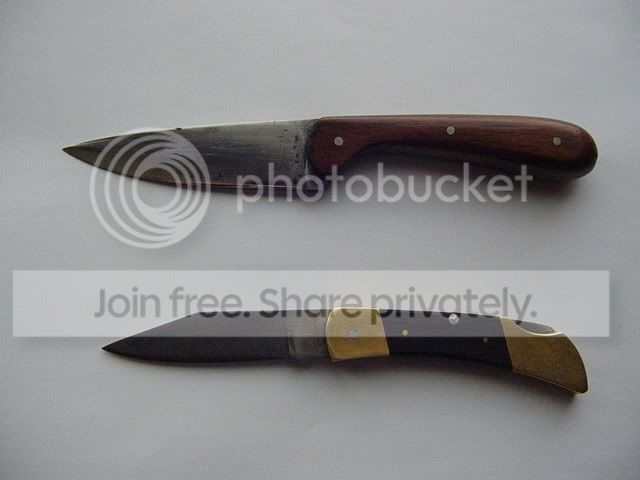
DSC05113.jpg


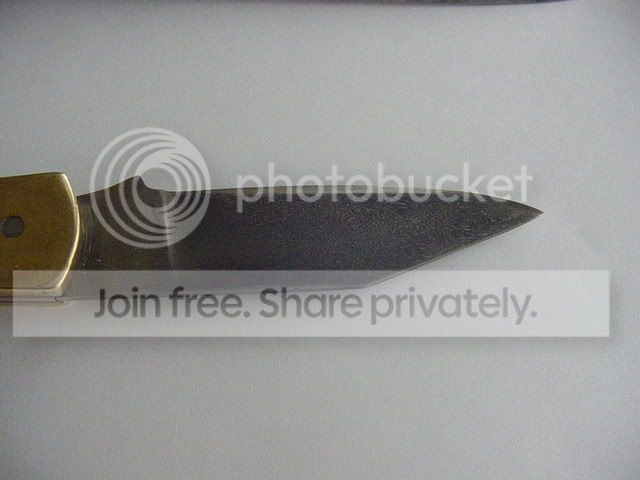
DSC05118.jpg


enclosed is a picture of my lawn mower blade pocket knife that i used for many years ( i suspect its 1045) ... not bad compared to some of the production knives i've own in the past..

and the folder is my first pocket knife... i got it for my 8th birthday and broke the tip on it the following year... left the stainless steel tip in a tree digging out a BB from my BB gun....it bothered me for a long time.. i liked that little knife that i held onto it for all these years... changed out the blade awhile back for a wootz blade... .. i get a chuckle out of thinking that someday, when i'm gone it'll show up on a forum like bernard levine's... haha ... i'd be good fun to see what kind of answers those guys come up with..;)


I don't like my part of MI right now I think I would hate the Sault today! Winter:barf:

Greg, I think you know that we think more alike than we do differently. Thanks for that last post, it gave me one of them smack yourself in the forehead and ask what you were thinking kind of moments. I have allowed the extreme polarizing tone of this thread to actually pigeon hole myself into an all chemical analysis steel snob, when I have been actively diversifying my activities and study for many years. I started out with less than much of what has been described by many newcomers. One thing I certainly didn’t start out with is metallurgy books, I moved on to them when I needed to know more about what I had seen that the knifemaking books either couldn’t address or made worse

Anyhow I worked with many reused and scrap items before I moved onto control freak mode, I remember the last knife I made from a spring that got more than share of ink in a few publications before I gave it to friend. But I still use scrap items to make period knives and tomahawks for my friends in the rendezvous circles, I don’t put my name or normal stamp on them because they are not examples of the work I want to be known for.

In the near future, I will probably do a crucible melt of my own just to say I did it, but I have been doing my own bloomery steel smelts for a couple of years. So far it has been for testing and comparisons but eventually I will make some items from it in order to produce some very old style blades in an authentic material. I may not stamp them with my usual mark even though they will be of no less value or cost than my other work, but will have a different focus, more on the materials than on performance. Not that the stuff is terrible, it will reach a very nice 61 HRC, just not everywhere, every time, and they will be sold with that made clear up front. But the work I am known for are my intensive, tightly controlled and meticulously heat treated tool steel blades. They are the ones that get my mark on them and that I cannot compromise in any way without betraying my customers.

I think you may agree that crucible or bloomery steel are not a shallow learning curve for a beginner, many folks have pointed out that we have to start somewhere, I can’t think of a friendlier start more conducive to a positive outcome for learning than a nice bar of 1080 or 1084. With that I got excellent results as a beginner and still get them today, so the skills learned last a lifetime.
 
I am a newcomer who has made a few knives. I'm learning here on BF and reading the books recommended here and I am enrolled in Joe Kesslars class at NESM in the fall and will attend the hammer in there in june. I was intrigued by several of the farrier rasp knives in the pictures on the page for joe's class as being a full time farrier I have a pile of 100's of used farrier rasps that are a by product of my vocation. I have of course also stocked up on aldo's 1084 to use as its properties are well known and recommended by everbody on here as the best starting point for newcomers like me.

But joe has been encouraging that I also figure out the properties of the brand of rasp that I use ( I have exchanged some emails with him). He told me to harden a couple and then strike them with a hammer. If they break than the steel is high enough in carbon to experiment with. They did so I made a couple of knives quenching in canola. I am having fun recycling the wasted steel from my work. I am also experimenting with different tempering temperatures and times for the rasp that I use. Its helping me learn about metallurgy as I try and solve the mystery of how to best harden and temper the Mercury Brand Farrier Rasp (thats the one I like best for work).
 
All Kevin was pointing out is there are inherent problems with using unknown steels, and you will get a more predicable result using a known steel. It's cool to use whatever steel if you want, just be clear you will get get unpredictable results. I know you can get good results with files, springs, etc., and guys will alwsys do so. But...well hell, you can get dead on results using new 5160, 1095, etc., for so little money nowadays, that the scrap steel is hardly woth the belts and electricity used. I don't get it.
 
Its ALIIIIVVEEEEE !

Just kidding. This was a great thread...still is.

Note to newer members, always look at the date of a thread you pull up with a search. Many are quite old.
My favorite necro-posts are when someone chimes in today with detailed advice to a newbie post from 2001, asking " Where can I get.....". I usually post, "I think he has figured that out by now".
 
Yikes! There is necroposting and then there is digging for fossils! :eek: Stacy, I cannot work out how to lock threads I started, perhaps I no longer have that privilege. But since I am not even a regular participant here any more I would be so happy if you would do the honors. I don't even think a eulogy is necessary before re-interring this thing, cremation would be nice but fossils wont burn.
 
... I try. :)

You can lead a horse to water, but you can't make it drink. ;)
 
Last edited:
I left it up because there is good info in it.
Since the OP has requested locking it, done.

Notice that none of the posts after it was brought back have anything to say.
 
Status
Not open for further replies.
Back
Top